LLMOps for Enterprises: Monitoring, Evaluation, Guardrails, and Cost Control
A pilot works, then the questions change: did last week’s prompt edit help, why did the bill move, who reviewed the outputs? LLMOps for enterprises answers all three with four control planes: monitoring, evaluation, guardrails, and cost control.
- AI Development
September 16, 2026
 AI Overview
LLMOps for enterprises is the operational discipline behind production LLM systems, covering monitoring, evaluation, guardrails, and cost control. Model behavior is non-deterministic and can change beneath a fixed model name, so unmonitored deployments ship regressions to users. System prompts account for 69% of input tokens, making caching the largest cost lever.


LLMOps involves the operation of large language model applications in a production environment: instrumenting them so you can see what they do, evaluating whether their output is still good enough, constraining what they can do, and controlling what they cost. It is necessary since the behavior of LLMs is non-deterministic, generally lacks a ground-truth label for comparison, and can change even when the model name remains unchanged.
Most companies end up in the same way — a pilot project succeeds, and a few hundred people begin to use it — and then the questions become: whether last week’s change to the prompt made any difference, why the cost increases without an obvious reason, and who looked at the outputs. Closing that gap is where a tech partner for enterprise innovation earns its keep, and it is separate from choosing the use case, which we cover in our framework for enterprise AI strategy.
LLMOps for enterprises comes down to four control planes. This guide covers each one, the standards underneath them, and the trade-offs that appear once you build.
From MLOps to LLMOps: What Actually Changes
The honest answer to what LLMOps is: it inherits most of MLOps, then breaks several of its assumptions. Databricks’ guidance sets out five ways LLMs change MLOps practice; three matter most. Projects usually start from an existing third-party or open-source model rather than one you train. The engineering logic often lives in prompt templates, agents, and chains rather than in the model itself. Evaluation depends on human feedback because there is often no single right answer to score against.
Three of those differences drive most of the operational work.
There is no label to compare against. A fraud model has an outcome you eventually observe; a summarization feature does not. That is what pulls evaluation into continuous operation.
The prompt is production code. And it rarely inherits the review, versioning, and release discipline that mature enterprise software development takes for granted: it changes most often, is reviewed least, and is version-controlled least. Anthropic’s caching documentation makes one consequence concrete: the cache prefix follows a tools → system → messages hierarchy, so modifying tool definitions invalidates the entire cache. Moreover, any prompt-level edit constitutes a cost event.
The model can change without you. Microsoft’s model-retirement documentation states that Standard deployments are auto-upgraded when a version retires, on a rolling region-by-region schedule; provisioned deployments are not, and one pinned with NoAutoUpgrade returns 410 Gone at retirement. OpenAI commits to at least six months’ notice for generally available models and as little as two weeks for preview ones. One logical deployment can therefore serve two versions across regions mid-rollout, and telemetry recording only the model you requested cannot see it.
Since the ground rules are different, you don’t get an LLMOps framework by renaming an ML platform. Pipeline discipline, CI/CD, and monitoring practices from MLOps consulting services transfer well; the evaluation and guardrail layers do not exist there yet. Teams treating LLMOps as a rebranding exercise find the gap at their first quality regression, in front of users.
The LLMOps Architecture Production Systems Converge On
Accounts published by companies that operate LLMOps on a large scale all point to a similar structure, the gateway located in front of the providers being the key element. In July 2024, Uber referred to its GenAI Gateway as a single platform to handle all LLM use cases within the company, it including a PII redactor, authorization facilities, the collection of metrics, and audit logs for the purpose of cost attribution. Zalando likewise described a proxy based on LiteLLM, which has been in operation since January 2024 and was presented in August 2026, featuring post-call hooks for anonymized cost tracking.
Whether the platform is assembled in-house or with generative AI development services, a production LLMOps architecture converges on the same five control points.
Control point | What it owns | Why it sits here |
|---|---|---|
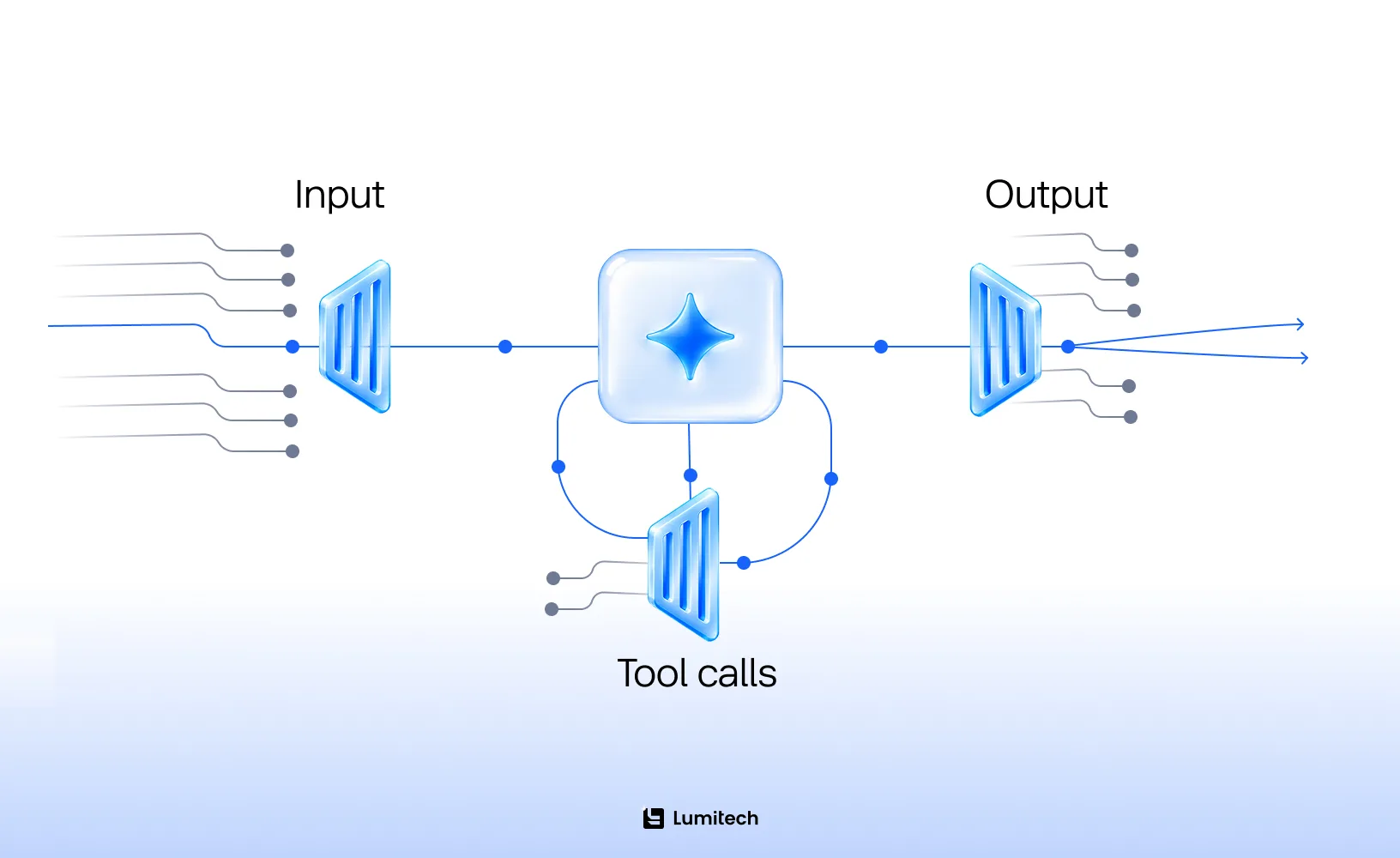
Gateway/proxy | Routing, auth, rate limits, cost attribution, redaction, cache injection | The one place every request passes, so the one place policy can be enforced |
Prompt and version registry | Prompt templates, model pins, tool definitions | Makes changes reviewable and rollbacks possible |
Trace store | Spans for model calls, retrieval, and tool execution | The evidence base for debugging, evaluation, and audit |
Evaluation harness | Offline suites, online scoring, human calibration | Catches regressions availability monitoring cannot see |
Guardrail layer | Input, output, and tool-call checks | Survives model swaps, being external to the model |
That last row is why an LLMOps architecture keeps guardrails outside the model rather than in the system prompt: independence is what lets a control survive a silent upgrade.
LLM Monitoring and LLM Observability in Production
LLM observability differs from conventional application monitoring in one respect that reshapes the rest: a request can succeed, return quickly, and be entirely wrong, so availability tells you very little about quality.
The LLM observability standard is not finished. OpenTelemetry’s GenAI semantic conventions moved into a dedicated repository during 2026, and gen_ai.* entries in the main registry now carry a notice that they have moved. Both the GenAI spans and metrics documents carry Development status; the only Stable attributes in play are borrowed core ones such as error.type. Vendor support is uneven underneath the marketing: Datadog ingests OpenTelemetry’s GenAI conventions, OpenInference and OpenLLMetry; LangSmith maps four conventions; Langfuse maps several and gives its own native attributes precedence over the generic OpenTelemetry ones. So “we use OpenTelemetry” does not by itself deliver portability between LLMOps tools, and enterprise LLM operations teams should treat convention support as a migration question.
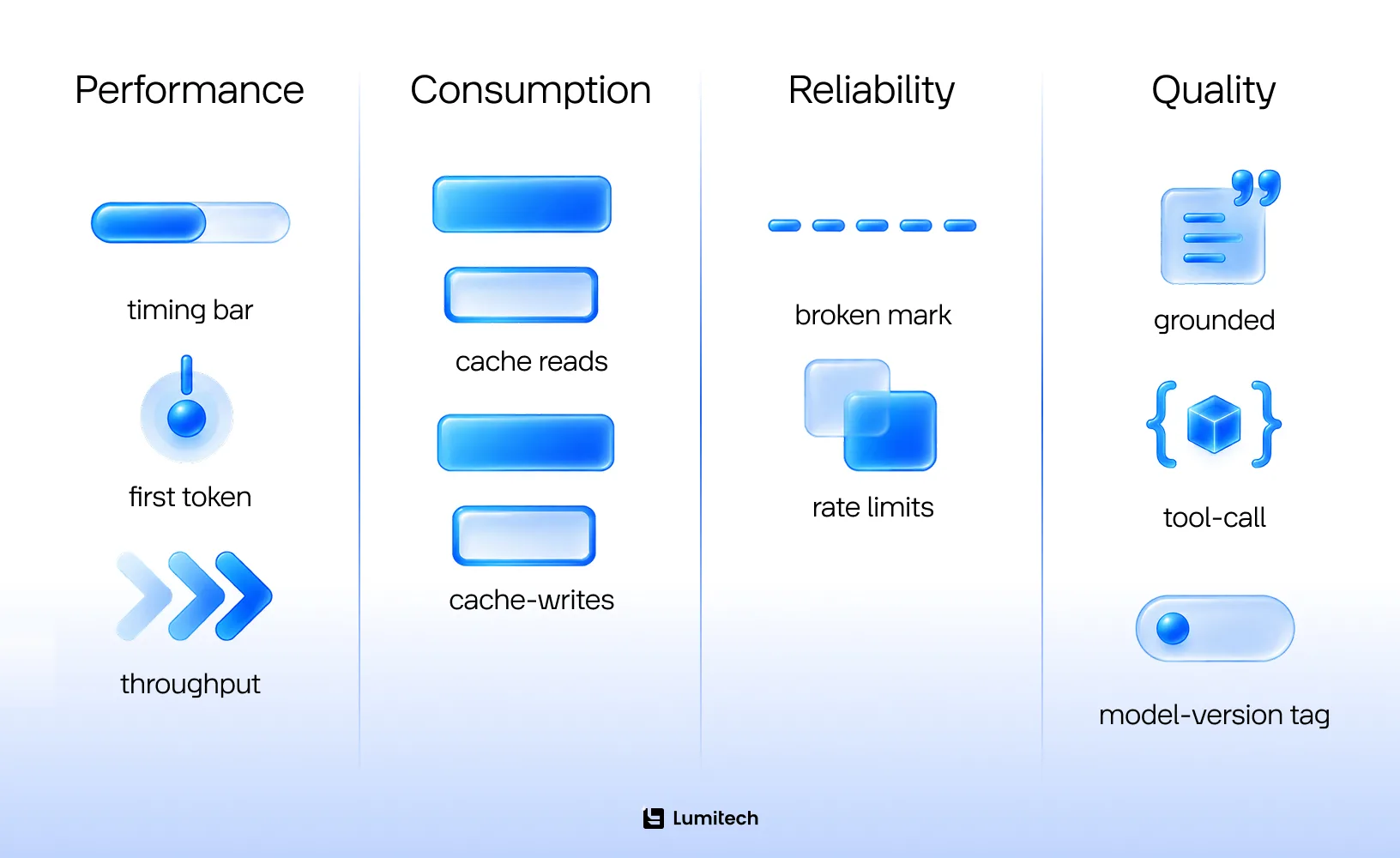
What the telemetry shows. Datadog’s State of AI Engineering, published on 21 April 2026 from anonymized usage data across thousands of its customers running LLMs in production, offers a rare aggregate view. In March 2026, 2% of all LLM spans in that dataset returned an error, and rate-limit errors accounted for almost a third of them. System prompts accounted for 69% of all input tokens, whereas only 28% of the LLM call spans had any cached-read input tokens. That population already invests in observability, and the same report's February cut put the error rate at 5%, so these figures are moving. Yet it was capacity limits, not model quality, that were the main cause of failures.
Retention and residency. LLM cost monitoring and quality debugging both want full prompts in the trace store; data protection wants them gone, which makes LLM observability a privacy-engineering problem too. Langfuse documents masking as a client-side operation whose hook affects only spans exported by that client, so instrumentation on another path receives its own unmasked copy, and states that secondary regions sit in the same legal jurisdiction as their primary. Traceability is also where LLM monitoring meets the disclosure posture we discuss in our piece on AI transparency.
LLM Evaluation: Why One Test Run is Not a Decision
Nearly every enterprise LLMOps program starts LLM evaluation with LLM-as-a-judge, and most start from a misread number.
The paper that brought the technique to widespread attention found that GPT-4 agreed with human preferences in 85% of the MT-Bench pairwise comparisons when ties were omitted, as compared to 81% for human-to-human agreement; when ties and inconsistent votes were included, the rate of agreement in the first turn dropped to 66%. However, this result applies to one judge from 2023 and concerns open-domain chat quality in English.
Two newer findings sharpen it. A 2026 preprint from UC Berkeley’s School of Information examined 21 different judge configurations using three benchmarks and about 541,000 judgments, discovering that the raw exact-match agreement exceeded the chance-corrected agreement by 33.8 to 41.2 percentage points on MT-Bench; the headline figure of 85% corresponds to a Cohen’s kappa of nearly 0.48. The study also found that test-retest reliability above 0.95 could coexist with serious position bias: a judge might be almost perfectly repeatable and still systematically incorrect. Domain specificity worsens the situation. At IUI 2025, ten registered dietitians agreed with the LLM judges in 68% of the overall-preference comparisons and ten clinical psychologists in 64%, compared to expert agreement levels of 75% and 72%, respectively.
Establish your noise floor before you measure signal. Airbnb’s engineering team published the clearest account in July 2026: the same judge drifts about one percent across runs on one dataset, roughly three-quarters of LLM-generated references differ across labeling runs on identical inputs, and the real signal being chased is worth one to three percent. When noise sits that close to the effect, a two percent movement can mean the model improved, the judge drifted, or the references shifted — and you cannot tell which without naming the noise first.
For retrieval systems, RAGAS offers reference-free metrics and a caution. In the original paper, its faithfulness metric matched human judgments 95% of the time against 70% for context relevance — on the 50-page WikiEval set, a small benchmark the authors built themselves. The asymmetry transfers even if the numbers do not: grounding is easier to detect than retrieval quality, which leaves retrieval the harder thing to monitor. Agents go further with pass^k, the share of k independent runs that succeed consistently; on τ²-bench’s telecom domain, GPT-4.1 recorded 34% at pass^1 and 19% at pass^4.
Not sure which control plane is missing?
An AI readiness audit maps what exists against what production requires — evaluation coverage, guardrail placement, cost attribution — and returns a prioritized gap list.

LLM Guardrails and the Controls Behind Them
The guardrail layer is where LLMOps meets security engineering, and the current threat baseline is the OWASP Top 10 for LLM Applications 2026, published on 3 August 2026 and the first edition to test its community vote against incident data: the vote carries 75% of the ranking weight and incidents 25%, drawn from 7,714 collected incidents, 6,639 of them classifiable. One movement matters especially: Unbounded Consumption rose four places to LLM06, putting cost control inside a security taxonomy rather than beside it.
Prompt injection is not a filtering problem. The UK’s National Cyber Security Center put this more bluntly than most vendors will, writing in December 2025 that prompt injection “will never be properly mitigated in the same way” SQL injection was, because under the hood of an LLM “there’s no distinction made between ‘data’ or ‘instructions'” — “there is only ever 'next token’.” Its recommended posture is privilege reduction: when an LLM processes information from a party, its privileges drop to that party’s. In March 2026, NIST’s Center for AI Standards and Innovation reported that among more than 250,000 attack attempts directed at 13 frontier models, at least one successful attack was found for each of the targets. OpenAI, in its remarks about the Atlas browser in December 2025, described the issue as “unlikely to ever be fully ‘solved’”.
Classifiers are useful and porous, and the vendors’ own numbers show it. Meta’s model card for Llama Guard 4 reports 69% recall with an 11% false-positive rate on English and 43% recall across seven non-English languages — figures for output filtering averaged over thirteen hazard categories, not for prompt-injection detection — and notes the model may itself be susceptible to prompt injection. Neither major cloud guardrail product documents efficacy: Amazon lists six Bedrock Guardrails policy types with no accuracy or latency figure. Microsoft is at least explicit, stating that Prompt Shields “may not catch all attack vectors or may flag legitimate prompts” and that you should always implement additional validation layers.
The economics invert by task. Independent benchmarking of 28 supervision systems, presented at an ICML 2026 workshop, found that content-moderation-specialized systems matched frontier models on detection (roughly 95% against 94%) while running five to ten times faster and about ten times cheaper. However, when it came to jailbreak detection, the situation is the opposite: the frontier models obtained better detection rates together with lower false-positive rates, at a cost that was ten to fifty times higher, and the specialized systems had a median false-positive rate of 30.5% for benign jailbreak-type inputs as against 10.2% for the general ones. Whether a particular layer is cheap depends on the kind of filtering you are doing.
Because filtering has a ceiling, LLM guardrails work best as volume reduction inside an architecture that is safe by construction. CaMeL, a design from Google, Google DeepMind, and ETH Zurich, solved 77% of AgentDojo tasks with provable security against 84% for an undefended system, by extracting control and data flow from the trusted query so untrusted content can never affect program flow. A 2025 cross-industry paper catalogs six design patterns for the same goal and states the trade-off: system-level design may keep an agent secure even where the model is vulnerable, at the price of intentional limits on arbitrary tasks.
LLM Cost Optimization for Production LLM Systems
LLM cost optimization fails predictably in LLMOps programs: teams reach for model switching first, because it is the most visible lever, and leave the mechanical ones alone.
Nine times out of ten the actual fix is upstream — a prompt prefix that changed and invalidated the cache, or a feature that never had caching in the first place. Cost belongs in code review, not in a monthly report.


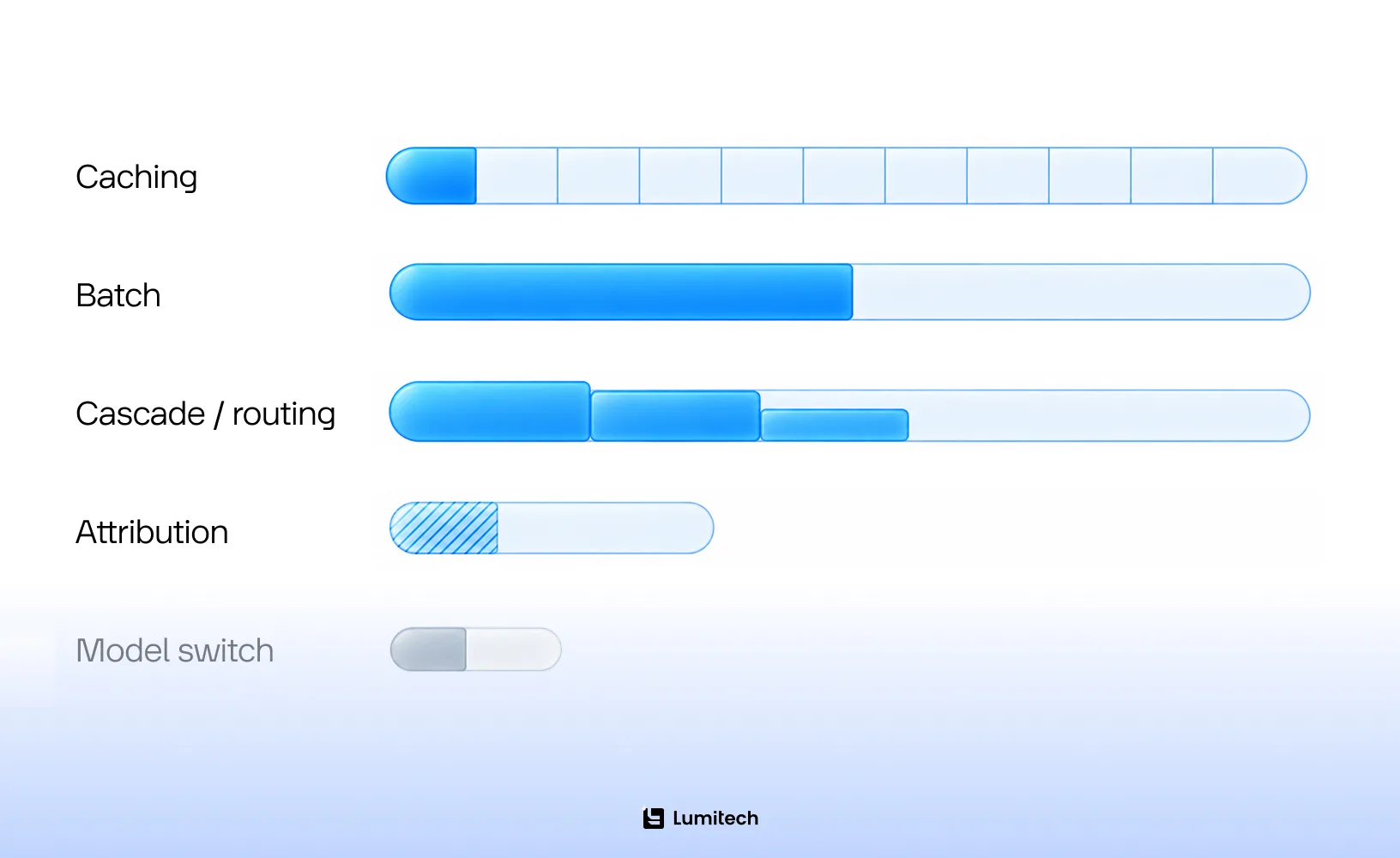
Caching is the largest unclaimed win. Anthropic and OpenAI now bill on the same shape, charging cache reads at 0.1× the base input rate and five-minute writes at 1.25×. The convergence is recent and imperfect: Anthropic’s one-hour writes bill at 2×, and OpenAI charged nothing for writes before its current model generation. Against that tenfold read discount, Datadog’s March 2026 telemetry found system prompts accounting for 69% of input tokens while only 28% of call spans showed any cached read. Zalando also observed this same pattern in data from one user’s session and therefore automatically inserted caching checkpoints at the proxy.
The mechanics have sharp edges. Anthropic specifies a minimum cacheable length per model, currently between 512 and 4,096 tokens; prompts that are shorter than this are processed without being cached, and no error message is given. On Bedrock, cached tokens do not count toward the input-tokens-per-minute limit for OpenAI models, so caching serves as both a capacity and cost-saving measure.
Batch is a halving with a non-uniform fit. OpenAI, Anthropic, and Google price asynchronous batch processing at 50% of standard rates; Bedrock offers the same discount on selected foundation models. The constraints determine the architecture: Bedrock's batch inference does not support tool calling or structured output and processes each record separately without allowing multi-turn interaction, so the 50% discount is not available to agentic workloads, whose token usage is increasing most rapidly.
Routing works within a narrower band than the headline suggests. The FrugalGPT paper is universally cited for a 98% cost reduction. Its own stated range across three datasets is 50% to 98%; the 98% comes from one finance-headline classification set, the weakest result is benchmarked against GPT-3 rather than GPT-4, and prices were retrieved in March 2023. That said, the tiered cascade approach is valid: DoorDash’s support system first carries out an in-house shallow similarity check and only proceeds to the more expensive LLM evaluator when this check flags a response.
Attribution is coarser than teams assume. AWS documents that its Cost and Usage Report carries no per-request line items, aggregating Bedrock cost by usage type, operation, and resource over an hour or a day; per-request attribution comes from model invocation logs. That gap bites hardest when an LLM feature sits inside a product, because per-customer margin depends on per-customer cost, a constraint we examine in our analysis of AI in SaaS systems. On Azure, Microsoft states that unused provisioned-throughput quota does not guarantee capacity, and that using quota to manage billing “isn’t the Azure best practice.”
LLM Governance, Standards, and What Regulators Expect
Regulation shapes LLMOps more directly than teams expect, and the position moved recently enough that much published guidance is now wrong.
The EU AI Act’s high-risk timeline has been extended. Regulation (EU) 2026/1744, the Digital Omnibus on AI, entered into force on 27 July 2026. Prohibited practices and AI literacy obligations have applied since 2 February 2025 and general-purpose AI model obligations since 2 August 2025, both unchanged. Transparency rules under Article 50 still apply from 2 August 2026, with a four-month transition to 2 December 2026 for marking duties on systems already on the market. Annex III high-risk obligations now begin on 2 December 2027, and high-risk systems embedded in regulated products under Annex I move to 2 August 2028. Anything stating that Annex III obligations apply from August 2026 predates the amendment.
Three provisions shape LLM governance design. Article 12 requires high-risk systems to be constructed so that events over their entire lifetime can be automatically recorded, with the recording linked to post-market monitoring. Article 15 stipulates that the accuracy levels and associated metrics must be stated in the instructions for use, and systems that continue to learn after deployment must be designed so that biased outputs do not affect their future operation. Article 26 makes it the responsibility of the enterprise as deployer rather than that of the vendor as provider: it requires that human oversight be carried out by individuals who have the necessary competence, training and authority to perform it; that monitoring be carried out in accordance with the instructions for use; and that the automatically generated logs be retained under the control of the deployer for a period of at least six months, unless another piece of legislation provides otherwise.
US banking supervisors have created a deliberate gap. On 17 April 2026, the Federal Reserve, OCC and FDIC issued revised model risk management guidance — SR 26-2, OCC Bulletin 2026-13 and FIL-15-2026 — superseding the 2011 guidance long known as SR 11-7. The replacement states that generative AI and agentic AI models are novel and rapidly evolving and that, as such, they are not within its scope; it also describes itself as most relevant to banks above $30 billion in total assets. Much vendor content still cites SR 11-7 as the governing framework for generative AI model risk. It is superseded, and its successor declines the subject. ISO/IEC 42001:2023 remains the AI management system standard accredited bodies certify against, and NIST AI 600-1 sets out twelve risks unique to or exacerbated by generative AI.
Liability has already been tested, if only at small-claims scale. In Moffatt v. Air Canada, 2024 BCCRT 149, British Columbia’s Civil Resolution Tribunal found negligent misrepresentation where an airline’s chatbot described a bereavement-fare policy contradicting the airline’s own page, awarding CAD 812.02 in damages, interest and fees. The decision sets no precedent, but the reasoning travels: “It makes no difference whether the information comes from a static page or a chatbot.”
Choosing Between Enterprise LLMOps Platforms and Building Your Own
Choosing an LLMOps platform is a harder build-versus-buy call than it looks because the market standard underneath has not stabilized.
What to Look for in an LLMOps Platform
Five questions separate serious options from feature lists.
- 01
Which telemetry conventions does it ingest, and can you leave? Portability is a claim to test, not assume.
- 02
Where do data and backups live? For EU deployments, backup jurisdiction decides procurement, not primary region alone.
- 03
Does evaluation run in CI, or only in a dashboard? A dashboard reports a regression; a gate prevents one.
- 04
Does it record the responding model, not just the requested one? The only reliable way to catch a rolling regional upgrade.
- 05
Is cost a first-class evaluation metric? Most tools treat it as a billing report.
Several enterprise LLMOps platforms are converging on this scope. Among these platforms, the ones answering the fifth question make the design choice most teams miss.
Which LLMOps Tools to Standardize On
The pragmatic sequence for LLMOps for enterprises is to standardize the gateway first, since it is the one place policy can be enforced without asking every team to cooperate; then the trace store, then evaluation. Among LLMOps platforms and open-source LLMOps tools, the choice matters less than the discipline of one enforcement point in front of the providers. Gartner forecasts 63.4% growth in AI model and platform spending in 2026 and expects buyers to turn to platforms that help them monitor performance, enforce policy, and control cost as usage-based pricing becomes harder to predict.
Where LLMOps for Enterprises Usually Stalls
Teams instrument availability but not quality, so regressions surface as user complaints. They build an evaluation set once and never re-baseline it. And they treat a disclaimer as a control. OpenAI’s post-mortem on an April 2025 GPT-4o update shows the cost: offline evaluations looked good, and A/B tests indicated that users who tried the model liked it, but the company later wrote that it didn’t have specific deployment evaluations tracking sycophancy. If you have no evaluation for a behavior, you will ship a regression against it. Nearly all of these failures are visible before launch rather than after it, which is what an AI readiness audit is for: it checks whether evaluation, telemetry, and ownership exist before the pilot becomes a dependency.
LLMOps best practices at this stage of the field’s maturity are mostly about sequencing. Instrument before optimizing, establish the noise floor before measuring improvement, put LLM guardrails where they are deterministic, use classifiers to reduce volume rather than to provide assurance, and measure cost per outcome rather than per token. Those habits do more for enterprise LLM operations than any tool selection.