
How to Choose the Right AI Use Cases: A Practical Enterprise AI Strategy Framework from Lumitech
Ask ten companies why their AI initiative stalled, and ten will point at the model. The data wasn’t clean enough. The accuracy wasn’t high enough. The vendor overpromised. The technology “wasn’t there yet.” It almost never is the model.
- AI Development
- AI Strategy
- Enterprise Strategy
August 05, 2026
 AI Overview
An enterprise AI strategy prioritizes AI use cases by business value and implementation complexity, sequencing quick wins before strategic bets. Effective strategies define the problem, data, model, and measurable result for each use case. Without this discipline, 70–85% of AI projects stall — failing from wrong use-case selection, not the technology itself. This uses the real 70–85% failure-rate figure from the article, states the definition, names four components (value, complexity, plus the problem/data/model/result structure), and carries a clear cause→consequence in present tense with the main keyword up front.

Most AI projects fail long before a single line of training code runs. They fail in a meeting room, months earlier, when someone decides what to build without a rigorous way of deciding whether it was worth building at all. The technology works. The use case was wrong.
At Lumitech, we’ve spent years building AI systems for companies in finance, logistics, and through our enterprise software development services — and the pattern is consistent: the teams that win aren’t the ones with the best data scientists; they’re the ones who picked the right three problems out of thirty. That discipline is the core of any real enterprise AI strategy. This article lays out how it works — a practical framework for choosing AI use cases that move the business, and the mistakes that quietly kill the rest.
If you already know AI can help but can’t confidently say where to start, this is for you.
Why Most AI Projects Don’t Deliver
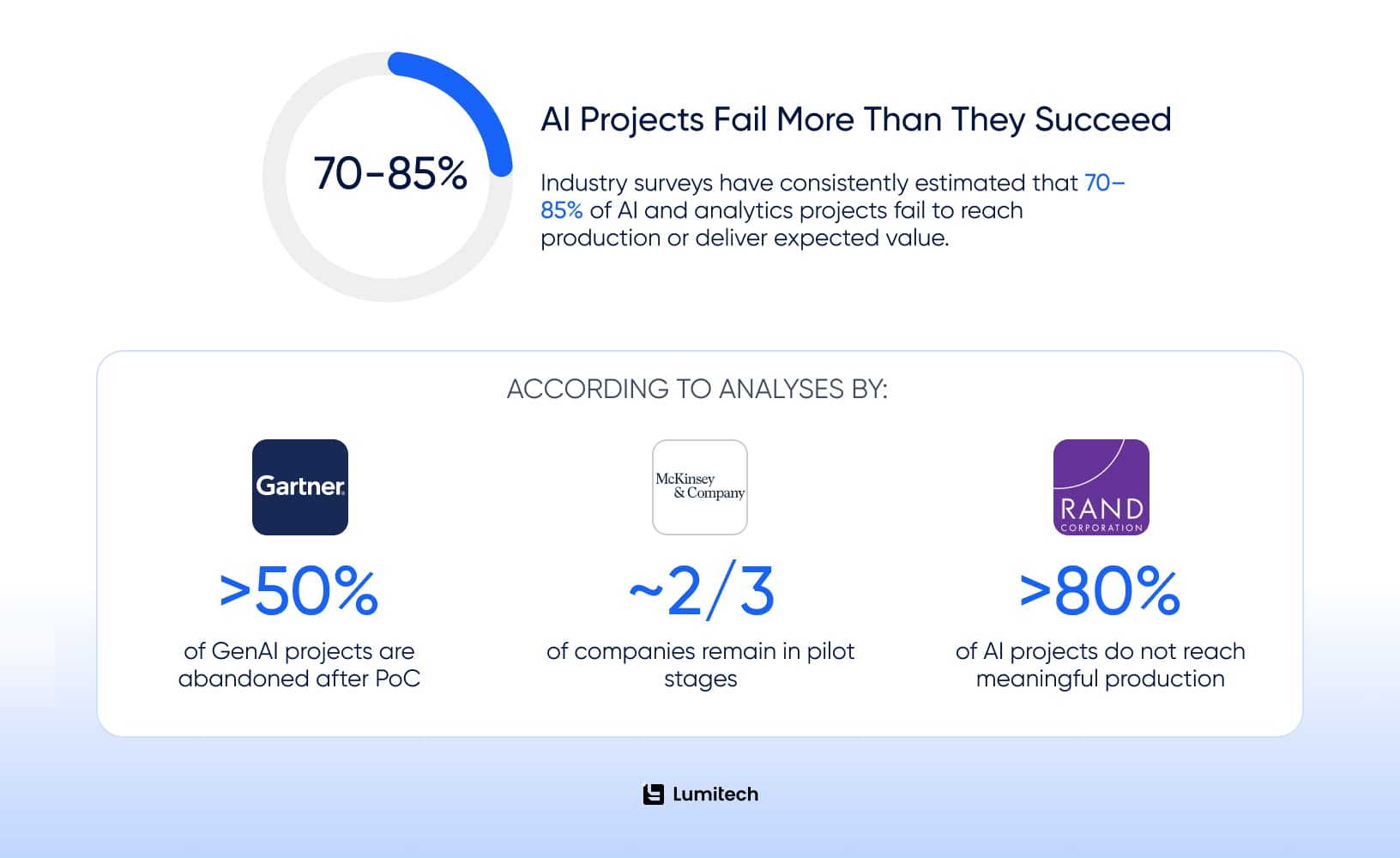
Industry surveys have consistently estimated that 70–85% of AI and analytics projects fail to reach production or deliver expected value, according to analyses by Gartner, McKinsey, and RAND.
Whatever the exact number, far more initiatives disappoint than deliver — and almost every time, the failure traces back to the choice of use case, not the technology inside it. Three causes come up again and again, none of them technical.
Chaotic Enterprise AI Roadmap Implementation
AI is the trend. The headlines say AI is transformative.
So the company launches something; they do not want to be left behind. They integrate a chatbot; a smart dashboard is also here; a pilot the next team over has never heard of. There is plenty of activity, but no underlying bet.
The result lands two quarters in — four unfinished pilots, no clear owner, and a spend nobody can quite justify.
Copying Someone Else’s Solution
A competitor ships a flashy AI feature, so the mandate becomes “we need that too.” But a use case is only as valuable as the context it sits in. Amazon’s recommendation engine is worth billions because Amazon has hundreds of millions of shoppers. Bolt the same idea onto a B2B company with 300 accounts, and it solves nothing. Copying the what without the why buys you impressive technology that answers no real question.
No Business Metric Attached
The quiet killer. If a project can’t point to the number it’s meant to move — revenue, churn, cost-per-ticket, fraud losses — you’ll never know whether it worked, and you’ll never win the next round of funding. “Improve customer experience” isn’t a metric. “Take average handle time from 11 minutes down to 7” is.
Two collapses show why.
IBM Watson for Oncology aimed at recommending cancer treatments. They had to deal with dirty clinical data, which could not ensure accuracy and made clinicians rely on it; after tens of millions, MD Anderson exited. A strategy failure, not a tech one. Then the AI assistant gathering dust — LLM search over documents, adoption gone in weeks, because approvals were the real friction. The tool worked. It just solved nothing anyone needed.
The instinct is to start with the most ambitious project. The discipline is to start with the one you can prove in a quarter. Credibility is what funds everything that comes after.



What Is an Enterprise AI Strategy?
It’s the decision layer that is the core of any single project: which problems AI should solve, in what order, and how you’ll know it worked. It’s not a list of tools or models — it’s a way of choosing, prioritizing, and measuring.
People confuse it with an implementation plan. They’re not the same thing, and mixing them up is why projects start in the wrong place. The right IT development partner for enterprises keeps the two straight.
Enterprise AI Strategy | AI Implementation Plan | |
|---|---|---|
Question it answers | What to build, and why? | How to build it? |
Horizon | 12–36 months, across the business | Per project, weeks to months |
Owns | Use case selection, prioritization, ROI logic, roadmap | Architecture, data pipelines, models, deployment |
Owner | CEO / CTO / Head of Innovation | Engineering/data science lead |
Measures | Business impact — revenue, cost, risk | Technical delivery — accuracy, uptime, latency |
Failure looks like | Right tech, wrong problem | Right problem, poor execution |
Comes | First | Second |
The plan without the strategy builds impressive things nobody needed. The strategy without a plan is a slide deck. You need both — in that order.
Components of a Solid Enterprise AI Strategy Framework
Forget the 40-page strategy doc. A useful framework is a small set of things you can defend in a room — five components, specifically:
A prioritized use case portfolio. A scored shortlist, ranked by business value against complexity, with quick wins separated from strategic bets.
A value and ROI model. For every use case, the number it should move and a conservative payoff-versus-cost estimate. No dollar figure, no green light.
A data and readiness assessment. An honest look at whether the data exists, is accessible, and is clean enough — because this is where most projects quietly die.
A staged roadmap. First, there are quick wins that build credibility; mid-term projects next, strategic initiatives last — each horizon funding the next.
Ownership and governance. One accountable owner per use case, plus the AI governance and responsible AI guardrails that keep it trustworthy as it scales.
Try this simple test. If your framework can’t tell you what to start on Monday and what to say no to, it is more of a vision statement than a strategy.
Six questions, five reports, two weeks. We run these checkpoints against the reports your supervisor looks at first and hand back the gaps — no platform commitment.

What a Use Case Really Means (and What It Doesn’t)
It often starts as a language problem. Teams say, “We want to use AI for customer service,” assuming it’s already a use case. However, they’ve just mentioned a theme, which is a direction. A use case, instead, is a decision you can build, measure, and defend.
“Use AI in logistics” is an idea. “Predict which shipments will miss their delivery window 48 hours out, so ops can reroute them and cut penalties” is a use case. The second tells you what to build, what data you need, and how you’ll know it worked. A real use case has four parts — miss one, and you have a wish, not a use case:
The problem. A specific, expensive business problem in business terms. Not “we lack insight into churn” but “we lose 4% of subscribers monthly and can’t tell who’s leaving until they’ve gone.”
The data. The raw material the model learns from. Do you have it, is it accessible, is it clean? This is where most use cases quietly collapse.
The model. The mechanism that turns data into a prediction or recommendation. Notice it’s the third item — a means, not the point.
The result. What the business does differently, and the metric that proves it. A prediction nobody acts on is worthless.
Let’s take a look at the following example — invoice processing.
Problem: finance spends 20 hours a week keying invoices at a 6% error rate.
Data: five years of scanned invoices and verified entries.
Model: document understanding that extracts fields and flags low-confidence ones.
Result: processing drops to 4 hours, errors under 1%. Every box filled. Force every candidate through these four boxes, and the vague ideas fall apart on their own — usually at “the data.”
The Four Types of AI Use Cases
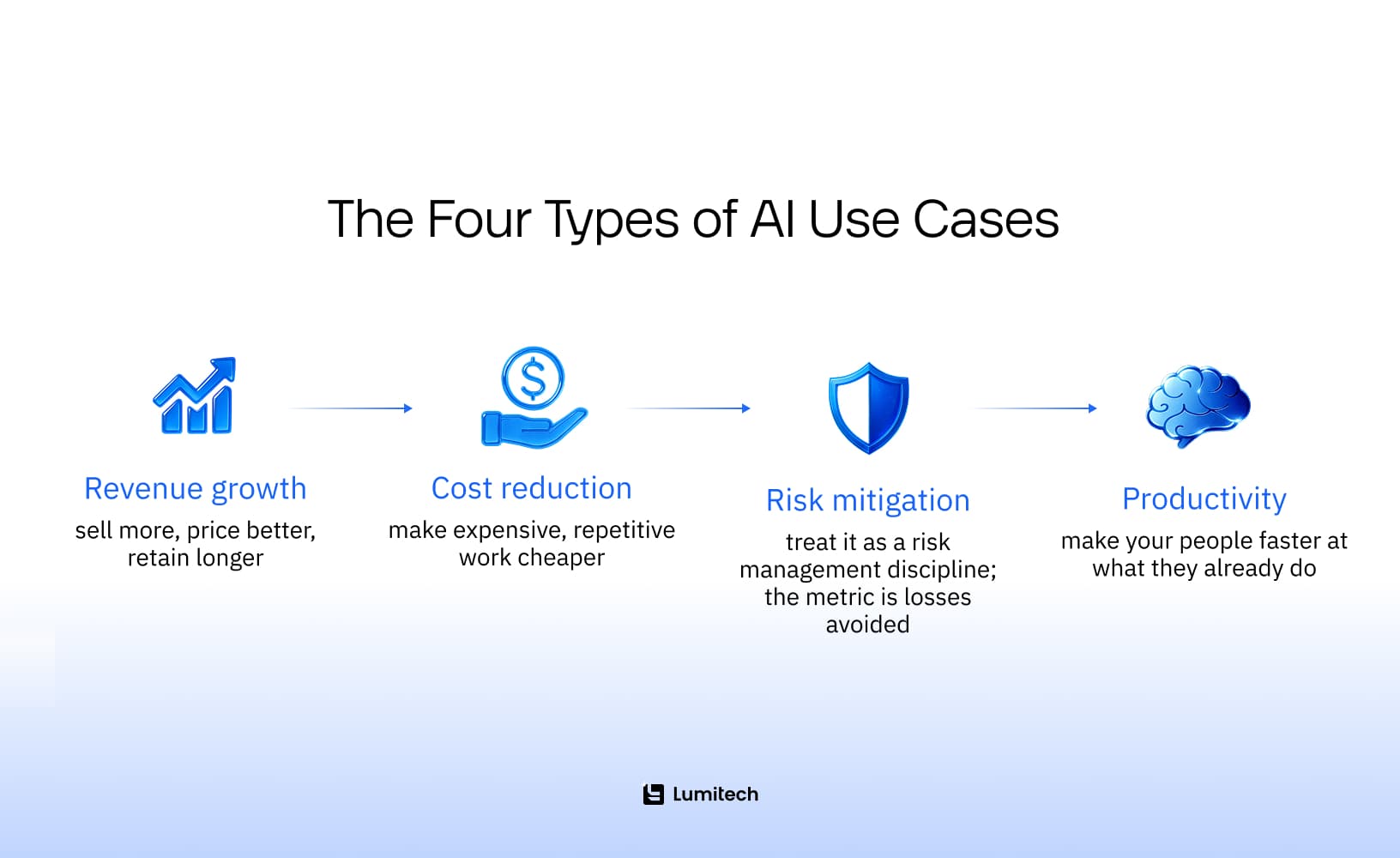
Almost every worthwhile set of artificial intelligence applications falls into one of four categories. Knowing the category tells you who should care and how you’ll measure success.
Revenue growth — sell more, price better, retain longer.
Churn prediction that flags at-risk accounts early enough for customer success to intervene.
Dynamic pricing, the kind that lets airlines and hotels adjust fares in real time, now reaching mid-market e-commerce.
Cost reduction — make expensive, repetitive work cheaper.
Document processing (the invoice example), which saves enormous back-office labor across finance, insurance, and legal.
Support deflection, where a well-built assistant — the product of solid AI chatbot development — resolves routine questions so agents handle only the hard ones.
Risk mitigation — treat it as a risk management discipline; the metric is losses avoided.
Fraud detection, the workhorse behind every payment system; PayPal and Stripe catch fraud in milliseconds.
Credit risk scoring that beats a rules-based system.
Productivity — make your people faster at what they already do.
Coding assistants like GitHub Copilot, which measurably speed up routine code.
Knowledge retrieval and content creation tools that get teams to a solid first draft in minutes — the pattern behind our work on AI chat interfaces in an enterprise decision platform.
Running an AI Opportunity Assessment: A Step-by-Step
It answers one question before you spend a cent: where would AI actually pay off here? It’s a short, structured exercise — a week or two, not a quarter.
Map the pain. List where work is slow, expensive, error-prone, or risky, in business terms. “Tickets take 11 minutes to route” beats “we should use AI.”
Turn candidates into real use cases. Force each through the four-part test. Most vague ideas fall apart here — that’s the point.
Pressure-test the data. Exists? Accessible? Clean? Labeled? The answer here drives most of the risk and the price tag.
Put a number on each. Value, complexity, time-to-value, uncertainty — score all four, then plot them and let the winners surface.
Sequence into a roadmap. Pull the high-value, low-complexity wins to the front, attach an owner and a target metric to each. The output isn’t a report — it’s a first move you can start Monday.
The exercise is deliberately fast and cheap. Its job is to stop you betting a year and a budget on the wrong problem.
Customer Stories
Explore What We've Built
A Race-Day Operating System for Safety and Compliance
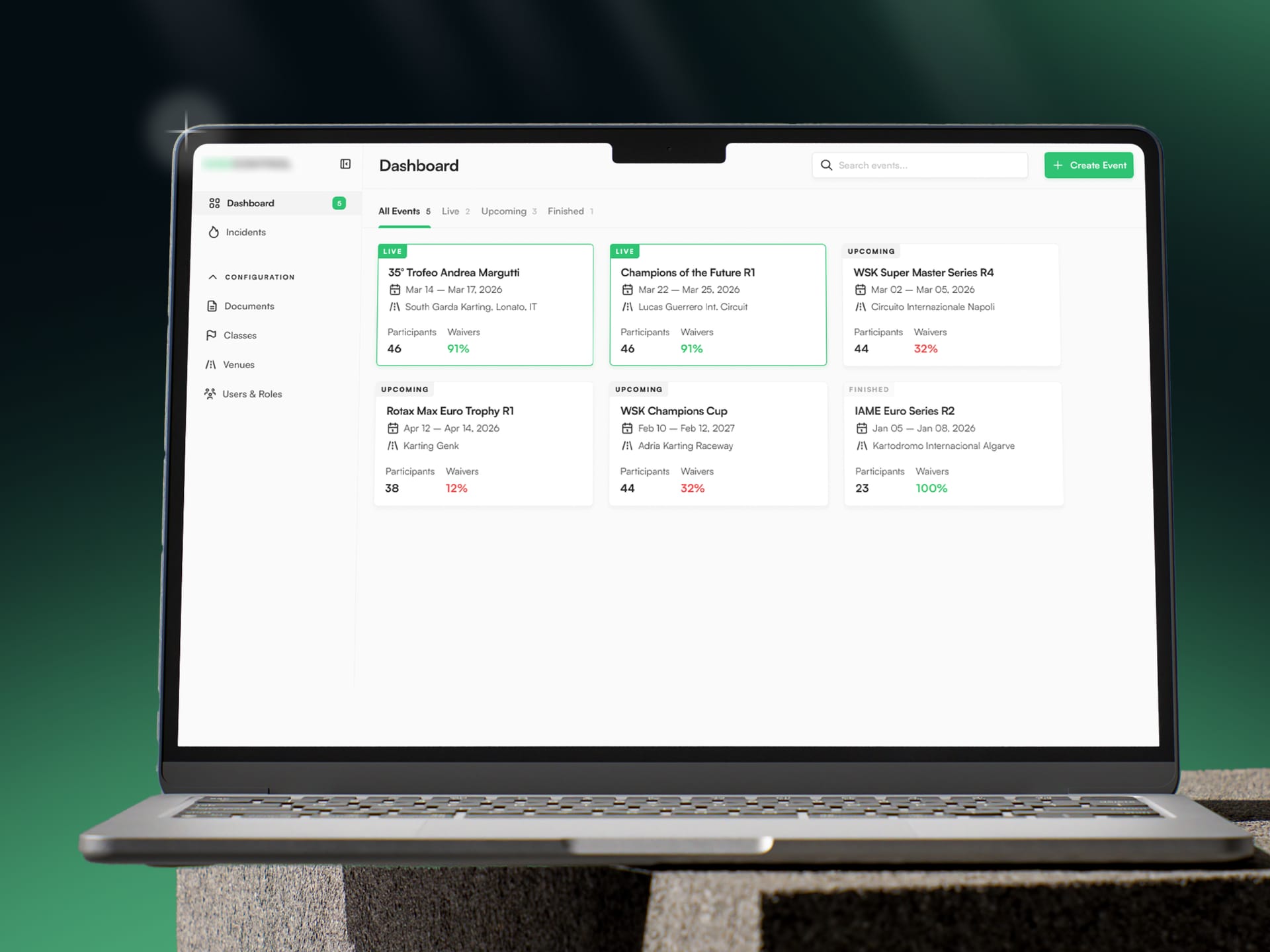
On race day, safety depends on more than sending alerts. Organizers need proof of who received each message, who acknowledged it, and what record remains. Lumitech built a platform around that responsibility, helping protect trust, compliance, and control.

Amsterdam
Oct '25 - Mar '26
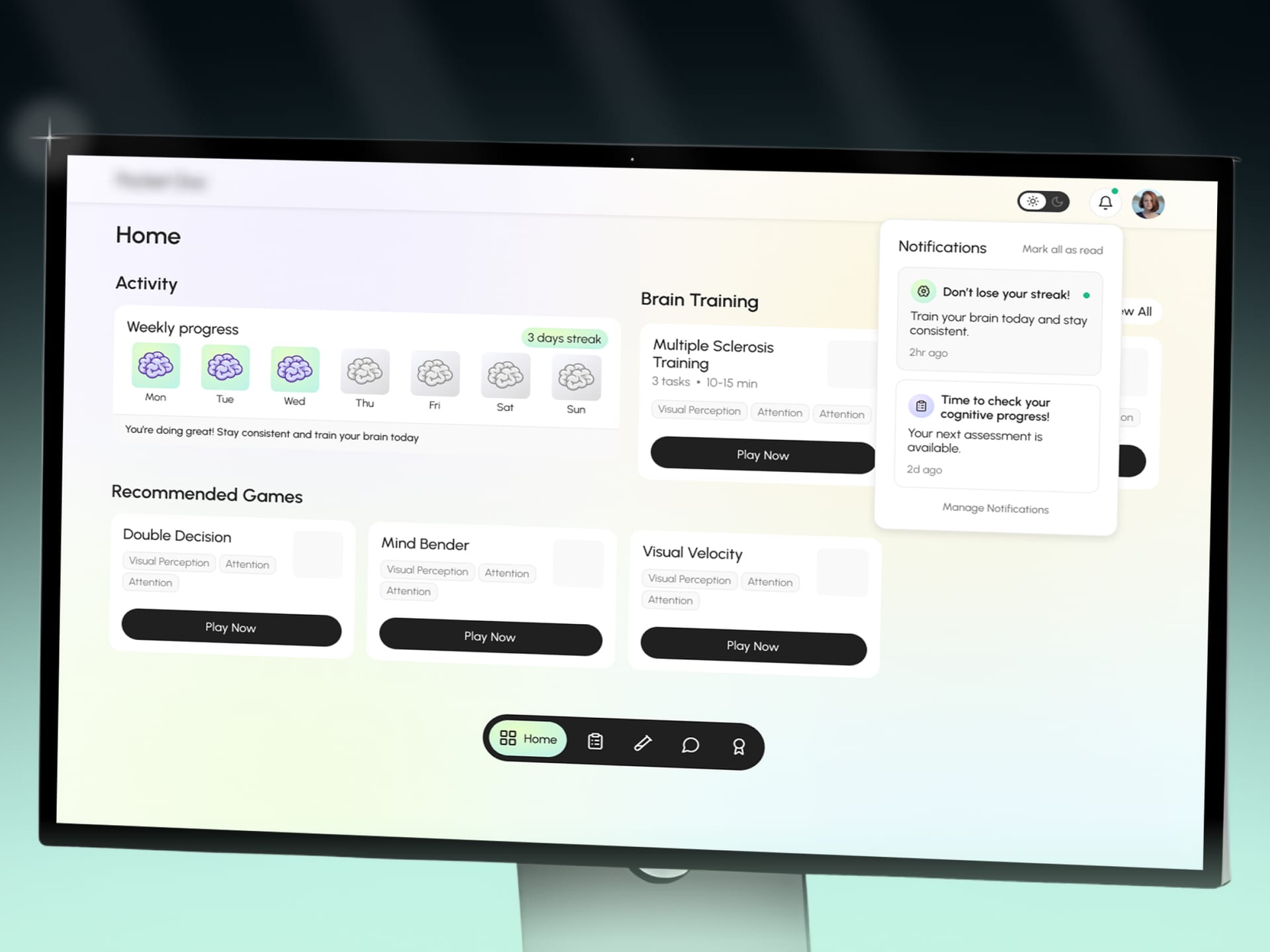
An AI‑Powered Cognitive Training and Brain Health Platform
Turning generic “brain games” into a personalized, data‑driven cognitive training experience – combining adaptive daily workouts, real health data insights, and a conversational AI assistant in one product.

Houston
Oct '25 — Mar '26
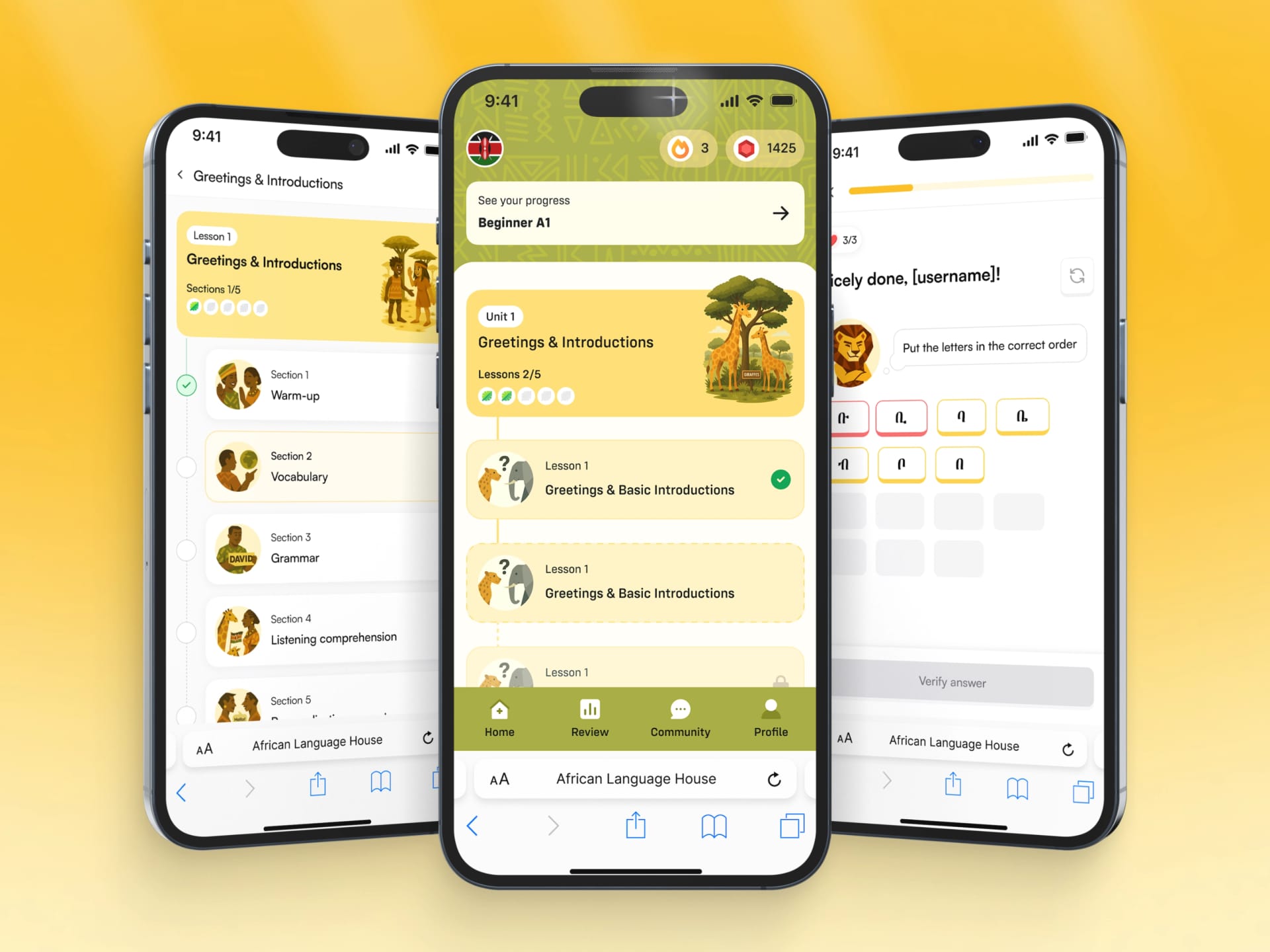
Reviving Roots: How We Built an AI-Powered African Language Learning Platform
Lumitech built an AI-powered language learning platform with speech feedback, adaptive lessons, gamification, and analytics for users in the African diaspora.
New Jersey
Aug '25 — Now

Fighting Misinformation with an AI-Driven Social Platform
Together with our client, we launched a social app designed to prevent the spread of fake news by empowering users to verify sources and flag misinformation.
Nashville
Jul ’24 – Apr ’25
EdTech & Training
A Race-Day Operating System for Safety and Compliance
On race day, safety depends on more than sending alerts. Organizers need proof of who received each message, who acknowledged it, and what record remains. Lumitech built a platform around that responsibility, helping protect trust, compliance, and control.
Client Location
Amsterdam
Duration
Oct '25 - Mar '26
Platform
Web + PWA
An AI‑Powered Cognitive Training and Brain Health Platform
Turning generic “brain games” into a personalized, data‑driven cognitive training experience – combining adaptive daily workouts, real health data insights, and a conversational AI assistant in one product.
Houston
Oct '25 — Mar '26
Reviving Roots: How We Built an AI-Powered African Language Learning Platform
Lumitech built an AI-powered language learning platform with speech feedback, adaptive lessons, gamification, and analytics for users in the African diaspora.
New Jersey
Aug '25 — Now
Fighting Misinformation with an AI-Driven Social Platform
Together with our client, we launched a social app designed to prevent the spread of fake news by empowering users to verify sources and flag misinformation.
Nashville
Jul ’24 – Apr ’25
The AI Use Case Scoring Model
Once you have a shortlist, you need a way to rank it. The question executives ask us is how to prioritize AI use cases when everything looks promising. Our AI use case prioritization framework answers it by scoring each candidate — really an AI use case assessment — on four dimensions:
Business value — how much it moves a number leadership cares about, in dollars where possible.
Implementation complexity — data readiness, integrations, and technical risk.
Time-to-value — how fast the business feels a benefit. A payoff in 6–8 weeks beats one in a year, early on.
Uncertainty — how confident you are it works at all. You want a deliberate mix of sure things and bets, not all of one.
Score each high / medium / low, and disciplined AI use case prioritization turns a fuzzy debate into a shared scoring model your whole team can agree on. Applied to three real candidates, the AI use case scoring model looks like this:
Use case | Business value | Complexity | Time-to-value | Uncertainty | Verdict |
|---|---|---|---|---|---|
Support ticket routing | Medium | Low | Fast | Low | Quick win — do first |
Churn prediction | High | Medium | Medium | Medium | Mid-term |
Dynamic pricing engine | High | High | Slow | High | Strategic bet — later |
Read across the rows, and the sequence writes itself. Ticket routing isn’t the biggest prize, but it’s cheap, fast, and certain — so it goes first and earns credibility. Dynamic pricing is the biggest prize and the riskiest, so it waits until the earlier wins have built the data and trust to support it.
Build an AI Use Case Prioritization Matrix
The scores turn into a picture. Plot every candidate on a simple 2×2 — AI use case prioritization matrix with business value on one axis and implementation complexity on the other. It turns scoring into decision-making you can act on, and four quadrants emerge:
High value, low complexity → do first. Your quick wins. They fund and de-risk everything else.
High value, high complexity → plan deliberately. Your strategic bets. On the roadmap, resourced properly — but not first.
Low value, low complexity → do if cheap, else skip. Nice-to-haves, not strategy.
Low value, high complexity → don’t. Where budgets go to die — and, tragically, where companies often start, because the hardest problem feels the most important.
The discipline is rare but simple: sequence by complexity, not by ambition. Earn the hard problems by winning the easy ones first.
If your top five reports lack named owners and replayable lineage, that is where we start. Tell us which reports matter, and we will map the gaps.

How to Measure AI ROI Before Designing Enterprise AI Implementation Strategy
Before you build, you need a number. The real question is how to measure AI ROI before you commit a budget — and you can, roughly, without writing code. We use a simple AI ROI framework: estimate the annual value, weigh it against the AI development cost, and apply a confidence discount for uncertainty.
Rough cut: (annual value × confidence) − annual run cost = expected return.
The easy mistake is overstating the upside. Enterprise AI ROI succeeds or fails on that first number being honest, not wishful — tie it to a measured baseline (“late-delivery penalties cost us $800K a year”), never a hope.
How to Validate Enterprise AI ROI With a Pilot
Estimates lie; pilots don’t. Validate the top use case with a small, time-boxed pilot — rapid AI prototyping on one workflow, with the target metric measured before and after. A pilot that can’t move the number in 6–8 weeks is telling you something, and it’s far cheaper to learn it there than in a full rollout. Without an AI ROI framework behind the pilot, you’ll mistake activity for impact.
Why Order Matters: The Enterprise AI Roadmap
A ranked list isn’t a plan yet. An enterprise AI roadmap turns it into a sequence where early wins bankroll what comes next. A solid enterprise AI strategy spans three horizons.
quick wins (0–3 months) for a visible and measurable outcome quickly;
mid-term projects (3–9 months) that need more integration and data work;
and strategic initiatives (9+ months) — the high-value, high-complexity bets that can reshape a competitive advantage, attempted now precisely because the earlier horizons built the capability to see them through.
Concretely, an enterprise AI roadmap for a B2B SaaS company (the kind we support through SaaS development) might run:
Weeks 1–8: support ticket routing — cheap, immediate, measurable in the helpdesk.
Months 3–7: churn prediction routed to customer success — more upside, needs the data cleaned up first.
Months 9–15: a usage-based pricing engine — potentially transformative, dependent on the data maturity the earlier work built.
Each horizon makes the next possible. That’s the difference between a roadmap and a wish list.
The Mistakes Companies Make Anyway
Even teams that understand all this manage to sabotage themselves. Four mistakes account for most of it.
Starting with the hardest problem. The most ambitious use case becomes the flagship — and collapses under its own complexity before delivering anything, taking the program’s credibility with it. Earn the hard problems by winning the easy ones first.
Ignoring data quality. AI is only as good as the data underneath it, and most companies overestimate theirs. Three weeks in, the team finds data scattered across systems and inconsistently labeled — the symptoms of weak data governance and no real data management discipline. Assess data readiness before committing.
No clear ownership. IT thinks it’s a business project; the business thinks it’s IT’s. The model gets built, and nobody acts on its output. Every use case needs one person who owns the outcome and can change how work gets done.
Not measuring results. If you didn’t define the metric before you built, you can’t prove value after — and the project dies at the next budget review regardless of whether it worked. Define the number first. Measure it after. Every time.
How Lumitech Helps
Lumitech is a software development and AI consultancy whose AI and ML services turn a shortlist into shipped systems. The bottleneck is rarely the code — it’s choosing well and sequencing sensibly, which is exactly what an enterprise AI implementation strategy has to get right. We help you build an enterprise AI strategy and then execute it, through five stages:
Discovery. We map where the real pain and value are, in business terms. There’s no single right AI strategy for enterprise adoption — only the one that fits your data and goals, which is why a serious enterprise artificial intelligence strategy starts by separating themes from actual use cases.
Use case mapping. Candidate ideas become properly formed use cases — problem, data, model, result.
Prioritization. We score everything and plot the matrix with your team, so the sequencing decision is shared and defensible.
MVP. We build the top use case as a focused first version — PoC development services designed to prove value fast, not to be perfect.
Scaling. Once it proves out, we harden it, integrate it, and move down the roadmap — with the monitoring and guardrails to keep it reliable.
We’re not here to sell you the biggest possible project. That’s usually the wrong place to start. We help you pick the right first three, prove they work, and build from there.
The Bottom Line
The central lesson is straightforward: the success of an AI initiative is determined as a business decision well before it becomes a technical one. AI is, in the end, business strategy expressed through software — the choice of model, data, or vendor rarely decides the outcome; the selection of which problems to solve, and in what sequence, almost always does. An enterprise AI strategy framework that prioritizes work by business value and implementation complexity, rather than by ambition or competitive pressure, is what distinguishes organizations that generate durable returns from those left managing a portfolio of stalled pilots.
Begin with the problem rather than the technology, sequence deliberately, assign a clear owner and metric to every use case, and validate the return with a contained pilot before scaling — get that first decision right and every one after it becomes easier. This is precisely the work Lumitech is built for: having delivered AI and enterprise software across finance, logistics, and regulated industries, the team brings the full expertise to move from strategy to production — from AI opportunity assessment and prioritization through to building, validating, and scaling what follows.


