

Outcomes at a Glance
About the Project
The brief was shaped by a real father-and-son karting story. The client was not looking at the sport from the outside. As a parent supporting his son’s racing journey, he had lived through the practice days, travel, pre-race pressure, documents, safety calls, and the small operational gaps that become very real when children are on track.
That experience revealed a wider problem around race days. The same gaps that affect one family can affect the whole event: organizers trying to reach every participant, parents needing clear updates, marshals managing incidents, and teams relying on complete, easy-to-verify records.
Lumitech had already worked with the client on a driver-focused motorsport product. This second project came from that wider view of the sport: the people responsible for keeping the event running safely.
The platform had to serve both sides of race day. Organizers needed one dashboard for schedules, participants, safety communications, incidents, waivers, and compliance. Participants needed a simpler mobile experience: sign a waiver, receive updates, and respond to critical alerts.
Interesting Facts
The product is part of a broader vision for youth karting. Top-tier racing already has telemetry, data, and mature systems around every detail. Karting often has the same ambition, but fewer tools and more fragmented race-day processes.
The client’s goal was to bring more structure to that world: race-day signals, flags, lap times, telemetry connections, safety records, and event operations.
This system became one focused part of that ecosystem. Its job is not timing, scoring, or chat. Its job is safety communication, acknowledgment, waivers, and a clean race-day record.
That focus shaped the product around practical race-day needs: full-screen RED FLAG alerts, QR/link onboarding, phone confirmation, guardian consent, and append-only logs.
The Challenge
Motorsport events carry real legal exposure, while the communication tools most organizers rely on were built for coordination, not accountability. In practice, that infrastructure is fragmented:
Group chats spread across mismatched devices and platforms.
PA announcements reach only those who happen to be listening.
Paper waivers can easily get misplaced or lost.
When something goes wrong, the organizer faces one question: can you prove who received the safety message, and when?
The brief came from direct experience running events. Not another logistics tool, since timing and scoring apps already exist, but something harder: a system where critical alerts require acknowledgment, and every important action leaves a record fit for legal, insurance, or internal review.
The hard part was not sending alerts. It was making every alert, acknowledgment, waiver, and incident belong to one traceable workflow, reliable under race-day pressure: real-time on signal, resilient when it dropped, precise enough to leave a compliance-grade record behind.
How Lumitech Approached the Build
The most important early decision was to build around acknowledgment from the start, rather than add it later to a broader platform. When a safety message is sent, the organizer is responsible for everyone who needs it, so the system confirms each one rather than assuming they do.
A RED FLAG alert had to behave differently from a routine notification: it takes over the active app interface. It stays until the participant makes a deliberate choice, reflected on the organizer’s dashboard in real time.
Reliable dispatch. Alerts are pushed to connected devices, while offline-first logic protects what cannot be lost: acknowledgments sync when signal returns, and any device that misses the acknowledgment window is flagged for escalation.
Defensible compliance. Waivers, consent, signatures, timestamps, and audit records were built into the core from the start, designed around the questions an insurer or lawyer would ask later, so evidence is captured during normal use.
Controlled onboarding. The PWA lets the operations team bring participants in through a link or QR code, with no app store cycle or training day, whether they register themselves or a team member guides them.
Narrow scope. The product drew a clear boundary: safety communication and event records, nothing more. That depth in one area mattered more than breadth across many.
Technologies and Architecture
The platform is organized into functional layers over a shared real-time backend. The layers below describe what each does; the stack, messaging transport, and local storage choices are available upon request for technical review.
Layer | Role in the platform |
|---|---|
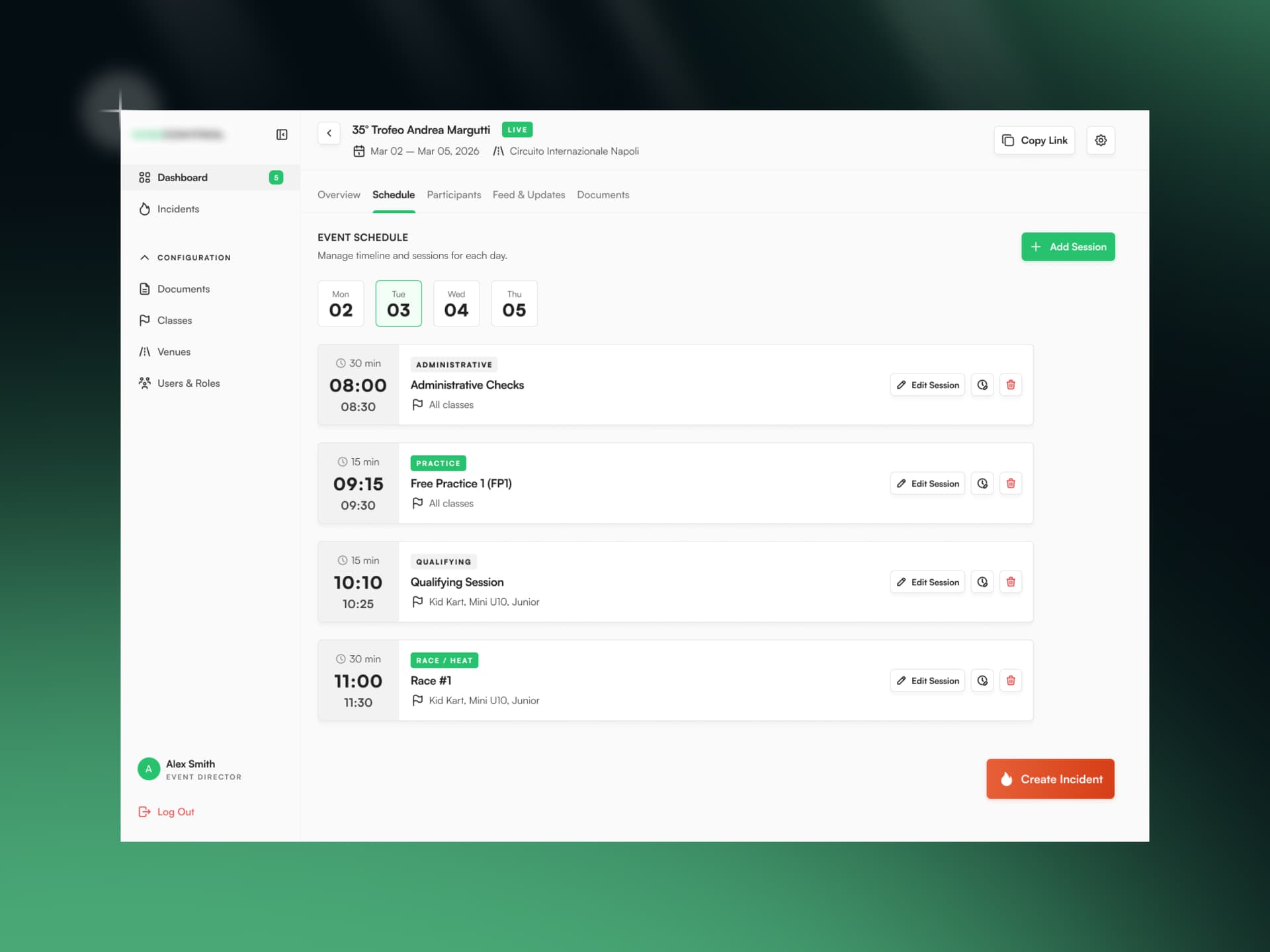
Organizer dashboard | Event setup, schedules, sessions, participants, license verification, roles, incident monitoring, and alert management |
Participant PWA | QR/link onboarding, phone-OTP authentication, waiver signing, updates, incident reporting, and critical alert delivery |
Real-time alerting | RED FLAG distribution, live acknowledgment status, escalation logic, and device state tracking |
Offline-first sync | Local capture of pending actions when connectivity drops, syncing once the device reconnects |
Compliance and audit | Waiver versions, enforced scrolling, touch signatures, guardian consent, device and IP capture, timestamps, and append-only records |
Data export | Append-only, tamper-evident logs exportable as PDF or CSV for legal or insurance review |
Core Features
RED FLAG Critical Alerts
A RED FLAG alert takes over the participant’s screen and stays until acknowledged, with the organizer watching the confirmation rate climb in real time.
Example: A red flag is thrown at Turn 3 for eleven drivers on the track. Within 12 seconds, all eleven confirm, and the dashboard shows 100% acknowledgment.
Acknowledgment Tracking and Escalation
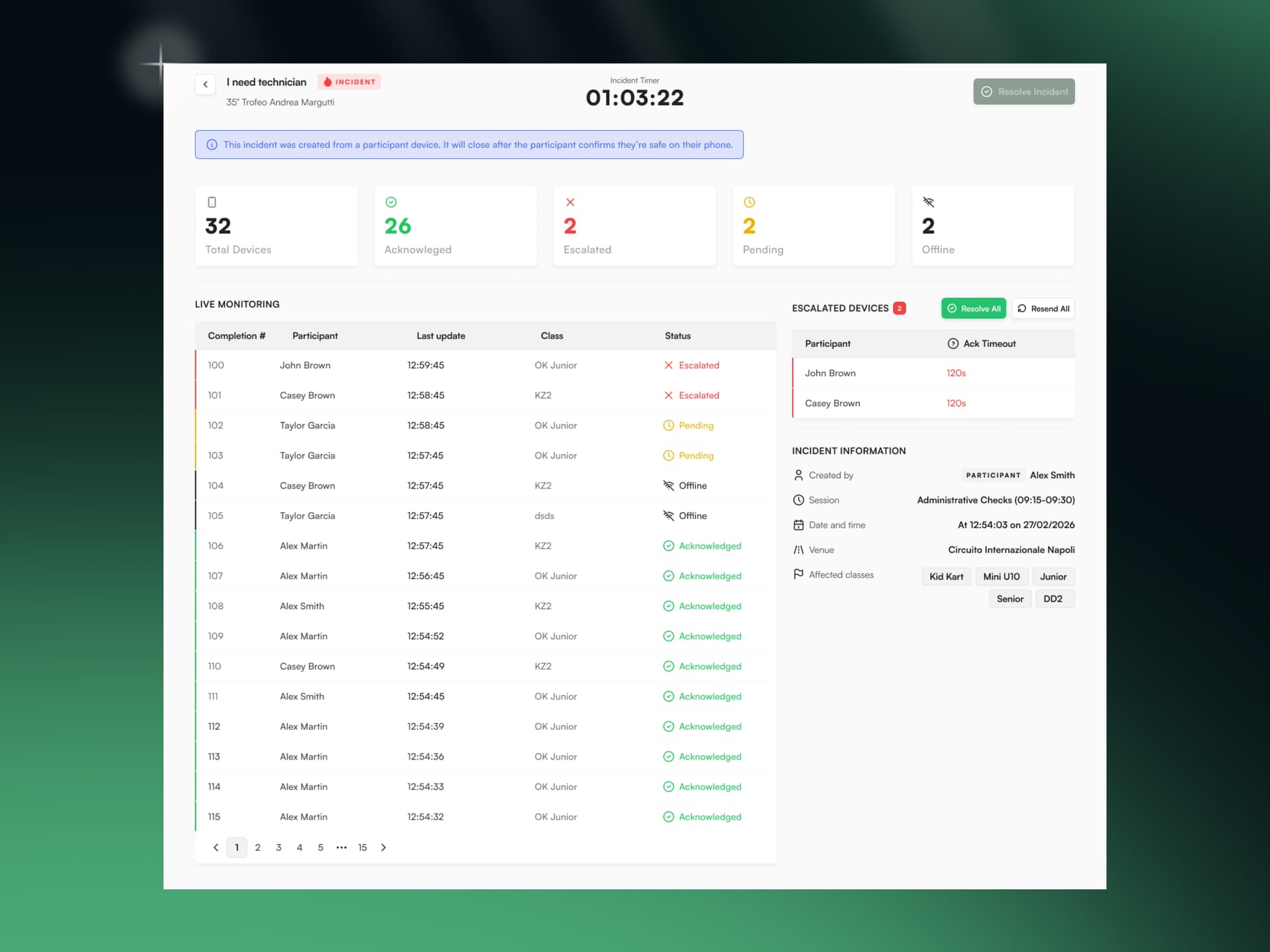
Every device carries a live status: acknowledged, pending, escalated, or offline. One that misses the window escalates on its own, so no participant is quietly counted as having reached it.
Example: A yellow flag goes out; nine drivers confirm, but one device reads "offline" and another “pending.” Both escalate at once, and a marshal heads to the paddock before anyone is missed.
Participant-Raised Incident Reporting
A participant can flag an incident from their phone, and it becomes a tracked item with its own timer and device status, open until they confirm they are safe.
Example: A driver reports “Mechanical, handling issue” from their phone mid-session. The organizer sees it instantly, dispatches a technician, and the incident closes only when the driver confirms they are safe.
Digital Waivers and Guardian Consent
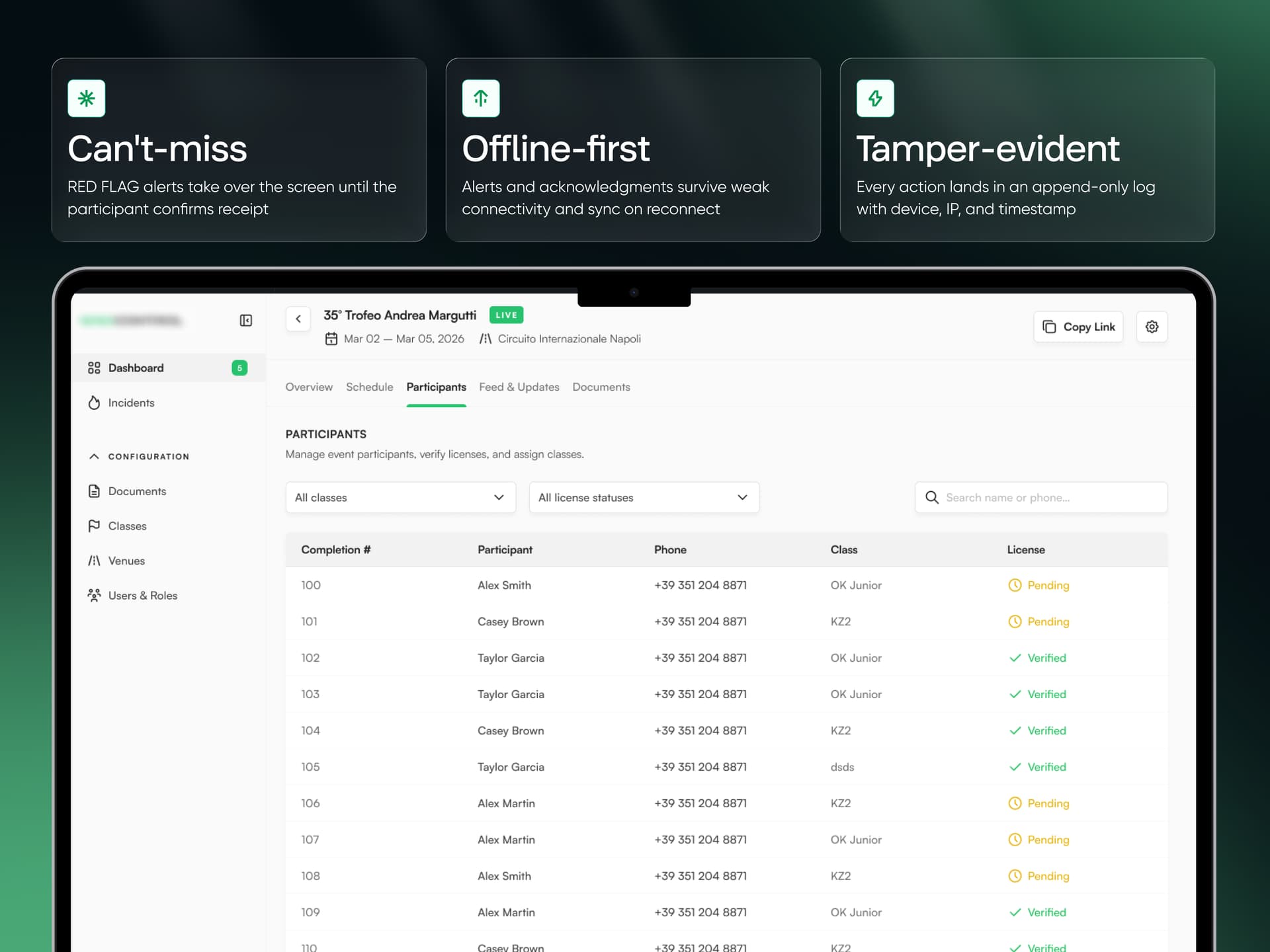
Versioned templates, enforced scrolling, touch signatures, IP capture, timestamps, and a guardian consent flow for minors. Organizers confirm each participant’s paperwork is complete before the start line.
Example: A 14-year-old signs the season waiver while a parent confirms consent on a separate device. Both signatures, timestamps, and device data are captured, ready if a question ever arises.
Tamper-Evident Audit Logs and Exports
Every alert, acknowledgment, signature, and consent lands in an append-only, tamper-evident log, exportable as PDF or CSV: a race-event audit trail captured as events happen, not reconstructed afterward.
Example: Three months after an incident, a lawyer asks who was notified. The organizer exports the log: every alert, confirmation time, and action, timestamped and unaltered.
Event Configuration and Operations
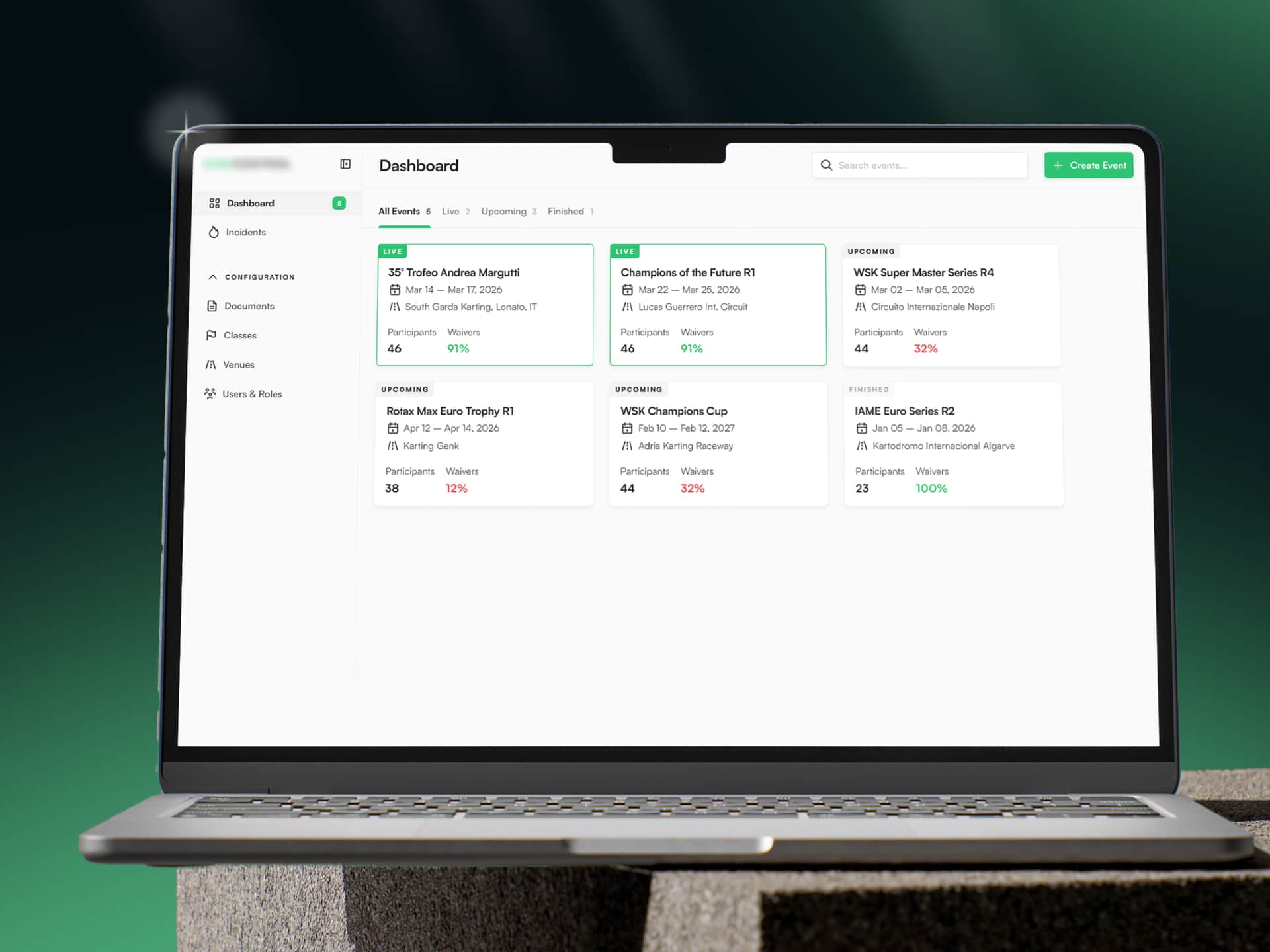
One control surface for the operations team: multi-event overview, waiver-completion rates, schedules, participants with license verification, classes, venues, and role-based access, all from one screen.
Example: Three events run this weekend, each at a different stage of readiness. The organizer opens one screen, sees waiver completion and open tasks for all three, and moves each forward.
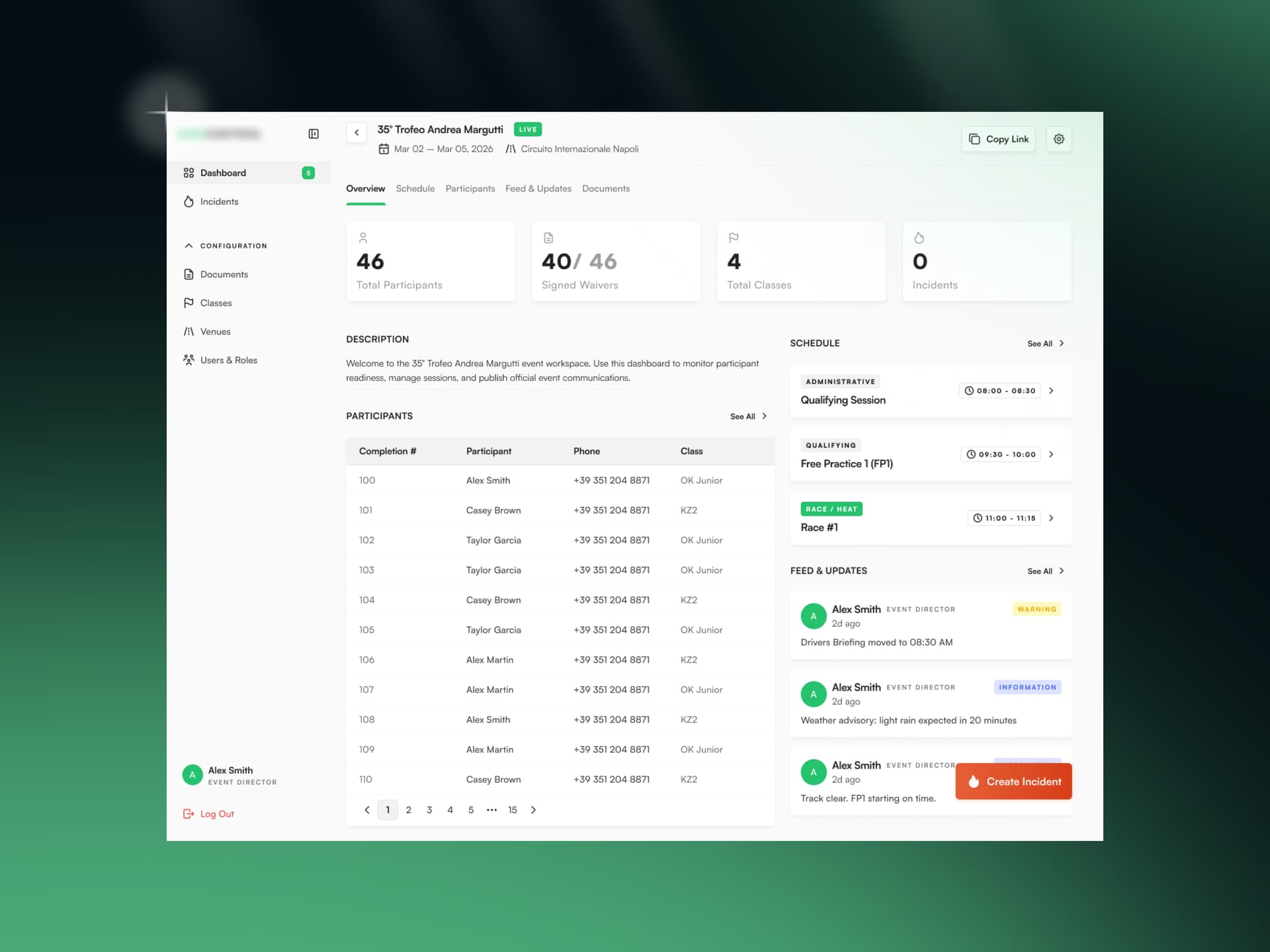
Broadcast Feed and Routine Updates
Organizers publish schedule changes, weather advisories, warnings, and updates to a structured broadcast feed, keeping the grid informed through one channel.
Example: The forecast turns, and the organizer posts “Session start delayed 30 minutes.” All 45 participants see it on their phones at the same moment, with no mixed messages.
Offline-First PWA for Event Operations
Participants join from a link or QR code with phone-OTP login, no app store step. Offline-first storage holds alerts and pending acknowledgments when signal drops, then syncs on reconnect.
Example: A participant in a low-signal pit lane receives a yellow flag and confirms it offline. The acknowledgment waits locally, then syncs the moment signal returns, leaving no gap in the record.
Results
Lumitech delivered a working motorsport safety and compliance platform, built and validated for live race-day conditions.
What changed:
One workflow instead of scattered tools. Safety alerts, waiver management, incident tracking, and audit trails now work together on a single platform.
Confirmed safety communication. Organizers can see who received and acknowledged a safety message, and who still needs attention.
A clear record for later review. Alerts, acknowledgments, waivers, consents, signatures, timestamps, and incident history are captured during the event.
Better race-day control. Unreached participants surface automatically, status is visible at a glance, and acknowledgment rates are measurable.
Resilience under weak connectivity. Offline-first architecture keeps pending actions on the device and syncs them when the connection returns.