
Government Software Development in the GCC: Procurement, Compliance and Vendor Guide
In government software bids, you price before the deployment model is confirmed, the budget is fixed, and there’s no discovery phase to fix mistakes later. This guide covers what GCC procurement actually changes in the estimate, contract, and delivery.
- GCC government software
September 21, 2026
 AI Overview
Government software procurement in the UAE governs RFP evaluation, budget ceilings, and infrastructure requirements before signing any contract. Vendors register directly through the Federal Supplier Register, which activates within 30 working days, or subcontract under a prime contractor with back-to-back payment terms. Unregistered or unverified subcontracts produce underbuilt support models and lost tenders.

The Misconception That Costs Vendors Money
A common assumption among software companies entering the region: government software development in the UAE is a commercial engagement with extra paperwork on top. Same estimate, same architecture, same delivery rhythm, plus a stack of forms.
That assumption is expensive to hold past the bidding stage.
In practice, procurement mechanics change the estimate. They change the architecture, the payment schedule, the infrastructure model, and even how the delivery team is expected to talk to the client. A vendor that treats government technology procurement as an administrative layer around a normal software project will misprice the bid, underbuild the support model, or lose the tender before a single line of code gets evaluated.
None of that announces itself early. It surfaces months later, after award, when the cost of fixing it is already sitting inside a signed contract, not a draft proposal.
In a commercial project, you find out what’s actually needed during discovery. In a government tender, you don’t get that phase — you price the unknowns before you’ve even won the work. That’s the single biggest mindset shift we had to make.



This article walks through how public-sector software development in the GCC actually works, end to end: the two entry routes into a program, RFP mechanics, budget ceilings, technical and commercial submissions, infrastructure constraints, cash flow, stakeholder dynamics, and bilingual scope. It draws on official UAE and Saudi procurement sources together with first-party experience delivering government software development services as a software development company in the UAE.
How Software Vendors Actually Enter Government Software Development UAE Projects
There are two structurally different ways into a government program. The difference matters more than most vendors expect.
Direct Procurement
On the UAE federal level, foreign and local suppliers can register in the Ministry of Finance’s Federal Supplier Register and bid directly through the Digital Procurement Platform. After approving the supplier account, the platform covers tender submission, contract negotiation, purchase orders, invoicing, and payment tracking in one interface. Registration typically activates within 30 working days.
Emirate-level entities — Abu Dhabi, Dubai, and others — run their own parallel supplier portals. Direct registration is real, and it’s the cleanest route if a vendor wants to hold the contract directly with the end client.
For a foreign vendor evaluating the opportunities of government IT procurement in the UAE for the first time, registration itself is rarely the hard part. The harder part is judging, before investing in a bid, whether a given opportunity will actually run through this direct channel or through a prime.
The Prime Contractor Model
Direct access exists, but it’s not the only route — and for most specialist software vendors, it isn’t even the main one. A large share of government software development in the UAE reaches vendors through a chain:
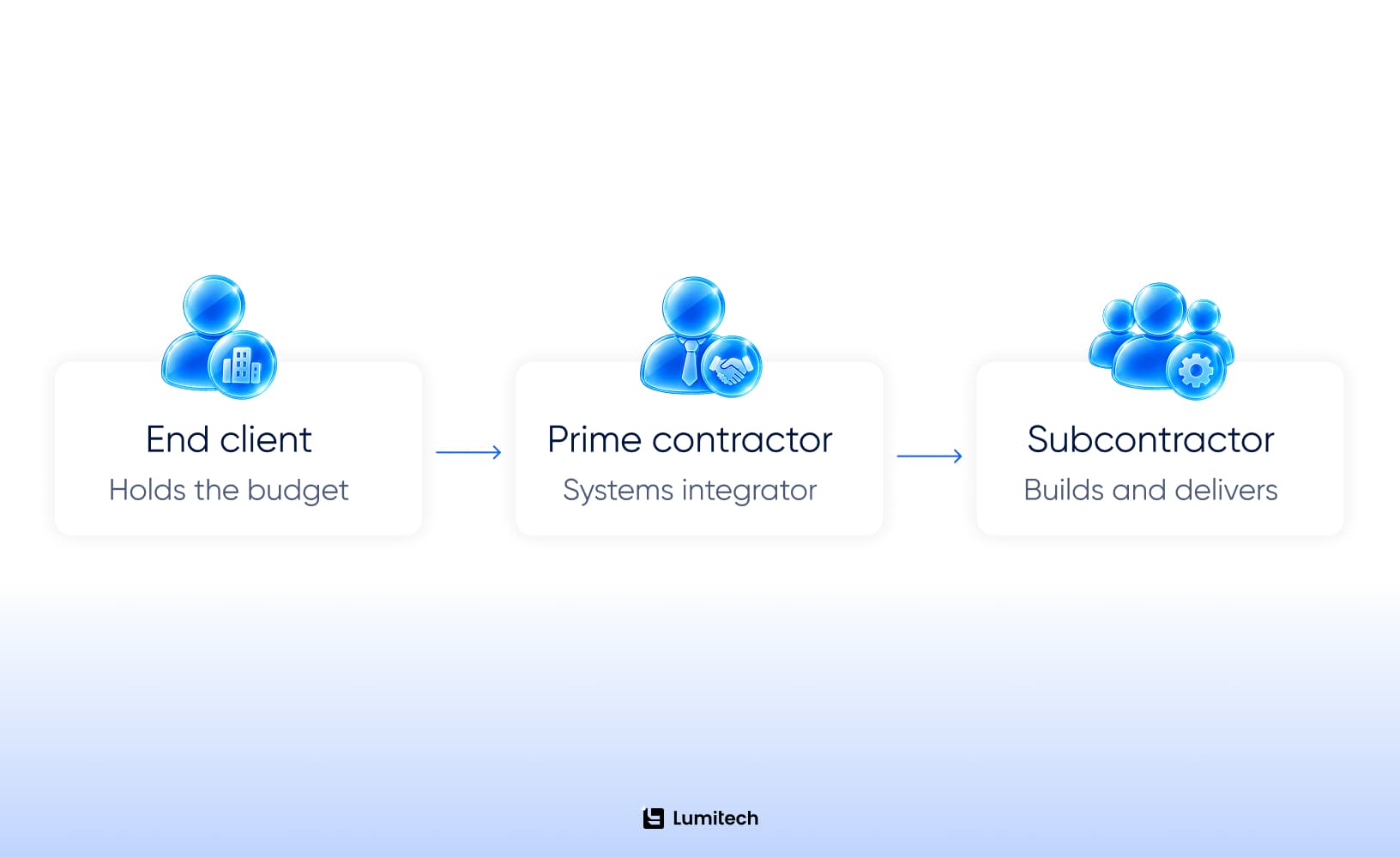
What subcontracting actually changes goes well beyond the signatory. Review and acceptance shift to a different party, the team builds against a different set of requirements, margin sits with someone else, payment timing moves, penalty exposure for slipped milestones lands elsewhere, and direct access to the end client’s decision-makers narrows or disappears.
Lumitech’s experience with government IT subcontracting in the UAE is consistent on a few points. Payments are typically back-to-back — the subcontractor gets paid only after the prime has been paid by the end client, so a delay upstream delays cash downstream regardless of how fast the subcontractor delivered its own work. Penalties assessed against the prime are routinely passed down the chain in the subcontract terms. Communication with the true decision-maker is often filtered through the prime’s project manager, which slows clarification on anything ambiguous.
The prime route isn’t necessarily a disadvantage. For vendors without an established federal relationship, it can be the most realistic way into the market. What matters is getting the subcontract terms right: clear response-time expectations, a defined escalation process for unclear requirements, and payment terms that don’t get pushed back whenever delays occur higher up the chain.
Working through a prime contractor changes more than margin. It can change cash flow, access to decision-makers, acceptance timing, and the contractual risk carried by the government software subcontractor — and none of that is visible from the tender document alone. A vendor evaluating a government software tender in the UAE should figure out early which of the two structures applies, because the answer changes how the commercial terms get negotiated.
Contract holder | Vendor holds the end-client contract | Prime holds the contract; vendor holds a subcontract |
|---|---|---|
Payment trigger | End-client milestone acceptance | Prime’s own payment from end client, then pass-through |
Penalty exposure | Direct, as negotiated | Often mirrored down from the prime contract |
Access to decision-makers | Direct | Filtered through the prime’s PM |
Margin | Full bid margin | Compressed by the prime’s take |
Why a Government Software RFP Has to Be Treated as Part of the Project Architecture
This kind of document is not a sales document to skim for scope bullets and a submission deadline. It’s closer to a technical specification that has to be reverse-engineered before a contract is signed.
Before agreeing on a price, the scope should cover everything that could affect delivery — from exact deliverables and hidden assumptions to integrations, migration volumes, hosting, security, performance, accessibility, Arabic/English requirements, training, penetration testing, support, acceptance criteria, and third-party dependencies.
The reason this matters more here than in commercial software sales is structural. In a typical commercial engagement, ambiguity gets resolved during a discovery phase after the contract starts. In GCC government procurement, that discovery phase — and the option to re-baseline the estimate after award — frequently doesn’t exist. One bid corresponds to one contract, priced once, before the vendor has had any chance to validate assumptions against the live environment.
An unresolved requirement in this kind of document is a commercial risk. Before submitting a bid, the vendor should either estimate it, explicitly exclude it in writing, or document the assumption used to price it. Silence on an ambiguous requirement isn’t a neutral choice — it usually gets read later as the vendor having accepted the broader interpretation, at no extra cost.
This is also where a software development company in the UAE with prior enterprise software development experience in regulated environments has a real edge. Reading an RFP for what it doesn’t say is a skill built from having been penalized for missing it once — and it’s exactly what separates a competitive bid from one that reads the document at face value.


The Budget Is a Ceiling. The Scope Usually Isn’t Negotiable.
GCC public-sector procurement budgets behave differently from commercial project budgets in one specific way: the ceiling is fixed by the approved allocation, and the required scope — the list of mandatory deliverables — is fixed by the RFP.
Neither side moves easily once the tender is published. A vendor can’t ask the client to raise the budget to match a more thorough technical approach, and can’t quietly drop a mandatory deliverable to fit inside the number.
That leaves exactly one lever: the technical solution itself.
We had a budget ceiling and four mandatory deliverables that weren’t going to change no matter how we argued the case. So we stopped trying to move the client and started simplifying the architecture — lighter stack, one cross-platform app in place of two native ones. That’s where the real negotiation happens: inside your own solution.
When both the budget and deliverables are fixed, the solution has to become simpler. That may mean a lighter architecture, reusable components, cross-platform development, fewer operational dependencies, and a clear split between the current scope and future phases. If compliant delivery still cannot fit within the budget, declining the bid may be the only realistic option.
Don’t ask “What’s the cheapest way to build this?”
Ask “What’s the simplest technically correct solution that satisfies every mandatory requirement?”
That framing keeps the estimate defensible under a fixed ceiling in public-sector IT procurement in the UAE while still meeting every line item the evaluators will check against.
For legacy environments, this is often where legacy modernization services intersect with the estimate directly. A modernization approach that reuses existing components can be the difference between a compliant bid and a bid that has to walk away.
Technical and Commercial Proposal Tender Submissions: Why Bids Fail Before Technical Evaluation
The processes in government IT procurement in the UAE generally require registered suppliers to submit separate technical and financial bids. The official Digital Procurement Platform structure treats these as distinct submissions, reviewed by different teams on different timelines. The commercial file goes to procurement; the technical file goes to the evaluators scoring the solution.
That separation exists to keep price from influencing technical scoring. Vendors break it by accident more often than you’d expect.
A single commercial figure left inside a technical-only submission can create a serious compliance problem — in some tender structures, it disqualifies the bid outright, regardless of technical quality. The same applies to inconsistent milestone names between the two documents, mismatched dates, a missing certificate, or an outdated template version. None of these are technical failures. They’re document-control failures with the same outcome as a technical one: the bid never gets evaluated on its merits.
A short pre-submission checklist for any technical and commercial proposal tender:
Check | Technical document | Commercial document |
|---|---|---|
Pricing | No prices anywhere, including annexes | Complete pricing, all line items |
Dates | Identical to commercial document | Identical to technical document |
Milestone naming | Identical to commercial document | Identical to technical document |
Scope description | Identical to commercial document | Identical to technical document |
Assumptions | Stated and consistent | Consistent with technical assumptions |
Attachments | All required certificates included | All required certificates included |
This is a mechanical discipline, not a creative one. It’s worth treating as its own review step, separate from writing the proposal content.
Infrastructure Requirements Can Change the Estimate More Than the Application Itself
The same application can cost materially more to deliver in a government software development UAE context than in a commercial one. The reason is rarely the application code. It’s the infrastructure model around it.
A typical cloud-based commercial project can rely on managed services for databases, queues, monitoring, backups, compute, and CI/CD, with the provider handling most of the underlying operations. In a restricted or client-controlled environment, much of that responsibility shifts to the vendor. The team may need to manage databases and queues itself, handle configuration and deployments, create operational documentation, build monitoring and backup processes, manage controlled access, and coordinate closely with the client’s security and infrastructure teams.
This kind of setup is common where the requirements for on-premises software development in Saudi Arabia apply, or where a UAE federal entity mandates sovereign hosting.
It shouldn’t be read as a blanket rule that GCC government procurement always means on-premises, though. Saudi Arabia’s Digital Government Authority publishes its own RFP preparation guidelines for digital projects and a digital procurement methodology guide that entities follow when defining deployment models. Cloud, hybrid, and sovereign options all appear, depending on the entity and the data classification involved. The deployment model has to be read from the specific project’s documentation, not assumed from the sector.
Database, queues | Managed service | Self-managed, vendor-operated |
|---|---|---|
Monitoring, backups | Provider-managed | Built and maintained by vendor |
Deployment | Automated CI/CD | Custom scripts, manual gates |
Access | Vendor-controlled | Coordinated with client security team |
Documentation | Internal | Must be operable by client staff |
On-premises deployment doesn’t necessarily make application code harder to write. It makes the surrounding infrastructure more expensive to own: deployment, monitoring, backup, security procedures, documentation, environment setup, and ongoing support can all need extra engineering effort that a commercial-cloud estimate wouldn’t include.
Documentation in particular tends to be underscoped. An operations runbook written for the vendor’s own team is not the same deliverable as one written so the client’s internal IT staff can run the system independently once the contract ends — the second version simply takes longer to produce. Vendors coming from a government software tenders UAE commercial background sometimes carry cloud-project pricing habits into an on-premises estimate and end up absorbing the difference. Teams that have already built software for restricted and offline environments tend to price this line item explicitly, separate from general DevOps hours.
Procurement Terms Shape Cash Flow and Contract Structure
Delivery, acceptance, and payment can happen at very different points in the project lifecycle. That means a project may be finished and delivered while payment is still months away, creating a significant cash-flow gap for the vendor.
Understanding this sequence matters most in public-sector IT procurement UAE contracts, where the gap between a technically finished milestone and a formally accepted one is where most cash-flow surprises originate.
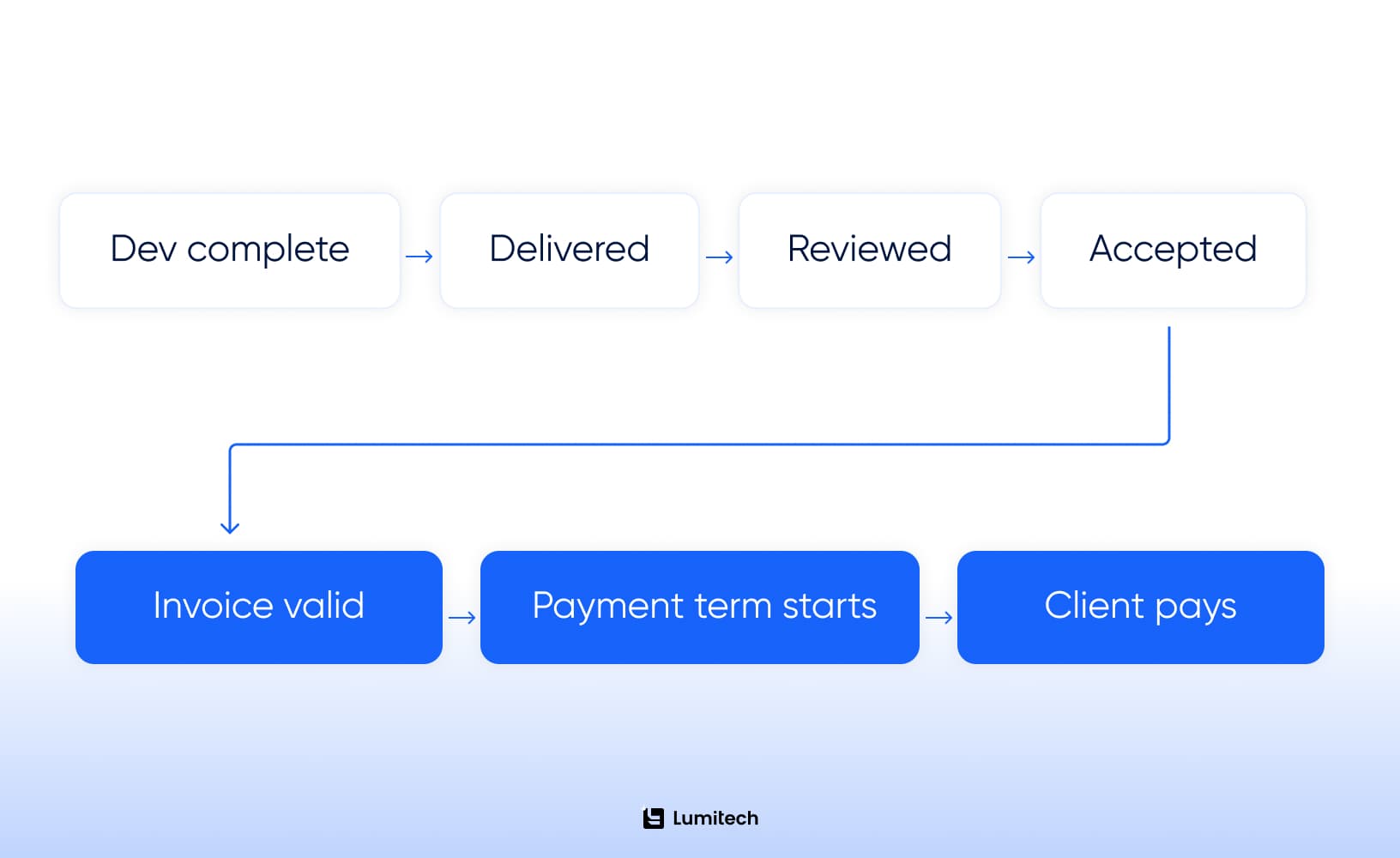
Every step between “delivered” and “paid” can add weeks. In a government contractor software UAE arrangement working through a prime, the vendor’s own payment additionally waits on the prime having first been paid.
The specifics shift from one entity and contract to the next, but Lumitech keeps seeing the same handful of terms: delay penalties near 1% of contract value per week, up to a 10% cap; milestones deemed accepted once a response window passes in silence; payment tied to a signed milestone report rather than delivery itself; and net-30 measured from invoice validation, not the delivery date.
The typical chain looks like this: development finishes → the milestone is delivered → the client reviews it → acceptance gets signed off → the invoice becomes valid → the payment clock starts → the prime or end client pays.
One thing worth negotiating for, where the contract structure allows it: an invoice-on-readiness clause that lets the vendor bill once the deliverable is demonstrably ready, if launch is delayed more than roughly 30 days for reasons outside the vendor's control — a third-party dependency, client-side environment readiness, or content that was never handed over.
Support and hyper-care commitments should be reviewed with the same attention to cash flow as the main delivery. An open-ended support obligation included in a fixed price, without a clearly defined scope, creates unpriced risk after the project has already been delivered. A defined hyper-care period — for example, a fixed number of weeks with agreed response times and a separate rate card for additional support — gives both sides more clarity than an informal promise to provide support “as needed.”
Bidding on a government contract in the GCC?
Get a second read on the RFP before you price it — Lumitech works through tenders, subcontracts, and compliance requirements for government software projects across the UAE and GCC.

Government Project Management: When There Is No Single Product Owner
Commercial software projects usually have one identifiable product owner who can make a call and be held to it. Public-sector IT procurement UAE programs frequently don’t. Decision authority is often spread across a program manager, a procurement officer, and mid-level department stakeholders — few of whom are hands-on technical evaluators, and none of whom may feel individually empowered to approve a direction without checking it with others.
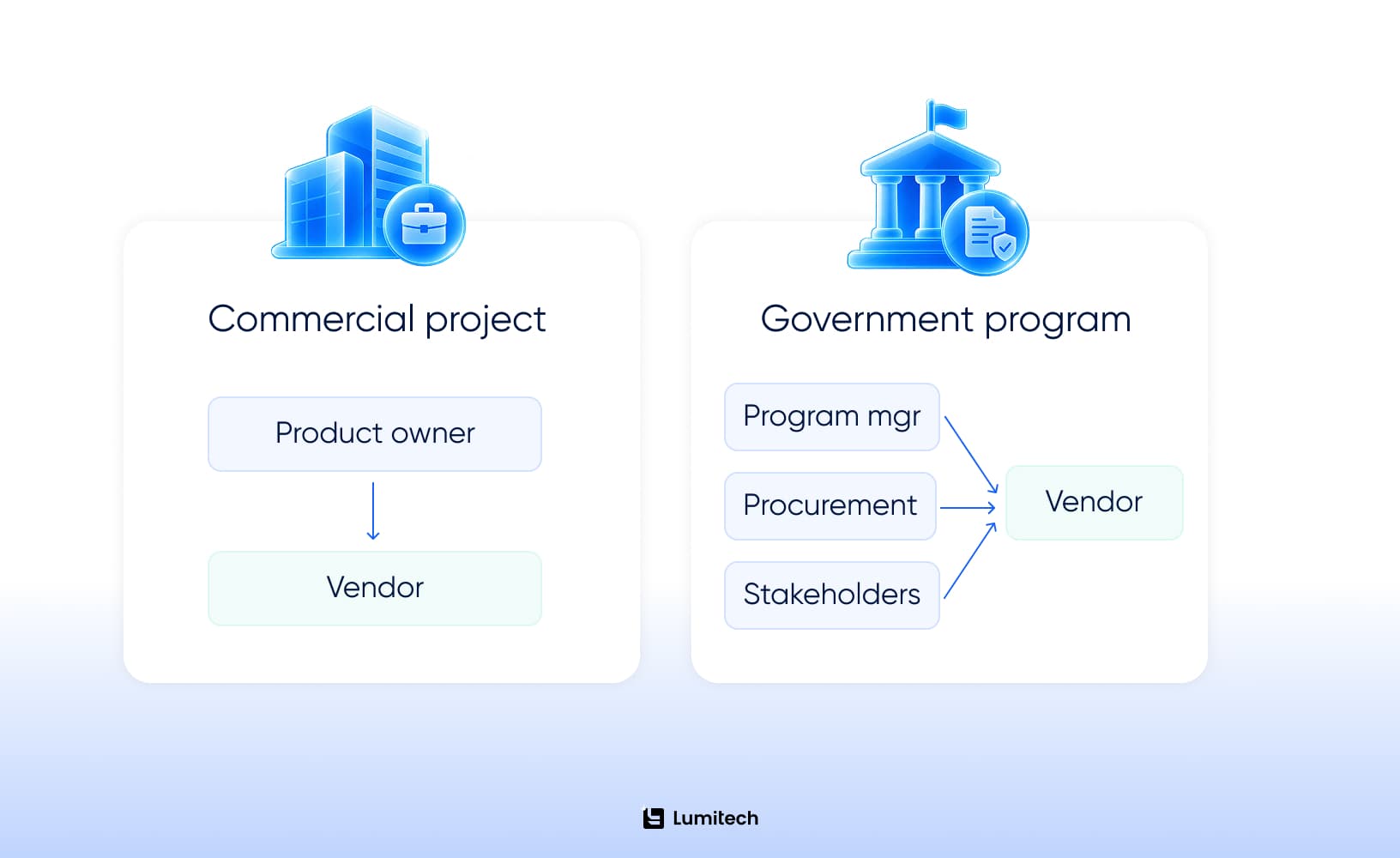
The operational lesson may seem counterintuitive: progress is often faster when teams propose a decision rather than leave the question open.
Asking, “What approach would you like us to use?” often leads to silence or a delayed, non-committal response because no one wants to take ownership of the decision.
The fix is concrete phrasing: “We recommend approach A because of X and Y. Please confirm or flag objections by [date].” A distributed group reacts faster to a proposal than it responds to a question.
Same pattern, every day. Show a screen instead of arguing over wording. One call plus a written summary beats a long thread. A decision log catches it when memories of the agreement start to drift.
And the client’s original email thread should never get broken into a new one — a fragmented thread is often where the paper trail of an approval quietly disappears.
When decision authority is distributed, a software vendor should actively reduce the client’s decision burden: propose a concrete option, explain the reasoning briefly, show something tangible wherever possible, set a response deadline, and document the outcome regardless of which way it goes. Over a multi-month engagement, this pattern compounds — a vendor that consistently shows up with a recommendation, not just a question, becomes the default source of direction for a stakeholder group that has no single owner of its own. That’s a genuinely useful position to hold heading into the next phase or the next contract renewal.
Bilingual Government Software Is More Than RTL Support
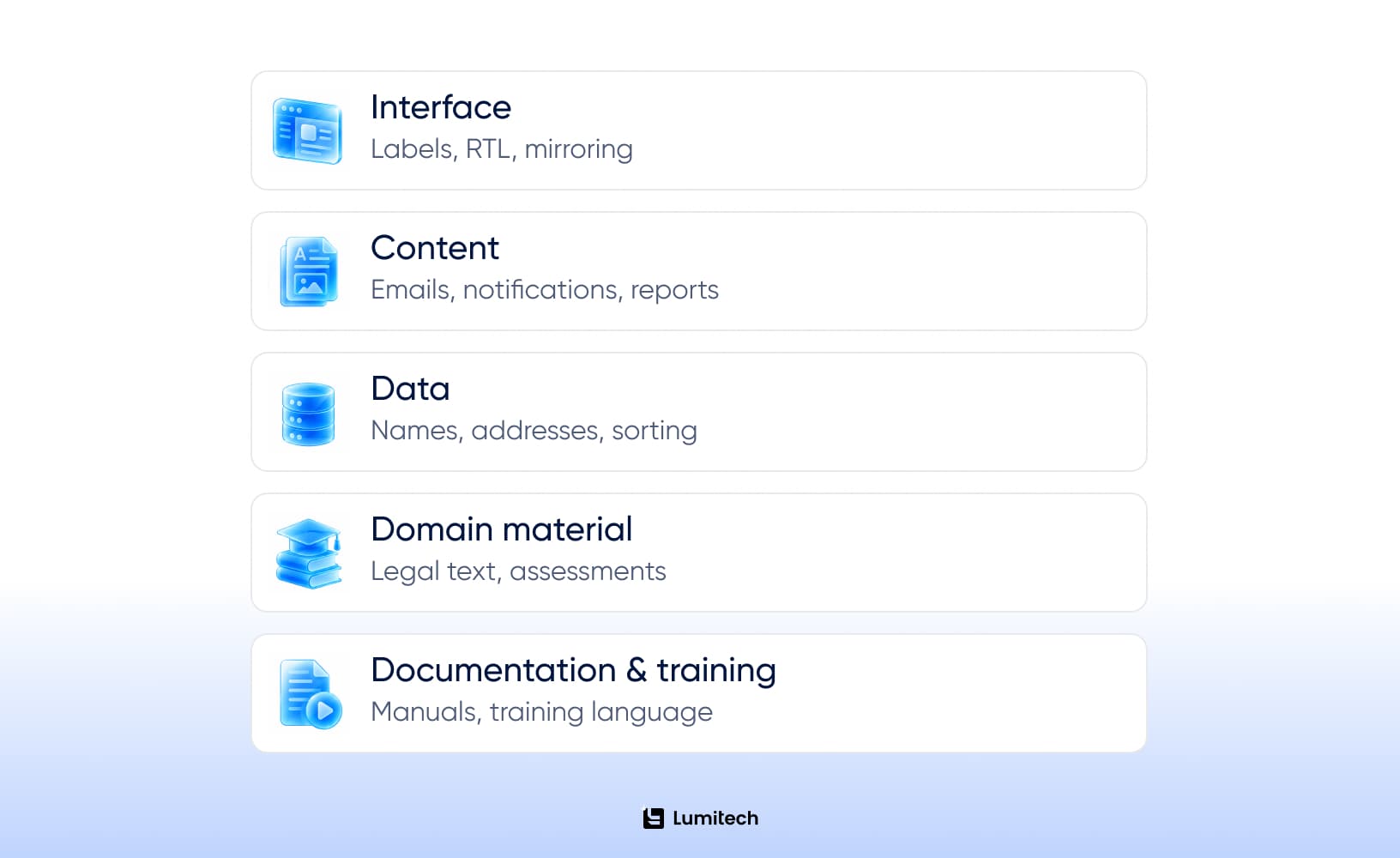
Arabic/English bilingual delivery is a stated requirement in most government software tenders in the UAE and Saudi RFPs, and it’s routinely underscoped because it looks like a UI task. It isn’t one. Bilingual scope runs across at least five layers of a system:
Interface — labels, right-to-left layout, component mirroring.
Content — pages, transactional emails, in-app notifications, generated reports, error messages.
Data — Arabic and English names stored and searched correctly, address formats, sorting order, validation rules that behave correctly in both scripts.
Domain material — legal text, regulatory language, assessment or scoring content that has to carry the same meaning in both languages, not just the same words.
Documentation and training — administrator manuals and training sessions delivered in the language the actual end users work in, not only the language the contract was negotiated in.
Translation and adaptation aren’t the same thing, and domain content is where that gap costs the most. Assessment material has to keep its scoring logic intact across languages. Legal and regulatory text has to keep every condition — lose one in the Arabic version, and it’s a compliance problem, not a wording issue.
Bilingual software should be estimated as a cross-cutting requirement, built into the architecture and content pipeline from the start — not bolted on as a translation task once the English version is already done.
Government software isn’t priced like a commercial project.
If procurement, infrastructure constraints, or bilingual scope are part of your next bid, Lumitech can help you scope it right the first time.

What Government Software Vendor UAE Teams Commonly Underestimate
A handful of patterns show up often enough in Saudi government software tenders and UAE tenders alike that they’re worth naming one by one, with why they happen and what the fix is.
Treating NFRs as “Included”
Security and performance requirements don’t show up as screens or user-facing features, so they’re easy to leave unpriced. The consequence: this work appears after award with no dedicated budget line, absorbed into margin that was never allocated for it. The fix is to estimate NFRs as their own effort lines in the technical proposal, not as a rounding factor on top of feature work — and to name them clearly enough that an evaluator can see they were priced, not assumed.
Not Reading the Purchase Order Against the Proposal
Vendors sometimes treat the PO as a formality once the proposal has been accepted. The PO can carry a contractual delivery date that differs from the estimated timeline in the proposal, and that date — not the proposal’s — is usually the one that governs penalty calculations.
Assuming Cloud by Default
Carrying commercial cloud-project pricing habits into a government IT tender in Saudi Arabia or a UAE bid without confirming the deployment model creates architecture and support budget risk that only appears once the environment constraints are already fixed.
Underpricing Support
Restricted access, change control, and bilingual users push up the real cost of post-launch support. A commercial SLA template doesn’t account for any of it, so pricing straight from the template under-recovers every time. Use it as a starting point, then price in what’s missing.
Selling Discovery Where the Procurement Mechanism Doesn’t Support It
A vendor used to a paid discovery phase before commercial engagements will sometimes propose one here, and the tender structure may simply have no contractual slot for it — one bid corresponds to one contract, with the estimate already fixed.
Fragmenting the Email Trail
Replying inside the client’s original thread keeps the context intact — exactly what matters when decisions are spread across several stakeholders. A new thread fragments the history and makes the trail harder to follow.
Discovery phase | Usually available, separately scoped | Often unavailable after award |
|---|---|---|
Budget flexibility | Can be renegotiated mid-project | Fixed ceiling, fixed scope |
Decision owner | Usually one identifiable person | Often distributed across roles |
Technical/commercial split | Often combined in one proposal | Submitted and evaluated separately |
Payment trigger | Delivery or invoice date | Formal milestone acceptance |
Before You Submit a Government Software Bid: 15 Questions
A government technology procurement bid — whether it moves through government IT procurement UAE channels or an equivalent Saudi process — is easier to price correctly when it’s checked against a fixed list, not reviewed impressionistically. Each of these should be answerable straight from the RFP, the PO, or a documented assumption, not left open at submission:
Do we know the maximum approved budget, and is it truly fixed?
Does every mandatory deliverable in the RFP appear somewhere in our estimate?
What in this RFP is confirmed, and what are we quietly pricing as an assumption?
Is the deployment environment — cloud, hybrid, or on-premises — actually confirmed in writing?
Who pays for third-party licenses required by the solution?
Who owns content migration, and has its volume been estimated?
Is penetration testing included in our scope, and who selects the tester?
Are security and performance (NFR) requirements estimated as their own line items?
What exactly needs to be bilingual — interface, content, data, documentation, or all four?
What specifically triggers milestone acceptance under this contract?
What specifically triggers a valid invoice, and does it match the acceptance trigger?
If a third party causes the delay, what does the contract actually say happens next?
Do training and hyper-care support have clear numbers attached — hours, weeks, a defined end point?
Does the PO’s delivery timeline match the timeline in our submitted proposal?
Is support priced for the actual infrastructure and access model, not a generic SLA?
What This Means for the Next Government Technology Procurement Bid
The point of preparing this way isn’t that it eliminates risk from GCC public-sector procurement. Some of that risk is structural, and it has to be priced in, not avoided. The point is that the risk becomes visible before signature, not after it — when the only options left are absorbing the cost or renegotiating from a weaker position.
The vendors who do well here aren’t the ones with the lowest price. They’re the ones who read the RFP like an engineer, not like a salesperson, and priced every assumption, not just hoped it wouldn’t come up later.
Reading a government software RFP this closely, splitting technical and commercial submissions correctly, pricing infrastructure and bilingual scope explicitly, and building a communication pattern suited to distributed decision-making aren’t separate skills. They’re one discipline, built through direct exposure to how public-sector software development GCC contracts actually run in practice, not from a procurement portal alone.
It’s the same discipline behind Lumitech's broader work in custom software development services and in tracking enterprise software trends in MENA and AI governance in MENA as public-sector software development in GCC accelerates across the region.
None of it replaces reading the specific RFP, PO, and contract in front of a vendor at a given moment. But it does mean the questions get asked before signature, when they still change the outcome — not after it, when all they do is explain what went wrong.


