
AI Agent PoC: How to Test an Autonomous Workflow Before Building a Full Product
Before investing in a full AI agent, validate that one workflow delivers reliable results at an acceptable cost. This guide covers how to select the right use case, test it, measure reliability, check security, and decide whether scaling is justified.
- AI Development
October 14, 2026
 AI Overview
An AI agent PoC is a time-boxed test of whether an LLM-driven agent completes one business workflow reliably and safely. The PoC measures task success across repeated runs, cost per successful task, and escalation rate. Escalating costs and unclear business value threaten agent initiatives: Gartner predicts that more than 40% of agentic AI projects will be discontinued by the end of 2027.

With an AI agent PoC, you can test an LLM-driven agent in a controlled way on a real-world business process before making a larger investment. The agent operates under restricted access, and its performance is assessed against predefined thresholds for repeated-run success, cost per successful task, escalation rate, and safety.
There’s a lot of behind-the-scenes work between a convincing demo and a dependable system. An agent may successfully resolve a support ticket in a demo and still fail when given the same input for the third time. It can call the wrong API, or loop until it exhausts its token budget. A proof of concept surfaces those problems while they are still cheap to fix.
In a nutshell
Prove one high-value workflow before expanding the scope.
Set the pass/fail criteria before the build begins.
Repeat every test; a single success is not enough.
Track the real cost of each successful task, including retries and human intervention.
Red-team for prompt injection and tool misuse before connecting production data.
What an AI Agent PoC Has to Prove
Agentic systems fail in ways that conventional software does not. Anthropic draws a useful line between two designs (Anthropic, “Building effective agents"):
Workflows: LLMs and tools follow predefined code paths.
Agents: the model dynamically directs its own process and tool usage.
That freedom is the source of both the value and the risk. The model decides which step comes next, so the same input can produce different paths, different tool calls, and different outcomes.
A useful proof of concept therefore answers four questions in a specific order:
Feasibility. Can the agent complete the task end to end with the data, tools, and permissions it will have in production?
Consistency. Can the agent deliver reliable results across multiple runs, including challenging real-world scenarios?
Unit economics. What is the fully loaded cost per successful task, including retries, failures, and human intervention?
Control. Can the team observe, constrain, interrupt, and audit what the agent does?
If the answer to the first question is yes and the answer to the second is “sometimes,” the project is not ready for a pilot. An agentic AI PoC that tries to prove business value before it has shown consistent behavior tends to produce a persuasive slide deck and very little decision-grade evidence.
Where an AI Proof of Concept Sits Among Prototype, Pilot and MVP
Mixing up these stage names creates mismatched expectations about what “done” means. The table below is a practical framework; no standards body defines these stages for agents.
Stage | Main question | Environment | Typical owner |
|---|---|---|---|
Proof of concept | Can the agent complete this workflow reliably and safely? | Sandbox, replicas, or shadow mode | Engineering and product |
Prototype | Will users understand and accept the interaction? | Controlled user sessions | Product and design |
Pilot | Does it hold up with real users, data, and volume in a bounded slice? | Limited production | Business owner with engineering |
MVP | Will the market or organization adopt it? | Production | Product leadership |
Production | Does it work at scale with monitoring, governance, and SLAs? | Full production | Operations and platform teams |
In practice, an AI proof of concept for an agent narrows the first row even further: one workflow, one set of tools, one measurable outcome.
Choose the Workflow Before You Choose the Model
An expensive mistake can happen before the first test runs: picking a task that never needed an agent.
In June 2025, Gartner predicted that over 40% of agentic AI projects will be discontinued by the end of 2027 due to escalating costs, unclear business value, or inadequate risk controls. In the same release, Senior Director Analyst Anushree Verma noted that “many use cases positioned as agentic today don’t require agentic implementations” (Gartner). The release also suggests a simple division of labor: agents where decisions are needed, automation for routine workflows, and assistants for simple retrieval.
Anthropic’s guidance points the same way. Its engineers recommend finding the simplest solution possible and increasing complexity only when needed, since agentic systems trade latency and cost for better task performance. Treat that as the first filter for any AI agent workflow automation idea.
Signals That a Task Justifies an Agent
OpenAI’s practical guide to building agents highlights three cases where agents have an advantage over deterministic automation:
Complex judgment. Decisions depend on context and exceptions, for example, approving a refund or triaging a claim.
Rules that resist maintenance. The rulebook has become so large and brittle that every policy change breaks something.
Unstructured inputs. The work depends on reading emails, documents, chat messages, or free-text notes.
A good PoC candidate meets at least one of these conditions, has a clear owner, produces a measurable outcome, and can tolerate a human checkpoint during testing.
Signals That Something Simpler Will Do
Some tasks never needed an agent:
The steps never change. A script or an RPA flow is cheaper and easier to audit.
The task is a single question answered from a knowledge base. A retrieval assistant may be enough.
The process is high-volume and low-variance. Conventional automation with one LLM call for classification can be cheaper and more predictable.
Lumitech’s enterprise AI strategy framework shows how to score use cases by business value and implementation complexity before committing engineering time.
Design the Test Before the Build
Another mistake is changing the definition of success once you see the results. Every metric used to decide the project’s future should be agreed on upfront. Otherwise, a 70% success rate becomes “promising” simply because it is the number the team got. An agentic AI proof of concept earns trust only when its pass marks predate its results.
A testing strategy for an autonomous AI agent workflow covers such decisions:
Scope. Let the PoC work on one process, approving the tools and setting explicit limits on what the agent can do independently.
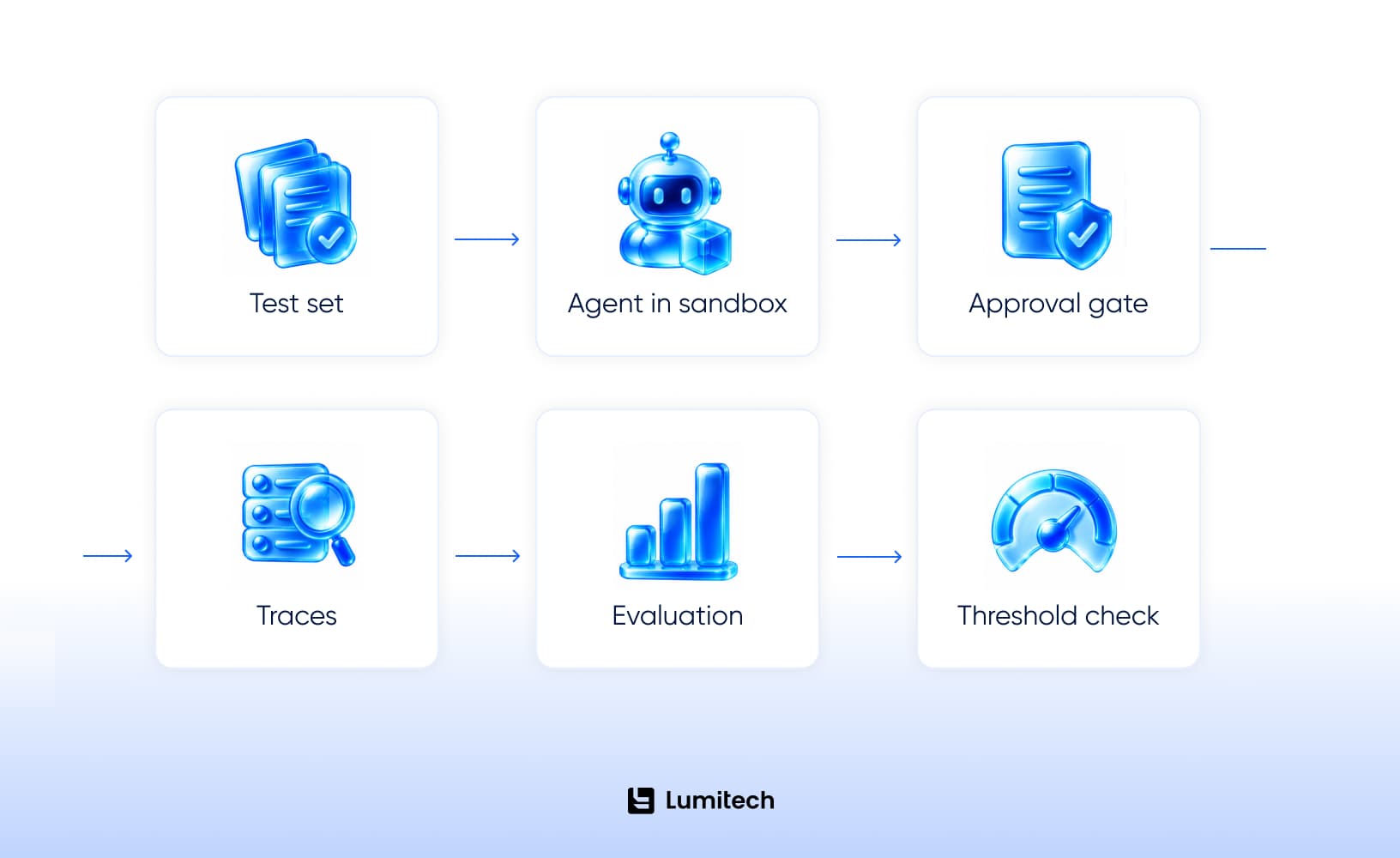
Environment. Use a sandbox, read-only replicas, or shadow mode to test the agent while the team remains responsible for executing actions.
Permissions. Follow the principle of least privilege by granting only the access required for the agent’s tasks.
Test set. Test against real historical cases with known outcomes.
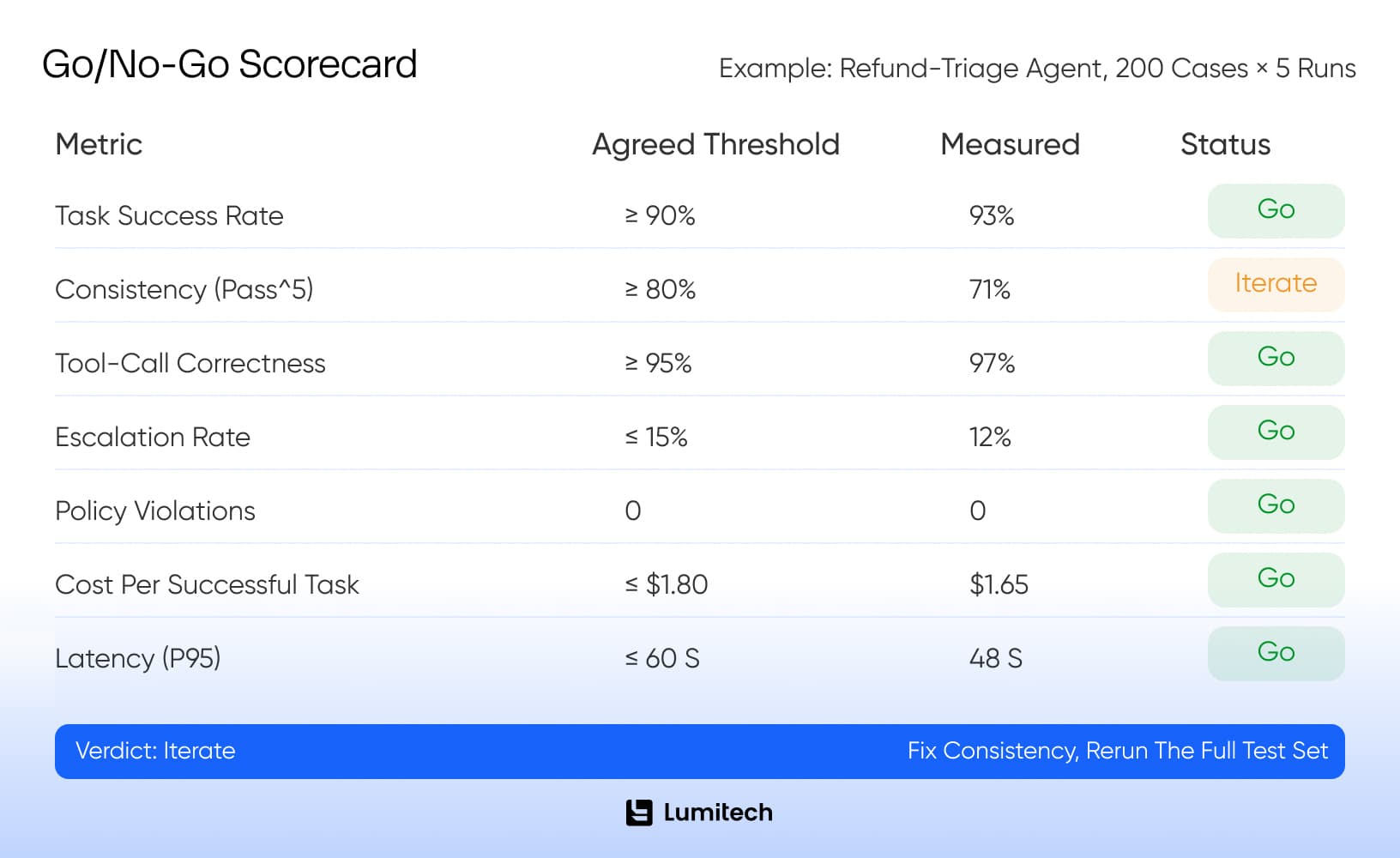
Gates. Define numeric thresholds for go, iterate, and stop decisions.
Set the verdict criteria before the build starts. The business owner approves the target success rate, cost per successful task, and actions that require human approval. Legacy integrations are tested against real data early, where many costly PoC surprises tend to surface.



Decide the Autonomy Level on Purpose
A 2025 framework from researchers Feng, McDonald, and Zhang describes five levels of agent autonomy, defined by the user’s role: operator, collaborator, consultant, approver, and observer (arXiv:2506.12469). The authors argue that autonomy should be set deliberately, separately from what the model is capable of.
Start with an approval-based approach for the first agent PoC: allow the agent to recommend actions with execution possible only after the team’s approval. Lower-risk, read-only tasks can be performed independently. With such an approach, the team can measure what the agent does while limiting the impact of potential mistakes.
Create a Test Set That Reflects Real Conditions
While synthetic data helps expand scenario coverage, real-world data reveals nuances and complexities that generated examples may miss. Use real historical cases with confirmed outcomes to check how the agent performs. Then add the cases that cause problems:
incomplete inputs;
conflicting instructions;
out-of-policy requests;
cases that should be escalated to a human.
A rigorous AI agent testing framework treats these edge cases as first-class test items with their own pass criteria.
Planning your first agent experiment?
Lumitech’s AI agent PoC validates tool use, edge-case handling, and safety before recommending whether to build, improve, pivot, or stop. Explore Lumitech's agentic AI development services to scope a focused test.

Which Metrics Show an Agent Is Ready to Move Forward
Good AI agent evaluation metrics connect technical behavior to the business decision the PoC must support. Accuracy alone says little about whether an agent can run unattended, which is why AI agent evaluation in a PoC needs several measures read together.
Metric | What it reveals | How to measure it in a PoC |
|---|---|---|
Task success rate | Whether the agent reaches the correct end state | Share of test cases completed correctly on the first run |
Consistency (pass^k) | Whether success repeats | Share of cases solved in all k repeated runs |
Tool-call correctness | Whether the agent uses systems properly | Correct tool, correct parameters, correct order |
Escalation rate | How often a human must take over | Share of runs handed off, appropriately or not |
Policy violations | Safety and compliance behavior | Count of actions outside allowed scope |
Cost per successful task | Real unit economics | Total model, infrastructure, and review cost divided by successful outcomes |
Latency | User and process fit | Median and p95 time to completion |
Risk should set the bar. An agent that can issue refunds needs stricter thresholds than one that only drafts content for human review. Agree on numeric targets with the business owner, but treat them as planning guidelines — not universal benchmarks for agent performance.
Why One Successful Run Isn’t Enough
AI agent reliability testing evaluates whether an agent can produce reliable outcomes under repeated test conditions. One successful run can make an agent appear more reliable than it actually is. That’s the motivation behind pass^k, a metric introduced by Sierra researchers in the τ-bench benchmark.
τ-bench (2024). GPT-4o-driven agents with function calling got success rates that fall below 50%. The consistency rate across eight retail trials was less than 25% (Yao et al., arXiv:2406.12045).
τ²-bench (2025). GPT-4.1 achieved only 34% success in a telecom scenario where the simulated user could also take actions, compared with approximately 74% in retail (Barres et al., arXiv:2506.07982).
These results come from simulated environments and since-superseded models. The lesson still applies: run every test case several times and judge the agent by how often it succeeds on every attempt.
Cost per Successful Task
A model call may be cheap, but that does not mean the task is cheap. Include retries, failed runs, and human review when calculating the cost of each successful task, then compare it with the current manual process.
In McKinsey’s State of AI survey published in August 2026, about two in ten respondents said AI-related operating costs, including token costs, had led their organizations to limit AI use (McKinsey).
How to Test an Agent: Methods, Tools and Security Checks
How to test an AI agent effectively comes down to the following three layers:
Automated evaluation. Offline evals run the agent against the fixed test set after every prompt, tool, or model change, turning AI workflow testing into a regression suite. An LLM can evaluate open-ended outputs when there is no single correct answer. That approach scales, but research on LLM judges documents position bias, verbosity bias, and self-enhancement bias (Zheng et al., arXiv:2306.05685). Validate the judge against human-labeled examples before relying on its scores.
Trajectory review. A correct result does not mean the agent followed the correct scenario. Trace the execution to see which tools it called, what parameters it used, and the order of its actions. For tasks with multiple steps and component-to-component handoffs, agentic workflow testing should check intermediate states, since a single incorrect value at the start can compromise the entire downstream workflow.
Tooling. The market for AI agent evaluation tools changes quickly, so evaluate platforms based on their capabilities. When comparing AI agent testing tools, focus on:
trace capture across every model and tool call;
dataset versioning;
support for repeated runs and pass^k reporting;
human annotation;
exportable results that will survive a vendor change.
Load and latency. Run AI agent performance testing under light workloads. What works smoothly in a demo may become sluggish under real-world load because of rate limits, slow legacy APIs, and long reasoning chains.
Red-Team the Agent Before Production Deployment
Once an agent has access to tools, prompt injection can cause more than misleading outputs — it can trigger real actions. Two findings involving NIST’s Center for AI Standards and Innovation (CAISI) highlight the severity of this risk:
Agent hijacking. AgentDojo tests published in January 2025 by the NIST team now known as CAISI showed that new attack techniques could increase agent-hijacking success from 11% with the strongest baseline attack to 81% (NIST).
Public red-teaming competition. A 2026 competition designed by Gray Swan with the UK AI Security Institute, US CAISI, and frontier labs collected about 272,000 attack attempts from 464 participants against 13 frontier models. It produced 8,648 successful attacks across 41 scenarios (arXiv:2603.15714).
The following OWASP resources offer a clear framework for building a test checklist:
The OWASP Top 10 for Agentic Applications, published in December 2025, includes manipulation of agent goals, misuse of tools, and abuse of identities or permissions.
The OWASP Top 10 for LLM Applications 2026, published in August 2026, moved Excessive Agency from sixth to third place.
Build at least one test case for each relevant category, especially indirect injection through documents or emails the agent reads.
Why Agent Pilots Stall Between Demo and Production
Scaling an AI solution beyond the experimental stage is rarely a smooth process. McKinsey’s survey of 1,719 participants, published in August 2026, found (McKinsey, PDF):
Among organizations with more than $1 billion in revenue, 40% of respondents reported scaling AI agents, up from 27% the previous year.
The share at smaller organizations stayed essentially flat at 22%.
These are self-reported figures, and the survey does not determine the reasons behind the trend. This may suggest that smaller companies have less capacity to handle the integration, governance, and testing required to scale AI agents.
Three causes deserve a place in the PoC plan:
Integration with legacy systems. Gartner notes that integrating agents into legacy systems can be technically complex and often requires costly modifications. A PoC that runs only against mock APIs has not tested the hardest part.
The wrong success metric. Klarna’s customer-service assistant is a well-documented example:
In February 2024, the company reported that the assistant handled two-thirds of its service chats in its first month. It estimated a $40 million profit improvement for 2024 (Klarna via PR Newswire).
In May 2025, its CEO told Bloomberg that cost had been “a too predominant evaluation factor,” resulting in lower quality, and the company began recruiting human agents again (PYMNTS). For a PoC, the lesson is to put quality gates in the scorecard from day one.
Missing orchestration design. Reliability issues can originate in the systems surrounding the model, especially how they handle retries, timeouts, state, and handoffs. Sound AI agent workflow orchestration decides which steps are deterministic code, which belong to the model, and where a human steps in.
Human oversight can be the key to making an AI agent deployment workable. One Lumitech project built an AI-powered WhatsApp commerce platform for a GCC pet retail and veterinary network. The assistant connects to the client’s ERP, CRM, warehouse, and logistics systems and runs on the client’s own infrastructure. It hands complaints, nuanced health questions, and complex delivery problems to staff who see the conversation history and order details. For regional context, see the analysis of enterprise AI adoption in GCC markets.
Ready to put one workflow to the test?
Lumitech’s AI proof of concept development isolates the riskiest assumption behind an agent idea and tests it, usually within two to eight weeks. You get a feasibility assessment, a risk map, and an implementation roadmap. Share the workflow you want to validate.

From PoC to Production: Making the Go/No-Go Call
The final step of AI agent validation is a decision, documented with evidence. A strong AI agent PoC report states:
the assumption tested;
the thresholds agreed at the start;
the measured results;
the failure modes observed;
the conditions under which the agent can move forward.
The PoC ends with one of four decisions: build, improve, pivot, or stop.
Before launching the pilot, confirm that all the following criteria are met:
Task success and pass^k metrics meet the required targets across the full test set.
No irreversible action can proceed without the required approval or a proven way to undo its effects.
The cost per successful task is competitive with the existing workflow.
Prompt injection and tool-misuse tests have been run and documented.
Traces, logs, and audit trails exist for every agent action.
Accountability for model updates, incident management, and retraining is clearly defined.
The EU AI Act (Regulation (EU) 2024/1689) applies to AI providers and deployers in the EU, as well as certain providers and deployers outside the EU whose systems generate outputs used within the Union. Current as of October 2026:
Transparency obligations, such as telling people they are interacting with AI, have applied since August 2, 2026.
The Digital Omnibus on AI, Regulation (EU) 2026/1744, in force since July 27, 2026, moved obligations for stand-alone high-risk systems listed in Annex III to December 2, 2027. Annex III covers areas including employment and credit scoring (EUR-Lex).
If an agent affects any of these areas, assess its risk level during the PoC. Expert AI governance consulting can identify the controls and audit trails needed to support the pilot.
When the verdict is “build,” a narrow production release is the natural next step. AI MVP development tests user adoption, AI performance, and business economics before a full build. For rollout planning beyond agents, see Lumitech's guide to AI PoC implementation. Teams that design a sound AI agent evaluation framework during the PoC can reuse it as the regression suite for every later release.


