Enterprise AI Adoption in the GCC: Why AI Projects Stop Short After PoC
“The demo works, so the hardest part is behind us.” After a successful test, approving a bigger budget can seem like the obvious next step. Yet the team may still have no clear plan for getting the system into employees’ hands.
- AI Integration
- GCC
October 07, 2026
 AI Overview
Enterprise AI adoption in the GCC requires clear ownership, approved data access, regulatory checks, and agreed criteria for launch. Without these, a successful PoC can remain stuck in testing. Roland Berger's 2026 report found that fewer than one in three GCC organizations had the operating model needed to scale AI.

An AI proof of concept (PoC) tests an idea under selected conditions. The data may be prepared in advance, the testers few, and engineers available to fix problems immediately. In daily use, the system needs current information, connections to existing software, and support after launch. The demo may leave much of that work untested and unbudgeted.
An AI readiness assessment helps establish what remains to be built, who needs to do it, and what it will cost. For leaders overseeing enterprise AI adoption in the Gulf Cooperation Council (GCC), understanding the pilot-to-production gap helps answer the question that follows a successful demo: will the expected return justify the time, budget, and effort still needed to launch?
How Far AI Has Spread in GCC Enterprises
McKinsey’s November 2025 report, produced with the GCC Board Directors Institute, shows how far AI use has spread. Among respondents, 84% reported some use in their organizations, up from 62% in 2023. Yet only 31% said AI was being scaled or fully deployed across the business. The survey covered 139 senior executives and board directors across all six GCC countries.
That gap does not measure project failure. A company can achieve results in one department while still working out how to extend them across the business. Other regional studies help explain the AI adoption barriers behind that next step
Roland Berger’s February 2026 findings show that nearly 80% of surveyed organizations had an AI strategy in place or under development. Fewer than a third had the operating model and governance needed to scale, while 34% had an enterprise-wide data foundation. Strategy has moved faster than the capacity to execute it.
BCG’s January 2026 research points to similar gaps in technology, data readiness, people, and operating models. Its findings cover around 200 organizations in Saudi Arabia, the UAE, and Qatar.
Regional averages give leaders context. Decisions about AI in GCC enterprises still need company-specific evidence: will AI adoption improve the intended workflow, and can the business support it within its existing systems and governance rules?
What a PoC Proves, and What It Leaves Open
A demo may end when the AI produces the right answer. An employee still has to use it to get something done, and that remaining work can be easy to miss.
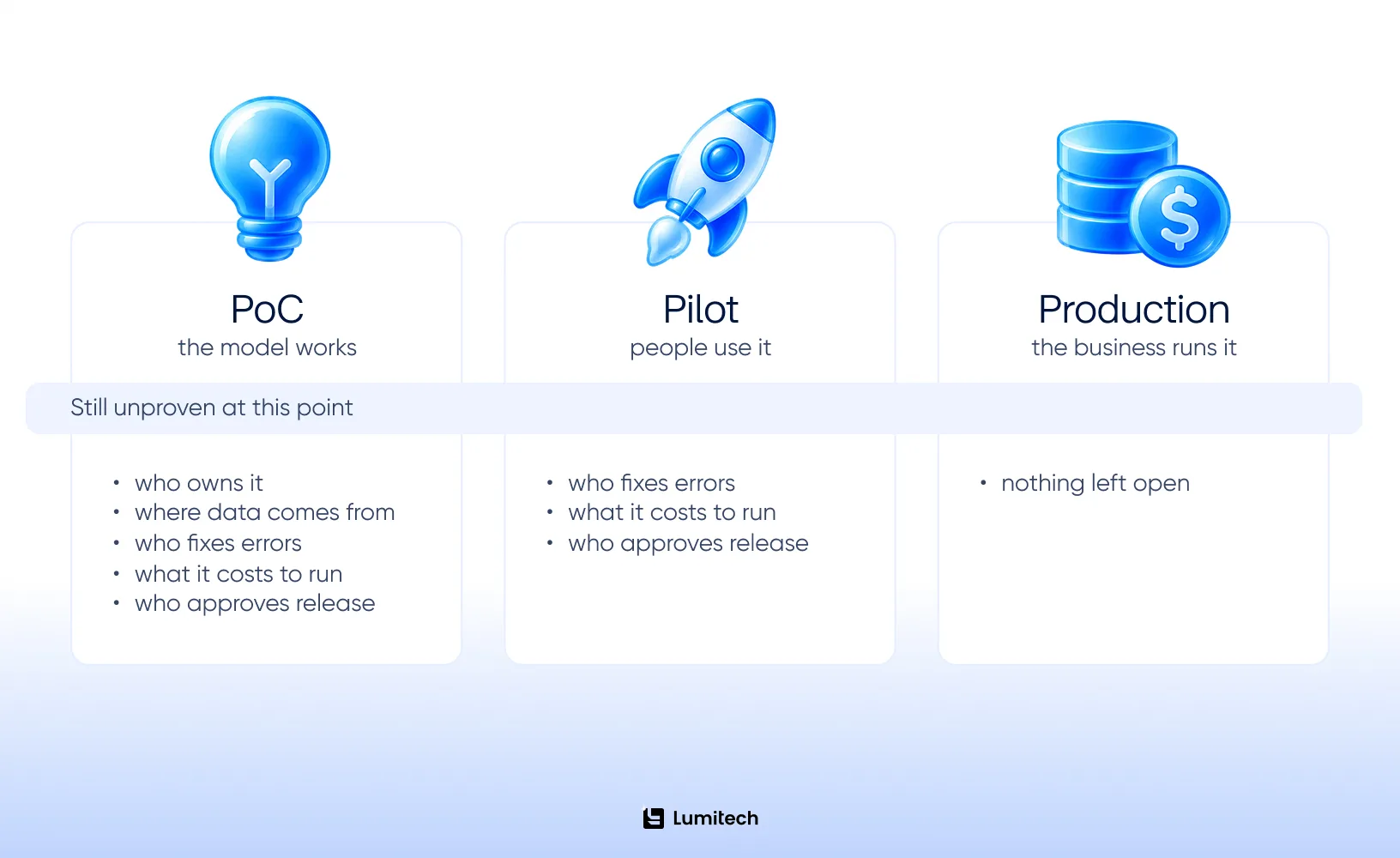
A document assistant, for example, might produce an accurate supplier-onboarding checklist from the files used in a demo. With a real supplier, it has to find the current policy for that country and respect the employee’s access permissions. The employee then has to collect missing documents and get the necessary approvals.
If the checklist leaves those steps unclear, the employee will still have to chase colleagues by email. Those exchanges take time, even if they never appear in the demonstration. Count them, and the expected savings may look rather different.
Other obstacles lie outside the task itself. Gartner reported in January 2026 that at least 50% of generative AI projects globally had been abandoned after proof of concept by the end of 2025. It cited poor data quality, weak risk controls, rising costs, and unclear business value.
The AI pilot gives the company a chance to see how these issues affect everyday use before it funds a rollout. Employees try to finish real tasks, the team measures the effort involved, and leaders can judge whether the improvement is worth the full cost of running the system.
How Close Is Your AI Project to Launch?
The Lumitech team can review your test results, data limitations, and workflow to clarify what still needs to be tested or built before launch.

Four AI Implementation Challenges That Can Still Block Launch
Launch work can extend well beyond the original technical brief. Deloitte’s 2026 State of AI in the Enterprise report, based on a global survey, found leaders felt better prepared on strategy than on infrastructure, data, risk, and talent. Four checks help define the remaining work: the workflow, the data, the owner, and the running costs.
A Workflow the Business Can Change
“Improve customer service” leaves too much open. A workable objective names the task, users, baseline, and intended result: support agents drafting replies to one request category using approved information, with a recorded review step.
AI use case prioritization can reveal dependencies outside the team’s control. Another department may own the records, an integration may need to be built, or the customer-facing team may need to approve a change. Each dependency affects what the project can deliver and at what cost.
A broader enterprise AI strategy sets priorities across initiatives. The AI implementation strategy for each project needs a clear problem statement and a named owner with authority over how the work gets done.
Data Beyond the Demonstration Sample
Data readiness means having reliable records, permission to use them, and a way to flag missing fields and keep information current. A folder prepared for a demo does not show whether those conditions will hold after launch.
A retrieval-augmented generation (RAG) assistant finds documents before it drafts an answer. Those documents must be current and permitted for that user. RAG development services cover the ingestion, retrieval, and evaluation work needed alongside model integration.
For a predictive system, historical examples need to reflect the decisions it will face after launch. Any gaps need to be documented, with an explanation of how they affect the proposed release.
Before the team sets a release date, it needs a data owner, approved access, an update process, and rules for rejecting unsuitable inputs. Any data engineering and analytics work needed to meet those conditions belongs in the delivery plan.
Enterprise AI Needs a Business Owner
A business owner has to decide which errors are tolerable, when a person should intervene, and how results will be measured. Engineering, security, legal, and operational specialists support those decisions.
The AI operating model defines who approves a new data source, investigates a disputed answer, and can pause the service. A name on an escalation chart means little without the authority and time to act.
The same owner needs to agree on the workflow and training plan with the employees who will use the system. If enterprise AI leaves them duplicating work elsewhere or unsure when to trust an answer, the expected benefit needs reassessment.
Budget for Integration and Ongoing Support
Machine learning operations (MLOps) covers deployment, monitoring, and maintenance after launch. Google Cloud’s guidance describes the supporting automation and infrastructure. The scope for MLOps consulting services should assign these responsibilities, including access management, evaluation, and support, before the production budget is approved.
Integration costs depend on where outputs go, who maintains each connection, and what happens when a connected system fails. Tests with the receiving teams show how much copying or correction remains.
For a system authorized to act, testing needs to follow the whole task: the request, permitted data retrieval, proposed action, approval, and recorded outcome. Failed connections and rejected approvals need their own tests so operators can recognize problems and recover safely.
These AI implementation challenges deserve explicit funding and acceptance criteria. Otherwise, a finished demonstration can arrive with an unfinished operating plan.
Jurisdiction, Language, and the Limits of a Regional Assumption
An AI system approved for one GCC deployment may need another review before it can be used elsewhere. The requirements depend on the legal entity, its users, the data involved, and the countries where that data is stored, processed, or accessed.
Which Data Rules Apply?
The UAE’s federal Personal Data Protection Law (PDPL) excludes health, banking, and credit personal data when specific laws regulate its protection and processing. The law does not apply to businesses in free zones with their own personal data protection laws.
Saudi Arabia has separate rules for transferring personal data outside the Kingdom. These differences affect which requirements apply to a particular deployment.
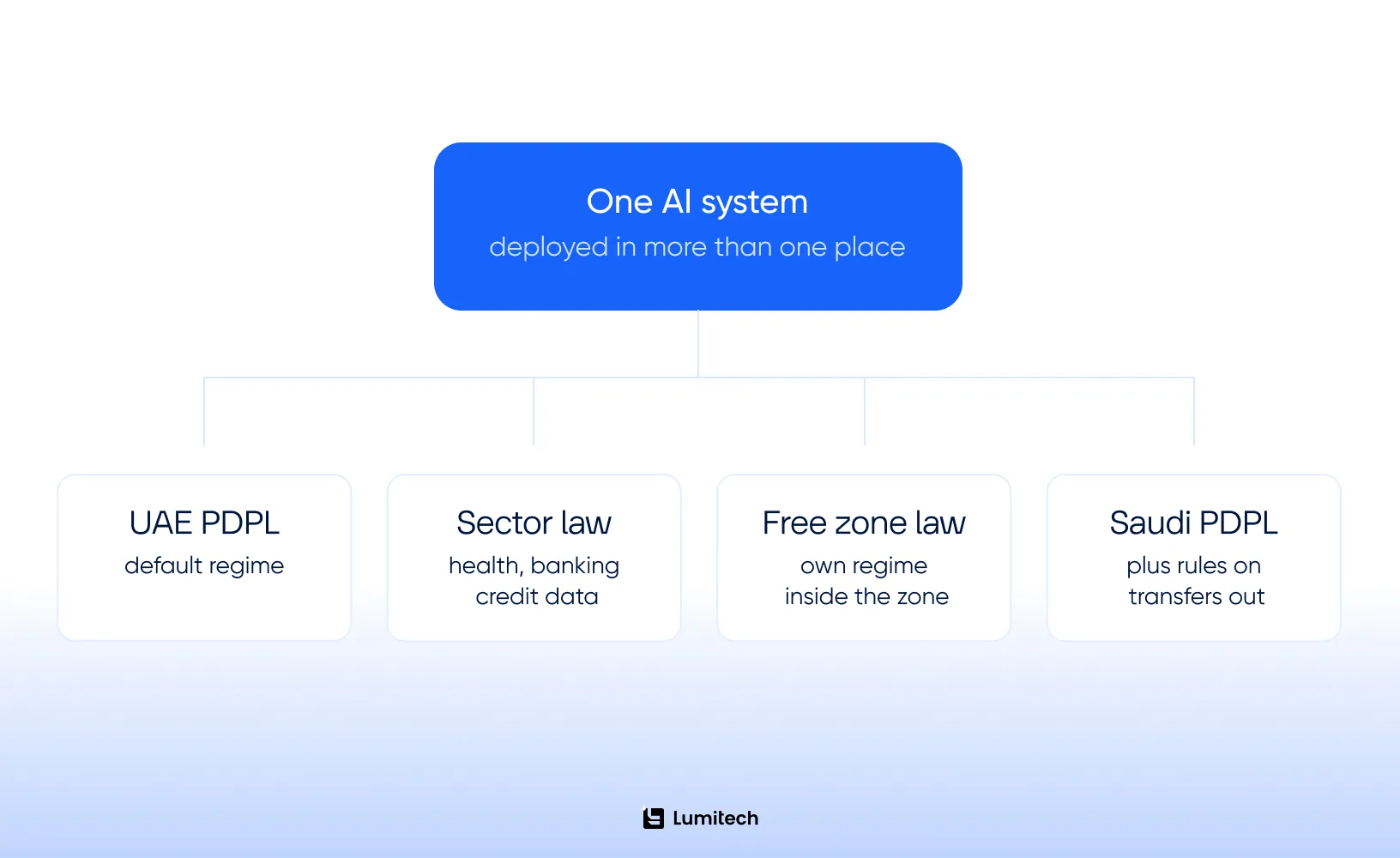
Before the architecture is approved, legal and security teams need to establish where data will be stored and processed. The same review covers support access and how subcontractors handle logs and backups. Local hosting alone does not answer those questions.
Language Tests and Model Licenses
Arabic language support needs testing on the documents and questions the system will handle. In its January 2026 evaluation, Abu Dhabi’s Technology Innovation Institute reported 71.7% for Falcon-H1-Arabic-7B on the Open Arabic LLM Leaderboard benchmarks. The same model scored in the mid-50s on AraDice, which covers dialect and cultural tasks. These tests measure different abilities; neither gives a production failure rate.
For bilingual workflows, the test set needs Arabic and English, mixed-language text, local terms, names, and scans where relevant. Reviewers must agree what counts as accurate and complete, and when uncertainty is acceptable.
Commercial-use and redistribution rights need a separate check for the exact model version and access channel. Permission to test may not cover live business use.
Different Uses Need Different Checks
The checks around an AI system should reflect the consequences of an error. An internal summary, a customer reply, and a change to a financial record need different levels of review and escalation.
For generative AI, the US National Institute of Standards and Technology (NIST) provides voluntary guidance through its Generative AI Profile. Local legal requirements still apply.
Early review of these issues helps procurement, legal, and engineering agree on what must be ready for launch. Any unresolved issue with data access, language performance, or approvals needs an owner and a decision on whether it blocks release.
Four Release Gates for an AI Implementation Plan
A release plan needs clear criteria for moving a pilot into live use. Teams should agree early on what would justify launch and what would hold it back. That gives everyone a basis for deciding whether an unresolved issue needs more testing, a change in scope, or a later release date.
The Existing Process Sets the Baseline
The current process provides the baseline for judging whether AI improves the work. That means measuring task volume, completion time, correction effort, and the intended business result. Defining eligible cases and exclusions keeps the comparison fair.
An AI readiness assessment for this task identifies the business owner, required data and integrations, evaluation criteria, risk reviewers, and an initial cost model. AI prototyping tests feasibility; the release plan covers what still needs to be established before live use.
Blockers such as unavailable data, unsigned access agreements, or too few reviewers need a plan to resolve them and an explanation of how they affect scope.
A Limited Workflow With Real Users
The PoC result shows what still needs testing with representative users. Within a limited workflow, the team records where they accept, correct, reject, or escalate outputs.
The pilot needs cases with incomplete inputs, conflicting information, and requests outside scope. Time spent checking answers counts toward the task, so the savings reflect the work employees still do.
Clear Release Criteria Before Testing Starts
An AI production readiness review should use criteria agreed before testing begins. Business and technical owners can then assess the results against the same requirements.
Release Question | What the PoC Showed | What Release Requires | Accountable Function |
|---|---|---|---|
Does it perform the agreed task? | It passed the test cases | Representative evaluation and documented limits | Business owner with domain reviewers |
Can it use the intended information? | The test sample worked | Approved sources, access controls, and update process | Data owner with security and legal teams |
Can people complete the task safely? | Users could try it | Outputs reach the system of record; training, review, escalation, and fallback | Operational owner |
Can the service be maintained? | The team could run a demo | Monitoring, support coverage, incident response, and rollback test | Engineering and operations |
Does the investment remain justified? | The benefit looked plausible | Observed usage, task outcomes, and updated cost model | Business sponsor with finance |
Expansion Starts With One Workflow
Deployment begins within the approved scope. The team tracks business outcomes alongside quality, cost, and exceptions. A route back to the established process remains available if the release cannot meet its agreed conditions.
The next step in scaling AI depends on what can be reused and what needs fresh approval. A system that works in one department may need different permissions, documents, evaluation cases, and support arrangements before another department can use it.
A plan for enterprise AI scaling carries the tested components forward and assigns funding and responsibility for that additional work.
12 Questions Before Scaling a PoC
Before the next funding decision, the team should be able to answer these questions with evidence from the pilot.
Is the business outcome measurable against a recorded baseline?
Is there a named business owner with authority over the workflow?
Is reliable data available, with permission to use it?
Has integration with the systems of record been tested?
Can the infrastructure handle the expected load and simultaneous users?
Are model and inference costs known at expected production usage?
Are access controls and security requirements defined and approved?
Have data residency and transfer requirements been confirmed for each jurisdiction?
Can the team monitor quality, cost, drift, and exceptions?
Can users return to the established process if needed?
Has the employee workflow been updated to include the system?
Will adoption be measured through completed tasks after launch?
Customer Stories
Explore What We've Built
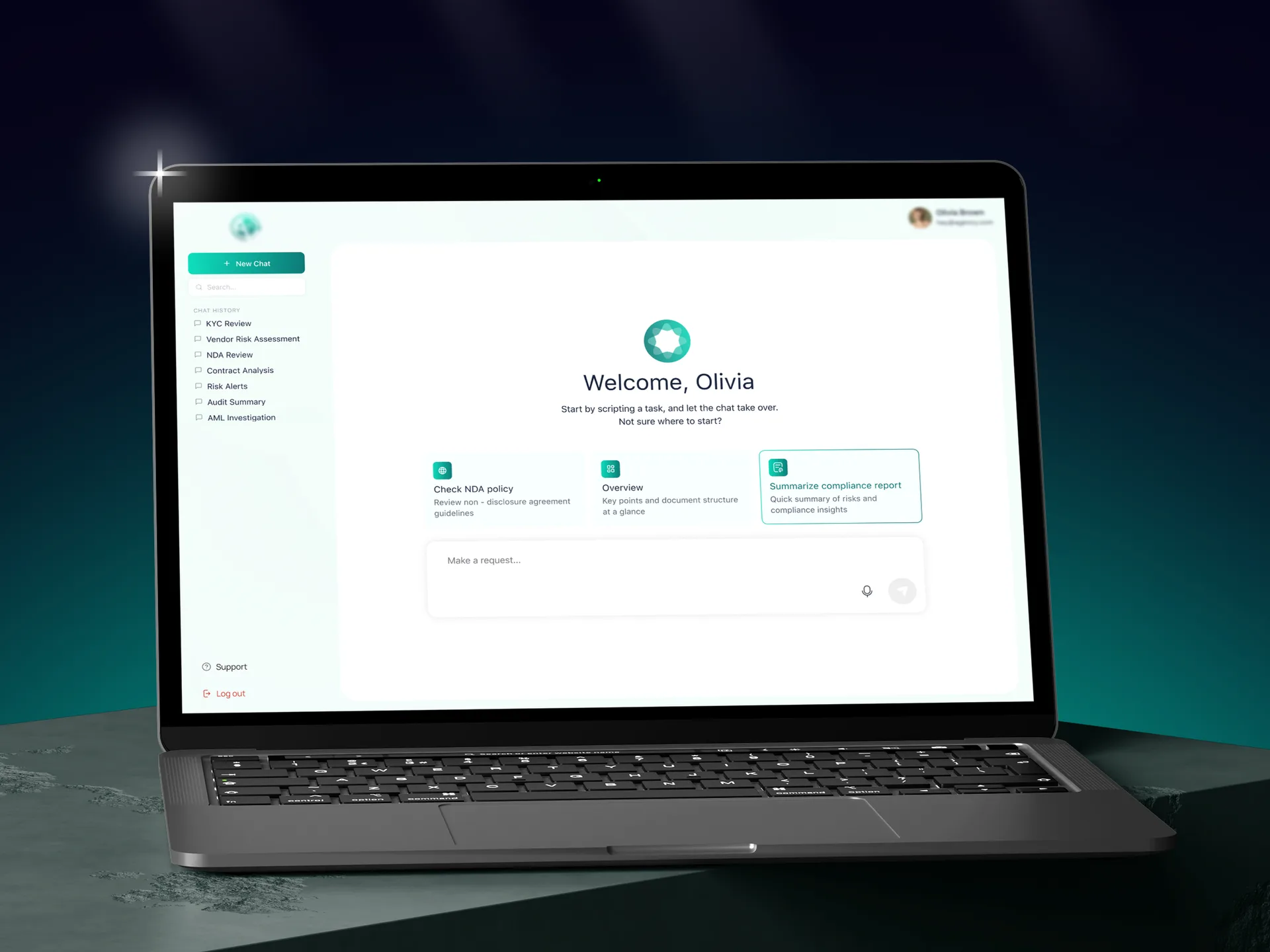
Legal AI Assistant for a Regional Fintech Institution
Discover how Lumitech designed an AI‑powered legal knowledge assistant that makes internal policies safe to use for a highly-regulated fintech organization.

Dubai
May '25 — Dec '25
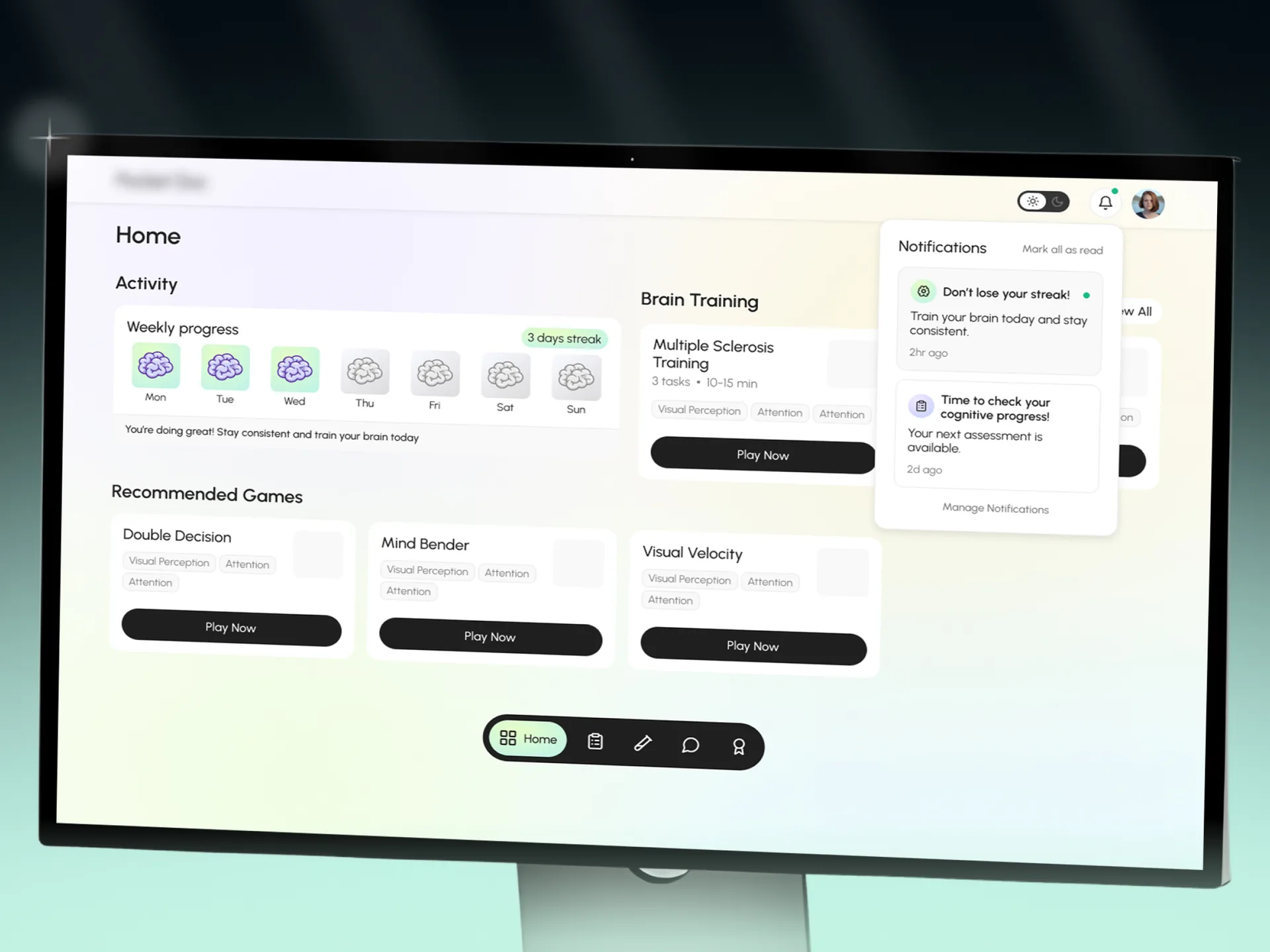
An AI‑Powered Cognitive Training and Brain Health Platform
Turning generic “brain games” into a personalized, data‑driven cognitive training experience – combining adaptive daily workouts, real health data insights, and a conversational AI assistant in one product.

Houston
Oct '25 — Mar '26
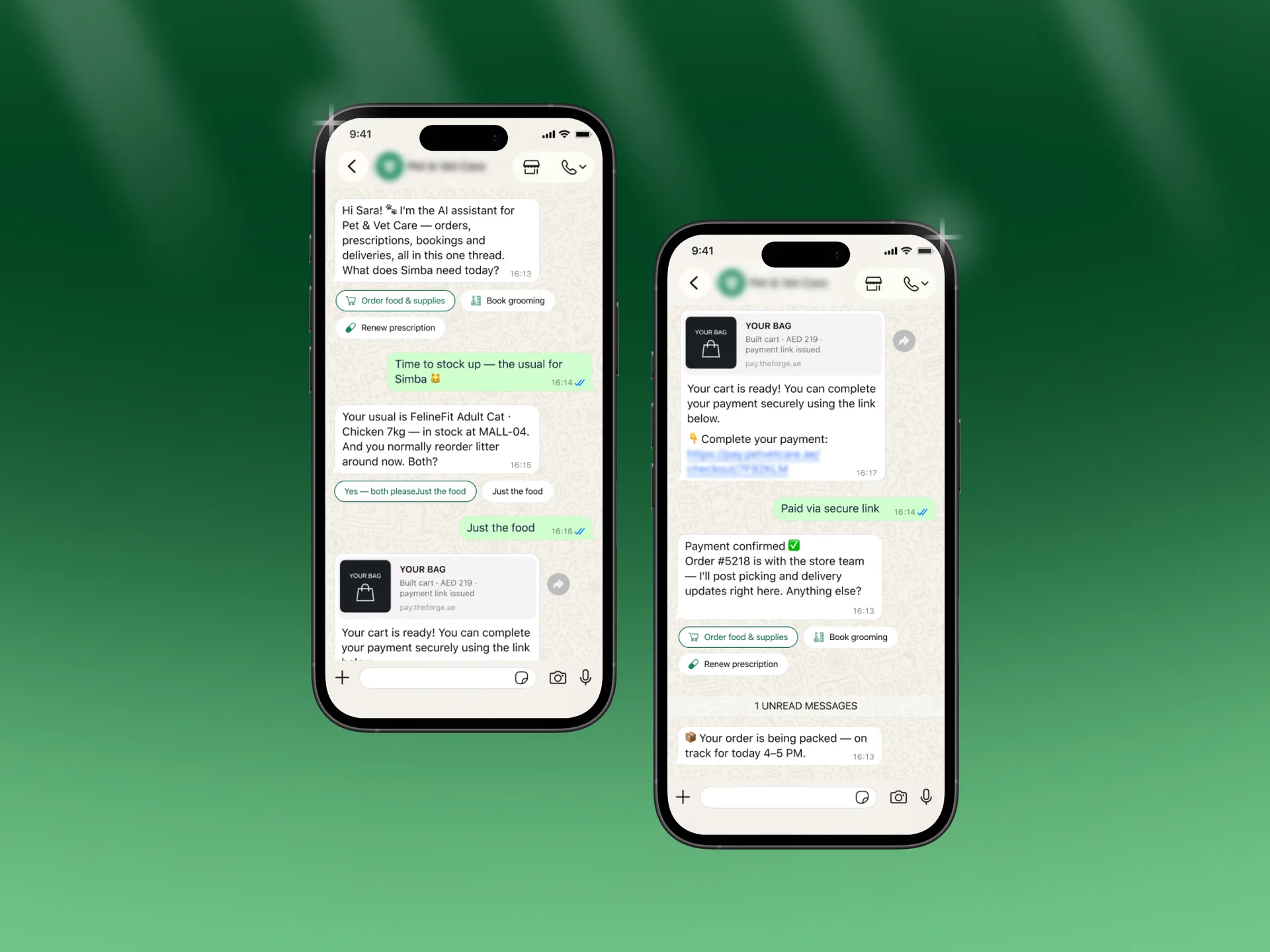
Enterprise WhatsApp Commerce for GCC Retail
Helping a leading GCC pet retail and veterinary network trade scattered digital touchpoints for a single AI-powered WhatsApp experience tied into the systems that already run the business.
Abu Dhabi
Dec '25 - May '26
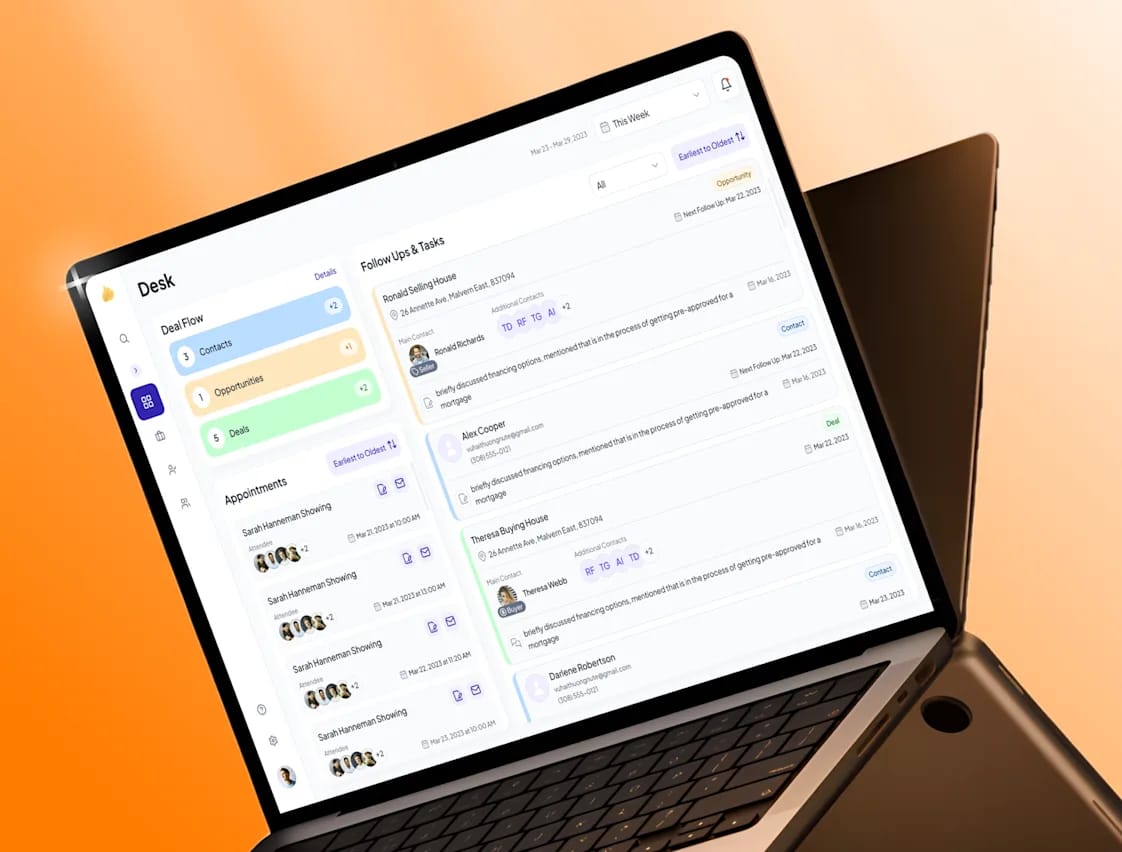
Transforming Real Estate with AI: CRM for Deal Management
With a focus on efficiency, transparency, and user-friendly design, the platform empowers real estate professionals to manage opportunities effortlessly while building stronger client relationships.
Nashville
Mar ’23 – May ’24
FinTech & Finance
Legal AI Assistant for a Regional Fintech Institution
Discover how Lumitech designed an AI‑powered legal knowledge assistant that makes internal policies safe to use for a highly-regulated fintech organization.
Client Location
Dubai
Duration
May '25 — Dec '25
Platform
Web
An AI‑Powered Cognitive Training and Brain Health Platform
Turning generic “brain games” into a personalized, data‑driven cognitive training experience – combining adaptive daily workouts, real health data insights, and a conversational AI assistant in one product.
Houston
Oct '25 — Mar '26
Enterprise WhatsApp Commerce for GCC Retail
Helping a leading GCC pet retail and veterinary network trade scattered digital touchpoints for a single AI-powered WhatsApp experience tied into the systems that already run the business.
Abu Dhabi
Dec '25 - May '26
Transforming Real Estate with AI: CRM for Deal Management
With a focus on efficiency, transparency, and user-friendly design, the platform empowers real estate professionals to manage opportunities effortlessly while building stronger client relationships.
Nashville
Mar ’23 – May ’24
How to Measure Value Without Overstating AI ROI
Time saved, extra capacity, avoided costs, and additional revenue are different outcomes, and an AI return on investment (ROI) estimate needs to distinguish between them before assigning financial value.
An illustrative workflow processes 6,000 eligible requests each month. If handling time falls from ten minutes to four, including review, the time released would be:
600 hours per month at full usage;
300 hours per month at 50% usage.
These are planning assumptions. They do not come from an industry benchmark or a Lumitech client result.
Those hours might help clear a backlog, speed up responses, avoid planned recruitment, or reduce overtime. Finance needs to agree before launch which outcome the business case will count. An avoided contractor expense can be checked against the budget; freed staff time needs evidence of how that capacity is used. Workload changes need to be recorded too, since a quieter month can make performance look better.
The full cost of AI implementation includes integration and setup, model usage, hosting, data preparation, evaluation, support, training, and continuing human review. Costs and benefits need to cover the same period. The calculation should also show what happens with lower usage or more exceptions.
Completed eligible tasks and sustained use give a clearer picture of AI adoption than login counts. After release, actual costs and outcomes guide the next investment decision.
What Enterprise AI Adoption Looks Like at Emirates NBD and Aramco
Emirates NBD’s published delivery lifecycle sets out four approval gates that determine whether an AI use case can move to the next stage:
Feasibility: The business case, available data, and initial risks have been reviewed.
Pilot: Evaluation results meet agreed thresholds, security and privacy reviews are complete, and the pilot has a plan.
Production: Performance meets expectations, remaining risks have been accepted, and support is in place.
Scale: Targets are being met, controls are working, and evaluation continues.
Teams also use shared controls from the bank’s Leap AI Platform, giving them a common basis for these decisions.
Aramco’s November 2025 update distinguishes identified opportunities from deployed systems: 442 identified AI use cases, more than 200 deployed solutions, and over 100 in development. These categories do not map one-to-one, so the figures cannot establish a conversion rate. They describe the scale of Aramco’s work, without setting a budget, timeline, or expected return for another business.
A plan for enterprise AI adoption should show what has been tested, what is ready for use, and who remains responsible after launch. Leaders can then base the next investment on evidence from their own business.
Not Every AI PoC Should Go to Production
A pilot can show that a project should stop or change direction. Stopping or redesigning makes sense when required data cannot be made available, full running costs exceed a credible benefit, or the risk of an error outweighs the gain. The same applies if simpler automation solves the problem, the workflow does not justify the change, or employees are unlikely to use the system despite its accuracy.
Keeping the evaluation cases and recording why the project stopped gives the next team evidence it can reuse. The pilot still has value if it prevents investment in a system the business would not use.
Your Next Release Can Be Built With Lumitech
A working demo gives your team something worth building on, even if the path to launch is still unclear. At Lumitech, we help work out that path with you, drawing on projects where the details became clearer through close work with the people who would use the system.
In our legal assistant project for a regional fintech institution, legal reviewers needed to see where answers came from and trust that access restrictions were respected. Our engineers built those requirements into a limited pilot. Feedback from the reviewers then helped refine the workflow before wider rollout was considered.
Your team brings the same essential knowledge: how the work gets done and what employees need from the software. Through our AI and ML development services, we work with you to turn that knowledge into a system your team can use, with the data connections, checks, and support the release needs.