
What Is Enterprise Fraud Management (EFM): Strategies and Emerging Trends
Fraud no longer hits one channel at a time — it moves between onboarding, payments, and support in the same day. Here’s what enterprise fraud management actually is, how the system works end-to-end, and which trends are reshaping fraud prevention.
- EFM
- Enterprise Fraud Management
July 27, 2026
 AI Overview
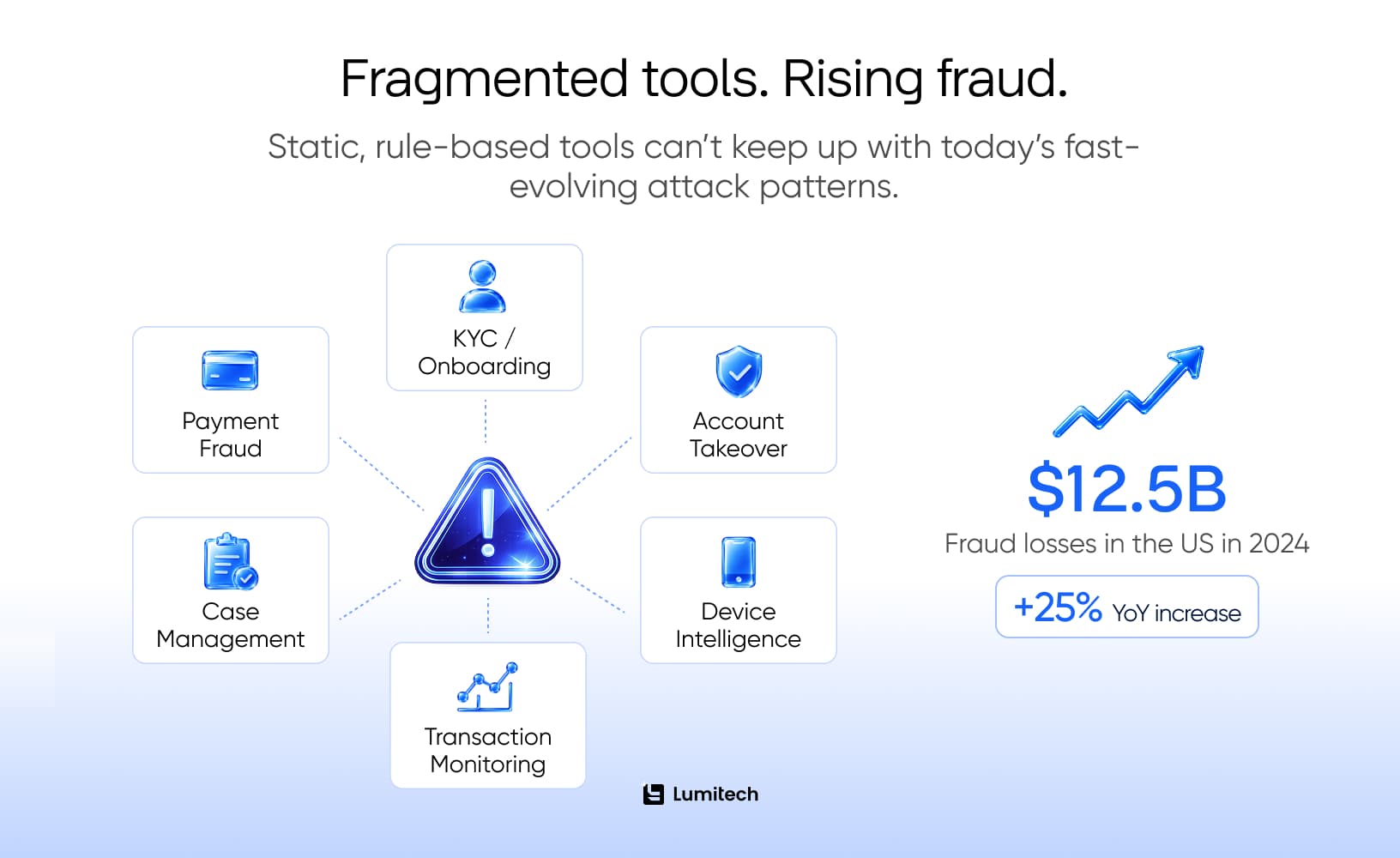
Enterprise fraud management (EFM) is a centralized system that detects and prevents fraud across onboarding, payments, and support through unified data, real-time risk scoring, machine learning models, and case management. Fragmented, single-channel tools leave gaps attackers exploit; US fraud losses reached $12.5 billion in 2024, up 25% year-over-year.

Fraud rarely announces itself through a single door anymore. A fraudster might probe an onboarding flow with a synthetic identity in the morning, test stolen card credentials at checkout by afternoon, and attempt an account takeover through a customer support call by evening — all against the same organization, often within the same 24 hours.
Meanwhile, the systems meant to catch these attempts often sit in separate silos: one team owns payment fraud, another owns KYC, a third owns account security, and none of them share a unified view of the same customer.
This fragmentation isn’t a minor inefficiency. Fraud losses in the US alone reached $12.5 billion in 2024, up 25% year-over-year, and static, rule-based tools are struggling to keep pace with how quickly attack patterns now evolve. That gap is exactly why enterprise fraud management exists — not as another point solution to add to the stack, but as a unified, enterprise-level approach to fraud that treats it as a core dimension of enterprise fraud risk management rather than a series of unrelated technical problems.
This matters well beyond banking: the same fragmentation problem shows up in fintech software development, insurance claims, e-commerce checkout flows, and telecom account provisioning alike.
Why “Unified” Is the Whole Point
Ask 10 fraud leaders what enterprise fraud management actually means, and most circle the same idea: everything under one roof. This means a single system that treats a customer’s onboarding, login, payments, and support interactions as pieces of the same risk profile.
That’s the enterprise fraud management definition worth relying on: a centralized system that connects data, rules, ML, risk scoring, real-time screening, authentication, and case management across every product line.
Enterprise fraud management explained at the level that actually matters: it’s not the individual capabilities that make EFM different — most organizations already have versions of each. It’s the wiring between them. A standalone tool watches one channel through its own isolated data; a card-fraud engine sees card transactions and nothing else. So what is EFM in fraud management terms, practically? It’s the operational layer that ties eight functions into one shared decision instead of eight separate ones:
Fraud detection
Enterprise fraud prevention
Continuous payment and account screening
Identity verification
Risk scoring
Authentication
Alert prioritization
Fraud investigation
Why Traditional Fraud Detection Tools Are Not Enough
Most fraud stacks don’t evolve as a unified system — they grow one tool at a time. A spike in payment fraud leads to a card fraud solution. New onboarding risks bring in a KYC automation platform. Rising chargebacks add a dispute management tool. Each new purchase addresses an immediate problem but creates a more fragmented fraud ecosystem.
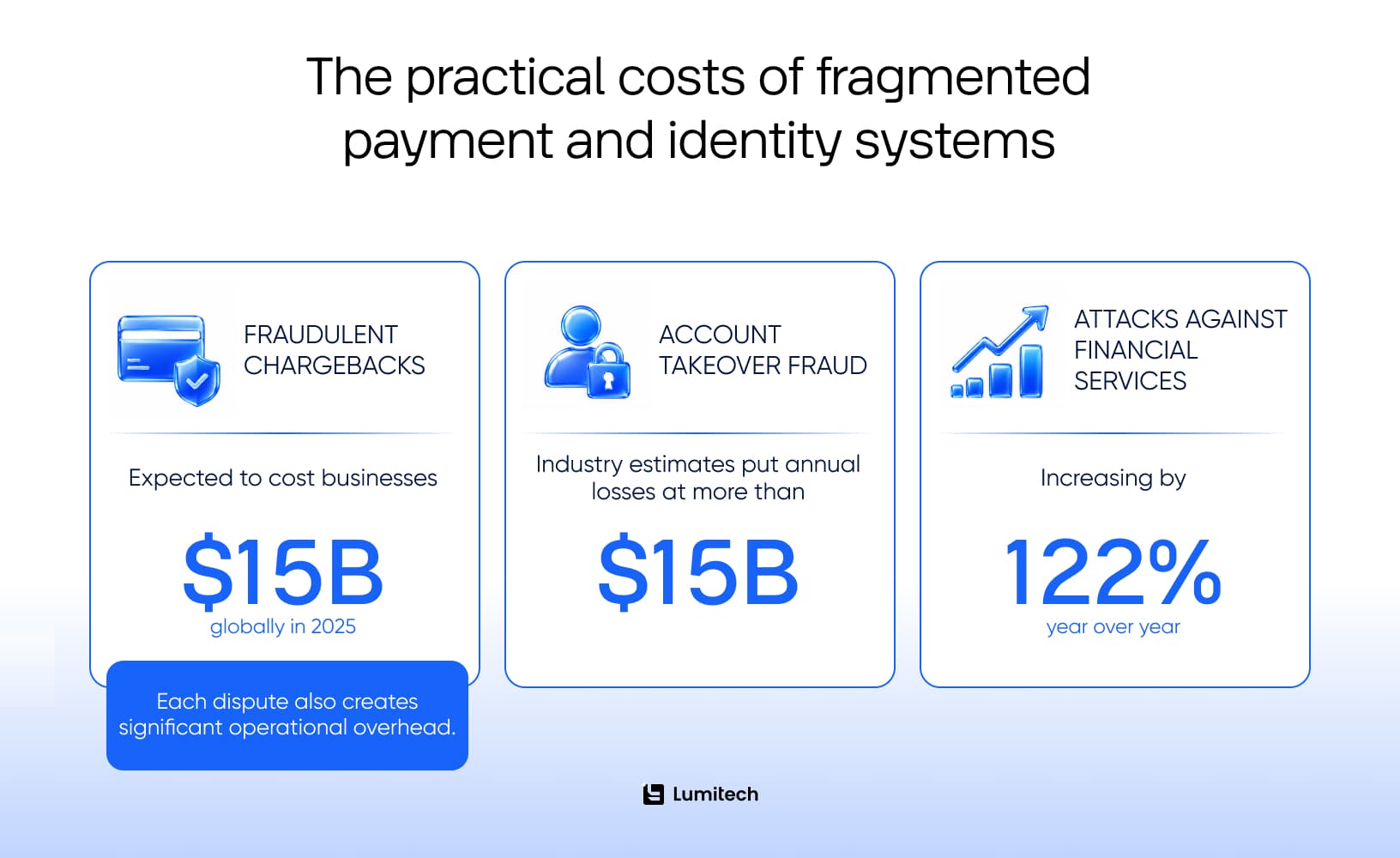
The practical costs of fragmented payment and identity systems are well documented. Fraudulent chargebacks are expected to cost businesses more and more, while each dispute also creates significant operational overhead. At the same time, account takeover fraud continues to rise, with industry estimates putting annual losses at more than $15 billion and attacks against financial services increasing by 122% year over year.
The recurring problems traditional, siloed tools share:
Data silos — each tool sees only its own slice of customer behavior.
Fragmented fraud systems — no shared logic or shared alerts between channels.
No unified customer risk view — the same customer can look “clean” in one system and “high-risk” in another.
High false-positive rates — isolated tools tend to over-flag because they lack context from other channels.
Heavy manual review — investigators re-verify information that other systems already collected.
Slow rule updates — static rule sets can’t adapt quickly enough to fast-evolving attack patterns.
Fraud spanning multiple channels — modern attack patterns, like account takeover that starts with a phishing email and ends in a wire transfer, deliberately cross the boundaries between separate tools.
Traditional Fraud Detection | Enterprise Fraud Management |
|---|---|
Single-channel focus (e.g., card payments only) | Cross-channel visibility (onboarding, login, payments, support) |
Isolated data per tool | Unified customer risk view across systems |
Static, manually updated rules | Rules plus continuously retrained ML models |
High false positive rates due to limited context | Lower false positives through enriched, shared signals |
Manual case handling per team | Centralized case management and orchestration |
Slow response to new attack patterns | Real-time decisioning with faster adaptation |
How Enterprise Fraud Management Works
From first data point to closed case, here is a step-by-step process explaining how enterprise fraud management works.
Data collection. Signals are pulled from every relevant source — transactions, device fingerprints, login behavior, KYC documents, and historical case outcomes.
Signal enrichment. Raw data is enhanced with context: geolocation, device reputation, behavioral biometrics, and third-party risk intelligence.
Risk scoring. Enriched signals feed into a scoring model that assigns a real-time risk value to each event, transaction, or customer.
Rules and ML models. Deterministic rules catch known patterns instantly; machine learning models catch subtler, evolving anomalies that rules alone would miss.
Real-time decisioning. The system approves, declines, or escalates each event within milliseconds — IBM’s z17 mainframe, for example, can process 5 million fraud inferences per second at this stage.
Alert prioritization. Flagged events are ranked by severity and likelihood of being genuine fraud, so investigators work the highest-risk cases first.
Case management and fraud orchestration. Analysts investigate prioritized alerts with full context — customer history, related accounts, and linked cases — instead of starting from scratch each time.
Feedback loop. Investigation outcomes feed back into the models and rules, continuously improving detection accuracy over time.
Put simply, EFM works by collecting and enriching data from every channel, scoring risk in real time using both rules and machine learning, prioritizing alerts by severity, and routing confirmed patterns back into the models through a continuous feedback loop. This cycle is what allows EFM to adapt to new attack patterns faster than static, single-purpose tools.
Core Components of an Enterprise Fraud Management System
An enterprise fraud management platform is built from several interlocking components, where each addresses a different part of the fraud lifecycle.
Component | Purpose | Business Value |
|---|---|---|
Transaction monitoring | Continuously screens payments and account activity for suspicious patterns | Catches fraud in progress, not just after the fact |
Real-time risk scoring | Assigns a quantifiable risk value to every event or customer | Enables consistent, explainable decisioning at scale |
Fraud rules | Encodes known fraud patterns as deterministic logic | Fast, low-latency detection of established typologies |
Machine learning models | Learns evolving fraud patterns from historical data | Detects novel and subtle fraud rules alone would miss |
Anomaly detection | Flags behavior that deviates from an established baseline | Surfaces fraud pattern detection for previously unseen attack types |
Digital identity verification | Confirms a person is who they claim to be during onboarding or high-risk actions | Reduces synthetic identity and application fraud |
Adaptive authentication | Adjusts authentication strength based on calculated risk | Balances security with a smooth customer experience |
Step-up verification | Requests additional proof only when risk crosses a threshold | Minimizes friction for legitimate, low-risk users |
Fraud alert prioritization | Ranks alerts by severity and confidence | Focuses investigator time on the highest-impact cases |
Case management | Centralizes investigation data, notes, and outcomes | Speeds up resolution and supports audit readiness |
Fraud orchestration | Coordinates rules, models, and vendors into one decision flow | Removes manual handoffs between disconnected tools |
Reporting and audit trails | Documents every decision for regulators and internal review | Supports regulatory readiness and post-incident analysis |
Taken together, the core components of an enterprise fraud management system are payment and account screening, real-time risk scoring, machine-learning rules and models, behavioral patterns for anomaly detection, digital identity verification, authentication controls, fraud alert prioritization, case management, and coordinated, cross-tool decisioning. Together, these components turn raw data into a real-time, auditable fraud decision rather than a series of disconnected checks.
Fraud Typologies EFM Should Cover
A modern EFM deployment needs to account for a wide — and constantly shifting — range of attack patterns, not just payment fraud:
Account takeover (ATO) — attackers gain control of an existing customer account, often through credential stuffing or phishing.
Synthetic identity fraud — fraudsters combine real and fabricated data to create an identity that doesn’t belong to any real person.
Application fraud — false information is submitted during onboarding or a credit application.
Payment fraud — unauthorized or manipulated transactions across cards, transfers, or digital wallets.
Card fraud — stolen or cloned card data used for unauthorized purchases.
First-party misuse — when a legitimate customer later disputes a valid transaction — continues to grow as a major source of payment risk. According to the Merchant Risk Council’s 2026 Global eCommerce Payments and Fraud Report, 62% of merchants reported an increase in first-party misuse disputes.
Mule accounts — accounts used to launder proceeds from other fraud or scams.
Phishing and social engineering — manipulating a person, rather than a system, into handing over credentials or funds.
Authorized push payment (APP) fraud — victims are tricked into authorizing a payment themselves, which is now driving new regulatory reimbursement mandates in markets like the UK.
Business email compromise (BEC) — impersonating an executive or vendor to trigger a fraudulent wire transfer.
Deepfake fraud — AI-generated audio or video used to impersonate a real person in real time.
KYC fraud — falsified or stolen documents used to pass identity checks during onboarding.
Effective KYC fraud prevention at the onboarding stage is particularly important, since a large share of the fraud typologies above — synthetic identity, application fraud, and mule accounts among them — take root at account opening rather than later in the customer lifecycle.
The deepfake category deserves particular attention given how fast it has moved from theoretical to operational. In early 2024, a finance employee at the Hong Kong office of UK engineering firm Arup was tricked into transferring HK$200 million — about US$25.6 million — across 15 transactions after joining a video conference in which fraudsters used deepfakes to impersonate the company’s CFO and other colleagues. The scam was discovered only after the employee contacted the company’s headquarters.
Gartner’s 2025 survey of cyber leaders found that 62% of organizations had already faced a deepfake attack in the prior 12 months, and the firm projects that by 2026, 30% of enterprises will consider identity step-up verification unreliable in isolation because of deepfakes.
If your top five reports lack named owners and replayable lineage, that is where we start. Tell us which reports matter, and we will map the gaps.

Enterprise Fraud Management (EFM) Strategies
A handful of fraud management strategies consistently separate organizations that stay ahead of fraud from those that are perpetually catching up:
Build a unified fraud data layer. Bring transaction, identity, device, and behavioral data into one accessible layer rather than leaving it scattered across departmental tools.
Apply risk-based authentication. Match authentication strength to calculated risk instead of applying the same friction to every customer authentication event — this keeps genuine customers moving quickly while slowing down suspicious ones.
Combine deterministic logic with adaptive models. Fixed rules catch known typologies instantly; machine learning models catch the subtler, evolving fraud pattern detection rules alone would miss.
Monitor transactions in real time. Batch or overnight reviews are too slow for fraud that plays out in seconds.
Prioritize alerts by severity. Route the highest-confidence, highest-impact alerts to investigators first, rather than working a flat, unranked queue.
Automate investigation workflows. Reduce manual data-gathering so investigators spend their time analyzing, not searching.
Create tight feedback loops. Every confirmed fraud or false positive should retrain the models that produced the original decision.
Actively reduce false positives. Overly aggressive controls block legitimate customers, and the resulting lost revenue and trust often exceed the direct cost of the fraud itself.
Align with compliance and audit requirements. Detection logic, decisions, and data handling need to meet PSD2, GDPR, and relevant card scheme rules before launch, not after.
The organizations that get ahead of fraud aren’t the ones with the most detection tools — they’re the ones that stopped treating fraud as a collection of separate problems and started treating it as one connected system. Every additional silo you tolerate is a seam a fraud ring will eventually find and exploit.


In short, effective enterprise fraud prevention strategies center on unifying data across channels, combining rules with ML, monitoring transactions in real time, and building tight feedback loops between investigation outcomes and detection models. Reducing false positives and staying aligned with regulatory requirements throughout — rather than bolting it on later — are what make these strategies sustainable at scale with our enterprise software development services.
Emerging Trends in Enterprise Fraud Management
AI-enabled enterprise fraud management system
Criminals now use generative AI to build synthetic identities, automate card testing, and run social engineering campaigns — all designed to slip past detection built for older, manual tactics.
Deloitte’s Center for Financial Services projects that generative AI could enable fraud losses in the United States to reach $40 billion annually by 2027, up from an estimated $12.3 billion in 2023.
Generative AI scams
A controlled study found AI-generated spear-phishing emails performed exactly as well as ones written by human experts — a 54% click-through rate for both, compared to 12% for generic phishing. The difference: AI produced that result in a fraction of the time, at a fraction of the cost.
Enterprise fraud management solution fighting deepfakes
Sumsub recorded a fourfold increase in detected deepfakes worldwide between 2023 and 2024. At the same time, McAfee researchers found that some voice-cloning tools could reproduce a voice with an 85% match from just three seconds of audio.
Customer Stories
Explore What We've Built

A Race-Day Operating System for Safety and Compliance
On race day, safety depends on more than sending alerts. Organizers need proof of who received each message, who acknowledged it, and what record remains. Lumitech built a platform around that responsibility, helping protect trust, compliance, and control.

Amsterdam
Oct '25 - Mar '26

An AI‑Powered Cognitive Training and Brain Health Platform
Turning generic “brain games” into a personalized, data‑driven cognitive training experience – combining adaptive daily workouts, real health data insights, and a conversational AI assistant in one product.

Houston
Oct '25 — Mar '26
Turning a Karting Method Into a Sport You Can Measure
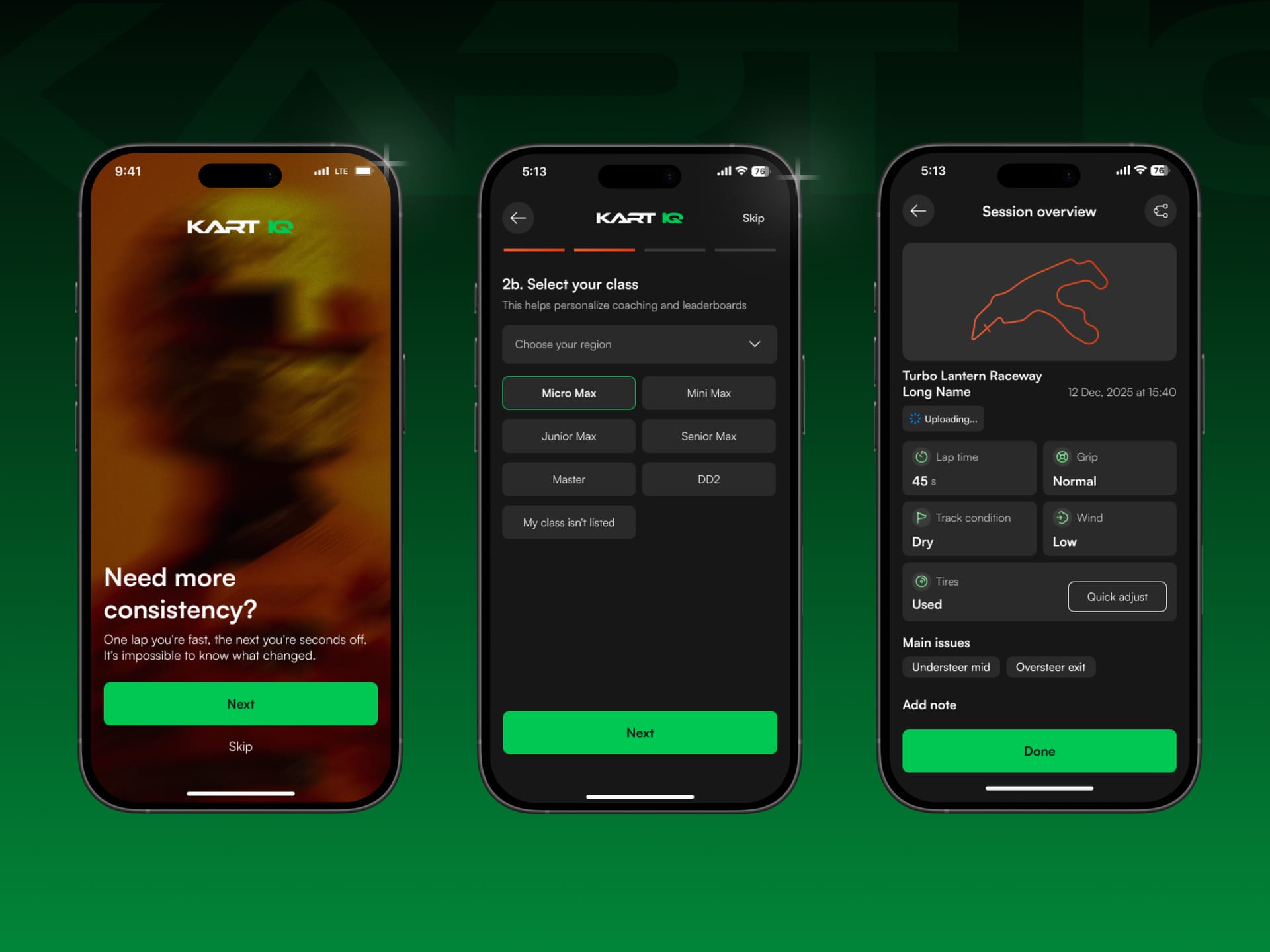
Speed is a system, not a gift. That’s the whole idea behind KART IQ. The book lays out the system; the app makes it real on the track, with live timing, telemetry a teenager can read, and a setup log that shows what actually worked.
Amsterdam
Oct '25 — Feb '26

Reviving Roots: How We Built an AI-Powered African Language Learning Platform
Lumitech built an AI-powered language learning platform with speech feedback, adaptive lessons, gamification, and analytics for users in the African diaspora.
New Jersey
Aug '25 — Now
EdTech & Training
A Race-Day Operating System for Safety and Compliance
On race day, safety depends on more than sending alerts. Organizers need proof of who received each message, who acknowledged it, and what record remains. Lumitech built a platform around that responsibility, helping protect trust, compliance, and control.
Client Location
Amsterdam
Duration
Oct '25 - Mar '26
Platform
Web + PWA
An AI‑Powered Cognitive Training and Brain Health Platform
Turning generic “brain games” into a personalized, data‑driven cognitive training experience – combining adaptive daily workouts, real health data insights, and a conversational AI assistant in one product.
Houston
Oct '25 — Mar '26
Turning a Karting Method Into a Sport You Can Measure
Speed is a system, not a gift. That’s the whole idea behind KART IQ. The book lays out the system; the app makes it real on the track, with live timing, telemetry a teenager can read, and a setup log that shows what actually worked.
Amsterdam
Oct '25 — Feb '26
Reviving Roots: How We Built an AI-Powered African Language Learning Platform
Lumitech built an AI-powered language learning platform with speech feedback, adaptive lessons, gamification, and analytics for users in the African diaspora.
New Jersey
Aug '25 — Now
Synthetic identity fraud
Synthetic identity fraud has become one of the most common fraud types financial institutions are tracking. According to Alloy’s 2026 State of Fraud Report, 44% of respondents ranked it as the top fraud category by case volume in their organization.
AI has made synthetic identities cheap and fast to generate — which means identity checks alone no longer prove much. Fraud teams now need behavior, device signals, and consistency across the full customer lifecycle to fill the gap.
Real-time decisioning
As instant payments become the norm, fraud teams have less time to react. Risk decisions now need to happen before a transaction is completed—not hours later during a batch review.
IBM’s z17, powered by the Telum II processor, demonstrates the scale now possible: in IBM testing, the system processed up to five million AI inference operations per second with sub-millisecond response times using a credit card fraud detection model.
EFM system for behavioral analytics
Consortium-based fraud intelligence allows financial institutions to detect patterns that no single bank can see alone. A leading example is BioCatch Trust™ Australia, launched in late 2024 with five of the country’s largest banks.
With real-time intelligence shared across participating institutions, fraud teams can detect mule accounts, linked fraudulent activity, and social engineering scams much earlier than would be possible in isolation.
AI agents for fraud operations
Increasingly, AI systems — including conversational assistants built through AI chatbot development — are handling the first stage of fraud investigations by triaging alerts, summarizing cases, and helping investigators navigate evidence before manual review begins. Solutions such as NICE Actimize’s FraudDESK CoPilot already apply this approach in enterprise fraud operations.
Growing focus on explainability
Modern enterprise fraud management systems are expected to provide more than a risk score. Investigators need to see which behavioral signals, device attributes, transaction patterns, or model features contributed to the decision. This shortens investigation time, improves consistency, and helps organizations meet growing regulatory expectations for transparent, auditable AI. The EU AI Act formalizes many of these requirements for high-risk systems.
How to Choose or Build an Enterprise Fraud Management Solution
Whether evaluating an IT development partner for enterprises or scoping a custom build, the same criteria apply to any serious enterprise fraud management solutions on the market.
Criterion | What to look for |
|---|---|
Real-time processing | Millisecond-level decisioning, not batch review |
Scalability | Ability to handle transaction volume growth without added latency |
Rules and ML support | Both deterministic logic and continuously retrained models |
Risk scoring capabilities | Transparent, tunable scoring across channels |
Explainable decisions | Clear reasoning behind each flag, for both investigators and regulators |
API integrations | Clean connections to core banking, payment rails, and identity providers |
Alert and case management | Structured workflows that reduce manual handoffs |
Identity and transaction data support | Unified handling of both KYC and payment data |
Compliance alignment | Built-in support for relevant regulatory frameworks |
Model monitoring | Ongoing tracking of model drift and performance decay |
False positive management | Tools to measure and actively reduce false decline rates |
Many organizations underestimate how much of this depends on the state of their existing technology stack. Institutions still running on decades-old core systems often find that legacy systems modernization services need to happen in parallel with any serious EFM rollout, since real-time decisioning is difficult to bolt onto batch-oriented infrastructure.
The same applies in the public sector: software development for government sector programs increasingly needs to account for fraud in benefits disbursement and procurement, not just banking.
Boiled down, choosing or building an enterprise fraud management platform comes down to 11 practical criteria displayed above. Missing more than two or three of these, such as understanding open banking APIs or compliance alignment rules, is a strong signal the system won’t hold up at enterprise scale.
Enterprise Fraud Management Implementation Roadmap
A practical sequence for organizations building out or upgrading their fraud capability:
Identify the primary fraud risks most relevant to your business — payment fraud, account takeover, application fraud, or a specific combination.
Audit current systems to understand exactly which tools, data sources, and teams already exist, and where the gaps sit.
Consolidate data sources into a shared layer accessible across fraud, risk, and compliance functions — modern data analytics services capabilities often accelerate this step considerably.
Develop a risk scoring engine calibrated to your specific customer base and transaction patterns.
Configure rules and models — deterministic logic for known patterns, machine learning for evolving ones.
Integrate authentication and identity verification, including risk-based and step-up flows where appropriate.
Build an alert prioritization workflow so investigators always work the highest-risk cases first.
Set up case management with full context available at the point of investigation.
Test and tune the false positive rate before scaling to full production volume.
Establish a continuous improvement process that feeds investigation outcomes back into the models and rules.
Ready to turn this roadmap into a working system?
A structured EFM system implementation roadmap conversation is a reasonable next step — as is a broader discovery call if you’re still scoping the full picture.

Conclusion
Fraud today doesn’t respect the boundaries between departments, tools, or channels — and organizations that keep defending against it with disconnected point solutions will keep losing ground to attackers who deliberately exploit the seams between them.
Enterprise fraud management represents a shift from isolated, reactive fraud checks to a unified, real-time, data-driven approach that sees a customer’s full risk profile across every touchpoint. It won’t eliminate fraud entirely — no system can promise that — but it meaningfully closes the gaps that fragmented tooling leaves wide open, while also reducing the false positives that quietly cost most organizations more than fraud itself.
Getting there generally requires more than off-the-shelf software. It typically calls for real capability to integrate data sources, build risk scoring logic tailored to your actual customer base, and maintain the system as attack patterns keep shifting — which is exactly why many organizations bring in an experienced partner rather than trying to stitch everything together internally.
Strong data governance in banking practices and a clear read on evolving payment trends both matter here, too, since EFM is only as good as the data discipline and market context that feed it.


