Top Cybersecurity Companies in Dubai: 10 Providers for 2026
Ten cybersecurity companies in Dubai compared by vendor type, core services, regulatory fit and buyer use case — from MSSPs and VAPT specialists to sovereign-cloud and engineering partners. Vendor data checked September 2026.
- Cybersecurity Software
- Vendors in Dubai
September 29, 2026
 AI Overview
Cybersecurity companies in Dubai fall into five delivery models: managed security providers running SOC and MDR, sovereign-cloud providers holding data and workloads in-country, offensive-security specialists doing VAPT and red teaming, distributors supplying the technology stack, and engineering partners building security into the product architecture. The right shortlist depends on whether the dominant risk is continuous monitoring, data residency, offensive testing, regulatory evidence, or system design. Compare vendor type, UAE delivery evidence, regulatory experience, and incident-response depth before signing.

Top Cybersecurity Companies in Dubai at a Glance
Most security shortlists in Dubai open with the question “who is the best?”. It is the wrong place to start, and the good news is that the right question is much easier to answer: what am I actually buying? A bank modernizing its core, a fintech opening up payment APIs, and a government contractor inside DESC’s scope each need a different kind of provider. Sort that out first, and the shortlist more or less writes itself — which is how the one below is organized.
For context on why the market has grown so quickly: the UAE Cyber Security Council reported roughly 600,000 cyberattacks a day against the country in August 2026, against a pre-escalation baseline nearer 200,000. Worth knowing, though, it says more about the volume of noise being filtered out than about any one company’s odds on a given Tuesday.
Key Takeaways
Five delivery models cover the market: MSSP/SOC, sovereign cloud and data residency, offensive security (VAPT), value-added distribution, and security engineering. Each solves a different problem.
DESC Information Security Regulation applies to Dubai Government entities and parties handling government information. It does not automatically bind every private company in Dubai.
DIFC and ADGM run their own data-protection regimes, separate from the federal PDPL.
Distributors supply technology to the channel. Buying from one is a different transaction from buying a managed service or an engineering engagement, and two of the ten names here sit in that group.
Ask for UAE delivery evidence, named certifications, and incident-response playbooks before the commercial conversation starts.
What Cybersecurity Companies in Dubai Actually Do
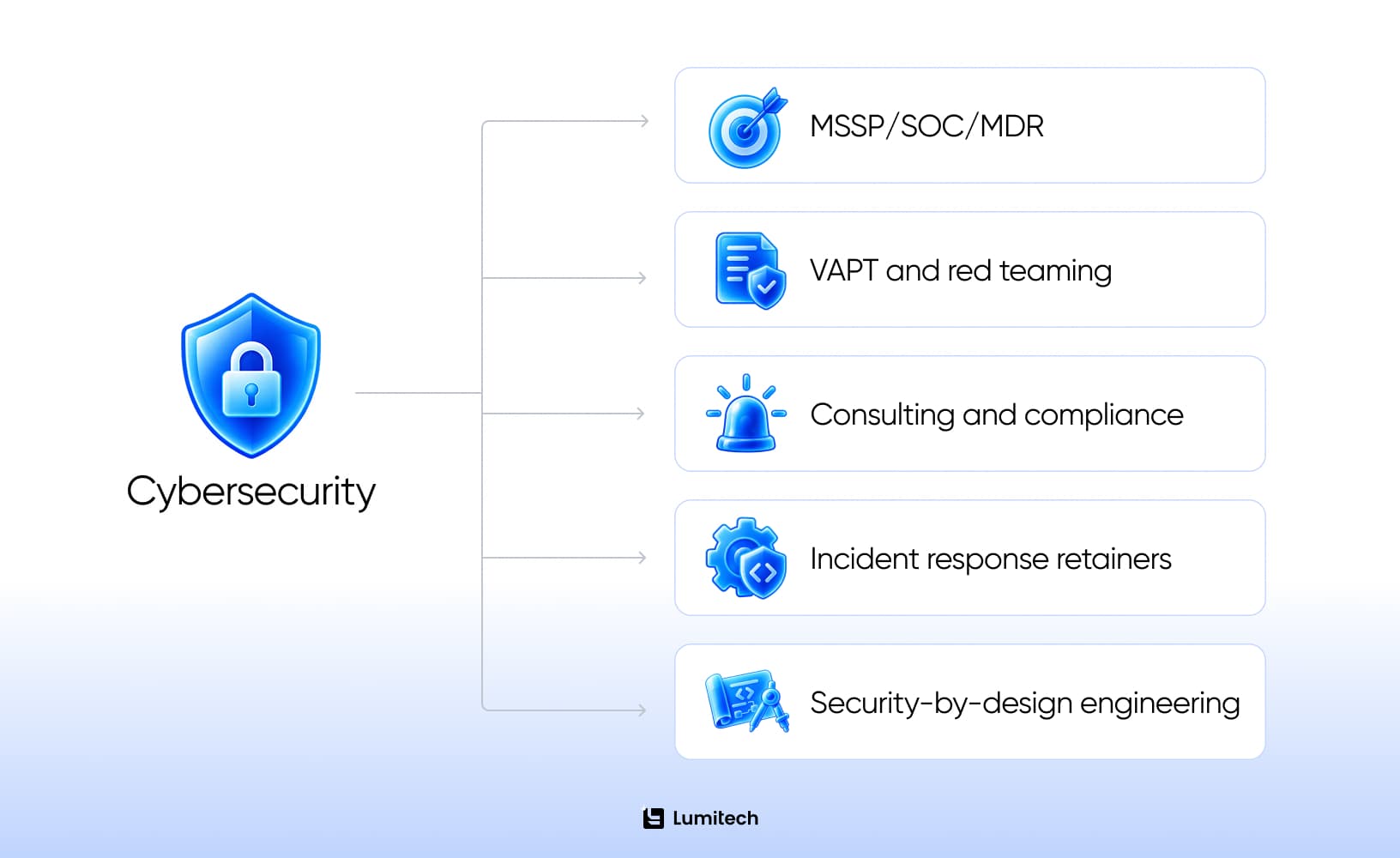
The phrase covers six fairly different service lines, and mixing them up is where most procurement headaches begin. A quick tour of each.
Managed Security: MSSP, SOC and MDR
Managed security service providers run continuous monitoring on your behalf — SIEM tuning, alert triage, threat hunting, and managed detection and response across endpoint, network, and cloud. Buyers looking for SOC services in Dubai are usually buying coverage hours, detection engineering, and an escalation path, billed as a monthly retainer.
This sits next to, and overlaps with, general IT operations. If the estate itself needs day-to-day administration, IT managed service providers in Dubai handle that layer; an MSSP owns detection and response specifically. Clarify which contract covers patching, because that gap causes real incidents.
Offensive Security: VAPT and Penetration Testing
Vulnerability assessment and penetration testing put a qualified team against your systems under agreed rules of engagement. Firms selling penetration testing Dubai engagements should distinguish clearly between automated scanning and manual exploitation. VAPT services UAE buyers in regulated sectors typically need CREST-accredited delivery and a report that maps findings to the framework their auditor uses.
The label on the quote matters less than the scope underneath it. Application penetration testing Dubai engagements target business logic, authentication flows, and API authorization, which a network-layer test will never reach. Red teaming goes further again, testing detection and response across the whole environment, with the vulnerability list as a by-product.
Sovereign Hosting and Data Residency
A distinct group of UAE providers sells security as a property of where the workload runs: in-country data centers, DESC-certified cloud platforms, and hosting arrangements that keep regulated data inside national borders. For banks under Central Bank supervision, government entities, and any organization with a contractual data-residency clause, this becomes the first constraint on architecture, ahead of tool selection.
Security Consulting and Compliance Advisory
Gap assessments against ISO 27001, SOC 2, UAE Information Assurance Standards or DESC ISR; control mapping; policy design; audit preparation; maturity roadmaps. Output is evidence and a plan, delivered as a project.
Incident Response
Retainer-based readiness — playbooks, tabletop exercises, forensics capability and a guaranteed response SLA. Buying IR after a breach costs materially more and starts slower.
Security-by-Design Engineering
Security built into the architecture during a build or modernization: identity and access models, tenancy boundaries, data-flow controls, secrets management, logging that produces usable audit trails. This is a software engineering engagement with a security mandate, and it covers ground that monitoring cannot reach. Where the project is tied to network and platform modernization, IT infrastructure companies in Dubai handle the underlying estate while the engineering partner owns application and data-layer controls.
Lumitech delivers this layer through its AI cybersecurity solutions practice, for teams building or modernizing regulated platforms.
Which UAE and Dubai Cybersecurity Rules Apply?
Applicability depends on the entity, sector, and the jurisdiction where the company is licensed. Four layers matter for most buyers.
Layer | Who it covers | Where to verify |
|---|---|---|
Federal / national | UAE Information Assurance Standards, maintained by the UAE Cyber Security Council. The standards sit inside the National Information Assurance Framework and apply to government entities and critical information infrastructure operators. Oversight moved from NESA to the Council, which now operates as the UAE Signals Intelligence Agency. | |
Dubai government | Dubai Electronic Security Center Information Security Regulation (ISR), now in its version 3 series. It applies to Dubai Government entities and to consultants, contractors and third parties handling their information. Dubai Law No. 15 of 2024 also lets DESC classify a non-government entity as critical, which brings it into scope. | |
DIFC | DIFC Data Protection Law No. 5 of 2020, amended in July 2025, supervised by the Commissioner of Data Protection. A separate regime from the federal PDPL, applying to entities incorporated in the DIFC and to processing carried out there under stable arrangements. | |
ADGM | ADGM Data Protection Regulations 2021, administered by the Office of Data Protection. Again, separate from the federal regime, with its own registration and annual fee obligations. | |
Financial sector | Institutions licensed by the Central Bank of the UAE carry additional cyber-risk and operational-resilience obligations set out in the CBUAE Rulebook. | CBUAE Rulebook |
Two things follow from that table. A vendor promising blanket “DESC compliance” to a private commercial entity may be describing a regime that never applied to you. And a DIFC-licensed firm answers to a different privacy regulator than a mainland one, so the audit evidence each needs looks different. Ask any prospective provider which regime governs your license. A confident, specific answer is a good sign; a vague one is useful information too.
Unsure which of these actually applies to you?
A short call maps your license, sector, and data flows to the regimes that genuinely bind you — so the vendor conversation starts from a real scope.

How to Choose the Right Vendor Type
Match the dominant risk to the delivery model, and four lenses do most of the work when you compare cybersecurity companies in Dubai.
Domain fit. A provider serving retail branch networks will not naturally read the threat surface of a payments platform with open APIs, or a legaltech system holding client matters. Transaction manipulation, data-residency breaches and privileged-access misuse are specific failure modes. A provider who cannot describe your sector’s attack paths concretely will fall back on generic advice, and you will hear it in the first meeting.
Scope versus depth. Long service lists are cheap to publish, so they tell you very little. A serious VAPT partner explains team composition, methodology, and accreditation; an MSSP shows detection engineering and incident-response playbooks, not only a dashboard. Ask who performs the work and where they sit.
Data residency. Where logs, backups, and production data physically sit is a contractual question before it is a technical one. Buyers under Central Bank supervision or a Dubai government contract should settle residency first, because it narrows the vendor list faster than any other criterion.
Regulatory alignment. The provider should name the applicable regime, describe the evidence an auditor will request, and show comparable engagements. Fintech and legaltech buyers need this most: access control and data segregation underpin both fintech software development and development services for legaltech companies, and both are audited.
Delivery-model choice also determines who carries the work. Some teams retain operations in-house and bring in specialists for testing and architecture; others move whole functions out, which overlaps with the decisions covered in IT outsourcing companies in Dubai. The costly mismatch runs both ways: a managed SOC when the exposure sits in application design, or an architecture review when what the team needs is someone watching alerts at 3 am.
Lumitech’s own UAE delivery footprint is covered on the software development services in the UAE page.
Top Cybersecurity Companies in Dubai and the UAE
Methodology. This is an unranked shortlist of cybersecurity companies in Dubai and the wider UAE, grouped by delivery model. We included companies based on four criteria: an operating presence serving UAE clients, a clearly identifiable primary delivery model, publicly verifiable service or certification evidence, and relevance to technical and regulated buyers. Positions carry no ranking meaning. Where a claim comes from a vendor’s own reporting, it is labeled as such.
Disclosure. Lumitech publishes this comparison and is included. The same criteria and the same card format apply to every entry, and Lumitech holds no ranked position.
Company | Vendor type | Best for | Core services | UAE presence | Regulatory / certification evidence |
|---|---|---|---|---|---|
Help AG | MSSP / MDR | 24/7 monitoring at enterprise scale | SOC, MDR, DDoS protection, security consulting | SOCs in Dubai and Riyadh; cybersecurity arm of e& | Publishes annual State of the Market Report; e& enterprise ownership |
CPX | MSSP / national cyber | Government and critical infrastructure | SOC-as-a-service, managed security, consulting | UAE-headquartered, Abu Dhabi | Named national strategic partner of the Cyber Security Council; co-launched the UAE Cyber Factory (May 2026) |
NTT DATA | Global managed security | Multinationals aligning UAE and global controls | Managed security, MDR, hybrid-cloud security, integration | Regional delivery; MEA is one of four NTT DATA regions | Dimension Data MEA rebranded to NTT DATA on 1 April 2024 |
Core42 | Sovereign cloud / national-scale managed services | Regulated workloads that must stay in-country | Sovereign cloud, managed services, cybersecurity, AI infrastructure | Abu Dhabi; G42 company formed from the G42 Cloud, Inception, and Injazat merger | Building sovereign financial cloud infrastructure with the Central Bank of the UAE (Feb 2026); cybersecurity R&D agreement with TII (Sep 2026) |
Moro Hub | Sovereign hosting / managed security | Dubai government entities and data-residency-bound buyers | Cyber Defense Center SOC, managed IAM, cyber exposure analysis, IT/OT/IoT monitoring, certified cloud | Dubai; subsidiary of Digital DEWA | DESC-certified Cloud Service Provider; MoU with DESC for government security assessment services (GISEC 2025) |
DTS Solution | Offensive security / assurance | Pre-audit VAPT and red teaming | Penetration testing, red teaming, OT security, DFIR, managed CSOC | Dubai-based since 2011; part of Beyon Cyber | CREST-accredited for penetration testing and incident response; IR recognized by DESC |
Paramount | Consulting / IAM / GRC | Banks and regulated firms with audit pressure | IAM, data security, GRC, data privacy, OT security, MSS | Dubai Internet City; operating since 1992 | Long regional track record in financial-sector GRC (company-reported) |
Spire Solutions | Value-added distributor | Partners and CISOs sourcing niche security technology | Exclusive OEM distribution, technical enablement, pre-sales across MEA | Dubai-based, operating across the region for close to two decades | Official Distribution Partner of GISEC Global since its first edition; sells through a partner ecosystem |
StarLink (Infinigate Group) | Value-added distributor | Partners and resellers sourcing technology | Distribution, enablement, technical pre-sales for 60+ vendors | Dubai-headquartered, founded in 2005; part of Infinigate Group since 2022 | Channel distribution model; sells through partners, not direct to SMEs |
Lumitech | Engineering partner | Security built into a platform being created or modernized | Security-by-design, identity and access architecture, secure AI platforms, compliance-ready logging | Dubai Silicon Oasis (DDP) | NCAGE-registered NATO supplier, code 00EXW, issued by the UAE National Codification Bureau |
Vendor data checked: September 2026.

1. Help AG
Help AG, the cybersecurity arm of e&, is among the region’s most established managed security providers, running security operations centers in Dubai and Riyadh for enterprise and government-linked clients.
Vendor type: MSSP / MDR / SOC.
What it does: 24/7 monitoring and detection, managed detection and response, DDoS protection, security consulting, and coverage spanning IT and OT environments.
Evidence: Help AG’s State of the Market Report 2026 — its sixth edition — reports DDoS activity in the region up 857% between 2019 and 2025, the longest observed campaign of more than 85 consecutive days, and a 65% increase in attack completion speed in Q1 2026. Figures are vendor-reported from its own SOC telemetry.
Best for: Large enterprises and public-sector entities that need continuous monitoring across multiple sites and environments, and teams looking to outsource or centrally manage cybersecurity operations.

2. CPX
CPX is a UAE-headquartered provider closely tied to Abu Dhabi’s technology ecosystem, focused on national cyber resilience, SOC-as-a-service and alignment with local frameworks.
Vendor type: MSSP / national cyber and consulting.
What it does: Managed security and SOC-as-a-service, threat intelligence, consulting and implementation aimed at government, semi-government and critical-infrastructure operators.
Evidence: CPX Holding is the Cyber Security Council’s named national strategic cybersecurity partner, and the two launched the UAE Cyber Factory at Make it in the Emirates in May 2026 — a national program to design and build sovereign cybersecurity capability in-country.
Best for: Ministries, authorities and critical-infrastructure operators with national reporting lines, and enterprises that need a provider fluent in state-level governance structures.
3. NTT DATA
NTT DATA combines global managed security coverage with regional delivery across hybrid and multi-cloud estates. If you still have Dimension Data in your vendor list, that is the same company: the Middle East and Africa business rebranded to NTT DATA on 1 April 2024.
Vendor type: Global managed security and integration.
What it does: Managed detection and response, cloud and infrastructure security, security integration tied to network and platform programs, and incident response coordinated across time zones.
Evidence: A global cybersecurity portfolio spanning advisory, transformation, and managed services. The MEA business operates as one of four NTT DATA regions, with a UAE country manager in place since 2025.
Best for: Multinational organizations that want one provider aligning controls and monitoring across UAE and international operations, and enterprises plugging into group-level governance frameworks.

4. Core42
Core42, a G42 company, delivers sovereign-enabled cloud and national-scale managed services for the public sector and regulated industries. It was formed by merging G42 Cloud, Inception, and Injazat, so buyers who previously contracted with Injazat now deal with Core42.
Vendor type: Sovereign cloud and national-scale managed services.
What it does: Sovereign public and AI cloud with UAE-specific data-residency controls, managed services and systems integration, and cybersecurity services for regulated workloads.
Evidence: In February 2026, Core42 announced work with the Central Bank of the UAE on sovereign financial cloud infrastructure. In September 2026, it signed a cybersecurity research agreement with the Technology Innovation Institute at GISEC Global 2026, covering cryptography and trusted computing for sovereign environments.
Best for: Banks, government entities and regulated enterprises whose first constraint is keeping data and AI workloads inside UAE jurisdiction, and organizations inheriting legacy Injazat contracts.

5. Moro Hub
Moro Hub (Data Hub Integrated Solutions), a subsidiary of Digital DEWA, combines UAE-hosted cloud with managed security run from its Cyber Defense Center in Dubai.
Vendor type: Sovereign hosting and managed security.
What it does: 24/7 SOC monitoring and incident response across IT, OT and IoT estates, managed identity and access management, cyber exposure analysis, forensics and threat hunting, delivered alongside in-country hosting.
Evidence: DESC-certified Cloud Service Provider, a mandatory status for serving Dubai government and semi-government entities. Moro Hub signed an MoU with DESC at GISEC Global 2025 to deliver security assessment services for government entities, and holds a standing partnership with the DFSA, the DIFC financial regulator.
Best for: Dubai government and semi-government entities, utilities and industrial operators with OT in scope, and private companies whose contracts require data to stay in the emirate.

6. DTS Solution
DTS Solution, a Beyon Cyber company, is a Dubai-based offensive security and assurance specialist that has operated in the GCC since 2011.
Vendor type: Offensive security / technical assurance.
What it does: Black, grey, and white-box penetration testing, red teaming and adversary emulation, web, API, and mobile assessments, security architecture review, OT cybersecurity, digital forensics and incident response, and managed detection.
Evidence: CREST-accredited for penetration testing and incident response, with incident response recognized by DESC in collaboration with CREST. Regulatory alignment covers UAE IA, DESC, NCA and SAMA. The company reports work with 800+ clients across the GCC.
Best for: Organizations that need realistic attack-path emulation ahead of an audit or a product launch, and financial platforms where accredited VAPT is an auditor expectation.

7. Paramount
Paramount (formerly Paramount Computer Systems) is a long-standing Dubai security provider operating since 1992, based in Dubai Internet City.
Vendor type: Security consulting / IAM / GRC.
What it does: Identity and access management, data security and privacy, governance risk and compliance, OT security, network and cloud security, and managed security services.
Evidence: Three decades of regional operation with a concentration in financial-services governance and identity programs. Specific client claims are company-reported and worth verifying against references.
Best for: Banks and regulated firms where audit readiness and access governance carry as much weight as threat detection, and organizations running IAM or DLP programs with board-level visibility.

8. Spire Solutions
Spire Solutions is a Dubai-based value-added distributor holding exclusive regional rights to a set of niche security vendors. Its own customers are largely channel partners: system integrators, resellers, MSPs and MSSPs.
Vendor type: Value-added distributor (VAD).
What it does: Exclusive OEM distribution across MEA, technical pre-sales, partner enablement, and hands-on solution architecture for integrators deploying the technology.
Evidence: Official Distribution Partner of GISEC Global since the event’s first edition, returning for a fifteenth consecutive year in September 2026. Founded and led by Sanjeev Walia. Its accreditations come from technology vendors, which is a different signal from a service accreditation such as CREST.
Best for: CISOs who want early access to specialist tooling, and integrators building a security stack for a client. A company buying a delivered service will contract with one of Spire’s partners.

9. StarLink (Infinigate Group)
StarLink is a Dubai-headquartered value-added distributor founded in 2005, part of Infinigate Group since the 2022 merger. It sells through a channel network, supplying partners who deliver to end customers.
Vendor type: Value-added distributor (VAD).
What it does: Distribution, partner enablement, and technical pre-sales across a portfolio of 60+ security and cloud vendors, supported by roughly 1,500 resellers.
Evidence: Infinigate Group confirms the merger and StarLink’s VAD role, with operations across 11 countries in the Middle East and Africa.
Best for: Resellers, integrators and internal teams sourcing technology through the channel. Companies looking for a delivered security service should buy from a provider in one of the other delivery models.

10. Lumitech
Lumitech is an engineering-led software and AI partner that builds security into complex systems at the architecture layer. It works with fintech, legaltech, and industrial clients whose platforms carry regulatory and operational pressure.
Vendor type: Engineering partner / security-by-design.
What it does: Security architecture across data flows, APIs, identity layers, and tenancy models; design and implementation of secure ID systems; compliance-ready logging and audit trails; and secure AI-enabled platforms such as a RAG-based investment intelligence platform for a regulated financial client. Commercial delivery runs through AI cybersecurity solutions.
Evidence: NCAGE-registered NATO supplier (code 00EXW), issued by the UAE National Codification Bureau. Dubai Silicon Oasis (DDP) base with delivery across the UAE.
Best for: Fintech and financial-markets platforms handling regulated data and real-time decision flows; legaltech and knowledge systems where access boundaries and IP protection matter; and industrial or infrastructure projects where software has to be safe by design.
Shortlist drawn up, architecture still open? When part of the answer sits in how the platform is built, Lumitech’s AI cybersecurity solutions team can review the design before you commit to a vendor.

5 Red Flags When Hiring a Cybersecurity Company in Dubai
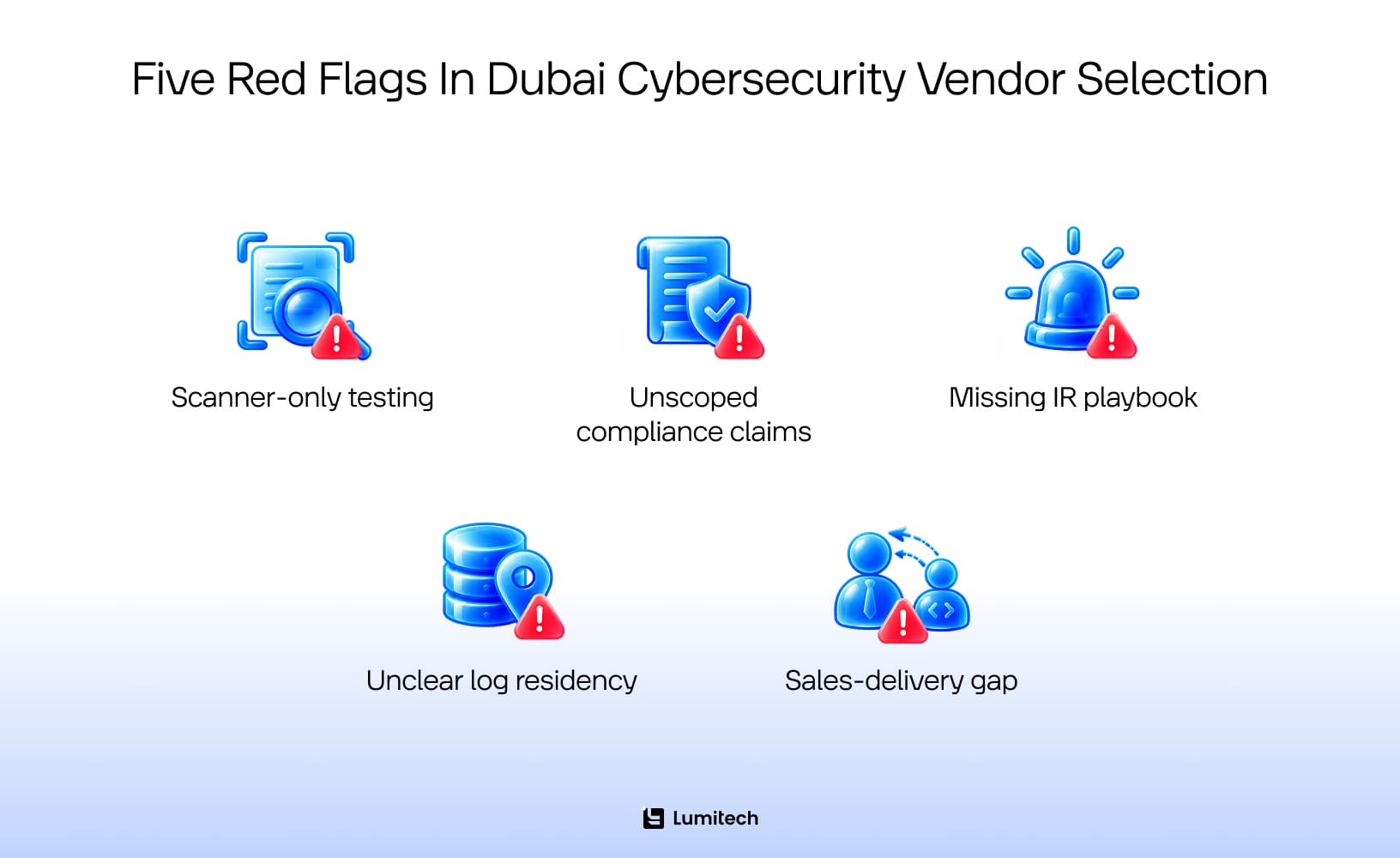
None of these are dealbreakers on their own. Use them as prompts for follow-up questions.
Scanner output sold as a penetration test. Ask for a redacted sample report. Manual exploitation, business-logic findings, and a documented methodology separate a real engagement from a tool license.
Compliance promised without scope. A provider who guarantees “DESC compliance” or “NESA certification” without first asking which regime governs your license is selling a phrase.
No incident-response playbook. Monitoring that produces alerts with no defined containment path, escalation matrix, or forensics capability buys visibility and stops there.
Unclear log and data location. Audit questions include where telemetry is stored, who can query it, and which jurisdiction holds it. A provider should answer them in the first call.
Sales team separate from delivery team. Ask to meet the people who will do the work, and ask how many are based in the UAE.
How Cybersecurity Services Are Usually Bought
Five commercial patterns cover most market engagements.
Monthly MSSP or SOC retainer — priced on coverage hours, data volume ingested, and the number of monitored assets.
Project-based VAPT — scoped by target count, test depth and retest allowance, usually delivered in a defined window.
Scoped consulting — gap assessment, control mapping or audit preparation with a fixed deliverable set.
Incident-response retainer — a standing agreement with an SLA, often bundled with readiness exercises.
Engineering engagement — a team working inside a build or modernisation programme, billed like any development contract.
Published pricing in this market is rare and moves quickly, so treat any figure you are quoted as scope-dependent. The useful comparison is what a day of senior delivery time actually buys you.
What Cybersecurity Looks Like Inside a Complex System
Traditional offerings assume a perimeter: protect the network edge, secure devices, watch logs. That layer still earns its keep. It simply stops short once you start building or modernizing core platforms. In fintech, legaltech, and AI-heavy products, risk lives inside the system — in how data moves between services, how APIs are exposed, how access is granted and revoked, and how the system behaves when something fails.
Core banking modernization projects show the pattern. Moving from legacy cores to service-based architectures opens new attack surfaces: internal APIs, microservices, event streams. When security sits outside the architecture blueprint, the result is a modern system running old habits — shared accounts, weak segregation, thin logging. Data migration challenges carry the same exposure, touching backup, encryption, key management, and temporary staging environments.
Regulated sectors make the point concrete. In one insurance platform modernization engagement, security had to be designed into the customer portal, the internal operations console, and the integration layer from the first sprint, because customers, regulators, and partners all touched the same system through different doors. The requirement went past keeping attackers out: every internal flow had to respect least privilege, produce an audit trail, and fail safely.
For teams evaluating cybersecurity solutions in Dubai, this is where the differentiator sits. Firewalls and endpoint agents still matter. Whether the system is designed to be safe by default — clear boundaries, controlled data flows, predictable failure behavior — is what determines the residual risk.
AI and Security: Where the Risk Actually Sits
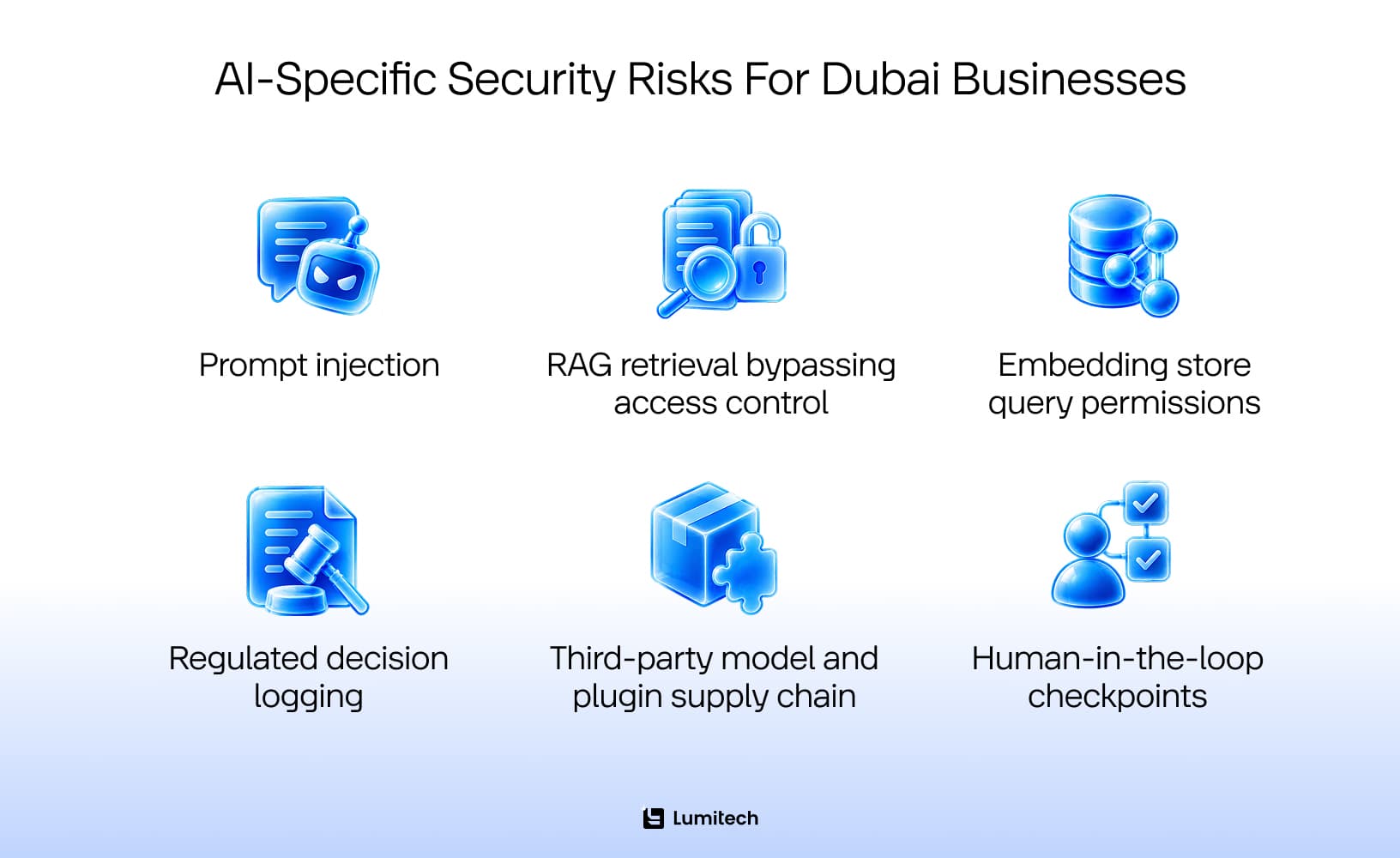
Plugging AI into a product introduces a specific set of risks. Large language models can be manipulated through prompt injection to disclose information or take actions outside their mandate. Retrieval-augmented generation pipelines leak documents when access control is enforced after retrieval. Model outputs feeding regulated decisions — credit scoring, legal triage — create compliance exposure when they are unconstrained and unlogged.
AI-powered patent screening illustrates the risk. Models analyzing sensitive IP raise questions about where embeddings live, who can query them, and whether data reaches third-party tooling. Platforms such as a real-time crypto market analytics platform for digital-asset markets sit on volatile, high-value data and expose client-facing APIs, where a flaw in access logic or rate limiting becomes a market-integrity problem as well as a security one.
The AI supply chain widens the trust boundary again. Libraries, model-hosting services and third-party plugins all enter scope. For companies in Dubai adopting AI quickly, a security partner needs fluency in both traditional controls and these newer surfaces — the embeddings store, the prompt-handling code, and how human oversight is designed into the workflow.
Work With an Engineering Partner That Builds Security In
Across fintech, legal, and industrial work, serious failures usually trace back to systems never designed to be safe in the first place. Layering monitoring on top of flawed architecture has a ceiling. The pattern is reassuringly consistent: the earlier security thinking enters the design process, the fewer surprises turn up at audit.
Lumitech’s engagements sit in that zone — platforms handling payments, legal documents and industrial processes, operating under regulators and clients who ask specific questions, where a breach carries consequences well past the technical. For these organizations, the requirement is keeping network and platform controls aligned with how the systems are actually built.
If the real risk in your system sits inside the architecture — data flows, identities, APIs, AI components — the useful conversation is with a partner that treats security as part of engineering. Lumitech customer stories show how that has worked in regulated environments.