
Healthcare Data Interoperability Market Outlook: Growth, Segments, and Key Players
The healthcare data interoperability market is moving from a compliance-driven technology category into a core layer of healthcare business infrastructure.
- Digital Transformation
- Big Data & Analytics
May 22, 2026
7 min read
 AI Overview
Healthcare data interoperability market is a fast-growing commercial infrastructure category driven by EHR maturity, government mandates, cloud adoption, AI readiness, and payer-provider data exchange. The article reviews market-size forecasts, regional dynamics, and explains where investment is flowing across software, services, middleware, cloud platforms, semantic interoperability, and healthcare data exchange use cases.


For years, interoperability was discussed mainly as a technical or regulatory challenge: how hospitals exchange records, how FHIR works, how health information networks connect systems, and how organizations reduce data fragmentation. Those topics remain important, but the commercial question has changed. Healthcare organizations now want to know where the market is going, who is buying these platforms, which vendors are gaining traction, and how interoperability investment affects digital health growth, payer-provider collaboration, AI readiness, operational efficiency, and demand for healthcare software development services.
This article takes that market-outlook view. Lumitech’s existing guide already explains interoperability in healthcare from a practical perspective, including standards, secure exchange, implementation challenges, and strategic value. The market conversation is different: it is about demand, procurement priorities, vendor categories, adoption triggers, and where healthcare companies can capture value as data exchange becomes a default requirement.
Market Size: How Big Is the Opportunity?
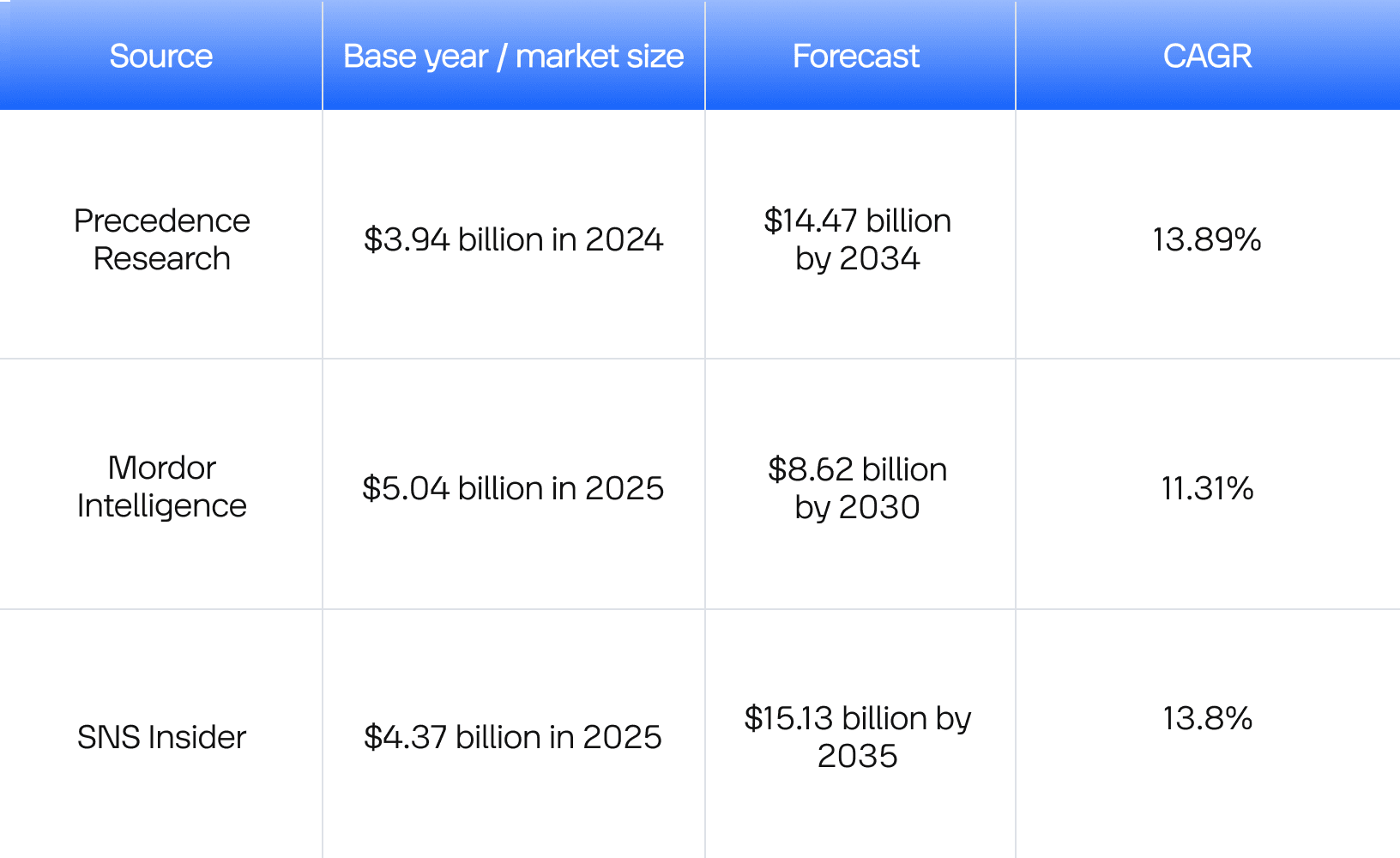
Depending on which research firm you ask, the numbers vary. The healthcare interoperability solutions market was valued at between $4.37 billion and $5.04 billion in 2025, with projections ranging from $8.6 billion to $15 billion by 2034, depending on scope and methodology. Precedence Research estimates the market will reach $14.47 billion by 2034 at a 13.89% CAGR. Mordor Intelligence puts the 2025 market at $5.04 billion, projecting $8.62 billion by 2030 at an 11.31% CAGR. SNS Insider reported the market at $4.37 billion in 2025 with expectations to reach $15.13 billion by 2035.
The variance in figures reflects how differently analysts define the category: some include only software platforms, others fold in professional services, managed services, and infrastructure. What matters more than any single number is the direction and the consistency: every healthcare data interoperability market forecast agrees on double-digit annual growth and a market that is roughly tripling over the next decade.
Regional Market Overview
The interoperability solutions market in healthcare is becoming global, but each region is moving at a different pace depending on digital maturity, regulation, and infrastructure investment.
North America: The Most Mature Market
North America remains the largest regional market. The region’s lead is driven by broad EHR adoption, regulatory initiatives, payer-provider data exchange needs, and established health information exchange networks. P&S Intelligence estimates North America holds around 40% of the market, while The Business Research Company identifies it as the largest region in 2025.
Europe: Regulation-Led Interoperability
Europe’s growth is shaped by data protection, national digital health systems, and cross-border health data initiatives. The European Health Data Space, published in the Official Journal of the EU in March 2025, is designed to support secure exchange, use, and reuse of health data across the region.
Asia-Pacific: The Fastest-Growing Region
Asia-Pacific is expected to be the fastest-growing region of the global healthcare interoperability market, according to both The Business Research Company and P&S Intelligence. Growth is supported by digitalization, public investment, national healthcare platforms, and expanding EHR adoption in markets such as India, China, Japan, South Korea, Singapore, and Australia.
Emerging Markets: Cloud-First Opportunity
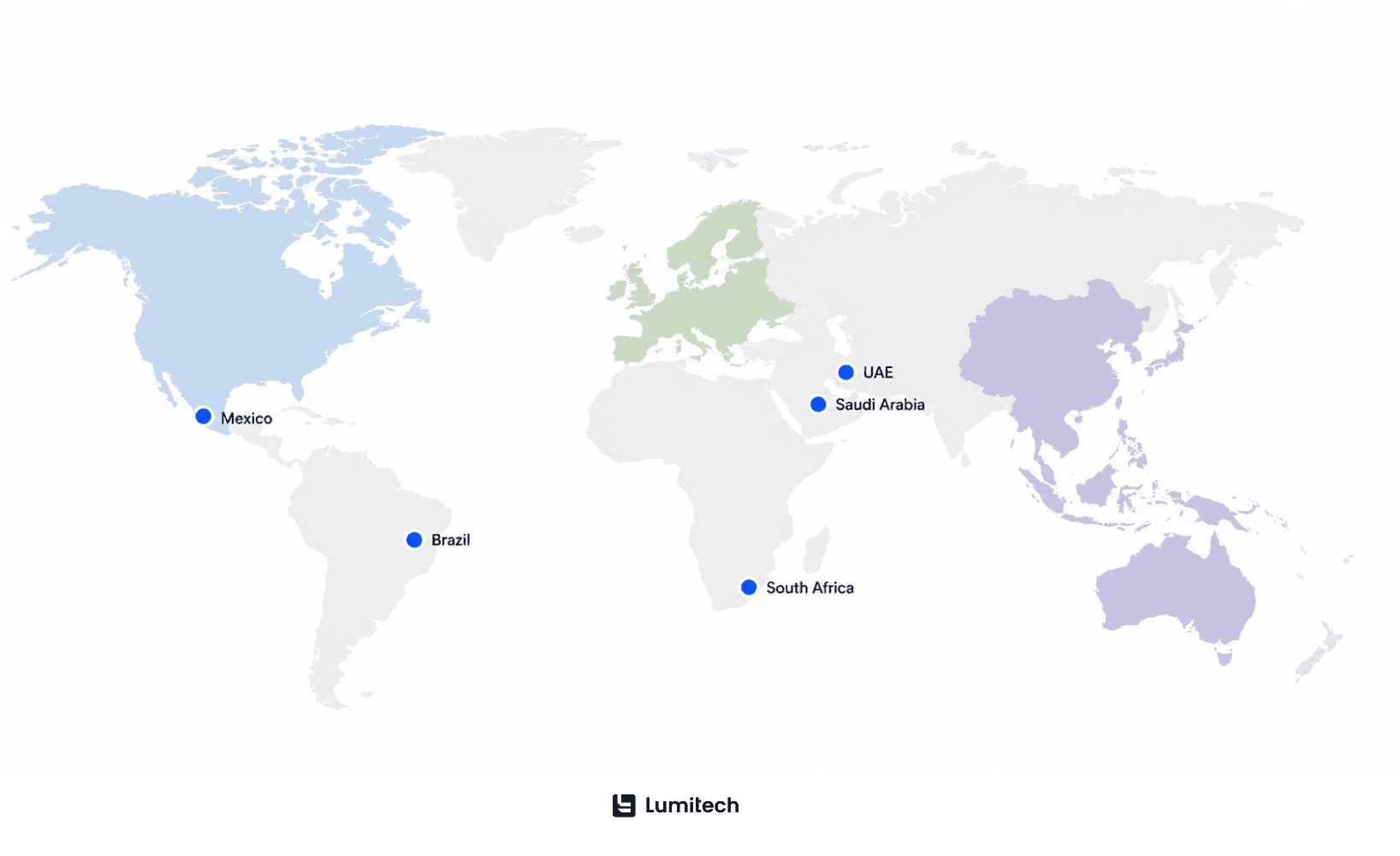
Emerging markets in the Middle East, Latin America, Africa, and Southeast Asia accelerate healthcare data exchange adoption and have an opportunity to build modern interoperability infrastructure without decades of legacy system constraints. Countries such as the UAE, Saudi Arabia, Brazil, Mexico, Indonesia, Vietnam, and South Africa are especially relevant as healthcare systems invest in cloud platforms, APIs, national digital health programs, and software solutions for government sector use cases. In the UAE, for example, Riayati, Malaffi, and Nabidh have been integrated to support unified health information exchange across federal and emirate-level systems. This also creates favorable conditions for digital health products, including AI healthcare apps in the UAE market, that depend on secure access to longitudinal patient data.
For healthcare markets like the UAE, interoperability means more than connecting hospitals or complying with new standards. It is about creating the data foundation for a more collaborative healthcare ecosystem, in which providers, payers, public health systems, and digital health companies can build services on the same trusted information. The opportunity for emerging markets is that they can move faster by adopting cloud-native platforms, APIs, and modern data architectures from the start.



What Are the Main Growth Drivers in the Market
The healthcare data interoperability market growth story has three engines running simultaneously — and they are each powerful enough to drive the market on their own.
Maturity of Electronic Health Record Adoption
Many healthcare organizations already digitized clinical workflows, but digitization alone did not create seamless data flow. Hospitals, labs, payers, pharmacies, imaging systems, patient apps, and virtual care platforms often still operate on different data models and exchange patterns. As a result, organizations are investing in interoperability platforms that help them normalize, route, enrich, and govern healthcare data across systems.
Regulatory Force
In the United States, the ONC 21st Century Cures Act Final Rule was designed to advance access, exchange, and use of electronic health information and address information blocking. ONC’s materials emphasize patient access to clinical information such as test results, medications, and clinical notes through standardized digital access.
CMS has also pushed the market toward API-based exchange. Its Interoperability and Patient Access rule required or encouraged payers to implement APIs for patient access and payer-to-payer or payer-provider data exchange, and the CMS Interoperability and Prior Authorization Final Rule gives impacted payers until primarily January 1, 2027, to meet API requirements. These government mandates for healthcare interoperability are turning interoperability from a modernization goal into a procurement requirement.
AI Dependency
Healthcare AI tools need clean, contextual, permissioned, and up-to-date data. Without interoperability, AI pilots remain trapped in isolated datasets or require expensive custom extraction work. As healthcare organizations move from AI experimentation to deployment, demand rises for data infrastructure and data engineering services that can supply structured, governed, and workflow-ready information.
Together, these forces explain healthcare data interoperability market growth: healthcare organizations are buying interoperability to reduce administrative burden, improve data processing in healthcare, make information usable for decision-making, support regulatory compliance, improve patient access, and create a foundation for AI-enabled operations.

Market Segments: Where the Money Actually Goes
The healthcare data interoperability market forecast looks different depending on which segment you examine. Not all parts of this market are growing at the same rate.
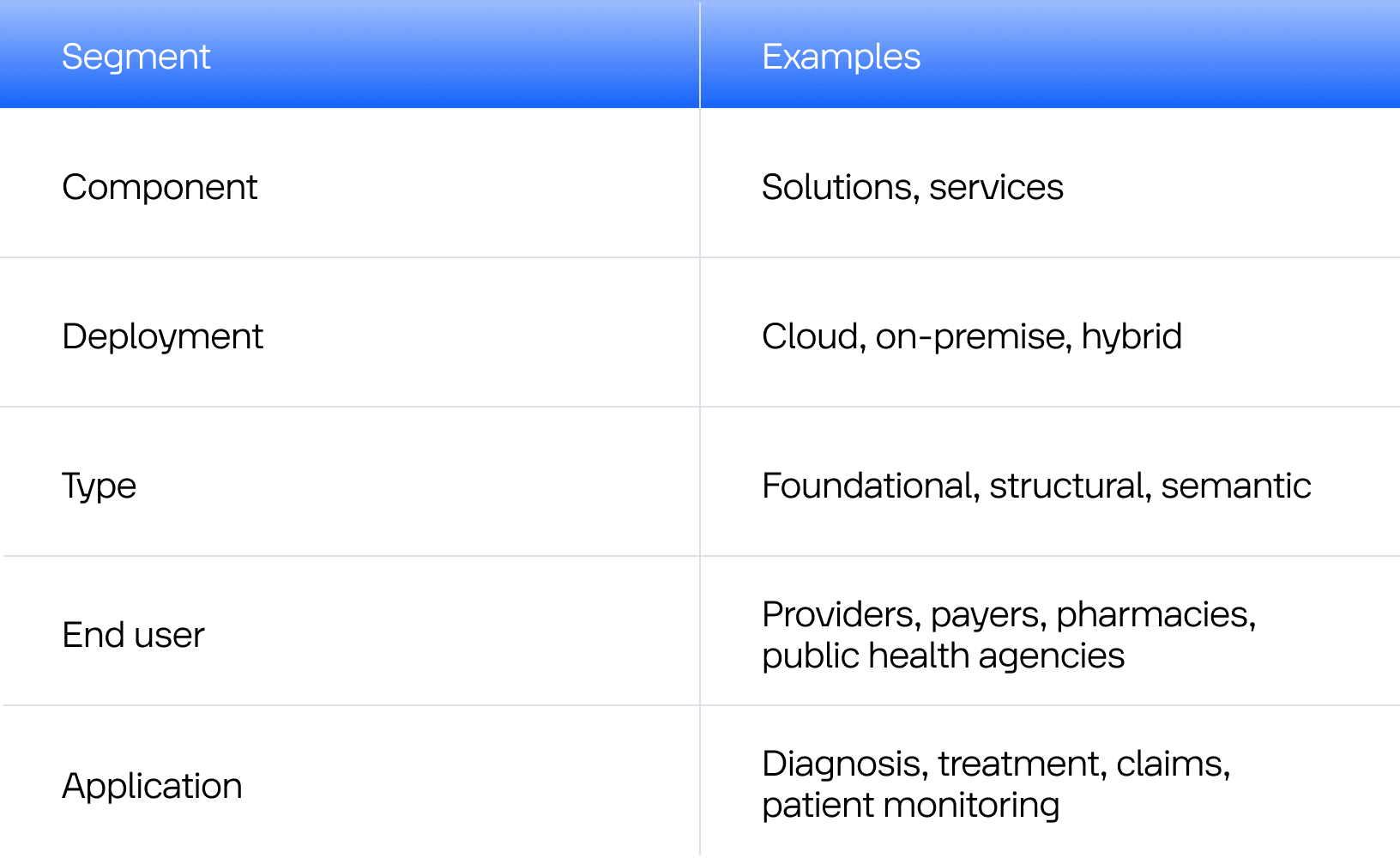
By Component
Software platforms held 46% of revenue in 2024, but the fastest-growing sub-segment is platforms and middleware: the integration and data engineering layer that connects legacy HL7 v2 feeds with modern cloud-based FHIR stores. Hospitals that cannot afford full EHR replacement (which is most of them) are instead investing in middleware that bridges old and new. Services (implementation, configuration, governance design, lifecycle support) still absorb roughly a third of total budgets, a figure that reflects how complex these deployments remain in practice.
By Interoperability Level
Structural interoperability held 41.9% share in 2024 as organizations focused first on message routing and document exchange. Semantic interoperability — the ability for systems to not just exchange data but to understand what it means — is where investment is accelerating, driven directly by the AI demand described above.
By Deployment
Cloud-based solutions accounted for 58.6% of market share in 2024 and are projected to grow at 12.38% through 2030, according to Mordor Intelligence. On-premise installations still dominate among large health systems with significant legacy infrastructure, but new deployments are overwhelmingly cloud-first. Microsoft Azure's FHIR service reportedly surpassed 1 billion monthly API calls in 2024 — a figure that illustrates just how much of this market has already moved to cloud infrastructure.
By Application
Diagnosis led the market in 2024, followed by clinical data exchange, medication data sharing, lab results integration, and imaging interoperability. The healthcare interoperability services market — implementation, consulting, managed services — holds the largest revenue share at 56%, which says something important about where organizations are struggling most: not in buying software, but in deploying it successfully.
This is why the interoperability solutions in healthcare market is not one uniform category. A hospital network, Medicare Advantage plan, AI remote patient monitoring startup, state HIE, and AI diagnostics company may all need interoperability, but they buy different capabilities and evaluate vendors through different criteria.
How to Evaluate Healthcare Data Interoperability Vendors
The market includes many types of healthcare data interoperability vendors, so buyers should avoid treating vendor selection as a simple ranking of the “top” platforms. The best healthcare interoperability solutions providers are the ones that match the organization’s data environment, regulatory needs, workflows, and long-term product strategy.
Main Vendor Categories
EHR vendors provide interoperability through native EHR APIs, app marketplaces, patient access tools, and network participation. They are often the first option for hospitals and health systems that want interoperability embedded directly into clinical workflows.
HIE platforms support regional, national, or network-based exchange between providers, payers, labs, pharmacies, and public health organizations. In the U.S., TEFCA is making this category more important by creating a “network-of-networks” model for nationwide exchange.
API and integration platforms help healthcare organizations and digital health companies connect with EHRs, payer systems, labs, and third-party applications through reusable APIs, connectors, and integration infrastructure.
Cloud providers support interoperability by offering scalable storage, analytics, identity, security, API management, and healthcare data services. They are especially relevant for organizations modernizing data platforms or building AI-ready infrastructure.
System integrators help large healthcare organizations implement interoperability programs and legacy modernization services across complex legacy environments, multiple vendors, and enterprise workflows.
Healthcare software development partners are useful when organizations need custom integrations, patient-facing applications, payer-provider workflows, data products, or interoperability features built into digital health platforms.
Data governance and compliance vendors support consent management, auditability, privacy controls, terminology management, patient identity, data quality, and regulatory alignment.
Key Criteria for Choosing a Vendor
A strong evaluation process should include:
FHIR and HL7 support, because modern interoperability increasingly depends on FHIR APIs while legacy HL7 v2 remains widely used. HL7 describes FHIR as a healthcare interoperability specification built around exchangeable “resources.”
Cloud readiness, including deployment flexibility, API scalability, uptime, and integration with modern data platforms.
Security and compliance, especially for HIPAA, consent, access control, encryption, and audit logs.
Data mapping and normalization, so exchanged data is usable across clinical, claims, operational, and analytics workflows.
Scalability, particularly for payers, provider networks, and digital health companies integrating with many partners.
Monitoring and observability, including error handling, interface monitoring, performance tracking, and data-flow visibility.
Experience with providers, payers, and digital health products, since each buyer type has different workflows and compliance pressures. CMS’s interoperability and prior authorization rule, for example, increases the importance of payer-facing API capabilities.
Support for custom workflows, because real healthcare operations rarely fit perfectly into standard interfaces.
Need help choosing the right interoperability approach? Lumitech helps design integration architecture and build secure, scalable data exchange workflows.

Trends Shaping the Market in 2026
Several healthcare interoperability market trends are influencing buyer expectations.
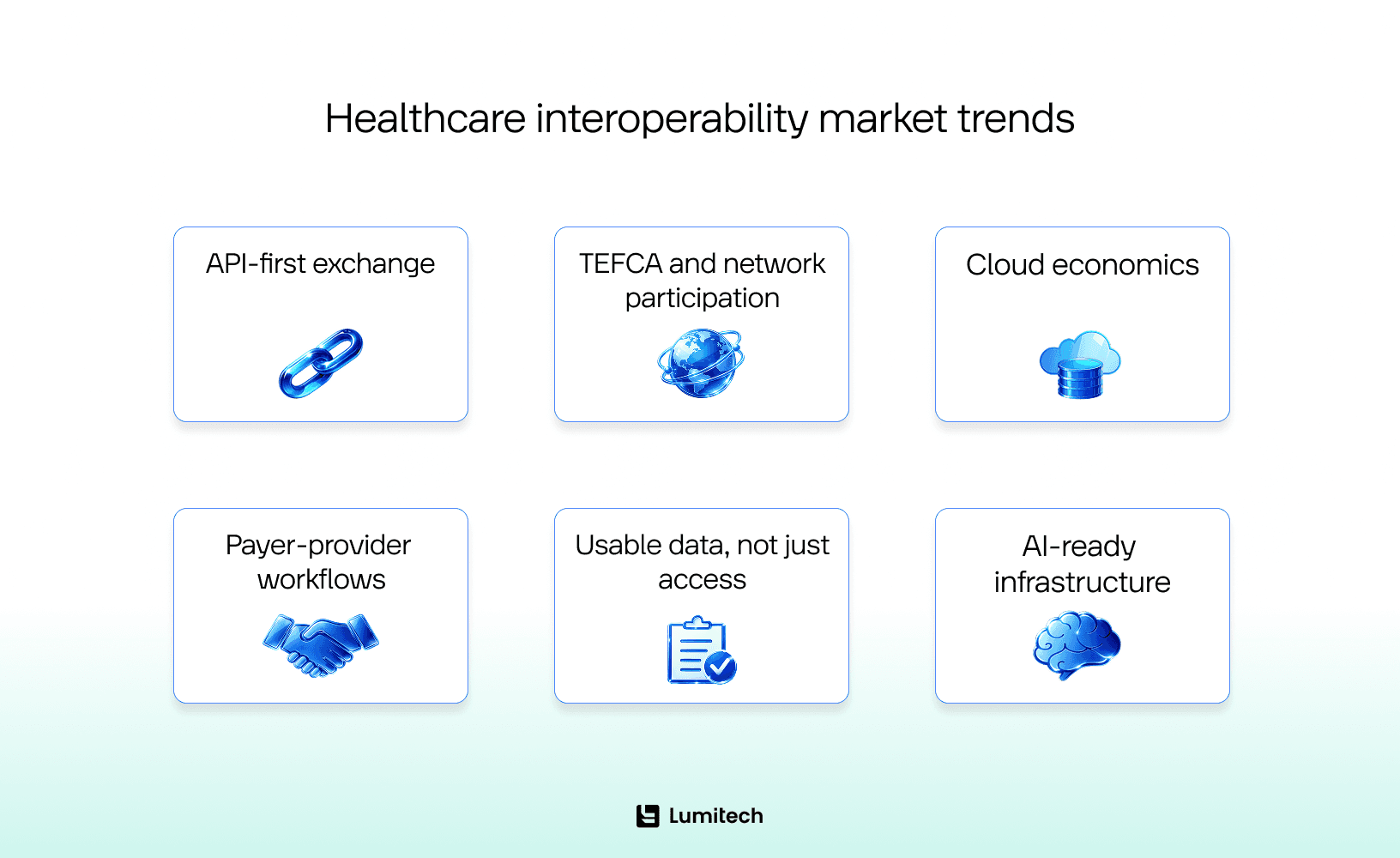
API-Based Interoperability is Becoming the Default
FHIR has shifted the market toward standardized APIs, developer-friendly access patterns, and app ecosystems. That does not eliminate legacy HL7 v2 or document-based exchange, but it changes what buyers expect from modern platforms: APIs, reusable connectors, governance, observability, and scalable onboarding.
TEFCA is Expanding National Data Exchange
The Recognized Coordinating Entity lists Designated QHINs that have completed onboarding for TEFCA exchange, and the list continues to change as additional organizations complete the process. Oracle Health says its Oracle Health Information Network is a Designated QHIN, and Epic reported that more than 1,000 hospitals and 22,000 clinics using Epic were live on TEFCA through Epic Nexus as of June 2025. This matters commercially because national exchange frameworks can reduce dependence on bilateral connections and create new expectations for network participation.
Cloud Adoption is Changing the Economics of Interoperability
Cloud-based platforms allow vendors to manage infrastructure, scale integrations, monitor exchange patterns, and release updates faster than traditional on-premise deployments. Redox, for example, describes its platform as cloud-hosted and built to support healthcare integrations across EHRs, APIs, and data formats. InterSystems also positions its interoperability hub model as a way to manage workloads across multiple customers from a cloud environment.
Payer-Provider Workflows are Becoming a Major Demand Driver
Prior authorization, care gap closure, and quality programs require data exchange inside operational workflows, not just data availability in a portal. Redox highlights use cases such as standardizing member data into a FHIR store and enabling real-time, EHR-integrated prior authorization workflows. Oracle Health has also promoted automated data exchange between providers and payers to reduce point-to-point connections.
Buyers Are Shifting from “Data Access” to “Usable Data”
Buyers increasingly care about data quality, semantic consistency, patient matching, provenance, consent, auditability, and analytics readiness. Data exchange adoption is valuable only when exchanged data can be trusted and used in clinical, administrative, or product workflows. For diagnostic companies, this shift is especially important because clinical diagnostics platform modernization depends on clean lab, imaging, EHR, and patient history data.
Buyer’s Guide: How Healthcare Organizations Should Evaluate Solutions
Healthcare organizations should evaluate the interoperability solutions market in healthcare through business outcomes, not only technical checklists.
Define the core use case. Is the organization solving patient access, payer-provider exchange, referral management, lab results, care gap closure, analytics, AI readiness, EHR integration for a product, or transforming clinical research for the wellness industry? A clear use case helps narrow vendor selection.
Evaluate network reach. For many buyers, vendor value depends on how quickly they can connect to target EHRs, payers, providers, labs, pharmacies, or national exchange networks.
Assess standards support and legacy compatibility. A modern platform should support FHIR and APIs, but healthcare still runs on HL7 v2, C-CDA, X12, DICOM, proprietary APIs, flat files, and custom workflows. The strongest solutions bridge old and new environments.
Review data quality capabilities. Normalization, terminology mapping, patient matching, provenance, validation, error handling, and observability are critical. Interoperability failures often happen not because data cannot move, but because it arrives incomplete, inconsistent, duplicated, or unusable.
Examine security, privacy, and compliance. Buyers should assess HIPAA alignment, audit logs, consent workflows, access controls, encryption, monitoring, and contractual responsibilities.
Analyze total cost of ownership. Integration costs include implementation, testing, maintenance, vendor fees, internal staff, change management, compliance work, and long-term support. A lower platform fee can be misleading if every new connection still requires heavy custom work.
What Does This Mean for Healthcare Companies?
The healthcare data interoperability market is entering a more commercially mature phase. What was once viewed mainly as a technical requirement is now becoming a strategic investment area for providers, payers, digital health companies, and healthcare technology vendors. Demand is being shaped by regulation, cloud adoption, AI readiness, value-based care, payer-provider collaboration, and the growing need to make fragmented healthcare data usable at scale.
For healthcare organizations, the key takeaway is clear: interoperability now means building the data infrastructure needed to improve operations, support better decisions, accelerate digital innovation, and compete in a more connected healthcare ecosystem. As healthcare interoperability market trends continue to evolve, companies that invest early in scalable, secure, and workflow-ready data exchange will be better positioned to adapt, grow, and deliver stronger value to patients, partners, and the broader healthcare market.


