
Data Interoperability in Healthcare: Strategy, Standards, and Real-World Implementation
In healthcare, data is often scattered across clinics, labs, and platforms. Interoperability helps bring it all together, so care teams can see the full picture, coordinate more quickly, and deliver a smoother patient experience.
- Health & Wellness
- DevOps & Cloud
- Big Data & Analytics
April 22, 2026
 AI Overview
Healthcare data interoperability connects patient records across clinics, labs, and hospitals so care teams can send, receive, find, and integrate information without fragmentation. Core standards include HL7 FHIR exchange protocols, nationwide frameworks like TEFCA, and clinical workflow integration for usability. Poor integration causes duplicated data and delayed care, while 70% of US hospitals now engage in all four interoperability domains, up from 46% in 2018.

Data interoperability in healthcare sounds abstract until it becomes personal. A patient visits a primary care doctor, then a cardiologist, then an imaging center, and finally the emergency department.
Every stop creates data: lab results, scans, appointments, discharges, insurance information, and changes in the treatment plan. The problem begins when this data remains scattered across systems, formats, and organizations. That is why data interoperability in healthcare is a strategic requirement for healthcare organizations that want to share data faster, reduce care-delivery delays, and improve the quality of patient-centered care.
What the Global Market Says About Healthcare Interoperability
The market clearly confirms the above. According to ASTP/ONC, by 2023, 70% of non-federal acute care hospitals in the United States were engaged in all four key domains of interoperable exchange – send, receive, find, and integrate – a significant increase from 46% in 2018.
However, connectivity alone does not translate into a seamless user experience. A 2025 JAMA Network Open study found that only 8%–19% of family physicians described their experience as “ideal,” depending on the type of data. This is a very important detail: the industry has learned to better send data, but not everyone has yet learned to embed it into clinical workflows so that it is easily accessible, easy to use, and truly useful at the time of decision-making.
For businesses, this means one simple thing: the benefits of interoperability in healthcare and the strategy are dependent not only on the integration team. It affects product strategy, clinical workflow optimization, compliance, data governance, patient experience, and the speed at which new digital health products are brought to market.
When data exchange is poorly designed, clinicians waste time manually searching for information, patients duplicate data across institutions, and companies themselves invest in new services on a shaky data layer. Where healthcare system integration is built correctly, the organization gains a more complete picture of the patient, better control over the data lifecycle, and a much stronger basis for analytics, AI, care coordination, and automation.
Why Data Interoperability in Healthcare Matters Now
The last few years have shown that interoperability in healthcare is moving from individual, local integrations to an infrastructure market.
TEFCA, intended as a nationwide trusted exchange framework, has already become a clear marker of this shift. The RCE website states that more than 10,600 live organizations are connected to the network, representing more than 60,000 unique connections, and more than 115 million documents have been exchanged through TEFCA as of December 2023. This shows that, along with a large-scale health information exchange, businesses also need those who can best build products and operating models on top of it.
Another strong signal comes from the eHealth Exchange: the network claims 25B+ transactions per year. Carequality, in its turn, writes that its framework has grown to more than 45 networks, connecting more than 600,000 care providers, 50,000 clinics, and 4,200 hospitals. Epic reports that over 20 million patient records are exchanged daily through Care Everywhere, and on a separate product page, 27 million charts are exchanged daily.
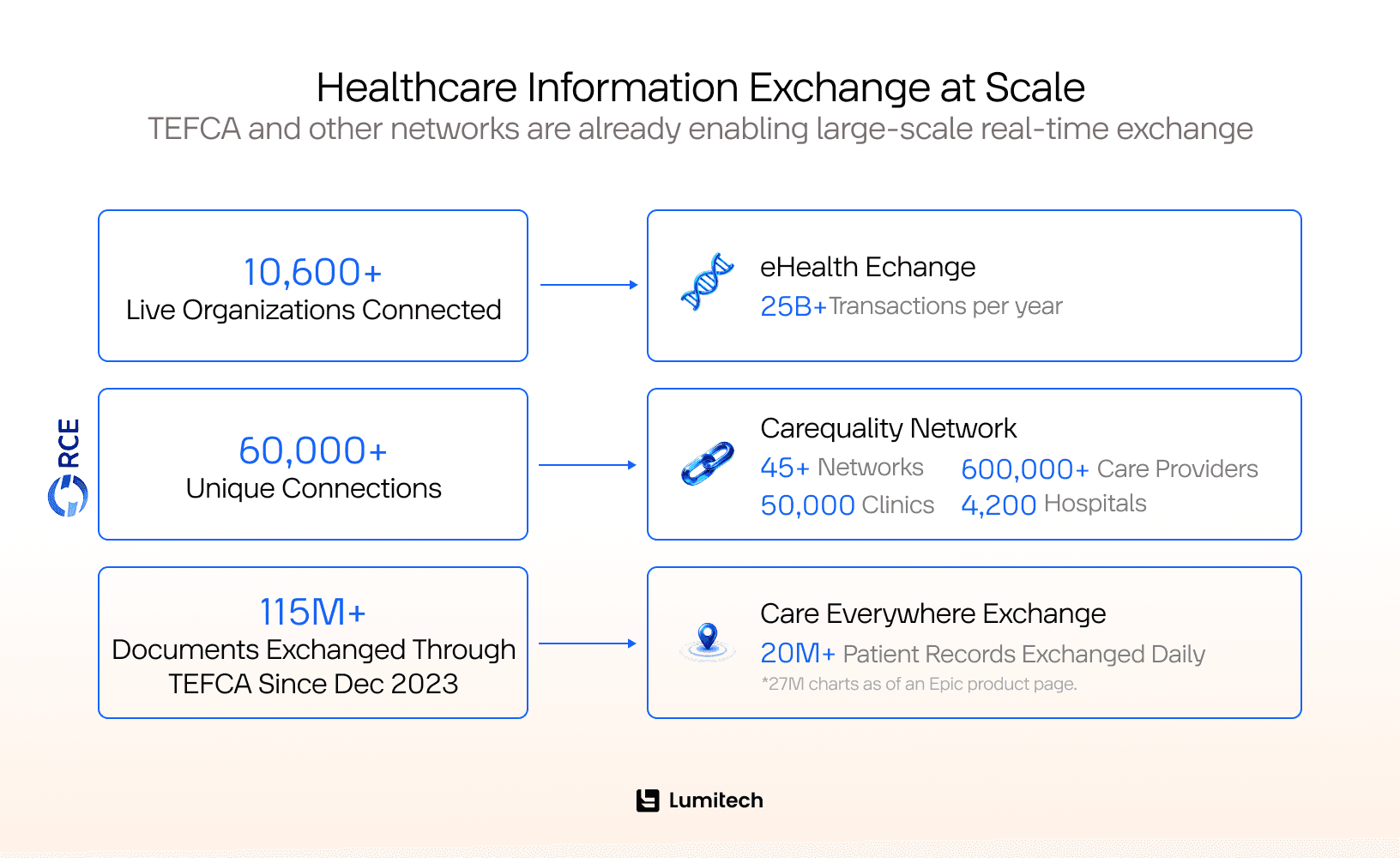
Put it all together, and the picture becomes quite clear: healthcare data interoperability is already a massive operational layer of the market, but this layer is still divided between different standards, networks, trust rules, and specific workflow decisions.
And this is where the main challenge for healthcare organizations arises. Connecting to a network or implementing a standard is just the beginning. Real business value appears when the system can:
exchange patient data securely,
correctly match the patient’s identity,
standardize input data,
place it in the right clinical or operational context,
and reduce the burden on people.
Therefore, today, a working digital health infrastructure is a critical element in healthcare operations.
How Does Healthcare Interoperability Work in Practice
To put it simply, if you want to know the answer to the question “how to achieve interoperability in healthcare”, keep in mind that it works through a combination of four layers:
data,
standards,
trust,
and workflow.
First, a clinical or insurance system creates data. Then, that data must be presented in a consistent format, for example, through HL7 v2, C-CDA, or FHIR. Next, the system must understand who the patient is, what access rights and sharing rules apply in a particular scenario, and through which channel that data can be transmitted. Then, the data must be received by another system, mapped to the local context, and presented in a way that can actually be used in clinical or operational work. That’s why interoperability in healthcare information systems is an end-to-end operating chain.
Here’s a simplified diagram of how it works in practice:
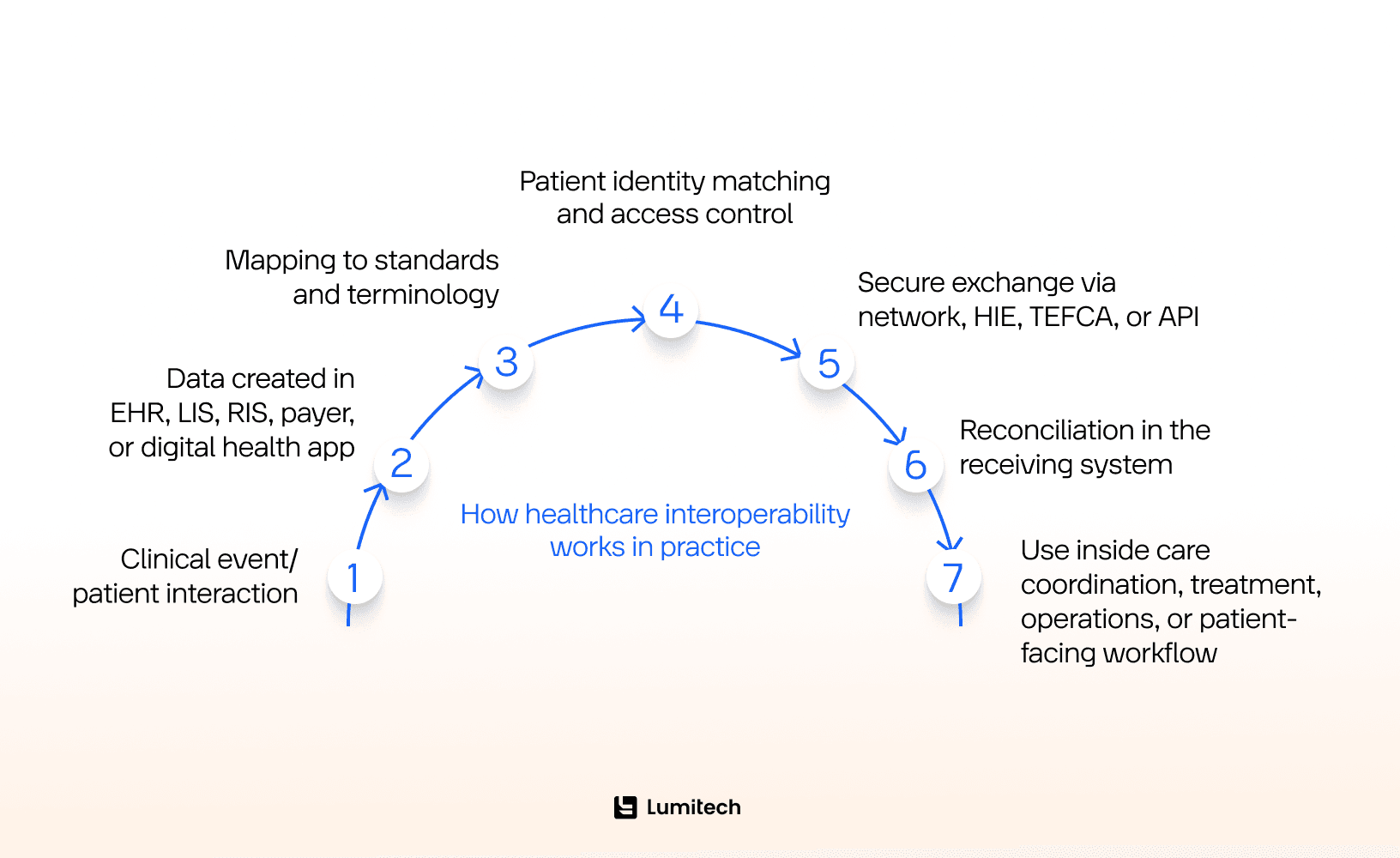
In real life, this chain often breaks in the middle. For example, data may be technically delivered, but end up in a document that is difficult to find. Or test results may arrive without sufficient context, requiring the doctor to open multiple windows or even manually search for confirmation.
This is why problems with interoperability in healthcare resemble a set of tiny limitations: poor patient matching, lack of data standardization, limited observability of integrations, record duplication, unstable semantics, and poor workflow design.
How Does Healthcare Data Interoperability Improve Patient Care?
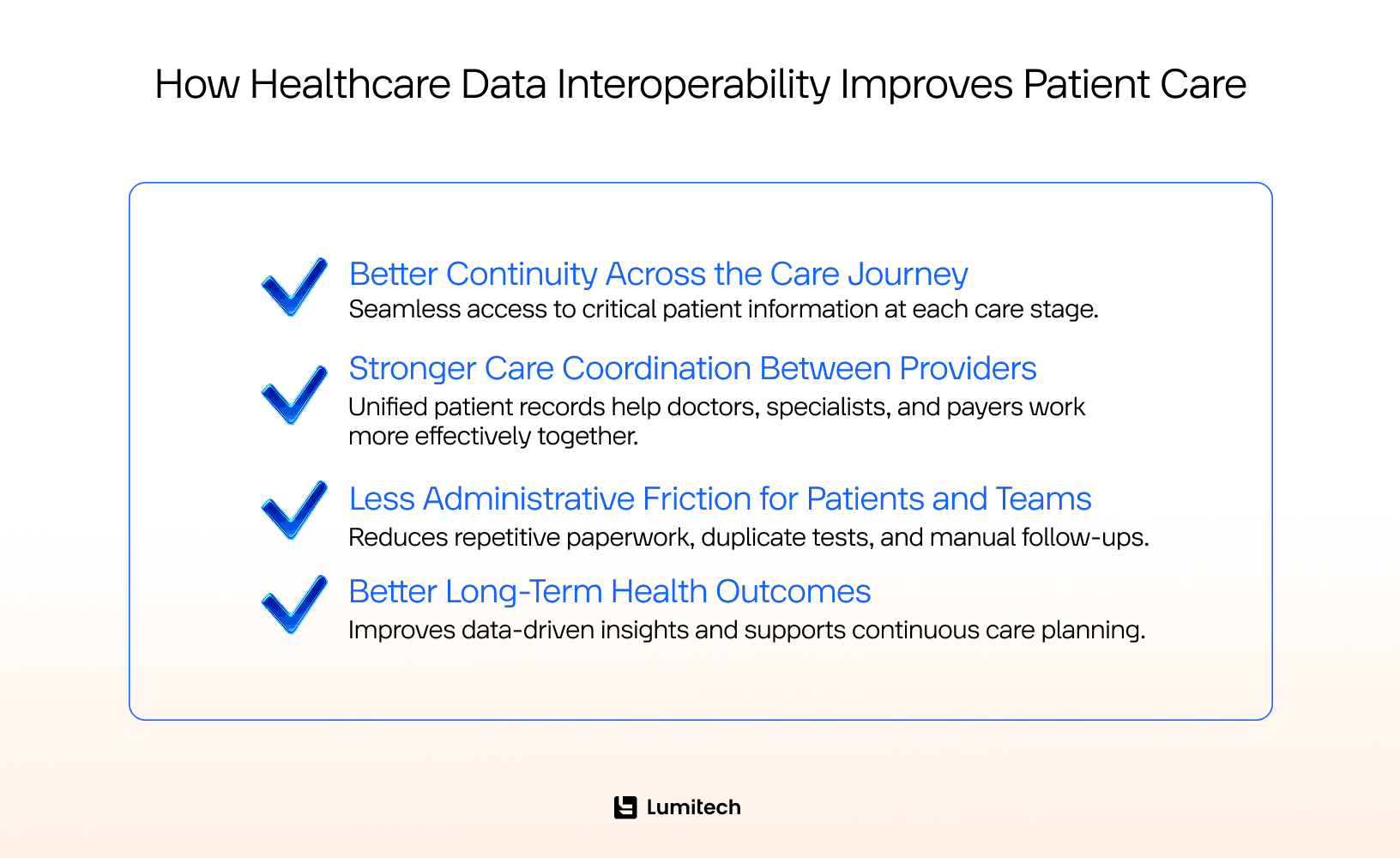
Better Continuity Across the Care Journey
The most obvious effect is better continuity of care. When a doctor sees a discharge from another institution, a medication history, previous test results, or allergy data at the right time, it directly affects the decision-making process.
But in a broader sense, interoperability also improves patient care by reducing some of the chaos of the care journey. The patient does not have to recreate their own medical history “from memory” every time, and care teams work with a wider information picture.

Stronger Care Coordination Between Providers
This is where the idea of a unified patient record comes into play. It is not necessarily a single centralized database that contains everything about the patient. Rather, it is the system's ability to collect, reconcile, and present the right data from different sources in a timely manner so that they appear as a single, reliable clinical context.
CommonWell, for example, explicitly emphasizes the importance of the Record Locator Service as a mechanism that enables real-time network searches to build a more complete picture of the patient.
For businesses, this also means better care coordination. Areas where this is particularly noticeable are:
chronic care,
referrals,
discharge transitions,
emergency access,
payer-provider workflows,
and remote patient monitoring.
In all of these cases, the value is created by the speed with which the right information gets to the right role.
Less Administrative Friction for Patients and Teams
When health information exchange becomes part of the day-to-day operational logic, an organization reduces duplication, shortens time for clarification, and creates better conditions for patient-centered care.
For the patient, this means fewer repeated questionnaires, fewer duplicate tests, and fewer situations where information needs to be exchanged between clinics.
For teams, this means less manual searching, less reliance on faxes, email chains, or phone calls for clarification.
Better Long-Term Health Outcomes
In the long term, interoperability leads to better health outcomes. When systems can exchange data, healthcare organizations can more easily build analytics, support long-term disease management, improve care planning, and create digital services that actually work in a clinical context.
That is why data interoperability today should be viewed as an important factor in the quality of healthcare, process efficiency, and long-term sustainability of healthcare delivery.
How Providers Exchange Patient Data Securely
When people talk about secure exchange, they often think of encryption or a secure API. But in healthcare, security is more about governance: who has access, under what conditions, on what basis, how auditing is conducted, and how the system behaves in the event of an error or incident. That is why TEFCA is so important for the market as it creates common trust rules and a legal framework for global exchange.
On the technical side, secure medical record exchange usually includes several components:
standardized data formats,
mechanisms for authentication and authorization,
consent control,
access logging,
monitoring of integration,
patient identity resolution,
and policies for cases of mismatches or partial matches of records.
The ONC specifically emphasizes that patient identity and patient record matching are a critical component of interoperability and the national health IT infrastructure. This is very important: even if the system exchanges data securely, incorrect patient matching still creates clinical and operational risk.
Therefore, in practice, the question “how do healthcare providers exchange patient data securely?” should be broken down into at least three parts:
how the organization defines the rules for access and exchange;
how it technically implements standards, APIs, documents, and network connections;
how it controls accuracy, provenance, auditability, and security at every step.
Without this, digital transformation in healthcare interoperability very quickly turns into a set of fragile integrations that are difficult to scale and even harder to trust in real clinical work.
Difference Between HL7 and FHIR Interoperability Standards in Healthcare
Why This Comparison Matters
One of the most common topics is the difference between HL7 and FHIR in healthcare interoperability. And here it is important to avoid simplifications like “FHIR is new, HL7 is old”.
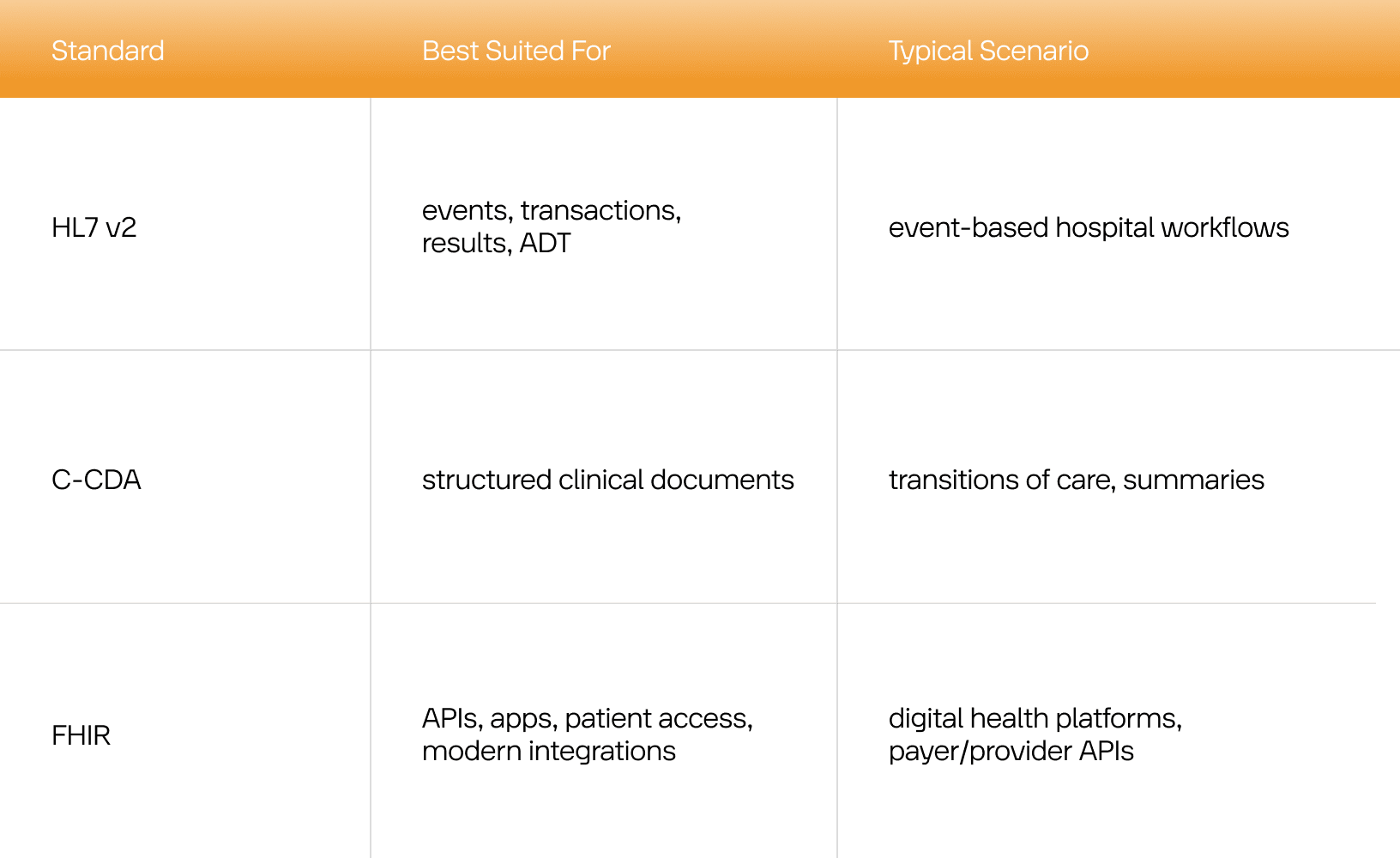
In fact, HL7 v2, C-CDA, and FHIR often solve different tasks and coexist in the same environment. HL7 calls Version 2.x the “workhorse” of electronic data exchange in healthcare, and this is true: a huge number of hospital operational workflows still rely on HL7 v2 messages.
What Is HL7 Used for?
HL7 v2 is best for transaction-heavy scenarios that require fast and reliable messaging between systems. These include admissions, discharges, transfers, lab results, orders, billing-related events, and other typical hospital workflows. It is a standard that has long been entrenched in healthcare infrastructure, and for many organizations, it remains the primary way to integrate critical systems.
How Does FHIR Improve Healthcare Interoperability?
FHIR is better suited for modern API-first scenarios, patient access, app ecosystems, payer-provider exchange, and those digital products that require more modular, resource-oriented interaction.
It makes interoperability much more convenient for modern product and platform architectures by enabling data access through more flexible, understandable, and developer-friendly mechanisms. That is why FHIR is increasingly becoming the basis for new digital health services and platform integrations.
HL7 vs FHIR: The Practical Difference
From a data engineering decision perspective, the difference between the two is not that one standard is better and the other is worse. They are simply optimized for different ways of exchanging data. HL7 v2 is strong in message-based exchange within hospital and clinical environments. FHIR is strong where API-led interoperability, working with separate resources, and faster connection of new services and applications are needed.
How to Implement Interoperability in Healthcare
Here is one of our stories. We started working with one of our clients, and at first, everything seemed very simple. The request sounded like “we need to connect the EHR, the laboratory, and several external services.” And for the client, it sounded quite easy.
During the first round of discussions in the team, we quickly realized that it was not just about integrations. One colleague looked at the connectors and said there was a lot of legacy logic; another immediately pointed out duplicate patients; and we saw the main thing from the product side: doctors did not have a complete picture of the patient exactly at the time when they needed it.
We sat down and walked through the patient journey step by step. We looked at where the data comes from, where it gets lost, where it gets duplicated, and where delays happen. We realized that data was being exchanged in a way that did not match the real workflow. Some information came without context, some arrived in an inconvenient format, and some still had to be checked manually by staff.


Therefore, in such projects, we try to make it clear where exactly the value is breaking right now. And once this is visible, we can properly build the architecture, standardization, and the interoperability layer itself.
And now let’s move on to the steps.
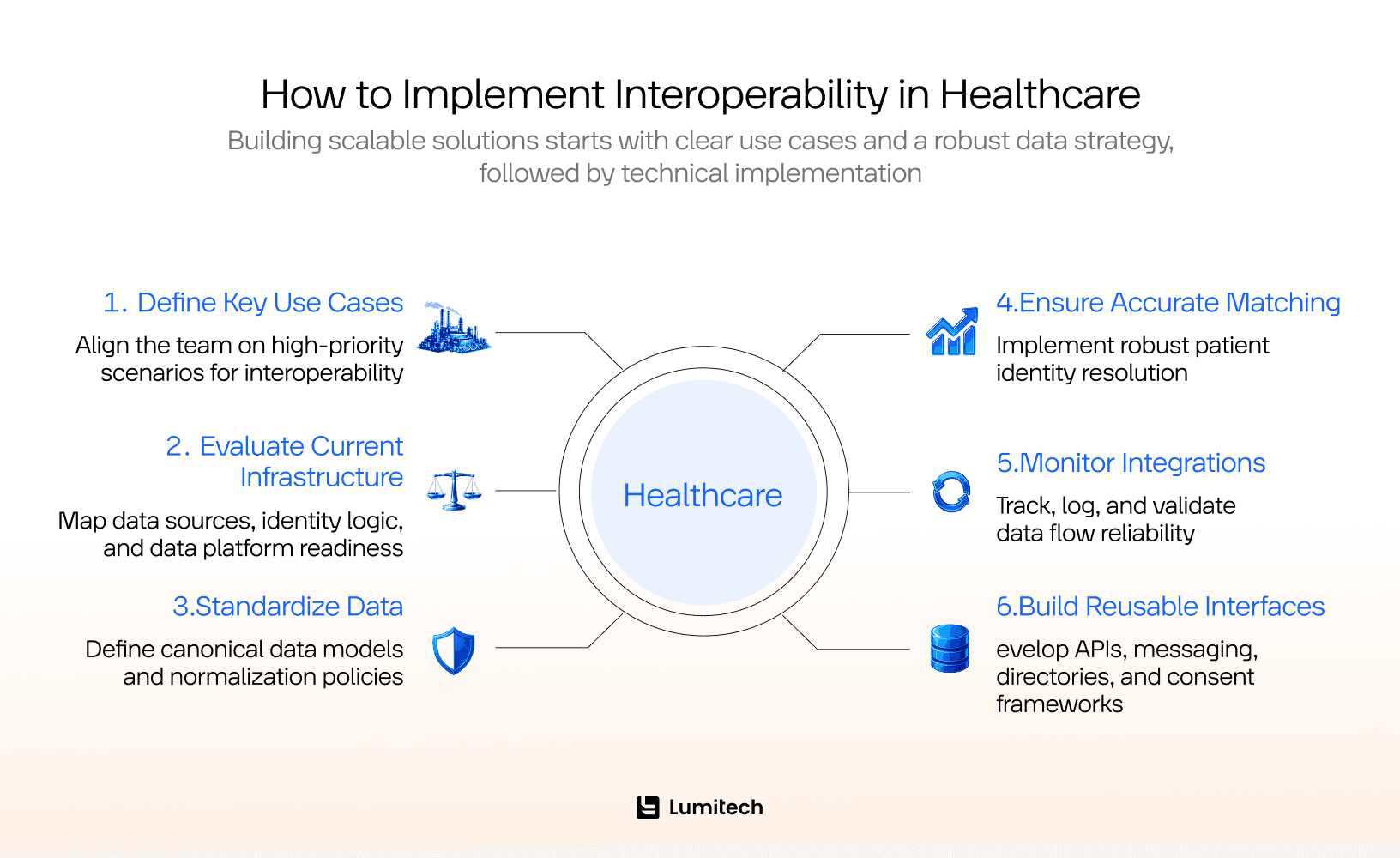
Define the Use Case for Data Interoperability in Healthcare
A good implementation almost always starts when the team agrees on the use cases that are important to the business and the clinic.
These could be referrals, imaging exchange, discharge summaries, prior authorization flows, patient access to records, data feeds for care coordination, or a data layer for analytics and AI. Without this, integration can become a technical activity with no clear value.
Assess the Infrastructure
Next, the team must assess the current digital health infrastructure: which systems serve as data sources, who owns the patient identity logic, where critical data flows, where the biggest delays occur, and what constraints in legacy modernization services are really hindering the exchange.
In many cases, data exchange is closely tied to the broader data platform strategy. That is why, in real programs, the data migration strategy, modern data platform architecture, and a general approach to data engineering services are often reviewed simultaneously alongside the connected data environment.
Define the Model and Policies for Interoperability Solutions in Healthcare
The next step is to define a canonical data model and data standardization policies. Then, you need to work separately on patient matching, as the lack of stable data exchange in the medical domain often results in poor-quality record matching, duplicates, or an incomplete picture of the patient's history.
Set Observability and Quality Control
After that, your task is to establish observability and quality control of integrations. In healthcare monitoring, integrations are a requirement for operational reliability. If mapping drift, partial payloads, incorrect codes, or delays in delivering results occur in production, they must be identified and addressed systematically.
Choosing Delivery Patterns
And only after that does it make sense to move on to specific delivery patterns: API, messaging, document exchange, directory services, consent logic, access policies, and platform services for reusable integrations. In this model, interoperability solutions in healthcare are built as a long-term capability. This is what distinguishes a mature healthcare interoperability strategy from a set of integration tasks in the backlog.
Problems with Interoperability in Healthcare
Interoperability in healthcare challenges rarely boil down to a single issue. More often, they are a combination of technical, organizational, and market constraints that accumulate over time and begin to impact care delivery, operational efficiency, and the speed of digital transformation.
Technical Complexity
Many problems arise at the level of the systems and data themselves. Healthcare organizations often coexist with legacy platforms, different exchange formats, heterogeneous data storage rules, and varying quality of master records. Because of this, even basic healthcare system integration can require significant effort.
Among the most common technical challenges:
incompatible data formats and integration methods;
low quality or fragmented patient records;
difficult patient identity matching;
lack of data standardization;
limited observability of integrations in production.
That is why challenges of interoperability in healthcare often manifest themselves as incomplete, duplicated, or difficult-to-reconcile data.
Operational and Governance Gaps in Healthcare Data Interoperability
Even when technical integration is possible, a weak governance model can negate its value. Without defined ownership, access rules, use-case priorities, and change-control processes, interoperability quickly becomes a set of point solutions without a unified logic.
The most common organizational barriers are:
Different priorities between IT, operations, clinical teams, and product stakeholders;
Unclear responsibility for data quality and lifecycle;
Poorly understood governance rules;
Weak coordination model between teams;
Limited focus on long-term maintainability.
In such an environment, even well-implemented standards do not yield stable results because the operational model itself remains fragmented.
Fragmented Ecosystem
Another reason why barriers to interoperability in healthcare remain significant is the market's fragmentation. Hospitals, labs, imaging centers, payers, digital health apps, and research platforms often operate in different technological contexts and at different levels of digital maturity.
As a result, organizations must simultaneously consider:
different interoperability standards in healthcare;
different levels of readiness among partners;
different trust frameworks and exchange models;
regulatory requirements;
the need to support both new and legacy integration patterns.
As a result, a system connectivity strategy must operate in a real-world environment where systems, partners, and processes vary widely.
Patient Identity and Data Accuracy
Patient identity resolution goes next. Even if data is transmitted quickly and securely, an error in patient matching can render the entire exchange valueless. Incorrect matching, duplicate records, or incomplete profiles create clinical risk.
That is why lack of data exchange in healthcare is often observed through:
duplicate patient records;
incomplete history of interactions;
the complexity of forming a unified patient record;
additional manual verification by staff;
lower trust in external data sources.
Without a high-quality identity layer, cross-system data sharing cannot become a reliable basis for care coordination and patient-centered care.
Where Interoperability Creates Strategic Value
For companies such as digital health vendors, healthtech platforms, payer tech teams, and provider organizations, interoperability creates strategic value in several ways.
First, it improves basic care delivery.
Second, it provides a stronger data layer for analytics, clinical workflow optimization, and AI. For example, the development of AI healthcare apps in the UAE market.
Third, it reduces the cost of future integrations if built as a platform capability rather than a set of isolated projects.
Fourth, it paves the way for new product experiences – from patient access and care coordination to remote monitoring and clinical decision support.
That’s why healthcare data seamless data sharing is increasingly being associated with topics like data processing in healthcare, AI remote patient monitoring, RAG development, healthcare software development services, and even broader stories like transforming clinical research for the wellness industry.
In all of these areas, interoperability is a condition for a product to work with real healthcare workflows at the required level of quality.
Summing Up
Healthcare data interoperability is about the ability of healthcare systems to securely, accurately, and in a timely manner exchange data and use it in real-world workflows. In this article, we’ve looked at how it works, why the market is moving toward large-scale health information exchange, the role of HL7, C-CDA, and FHIR, and the technical and operational barriers that most often hinder implementation.
What it does:
Better continuity of care across providers and care settings;
Stronger care coordination and fuller clinical context;
Less manual work, duplication, and administrative friction;
A more robust foundation for analytics, automation, and AI;
A more resilient digital health infrastructure for scaling products and services.
Key takeaway:
Integration across healthcare systems creates value when data becomes useful to all parties: the doctor, patient, and business.


