



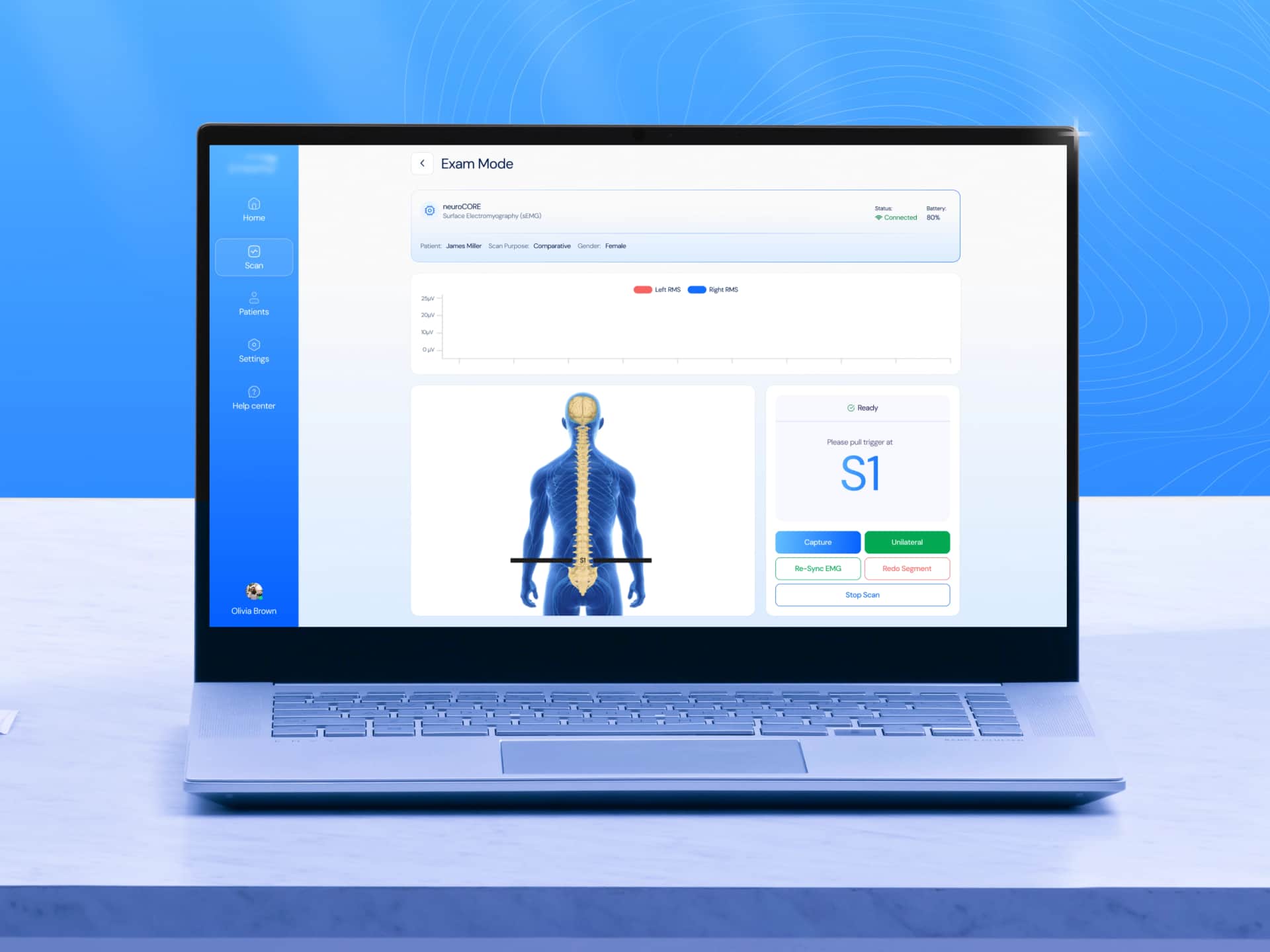




About the Project
INSiGHT neuroTECH by CLA develops an ecosystem of solutions for chiropractors that combines medical devices, software, and educational tools into a single clinical platform. Used by thousands of clinics worldwide, the product supports daily practice by helping clinicians assess a patient’s nervous system state and turn scan results into actionable insights.
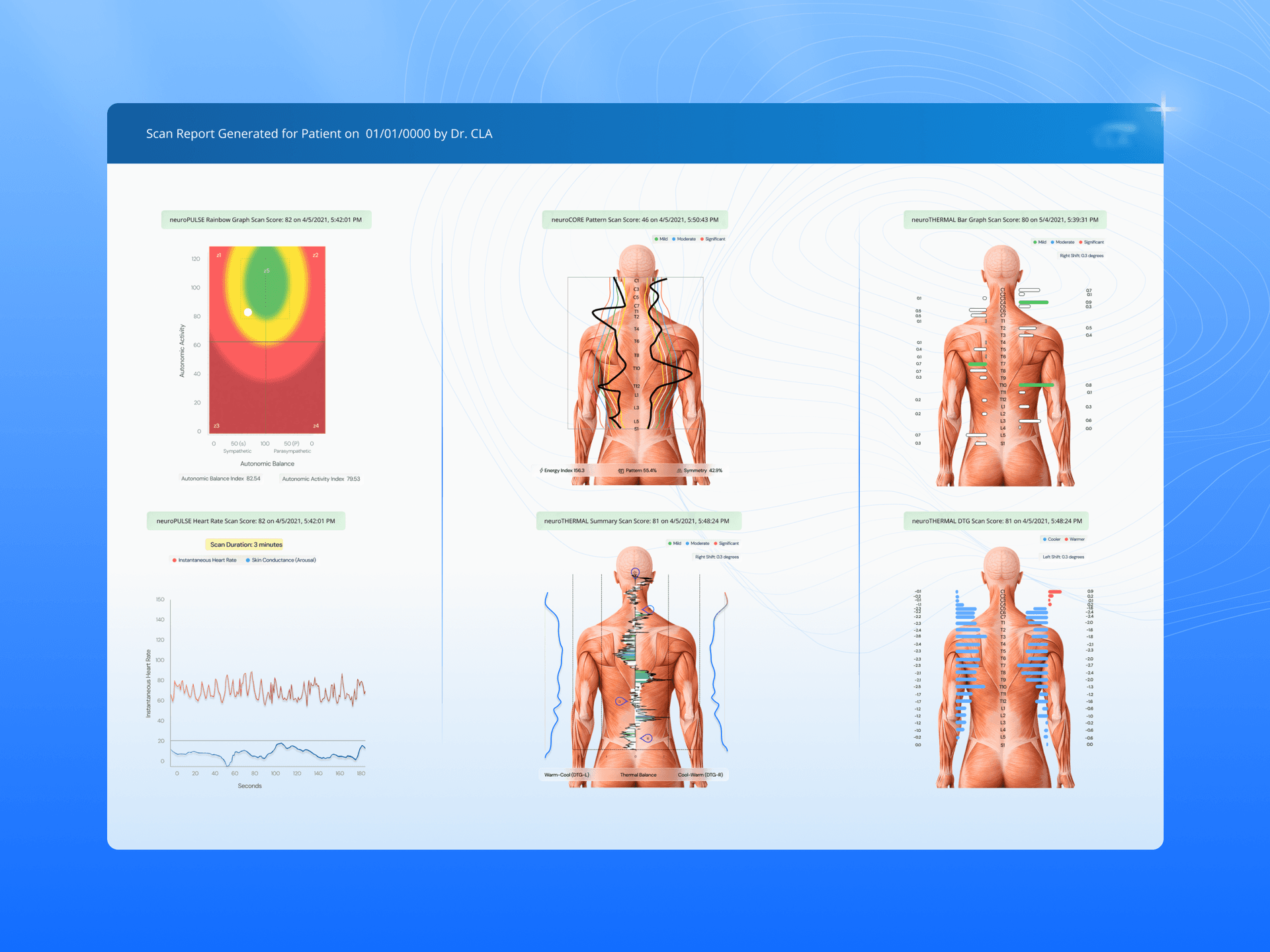
At the core of the platform is a neuroscanning system that brings together data from multiple diagnostic sources, including HRV (heart rate variability), EMG (muscle activity), and thermography, to generate a comprehensive neural profile of the patient. This data is then processed and visualized as reports, scores, and clinical metrics for assessment, patient communication, and treatment planning.
The product is a combined hardware-software workflow built around real clinical use. Its value depends on the ability to collect complex biomedical signals, process them reliably, and present them in a format that is both medically meaningful and easy to interpret in practice.
Interesting Facts
The technology behind the INSiGHT sensors is so precise that it was originally developed in collaboration with research tied to the Space Foundation. It is one of the few chiropractic technologies to be officially Space Certified, acknowledging its origins in high-performance physiological monitoring.
Over 13,000 chiropractors across 26 countries utilize this specific ecosystem to guide their daily clinical decisions, making it one of the most widely adopted neuro-functional assessment tools in the world.
By centralizing data through the cloud-based Synapse system, CLA has built one of the world’s largest tranches of chiropractic wellness data. This anonymized “big data” repository allows for unprecedented research into how the nervous system adapts to stress across different demographics, from newborns to professional athletes.
The CORESCORE was specifically developed to solve a psychological gap in healthcare: the “symptom trap.” By creating a single score, the system allows patients to view their health like a grade on a report card, shifting the focus from “How do I feel today?” to “How well is my nervous system functioning?”
Client’s Request
The client approached Lumitech with a modernization request to redesign the platform and improve the overall user experience. The product already had a strong technological foundation and advanced diagnostic capabilities, but its interface and interaction logic no longer reflected the sophistication of the underlying system.
As a result, several usability problems affected day-to-day clinical work: scan data was difficult to interpret, interfaces felt cluttered, workflows were inefficient, and communicating results to patients was more difficult than it should have been. Although the platform delivered valuable diagnostic insights, the user experience limited their practical use.
The client needed a technology partner who could rethink the product from a user experience perspective without losing its depth of clinical and technical functionality. The goal was to redesign the platform so that complex biomedical data could be understood more easily, clinical workflows could become more efficient, and the product could better support both practitioner decision-making and patient communication.
Challenges
The core challenge of the project was not only redesigning the interface, but doing so around a technically complex diagnostic system operating in a clinical setting.
The platform processes multiple biomedical data streams, including HRV, EMG, and thermal data, which must work together as part of a single scanning experience. From a product and engineering perspective, this meant the system had to:
Synchronize multiple incoming signals
Visualize scan data in real time
Aggregate results into a unified clinical metric (CORESCORE)
Present complex outputs in a format that was clear for both practitioner interpretation and patient communication
This created a dual challenge. First of all, the interface had to support real-time interaction during scans and fit naturally into clinical workflows. Second, it had to simplify the interpretation of technically dense biomedical information without losing the meaning or reliability of the underlying data.
An additional layer of complexity came from compliance requirements. Because the product operated in the healthcare domain and had to align with strict Canadian regulatory standards, any redesign had to be approached with particular care. Improvements to usability and workflow logic could not compromise consistency, clarity, or the reliability expected from a clinical software environment.
Together, these constraints made the project both a UX modernization effort and a technically sensitive product redesign within a regulated healthcare context.
Our Approach
Lumitech approached the project as a product redesign centered on system behavior, not just interface updates. The goal was to make the platform easier to use in clinical practice while preserving the depth and reliability of its diagnostic logic.
We reworked the product as a decision-support system built around how scan data is interpreted and used in practice. This meant improving workflow logic, redesigning the presentation of HRV, EMG, thermal data, and CORESCORE, and organizing outputs to better support both clinical assessment and patient communication.
As a result, the platform evolved from a data display interface into a more coherent clinical tool, where workflow, visualization, and information structure worked together more effectively.
Core Features
The transformation of INSiGHT neuroTECH involved a comprehensive overhaul of the platform's functional layers, moving from basic data capture to a sophisticated clinical intelligence engine. The following modules represent the core pillars of the modernized system:
Clinical Data Visualization
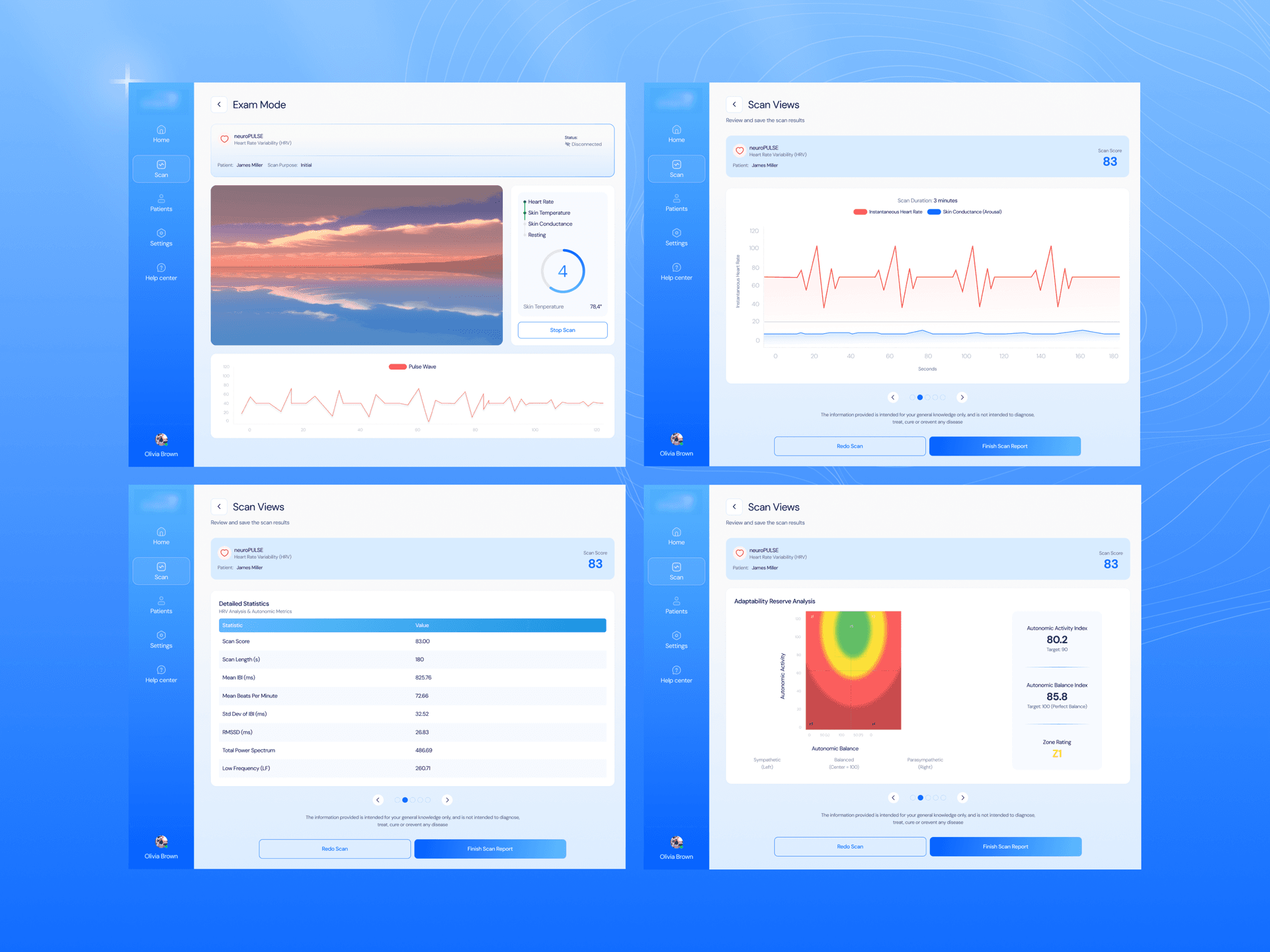
A significant part of the redesign focused on how biomedical data was presented across the platform. We redesigned key visualization formats, including heatmaps, graphs, body mapping, and comparative reports, so that complex numerical outputs could be interpreted as clearer visual patterns. This made scan results easier to read during clinical use and reduced the effort required to move from raw data to assessment.
Decision-Support UX & Workflow Optimization
The interface was structured as a decision-support tool rather than a static dashboard. Each stage of the product was organized around a logical clinical sequence: scan → analysis → interpretation → report → action. This helped align the system more closely with real diagnostic workflows and made it easier for practitioners to move through the product without unnecessary friction.
Scan-to-Report Flow
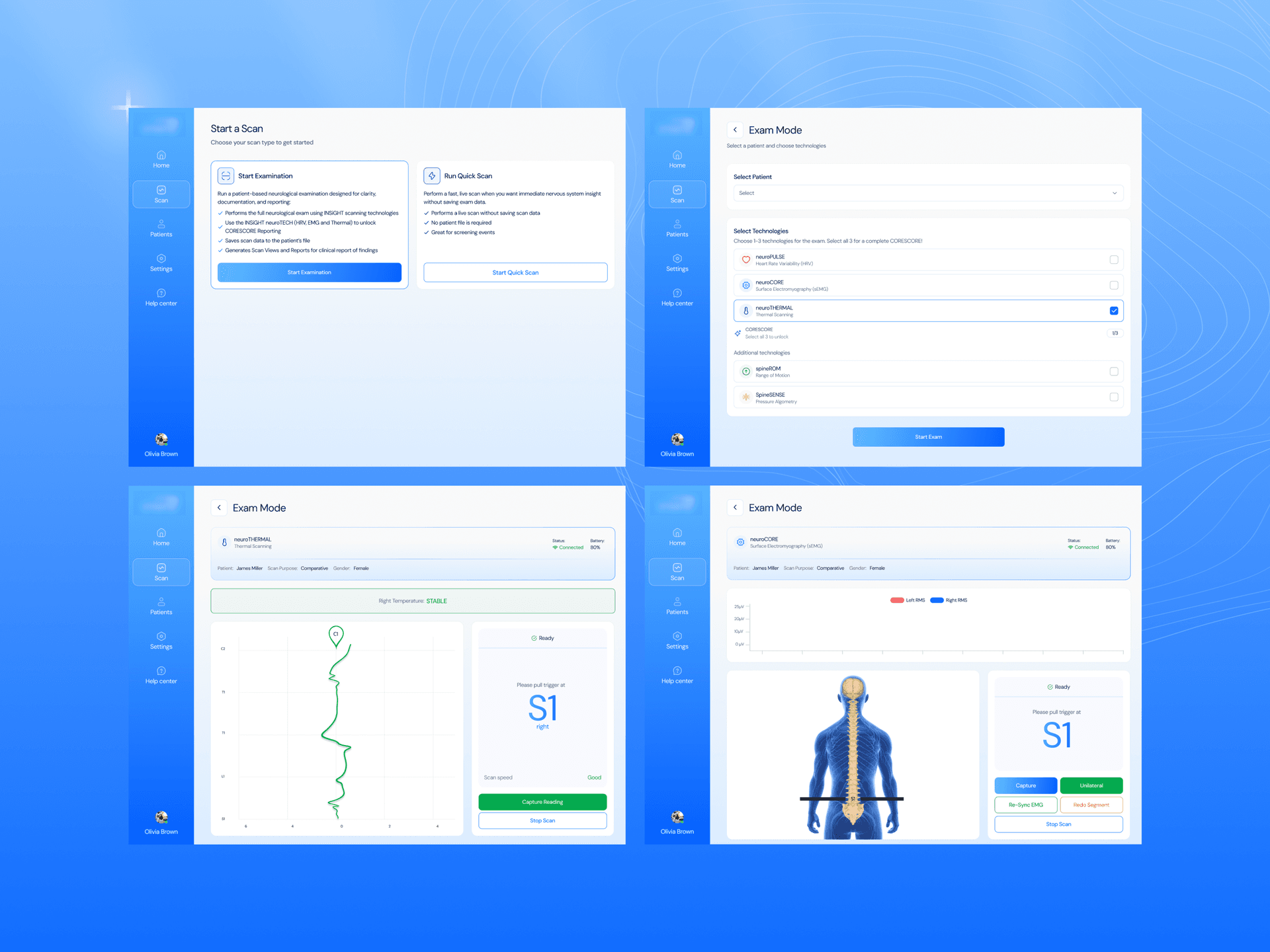
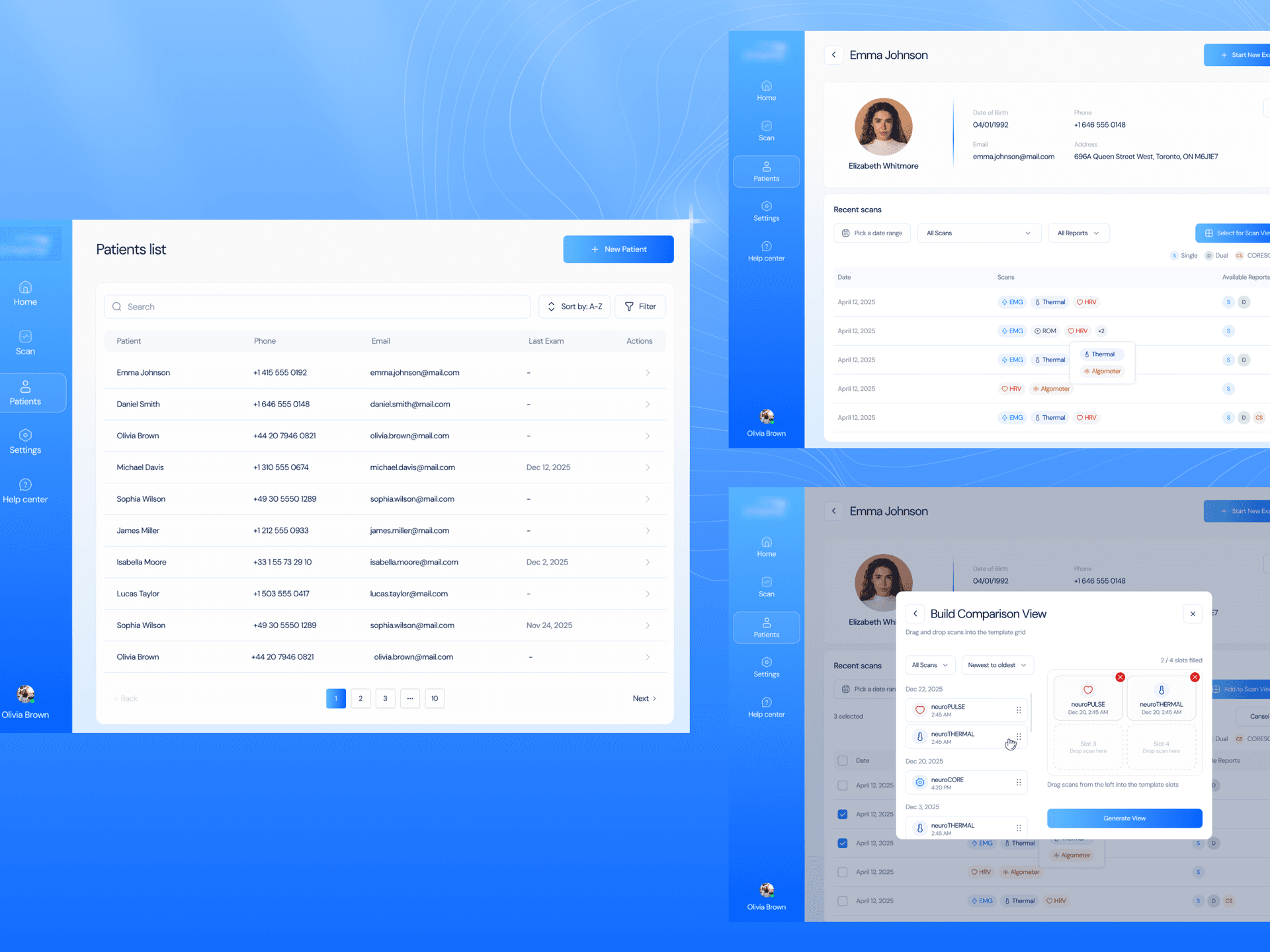
We optimized the workflow from scanning to report generation by reducing the number of steps and removing redundant actions. In a clinical setting, where time is limited and attention must remain on the patient, this made the platform easier to use and better suited to day-to-day practice.
Data Aggregation & The CORESCORE Engine
The platform combined multiple signal sources into a more unified interpretation layer. Instead of requiring practitioners to assess HRV, EMG, and thermal data separately, the system aggregated these inputs into a single metric such as CORESCORE. This provided a faster high-level view of patient state while preserving access to detailed scan data when needed.
Patient Communication & Education Layer
Recognizing that the platform is a vital tool for patient retention, we developed a dedicated communication layer. This feature set focuses on “patient-facing” reports that simplify clinical findings into meaningful health narratives. By visualizing progress and identifying areas of concern through clear, non-technical imagery, the system helps build trust and empowers patients to remain committed to their treatment plans.
Cross-Platform & Offline Resilience
To support the mobility required in a modern clinic, the interface was fully adapted for iPad and tablet use, ensuring a consistent experience during bedside or table-side scanning. Furthermore, the architecture supports offline scanning scenarios, allowing data to be captured and cached locally when connectivity is intermittent, then synchronized seamlessly with the central clinical database once reconnected.
Analytics Layer
As part of the redesign, we also improved the platform’s analytics layer. The system was enhanced to process biomedical signals, aggregate them into diagnostic indicators, visualize trends, and support tracking of patient progress over time. This helped strengthen the product’s role as a clinical decision-support platform rather than a simple data display tool.
Technology Architecture
The platform combined hardware, software, and analytics components into a single clinical ecosystem. Its core architecture included:
Medical devices — scanning hardware used to capture biomedical signals during patient assessments.
Synapse cloud platform — the central software environment for managing scan data, workflows, reports, and clinical interaction.
Analytics layer — responsible for processing incoming signals, aggregating them into diagnostic indicators, and supporting the interpretation of patient state.
Physician interfaces — clinician-facing application layers used during scanning, analysis, reporting, and patient communication.
Together, these components formed a unified platform for diagnosis, training, and daily clinical use. The product redesign had to account not only for interface improvements but also for how hardware, analytics, and software workflows interact within a single system.
Results
Lumitech focused on the platform components with the greatest operational impact: scanning screens, analytical reports, and core user flows. This allowed the client to improve usability and business value without interrupting the product’s existing operation.
Key results of the redesign included:
Improved usability through clearer navigation, simplified interfaces, and better interaction logic
Faster clinical workflows by reducing friction between scanning, interpretation, and reporting
Clearer patient communication through more intuitive visual reports and result presentation
Stronger product effectiveness by making the system more useful as both a diagnostic and a patient retention tool
More broadly, the redesign showed that meaningful product improvement in healthcare does not always require rebuilding the entire system. By focusing on the most critical workflows and rethinking how complex medical data is presented, Lumitech helped turn the platform into a clearer, more effective clinical tool.

