Healthcare AI Governance: What to Recheck When an AI Tool Changes
The hospital approved one version of an AI tool for one workflow. Months later, the software, data, or users may have changed. Does that approval still cover the tool staff are using today?
- AI Development
- Healthcare
October 22, 2026
 AI Overview
The hospital signed off on one version of an AI tool. Since then, the supplier has updated it twice, and a second unit has started using it. Under healthcare AI governance, someone has to ask whether that old approval still covers what staff is using now, and who can pause it if it doesn’t.

Months later, the supplier may have updated the model, IT may have connected the tool to another data source, and other wards may have started using it. The approval stays on file through all of that, even though the tool it describes has changed.
That is when the tool can give the right answer in the wrong clinical context. A summary may show the correct potassium value, but from an older visit. A note may read normally and still be saved under the wrong encounter. In cases like these, the model itself may not be the problem.
The problem may lie in the integration that connects the AI tool to the hospital’s electronic health record (EHR). That integration chooses which records the model sees, whether dates come with them, and where the finished note is saved. So the review has to cover healthcare software development as well as the model. For AI governance in healthcare, the practical check is whether today’s setup still matches the one the hospital approved.
AI Governance in Healthcare Starts With What the Tool Is For
A summary assistant and a deterioration alert may read the same patient record. That is about where the similarity ends.
With the summary, staff look for missing facts and details the chart never supported. The alert is judged by missed cases, false alarms, and whether anyone can respond when it fires. A warning at 2 a.m. has little value if the right specialist isn’t on call.
A feature list won’t answer those questions when the hospital compares AI solutions in healthcare. The approval record needs to show who checks each output and who can pause the tool if its use changes.
AI Governance for Healthcare Teams With Limited Time
A healthcare AI governance framework may have every role filled on paper and still fall short in practice. The people named there already have clinical, privacy, or IT jobs, and model checks, incident follow-up, and supplier updates get added on top. If nobody has time set aside for them, ownership doesn’t help much.
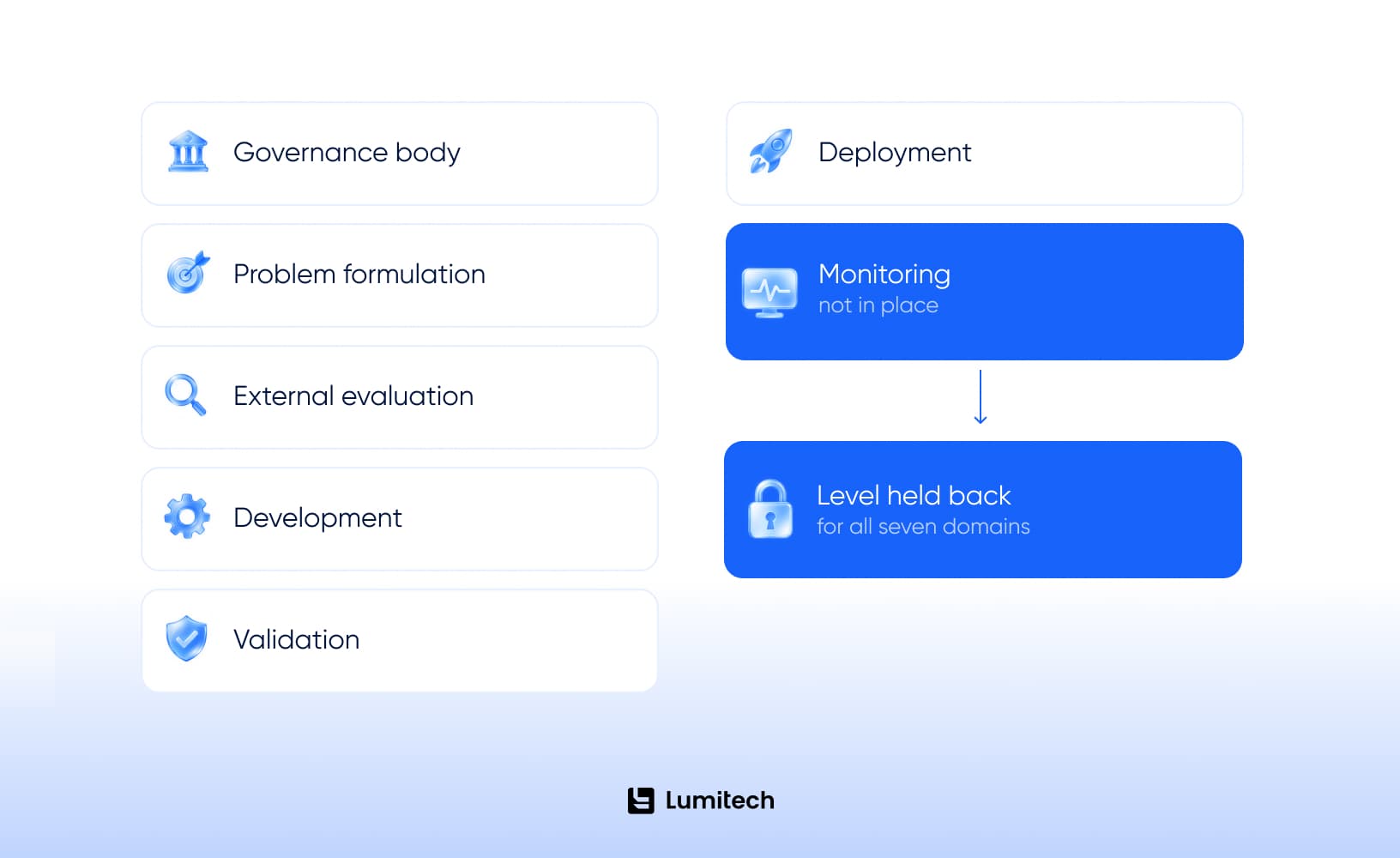
Research on governance maturity adds a related point. A February 2026 systematic review in npj Digital Medicine grouped healthcare AI governance into five maturity levels across seven domains. The weakest domain set the overall level, so good testing couldn’t make up for missing monitoring. The authors didn’t show that the maturity model improves patient outcomes.
An October 2024 Duke-Margolis white paper found several ways to divide the work across six US health systems and other organizations. The structures differed, but the demand on staff remained. A smaller provider can use a simpler setup, as long as there is a current inventory, named owners, a review group, and one clear route for reporting problems.
Where Patient Data Goes Once the Tool Is Connected
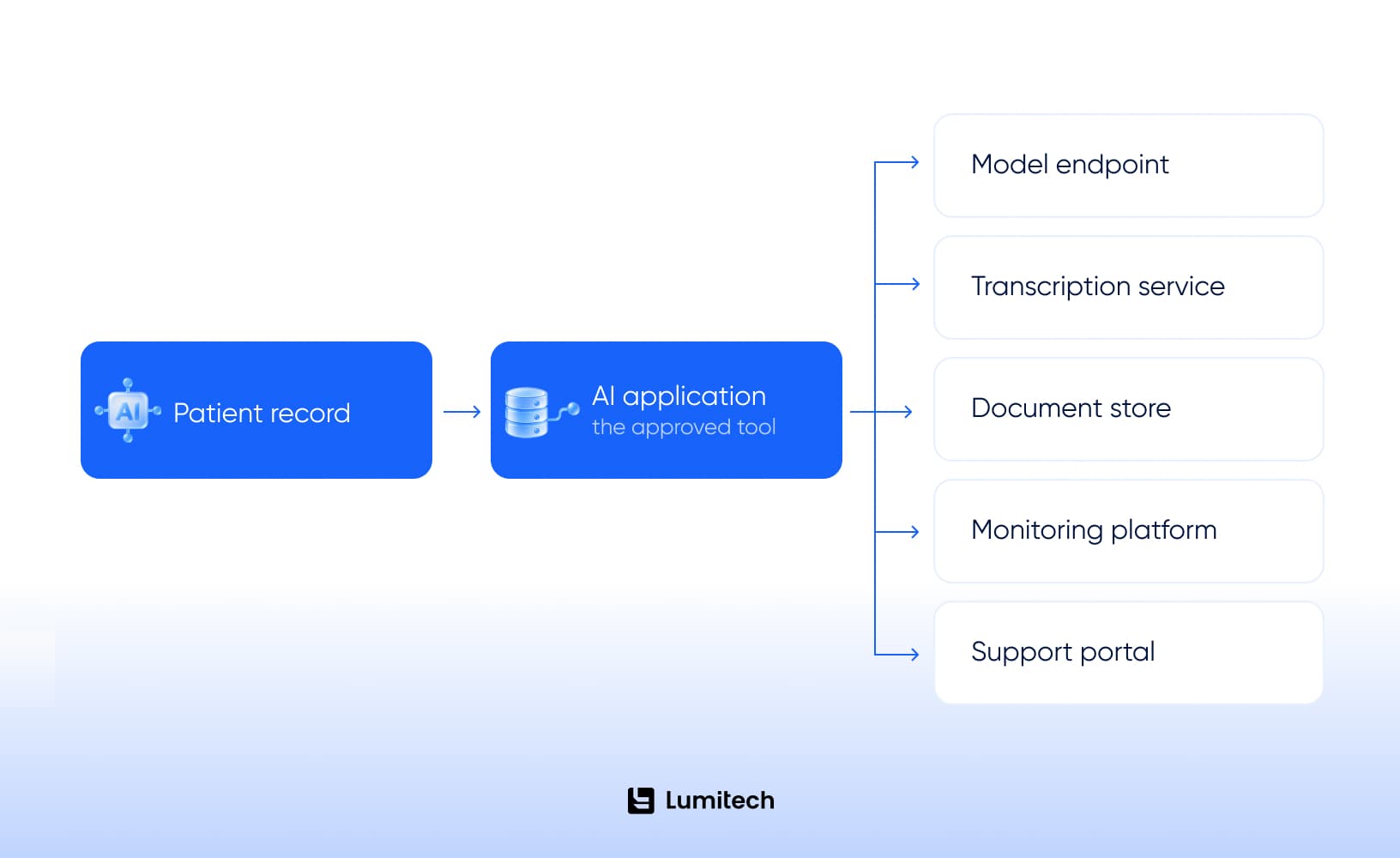
A patient record may pass through several services before the note reaches the chart. Healthcare AI data privacy covers the main application and any transcription service, document store, monitoring platform, or support portal. Clinicians may never see some of them.
AI data privacy healthcare reviews need to follow that route. Testing can create another copy, and so can a support investigation. Each destination has its own access rules and retention period, which need to be clear before routine use.
Drafting a Note and Improving a Model Are Different Uses
AI governance for healthcare data starts by separating the jobs one patient record can do. One copy may help draft a clinician’s note. Another may be used to check that draft or improve the supplier’s model later. Permission for one use doesn’t automatically cover the others.
Before records are shared, the hospital should know what leaves each source system, who receives it, where copies are kept, and when they’re deleted. That includes prompts, outputs, and logs seen by support staff or subcontractors.
For care delivery, healthcare data processing also has to keep dates, encounter details, and corrections attached. Without them, an older result can look current.
Why Removing the Name Isn’t Enough
Removing a patient’s name doesn’t make a record anonymous. A rare condition combined with dates or locations can still identify the person.
Under the Health Insurance Portability and Accountability Act (HIPAA), the Department of Health and Human Services (HHS) recognizes two ways to de-identify data: Expert Determination and Safe Harbor. Safe Harbor goes beyond the obvious patient fields. If a listed identifier appears anywhere in the record, including a clinical note or image annotation, it still has to be removed. Deleting a patient’s name from the profile isn’t enough if the same name remains in free text.
The same check applies to exported logs and any other data that leaves the core record. Synthetic data can reduce exposure during development, but it can’t show how the model performs on the hospital’s own patients. Testing on real records still needs a decision about what can be shared and on what terms.
What HIPAA Asks of the Hospital and Its Suppliers
HIPAA compliance for AI healthcare systems starts with a simple check: who handles the hospital’s records, and why. HIPAA places obligations on covered entities and their business associates when they handle protected health information (PHI). Which rules apply depends on each organization’s role and what it does with the data.
Once roles are clear, the hospital has to confirm that the HHS Privacy Rule allows the proposed use before any records are shared. Some arrangements need agreements or patient authorizations as well. And HIPAA may not be the only law involved, since other privacy laws can apply to the same information.
What to Look For in the Business Associate Agreement
A supplier that creates, receives, maintains, or transmits PHI on a hospital’s behalf may be a business associate. Under HHS cloud guidance, a supplier that stores encrypted electronic PHI for a covered entity still needs a business associate agreement (BAA), even if it doesn’t hold the decryption key.
The agreement gives the hospital something concrete to compare with the service. Retention, subcontractor access, support procedures, and product settings should match its terms. A promise not to use patient data for training should state what it covers and any exceptions.
How Security Safeguards Work After Go-Live
A nurse moves to another unit, but the old access is still there. Someone leaves, yet the account stays open for a few more days. A new integration gets switched on and starts seeing more of the chart than expected. None of this looks dramatic, but it is exactly where security controls can break down.
The HIPAA Security Rule requires administrative, physical, and technical safeguards for electronic protected health information. After go-live, the hospital needs to see whether those safeguards still hold up in the real setup: whether access drops when it should, failed logins show up in the logs, and recovery or incident steps work when the team needs them.
There may be more to check soon. In January 2025, HHS proposed adding a technology asset inventory, more detailed risk analyses, and yearly proof from business associates that their technical safeguards are in place. For now, those changes are only proposed, and the current Security Rule still applies.
Where Bias Enters a Clinical Model
Bias can start with the target a model is trained to predict. A score may be accurate on its own terms and still tell clinicians the wrong thing about a patient’s needs. The first check is therefore what that score actually stands for.
A 2019 Science study found exactly this problem in a population-health algorithm that treated healthcare spending as a proxy for health needs. At the same risk score, Black patients were sicker than White patients. The finding concerned one algorithm and can’t be generalized, but it shows how a poor target can carry inequality into the result.
The data may offer the wrong clue too. In Oakden-Rayner and colleagues’ analysis of the ChestX-ray14 dataset, 80% of pneumothorax cases in the test set already had a chest drain. Performance dropped substantially in cases without one, including patients whose pneumothorax could still be untreated. The overall score looked stronger than performance in the cases where a missed finding could do the most harm.
Does the Model Work as Well for Every Patient Group?
An overall score can hide weak results for part of the hospital’s patient population. Local testing should therefore use the kinds of cases clinicians actually see. Depending on the tool, reviewers may compare results by age, sex, language, disability, or disease severity, provided the hospital can lawfully use those data.
The type of error matters too. A screening model may miss cases, while too many false alarms can wear down staff attention. Small groups are harder to judge, and for risk models, calibration shows whether predicted probabilities match what later happens.
A September 2025 federal report, based on the 2024 American Hospital Association survey, found that 74% of hospitals using predictive AI had evaluated at least some models for bias. The sample covered 1,587 non-federal acute care hospitals. The findings were self-reported, and some models may not have been assessed.
What Happens After an AI Alert Reaches the Care Team
AI governance in healthcare has to follow the output into the clinical workflow. A deterioration alert may work well in one hospital because a specialist is available overnight. In another, the same alert may wait until morning. The model hasn’t changed, but the response around it has.
Generative tools create a different problem. A summary can leave out an important detail, add something the record doesn’t support, or give conflicting recommendations. Better source data can help with some of that. Other cases may simply need tighter limits on where the tool is used.
Predictive tools often need local thresholds too. A setting that works in an intensive care unit (ICU) can overwhelm a general ward with alerts.
When Records Move, but Clinical Context Gets Lost
AI healthcare interoperability can fail even when the transfer itself works. The receiving application may get the right patient and visit but lose track of what was recorded, or whether it was later corrected, stopped, or changed.
Medication data makes this easy to miss. The tool pulls the right drug name, yet the record no longer shows that the prescription was stopped. The summary looks ordinary. The treatment, however, is now presented as current. To sort that out, the team has to follow the exchange back and find the point where the status dropped out.
What FHIR Settles and What the Hospital Still Decides
Fast Healthcare Interoperability Resources (FHIR), developed by Health Level Seven International (HL7), gives applications a standard way to exchange health information. The standard doesn’t settle every local decision. The hospital still decides how records are interpreted and who can access them.
A local setup still has to deal with profiles, terminology mappings, units, timestamps, and missing values. HL7’s FHIR security guidance covers authentication, permissions, and audit controls, while the hospital sets up access across its own systems. For AI applications in healthcare, those choices affect the data the model gets and what later appears on screen.
What HTI-1 Lets Reviewers See About a Model
If a predictive tool comes with certified health IT, Health Data, Technology, and Interoperability (HTI-1) can give the hospital more to go on when it reviews the model. The rule was issued by the Office of the National Coordinator for Health Information Technology (ONC). Under 45 CFR 170.315(b)(11), evidence-based interventions come with 13 source attributes and predictive interventions with 31. For predictive tools, that record can cover intended use, development, performance, fairness, validation, and maintenance.
That record can thin out once a hospital brings in a model from somewhere else. HTI-1 applies when the health IT developer supplies the intervention with the certified product; a third-party model added later may not come with the same detail. Some fields may be missing as well. In AI data sharing healthcare interoperability work, reviewers therefore have to check the model in front of them and see what documentation is actually available.
Testing What Happens When AI Writes to the Chart
Writeback problems often show up when something interrupts the normal flow. The connection drops and someone sends the request again. A clinician corrects the visit record before the draft comes back. Or the user loses access in the meantime.
After each failure, the team needs to open the chart and see what is there. Did the note land on the right visit? Is it still marked as a draft? Did a retry create a second copy? And a rejected draft should stay rejected, wherever it ends up.
Generative Tools Change Without Changing Their Name
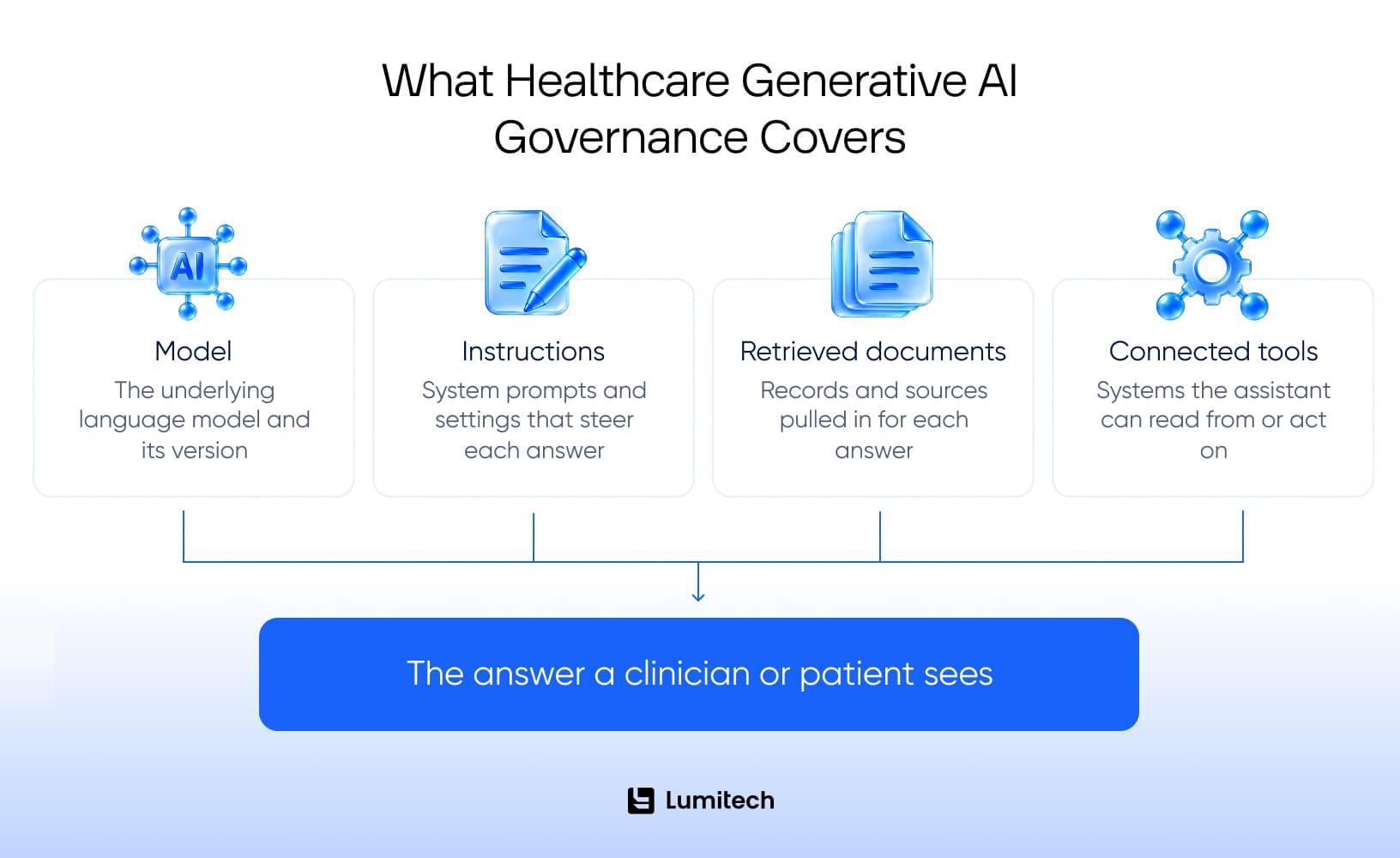
Healthcare generative AI governance covers the model and the parts around it that shape the answer: instructions, retrieved documents, and connected tools. A supplier can change any of them without changing the product name. By then, the hospital may be relying on test results for a setup it no longer uses.
The National Institute of Standards and Technology (NIST) Generative AI Profile offers a voluntary reference for reviewing those risks. It doesn’t certify a medical use or replace any law that applies.
What a Generative Tool Should Be Allowed to Do on Its Own
Clinical review only works if staff have enough context to check the answer. For summaries, that means looking for invented details, missing facts, or information tied to the wrong patient or date. With AI chatbots in healthcare, patients also need a way to reach a person when the chatbot can’t help.
Generative AI governance in healthcare has another issue: instructions hidden in retrieved documents can redirect the assistant or trigger a connected tool. Those documents should stay source material, tool permissions should stay limited, and consequential actions should need separate approval.
Tracing a Bad Answer Back to Its Source
When an answer causes concern, the team should be able to reconstruct how it was produced. That means having the model version, prompt, retrieval settings, approved sources, and application settings tied to the affected output. If the supplier changes one of those pieces, the hospital can see which tests need to run again.
A correction rate, meanwhile, can miss the most serious problems. It won’t show an omission nobody noticed, an unsafe suggestion someone accepted, or a disclosure that was never reported. Monitoring has to capture those cases too and connect them to the version in use.
Not Sure What Your Original Approval Still Covers?
Our team can map where patient data travels, check how the integration handles dates and corrections, and identify what has changed since the tool was signed off.

Which Rules Apply to a Healthcare AI Tool?
Healthcare AI regulatory compliance depends on what the software does, who uses it, and where it’s deployed. A hospital can have every right to process the patient data and still need a separate look at the tool’s clinical function. Privacy law, medical-device rules, and health IT certification each answer a different part of the question, so clearing one review says little about the others.
When Does the FDA Treat the Software as a Device?
In the US, the Food and Drug Administration (FDA) regulates software that meets the medical-device definition. Its January 2026 clinical decision support guidance explains which functions fall inside or outside that framework. HIPAA compliance doesn’t decide that classification.
AI in healthcare regulatory compliance also means separating law from guidance. FDA’s January 2025 lifecycle guidance for AI-enabled device software is still a draft. Guidance is generally nonbinding; legal obligations come from statutes and regulations.
Rules That Come With Certified Health IT
Health IT certification can still impose transparency and risk-management duties when a predictive tool falls outside FDA’s device framework. AI governance healthcare compliance therefore have to cover both.
Those certification requirements may still change. As of October 2026, HTI-5 would remove the AI model-card requirements, but the rule is still proposed. Procurement has to follow the requirements in force while keeping that change in view.
Which EU AI Act Deadline Applies?
The European Union (EU) AI Act classifies systems by risk and assigns duties based on an organization’s role. A healthcare label alone doesn’t decide which requirements apply. The system’s function and the product legislation around it matter too.
The date depends on where the system falls under the Act. Annex III high-risk requirements apply from December 2, 2027. For systems covered through Annex I product legislation, the date is August 2, 2028.
That distinction matters for EU AI Act healthcare compliance. It doesn’t change the deadlines the hospital may already have under GDPR or medical-device law.
Six Questions to Answer Before Release
In healthcare AI governance, a release review brings the separate checks together into one decision: what the hospital is approving, what limitations remain, and who is responsible after launch. This healthcare AI governance checklist gives that review a practical structure, though it doesn’t amount to regulatory certification.
Release Question | What the Team Reviews | Responsible Lead |
|---|---|---|
1. Is the use clearly defined? | Intended users, patient population, workflow, and exclusions | Clinical or operational owner |
2. May the system use these records? | Data flows, legal basis, agreements, and retention terms | Privacy lead |
3. Does it perform adequately on local cases? | Representative tests, subgroup results, and known limitations | Clinical evaluation lead |
4. Does the integration preserve meaning? | Patient identity, terminology, permissions, and writeback tests | Integration lead |
5. Have applicable obligations been addressed? | Classification, market requirements, and supplier documentation | Regulatory and legal leads |
6. Can the team supervise the service? | Monitoring, incident response, fallback, and change procedures | Operational owner |
What the Approval Should Spell Out
A good approval is specific. It says which sites, users, patient groups, data sources, and software versions it covers, and it lists the changes that would send the tool back for review, such as moving into a new specialty, switching model providers, or getting permission to write straight into patient records. With that on paper, a team can check whether a change was covered instead of arguing about it later.
An AI readiness audit helps here by showing which checks are finished and which aren’t. Anything still open goes into the delivery plan with an owner’s name next to it and a clear call on whether it holds up the release.
Rehearse the First Incident Before It Happens
The first real incident is a bad time to work out the process, which is why AI governance for healthcare includes a rehearsal. Before launch, that rehearsal shows how staff reports a suspicious output, how the affected function gets switched off, and how people fall back to the old workflow. It should settle who assesses the impact on patients, who contains the problem and looks back at earlier outputs, and who signs off on recovery or any notification that’s required.
When Does an Approved Tool Need Another Look?
The first sign may be something small. A clinician starts checking every summary against the chart. Nurses stop trusting one alert and call the ward before acting on it. A new manual step appears because staff have learned that the tool sometimes gets the context wrong.
By then, the old test results may not tell the whole story. The patient mix shifts, clinicians document differently, or an upstream system starts sending data in a new way. AI governance for healthcare has to pick up those changes before staff quietly build workarounds around the tool. In AI governance healthcare reviews, those workarounds can be a useful clue that something in daily use has moved on.
If the same issue keeps coming back, the hospital may run another test, limit the tool to certain teams, or stop using it altogether. Taking it out of service still leaves a few jobs behind: closing access, removing integrations, sorting out stored records, and checking what copies the supplier still holds.
From Approval Questions to an Engineering Plan
A tool may already be live while the original approval no longer reflects how it is used. In other cases, the work of healthcare AI governance starts earlier, before a supplier is selected or a new integration goes into production.
Our AI governance consulting team can help turn those questions into a technical plan: which data flows need review, which integration changes are required, and what should be tested before release. Our engineers can then build and test those changes with the client’s clinical and IT teams. Approval remains with the people responsible for the system’s use.