
AI Chatbot in Healthcare: A Pre-Launch Safety, Compliance, and UX Checklist
A wrong answer from a retail bot costs a refund. A wrong answer from a healthcare bot costs more. This is the pre-launch checklist that closes that gap.
- Health & Wellness
- AI Development
July 22, 2026
 AI Overview
An AI chatbot in healthcare is a conversational software system, powered by natural-language processing, that supports administrative tasks like scheduling and intake rather than clinical diagnosis. Core components include clinical safety testing, HIPAA-compliant PHI protection, and human escalation logic. Without rigorous adversarial pre-launch testing, even one unsafe answer per thousand can directly endanger a real patient.

A retail chatbot that gets an answer wrong costs someone a refund. A medical one that gets an answer wrong can cost someone their health. That single difference is why launching a healthcare chatbot is not like flipping the switch on a customer-support bot, and why the “move fast and iterate in production” playbook that works for e-commerce is dangerous the moment real patients are on the other end of the conversation.
The pressure to automate is real. Support lines are overwhelmed, staff is stretched, and the promise of chatbots and healthcare working together — instant answers, 24/7 triage help, fewer no-shows — is genuinely compelling. But the gap between a demo that impresses a hospital board and a system that’s safe to put in front of anxious, symptomatic, sometimes vulnerable users is enormous. Between those two points sits a body of testing that most teams underestimate.
This guide outlines what needs to happen before launch. It’s written for product owners, clinical leads, compliance officers, and engineering teams who are seriously evaluating AI chatbots in healthcare and want a structured way to de-risk the rollout — the same rigor that responsible healthcare software development applies to any clinical-facing system, specifically focused on conversational AI. We’ll talk about what these systems are (and what they must never claim to be), the proper areas for their application, clinical safety and privacy testing, the preparations before their launch, and the checklist that may come in handy on the day of launch. The goal is to make sure the version you ship holds up when the traffic is real, and the stakes are, too. Done right, chatbots in healthcare free clinicians to do the work only clinicians can.
What Is an AI Chatbot in Healthcare?
An AI chatbot in healthcare is a conversational software system that uses natural-language processing — increasingly powered by large language models — to interact with patients, caregivers, or staff. It sits within the much broader wave of AI in healthcare apps, from wellness trackers to clinical decision-support tools, but a conversational interface carries risks the others don’t: it invites patients to describe symptoms in their own words, which is exactly where things can go wrong. It can answer administrative questions, guide users to resources, collect intake information, or help navigate services. Critically, it is a support and navigation tool, not a diagnostic authority: it should never be positioned as a replacement for a qualified clinician’s judgment.
That boundary matters more than any feature. The most dangerous framing a team can adopt is treating a chatbot in medical field deployments as a junior doctor who happens to be cheaper. It isn’t. These systems don’t understand medicine; they predict plausible language. That makes them excellent at explaining where to park for an MRI and genuinely hazardous if asked to confirm whether a chest pain is serious. The role of AI chatbots in healthcare is to reduce friction in care, not to make clinical decisions.
The category is broad. Some chatbots are simple rule-based flows that answer FAQs and book appointments. Others use retrieval and generative models to handle open-ended questions. The broader chatbots in the healthcare industry landscape span everything from wellness-app nudges to hospital-grade triage assistants, and the level of testing a system needs scales directly with how close it gets to a clinical decision. A bot that shares visiting hours needs light validation; one that interprets symptoms needs a great deal more.
Where AI Chatbots in Healthcare Deliver the Most Value
The safest, highest-value deployments are administrative and informational rather than diagnostic. Administrative tasks such as scheduling, sending reminders, answering insurance or billing queries, placing medication refill requests, pre-visit intake, and wayfinding make life easier without requiring the AI to carry out any medical evaluations. As tasks move closer to interpreting symptoms or advising on treatment, both the value and the risk rise sharply — and so must the testing behind them.
A useful way to scope a rollout is to sort the healthcare chatbot use cases you’re considering into two risk tiers.
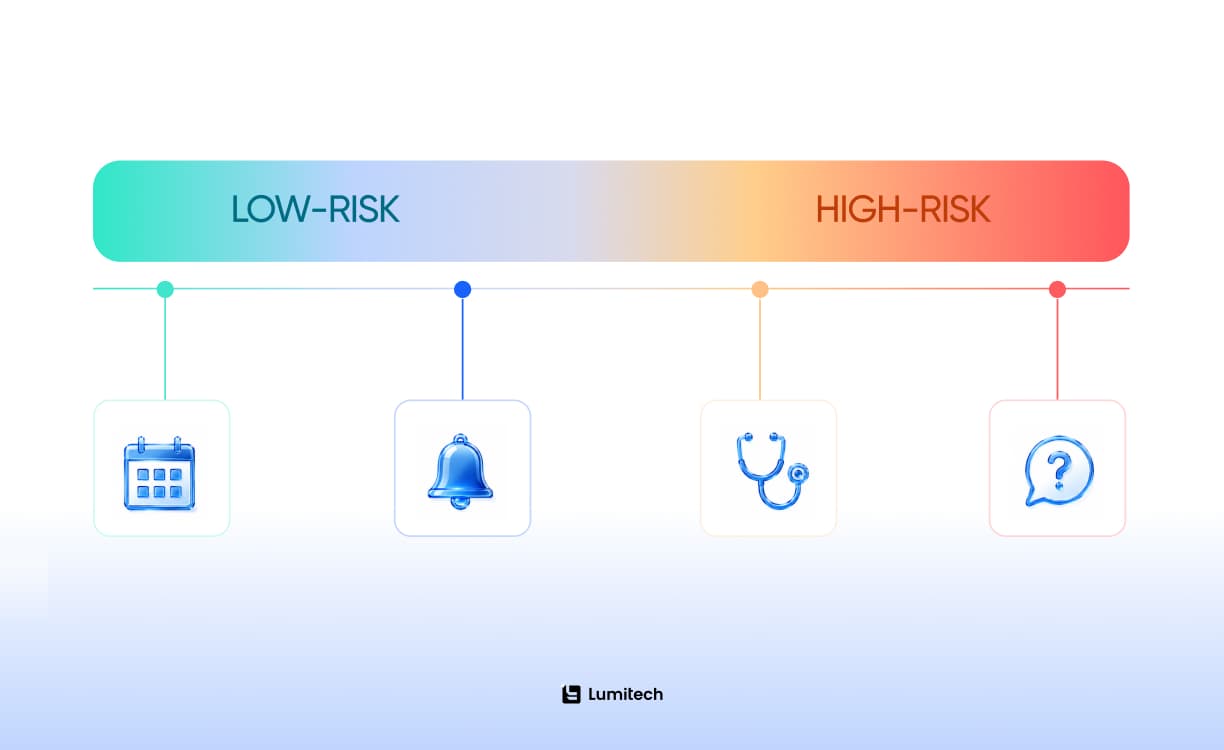
Low-risk, high-value use cases are the natural starting point. These include:
appointment booking and rescheduling
automated reminders that cut no-show rates
answering questions about hours and locations
insurance and billing FAQs
prescription refill requests
collecting structured intake forms before a visit.
Chatbots also pair naturally with AI in remote patient monitoring programs, nudging patients to log readings or flagging when a check-in has been missed — administrative support, not clinical interpretation.
Here, the use of chatbots in healthcare primarily replaces phone tag and paperwork, and errors are recoverable. This is also where an AI chatbot tends to pay for itself fastest, by absorbing the routine volume that clogs call centers.
High-risk use cases call for much greater consideration and awareness, as well as professional involvement. Under this classification fall symptom evaluation, triage recommendations, medication advice, mental health support, and everything that influences whether a person contacts a specialist. Modern chatbot technology in healthcare can support these flows, but only with rigorous safety testing, conservative escalation, and clear limits on what the system will attempt. When in doubt, the correct course of action is to hand off to a human rather than guess.
What to Test Before Launching a Healthcare AI Chatbot
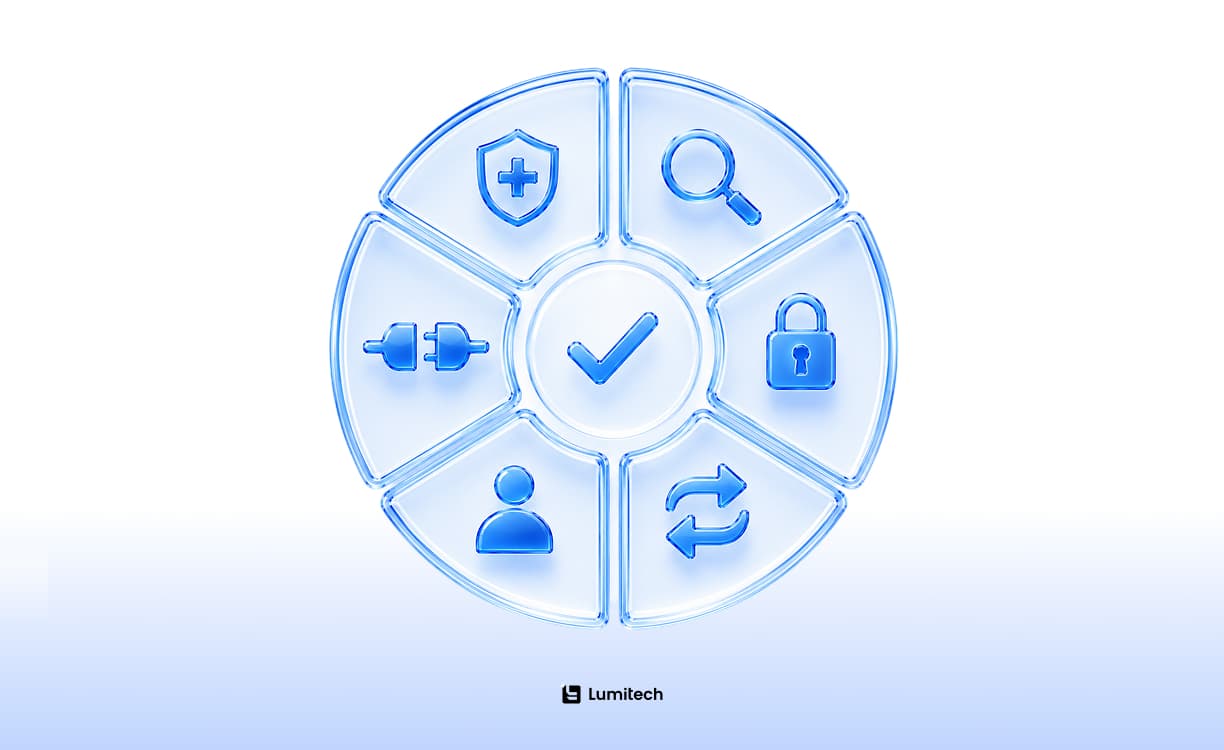
Before launch, test at least six things: clinical safety (does it ever provide unsafe guidance?), accuracy and hallucination control, PHI protection and HIPAA compliance, escalation and human handoff, patient experience and accessibility, and integration integrity. Each needs documented, adversarial testing — not a happy-path demo. The main question here is how it fails when used the way real, frightened, imprecise people actually use it.
Clinical Chatbot Safety
Safety testing here asks a blunt question: can this system ever produce output that leads a user toward harm? You test it by trying to make it fail. Feed it emergency presentations (chest pain, stroke symptoms, suicidal ideation, anaphylaxis) and confirm it recognizes red flags and escalates immediately rather than offering reassurance.
Structured symptom-checker chatbot testing should cover a wide range of presentations, including atypical and mixed ones, and verify that the bot never downplays a potentially serious situation. Patient triage chatbot testing goes further, checking that severity is graded conservatively — when uncertain, the system should always err on the side of “seek care,” never away from it. Underpinning both, a documented AI chatbot risk assessment healthcare teams can defend should catalog every plausible failure mode, its potential harm, and the control that mitigates it.
The mindset that matters here is adversarial, not confirmatory. It’s easy to prove a bot works when you ask it the questions it was designed to answer; the point of safety testing is to attack it. Assemble a red team that includes clinicians, and have them deliberately phrase questions the way real people do — vaguely, emotionally, with incomplete or contradictory details, sometimes in the middle of a genuine emergency. Log every response that falls short of safe behavior, trace it to its root cause, and retest after the fix. A single unsafe answer in a thousand is not a rounding error when the thousand is real patients; it’s the one that ends up in an incident report. Weight your test set toward the highest-severity scenarios, because those are the ones where a wrong answer is least recoverable.
Hallucination and Accuracy Controls
Generative models invent things. In most cases that’s a minor inconvenience; within healthcare that can become troublesome. Create a robust framework of questions with known responses, and verify the model not only for correctness but also for the types of errors it makes. Health bots that confidently state an incorrect dosage are far more dangerous than ones that say, “I’m not able to help with that — here’s how to reach a nurse.”
Limit the model to vetted content wherever possible, and test that it stays inside those bounds under pressure. Try to coax it off-script with leading questions, hypotheticals, and persistent rephrasing, and confirm it declines rather than improvises. Every generative answer that touches on health information should be traceable to an approved source.
Pay particular attention to confident wrongness, because that’s the failure mode users can’t defend against. A hesitant, hedged wrong answer at least signals doubt; a fluent, authoritative one invites trust it hasn’t earned. Measure how the system behaves at the edges of its knowledge — questions it wasn’t built for, or ones that sit just outside the approved content — and confirm that its default there is graceful refusal, not confident invention. Retrieval-augmented approaches that ground answers in a curated knowledge base help enormously, but they’re not magic: test that the retrieval actually fires, that it pulls the right passage, and that the model doesn’t quietly override a correct source with a plausible-sounding fabrication of its own.
PHI Protection and HIPAA Compliance
Any system that handles identifiable health information in the US must comply with HIPAA requirements, and testing it is not optional. A HIPAA-compliant AI chatbot must encrypt data in transit and at rest, enforce access controls, log activity for audit, and operate under a signed business associate agreement with every vendor in the chain — including the model provider. Every stage of healthcare data processing the chatbot touches — collection, transmission, storage, deletion — needs to be mapped before launch, not discovered afterward.
Run a dedicated PHI data protection chatbot review that traces exactly where patient data travels, where it’s stored, how long it’s retained, and who (or what) can access it. Confirm the system doesn’t leak information across sessions, doesn’t send PHI to services that aren’t covered by a BAA, and redacts sensitive data from logs and analytics. A genuinely HIPAA-compliant AI chatbot is proven so through documented data-flow testing, not asserted so in a marketing sentence.
The model provider is the easiest link to overlook and one of the most important. If an AI chatbot for hospitals sends conversation content to a third-party language model, that content may include PHI the moment a patient types their symptoms or their name, and the provider must be covered by a business associate agreement and configured not to retain or train on your data. Test this deliberately: confirm that data-retention settings are actually applied, that prompts and responses aren’t being logged somewhere outside your controls, and that the contractual terms match the technical reality. Regulations also vary by jurisdiction — teams operating outside the US face frameworks like GDPR that impose their own requirements — so scope your compliance testing to every region you serve, not just your headquarters. This is also where dedicated AI cybersecurity solutions earn their keep, since a chatbot handling PHI is a genuine attack surface, not just a compliance checkbox.
Escalation and Human Handoff
The single most important safety feature for chatbots in the healthcare industry is knowing when to stop. Test that the system escalates reliably, quickly, and in every scenario where it should — emergencies, repeated user confusion, explicit requests for a person, low-confidence answers, and any high-risk topic. Escalation should be the default when uncertain, and it should be frictionless for the user.
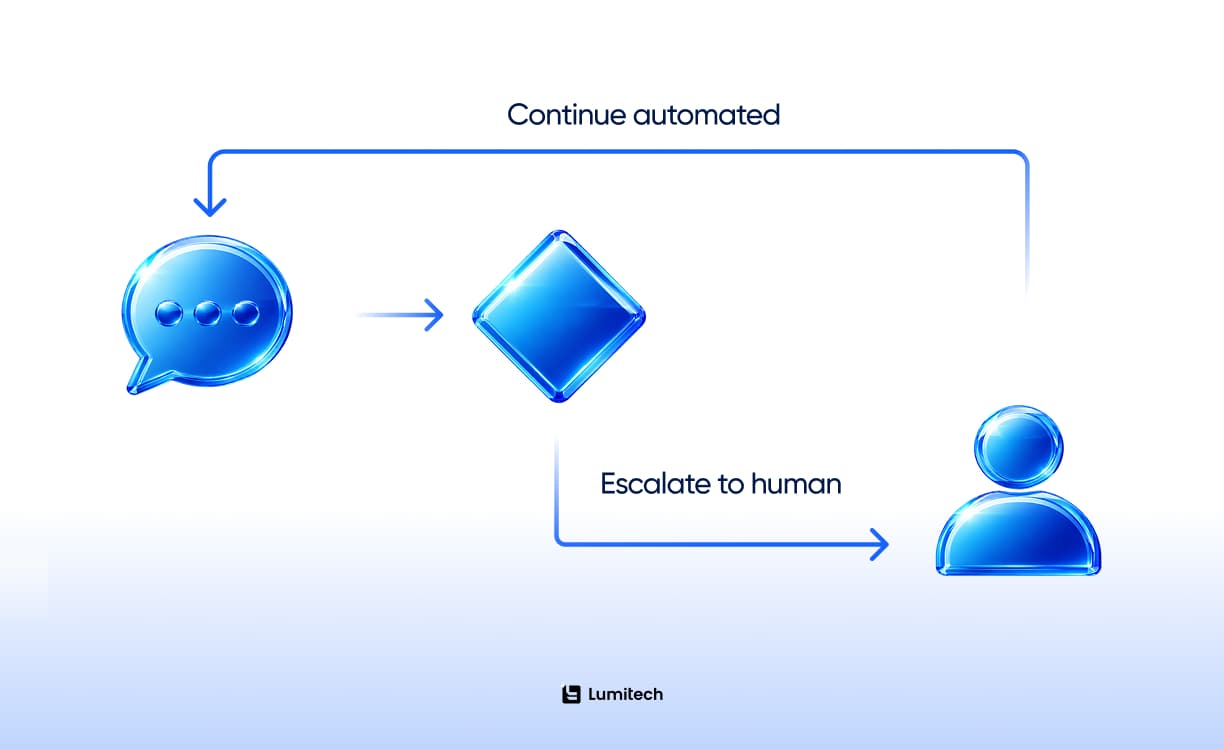
Verify handoff works end-to-end: the user reaches a real person, context transfers so they don’t repeat themselves, and after-hours paths route to a safe destination rather than a dead end. Test what happens when the escalation channel itself fails — the fallback must never be “the bot keeps improvising.”
It helps to define escalation triggers explicitly and then test each one in isolation. Emergencies should short-circuit everything else immediately. Repeated misunderstanding — the user rephrasing the same question two or three times — should trigger a handoff before frustration turns into abandonment. An explicit “I want to talk to a person” must always be honored without a maze of confirmations. And any answer the model itself is low on confidence in should be routed to a human rather than delivered with false certainty. Time the whole path, too: an escalation that technically works but leaves a symptomatic patient waiting without acknowledgment is a poor experience at exactly the moment when experience matters most. Instrument the handoff so you can see, after launch, how often it fires and whether it resolves as intended.
Patient Experience and Accessibility
A safe bot that patients can’t use isn’t safe in practice. Rigorous patient chatbot UX testing puts real, representative users in front of the system — including older adults, people with low digital literacy, non-native speakers, and users with disabilities — and watches where they struggle.
Test tone under stress: the AI healthcare chatbot system should be calm, plain-spoken, and never dismissive. Confirm it meets accessibility standards (screen-reader compatibility, legible contrast, keyboard navigation) and clearly communicates its limits, so users always know they’re interacting with software and how to reach a human.
Language and literacy deserve explicit attention. A patient under stress reads at a lower level than they do calmly, so plain, jargon-free wording becomes a safety feature. If you serve a multilingual population, test each supported language with native speakers rather than relying on machine translation, because a mistranslated instruction in a medical context can cause real harm. Watch, too, for the subtle failure where the bot is technically accurate but emotionally tone-deaf: a curt, robotic reply to a frightened person can drive them away from care as surely as a wrong answer would.
Integrations and Data Flows
Most production failures occur at the seams. If the bot connects to an EHR, a scheduling system, or a billing platform, test every integration for correctness under both load and failure conditions — and where possible, build on established healthcare interoperability solutions rather than custom point-to-point connections, since standardized data exchange is easier to audit and far less brittle.
Confirm an appointment-scheduling chatbot healthcare staff depend on can’t double-book, book into the past, or silently lose a confirmation. Test what the system does when a downstream service times out or returns an error — it should fail safely and transparently, never pretend an action succeeded when it didn’t.
If your top five reports lack named owners and replayable lineage, that is where we start. Tell us which reports matter, and we will map the gaps.

Healthcare AI Chatbot Development: What to Build Before Launch
Before go-live, build the scaffolding that enables safe operation: a governance model with named clinical and compliance owners, an approved content pipeline, guardrails and escalation logic, comprehensive audit logging, and a monitoring stack. The chatbot itself is only part of the deliverable; the system around it — controls, oversight, and the ability to see what’s happening — is what separates a responsible launch from a reckless one.
Responsible AI chatbot development for healthcare starts with governance, not code. That’s a different starting point from most consumer AI chatbots development work, where speed to launch is usually the top priority. Decide who owns clinical accuracy, who owns privacy, and who has the authority to pull the system offline if something goes wrong. Without those names assigned before launch, no one is accountable when it matters.
Everyone wants to talk about what the chatbot gets right. We spend most of our time on what it does when it’s confused, under pressure, or being asked something it was never built to answer. That’s the part that actually determines whether it’s safe.


Building a Compliant Chatbot Solution for Healthcare
A defensible chatbot solution for healthcare is built in layers. Underneath the conversation sits a content layer of vetted, approved answers; a guardrail layer that constrains what the model can say and forces escalation on high-risk topics; a privacy layer that keeps PHI protected end-to-end; and an observability layer that records everything for review. Skipping any layer to hit a deadline is how teams end up in the headlines.
Mature AI chatbot development for healthcare also plans for the unhappy paths from day one: what the bot says when it doesn’t know, how it behaves when an integration fails, and how quickly a human can intervene. A well-built AI chatbot treats “I can’t help with that, but here’s who can” as a feature, not a failure. The broader market is full of impressive demos; the ones worth trusting are the ones that can show you their guardrails, audit trail, and escalation logic — not just their conversation flow. Whatever an AI chatbot healthcare vendor promises, insist on seeing how the whole system behaves when things go wrong, because that’s where safety is won or lost.
Healthcare AI Chatbot Pre-Launch Checklist
Use the checklist below as a final gate before go-live: if you can’t check every box with documented evidence, you’re not ready to launch. It consolidates the safety, compliance, and experience work above into a single review artifact that clinical, legal, and engineering stakeholders can sign off on together. Treat an unchecked box as a launch blocker, not a nice-to-have.
Run through this healthcare chatbot pre-launch checklist before you ship:
Clinical safety. Red-flag and emergency scenarios trigger immediate escalation; triage errs on the side of caution; a documented risk assessment is in place and signed off.
Accuracy. Factual accuracy is measured against a known-answer bank; the model is constrained to vetted content; hallucination attempts fail safely.
Privacy and compliance. Data flows are mapped; encryption, access controls, and audit logging are verified; BAAs are in place with every vendor; PHI never leaks across sessions or into logs.
Escalation. Human handoff works end-to-end, transfers context, and is the default under uncertainty; escalation-failure fallbacks are safe.
Patient UX. Representative users (including older, low-literacy, and disabled users) have tested it; accessibility standards are met; the system discloses that it’s software.
Integrations. Every connected system is tested under load and failure; no silent failures; safe degradation confirmed.
Monitoring. Ongoing healthcare chatbot monitoring is live — real-time dashboards, anomaly alerts, and a documented process for reviewing flagged conversations and shipping fixes.
A responsible rollout treats this list as a recurring review. Threats, models, and content all drift after launch, so the gate you build now is one you’ll walk through again with every significant update.
Monitoring deserves special emphasis because it’s the control that catches what pre-launch testing missed. No test suite, however thorough, anticipates every way real users will phrase things or every edge case production traffic surfaces. Live dashboards should track escalation rates, refusal rates, user drop-off, and any spikes in categories you’ve flagged as high-risk. Route a sample of real conversations — with privacy safeguards in place — to human reviewers, and treat every flagged exchange as a potential fix rather than a one-off. Set alert thresholds so that an unusual pattern reaches a human quickly, and rehearse the kill switch before you need it: everyone should know in advance who has the authority to take the system offline and how quickly that can happen. The launch is the start of the safety work, not the end of it.
Ready to move from checklist to build?
Lumitech develops HIPAA-compliant, clinically-tested chatbot solutions for healthcare teams who’d rather launch it right than launch it fast.

The Bottom Line on Chatbots in Healthcare
The teams that launch an AI chatbot in healthcare safely are the ones that treated testing as the product, not the paperwork. A polished conversation flow is the easy 20%; the clinical safety validation, the privacy testing, the escalation logic, and the monitoring are the 80% that determines whether the system helps people or harms them.
Start conservative, automate the low-risk volume first, keep a human firmly in the loop for anything clinical, and expand only as your evidence grows. As agentic AI systems that can take multi-step actions on a patient’s behalf become more capable, that same conservative discipline — not less of it — will be what keeps them safe to deploy. Used this way, these systems can genuinely lighten the load on strained systems and give patients faster, calmer access to the help they need, without ever pretending to be the clinician they still deserve.


