Digital Twins in Construction: From Live Site Data to Smarter Project Delivery
Construction has always been data-heavy and insight-poor. Models, programmes, RFIs, site photos, drone scans, sensor readings — they exist, but they rarely come together in a way that changes how the project runs day to day.
- Industrial Sector
- Construction
June 04, 2026
 AI Overview
A digital twin in construction is a continuously updated virtual replica of a project that connects BIM models with real-time sensor, IoT, and equipment data rather than static reports. Core stack layers include BIM authoring, sensor integration, data connectivity, and a live operational view linking design intent to as-built reality. Unreliable data feeds break trust in the twin, since the system is only as dependable as its weakest integration layer.

A digital twin is not “one more system” on this pile; it is an attempt to turn all that fragmented information into a single operational view that stays in step with the site. What follows is a practical look at what that actually means, how it works technically, and where it genuinely moves project and asset metrics.
What a Digital Twin Actually Means in a Construction Context
Most medium and large projects today generate a huge amount of information. You have BIM authoring models, 2D sheets, schedules, daily logs, equipment telemetry, access‑control data, even early experiments with sensors and drones. Despite this, decisions on site are still often made from static reports and spreadsheets that are out of date by the time the meeting starts. The data exists, but as isolated islands.
In that context, digital twins in construction are less about a new buzzword and more about changing the relationship between the site and its data. For a construction team, a digital twin is a virtual replica of a construction project or building that is updated continuously — a dynamic digital representation of physical assets, not just a frozen 3D file. You still start from a BIM model, but the goal is to turn it into a BIM model with real-time data attached to elements and systems, so that it reflects what is currently built and how it behaves.
What makes this a live cyber-physical construction system is the way sensor data integration, IoT feeds and real-time construction data all feed into the same structure. Structural gauges, environmental sensors, concrete maturity probes, equipment telemetry, and manual updates from the field all adjust the twin as the project evolves. The twin connects design intent with as‑built and as‑operated reality, and it enables teams to base decisions on what is happening now instead of relying only on weekly progress narratives.
When we work on software development solutions for construction, we see this as an integration problem before anything else: if you cannot trust the feeds, you cannot trust the twin. In that sense, digital twin technology in construction is less about 3D visuals and more about building a reliable bridge between the physical project and its digital counterpart.
The Technology Stack Behind a Construction Digital Twin
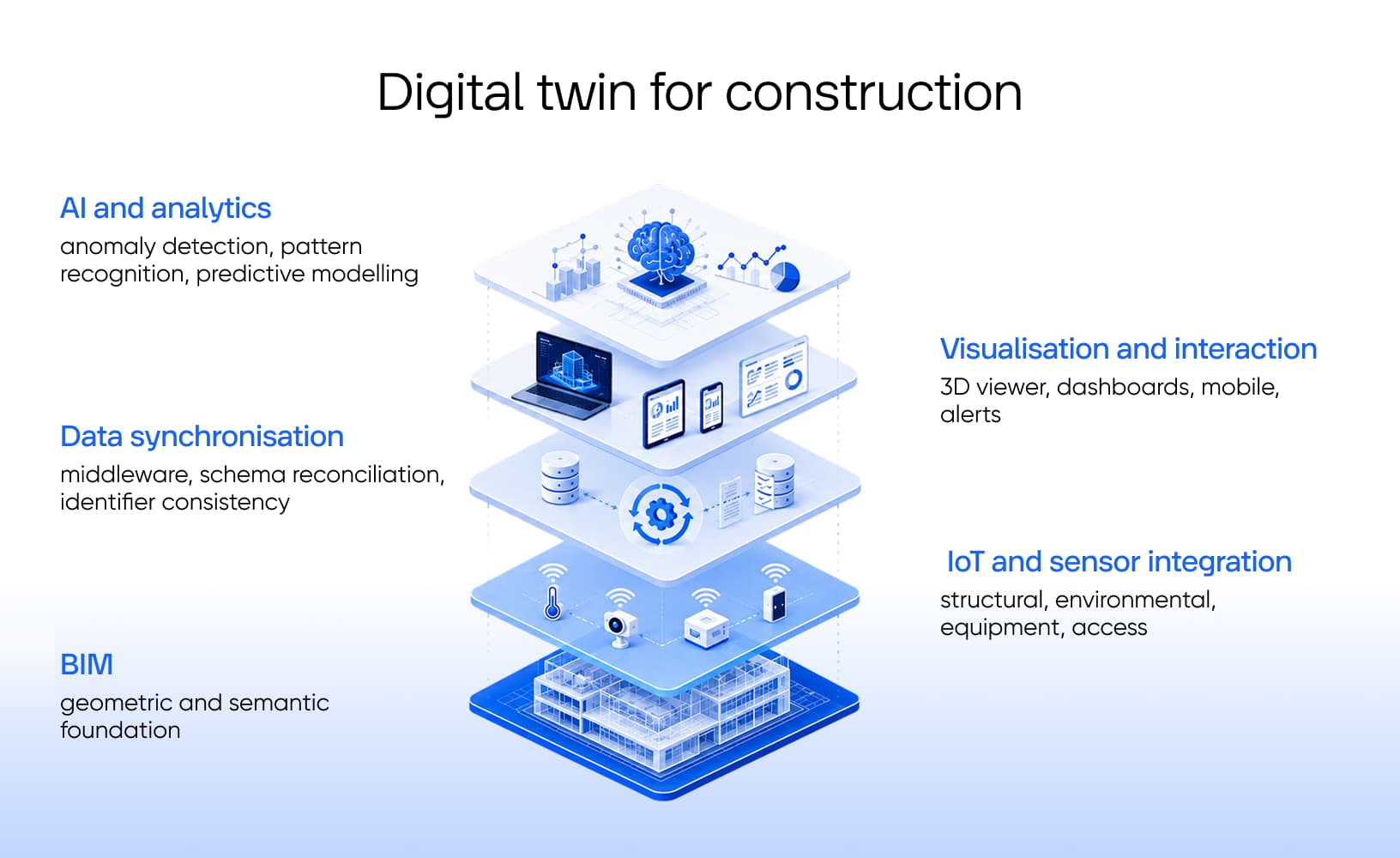
A digital twin for construction is not one product you install. It is a set of layers that, together, behave like a system. If any of these layers is weak — especially the middle ones — the whole setup degrades into a slightly nicer dashboard rather than a dependable view of reality.
BIM as the geometric and data foundation
BIM provides the geometric and semantic skeleton of the twin. In design, it is a structured model of spaces, systems and components, used to coordinate disciplines and extract quantities. As a design deliverable it is frozen at a point in time. As a live data container, the same BIM-based digital model becomes the place where each physical element has a digital identity, with attributes that can change as work progresses. That shift — from static drawing set to evolving data structure — is the first step toward a real twin.
IoT and sensor integration
On site, the model only comes alive when it is tied to sensor data integration. That usually means instrumenting specific areas or systems with structural sensors (strain, displacement, vibration), environmental monitors (temperature, humidity, dust, noise), equipment telemetry (runtime, fuel, GPS), concrete maturity sensors, and access‑control logs. Data arrives at different frequencies — seconds for some readings, minutes or hours for others. The challenge is to get those signals mapped to the correct locations and objects in a way that can support a real-time digital building representation instead of a loose collection of graphs.
Data synchronization layer
Between the physical world and the model sits the data synchronization layer — effectively an integrated construction data platform. This middleware keeps data synchronization between physical and virtual assets under control. It deals with latency, filters noisy readings, reconciles schema mismatches between BIM tools, IoT platforms and project databases, and keeps identifiers consistent as models change over time. From an engineering perspective this is often the hardest part; small errors in mapping or timing can easily cascade into a twin that is always “almost right” and therefore not trusted.
Visualization and interaction layer
Most users interact with the twin through the visualization and interaction layer. This can include 3D viewers linked to the schedule, dashboards for planners and commercial teams, mobile interfaces for site engineers, and alerting tools for HSE and operations. The question here is practical: how does someone standing on a slab, or sitting in a coordination meeting, actually see and act on the twin? Without good interaction patterns, the rest of the stack becomes a background service few people touch, even if the data is sound.
AI and analytics layer
On top of all that sits the AI and analytics layer. This is where pattern recognition, anomaly detection and predictive modelling live — from spotting unusual crane utilisation patterns to flagging structural responses that deviate from expected behaviour. Increasingly, generative approaches play a role as well: summarising complex site data, producing scenario comparisons, or turning raw logs into narratives for non‑technical stakeholders.
In our work on generative AI solutions, we see this layer acting as the interpreter between the twin’s raw streams and the decisions teams need to make. Taken together, these layers are what make a digital twin for construction a functioning system rather than an impressive static model.
Where Digital Twin Technology Delivers Real Value Across the Project Lifecycle
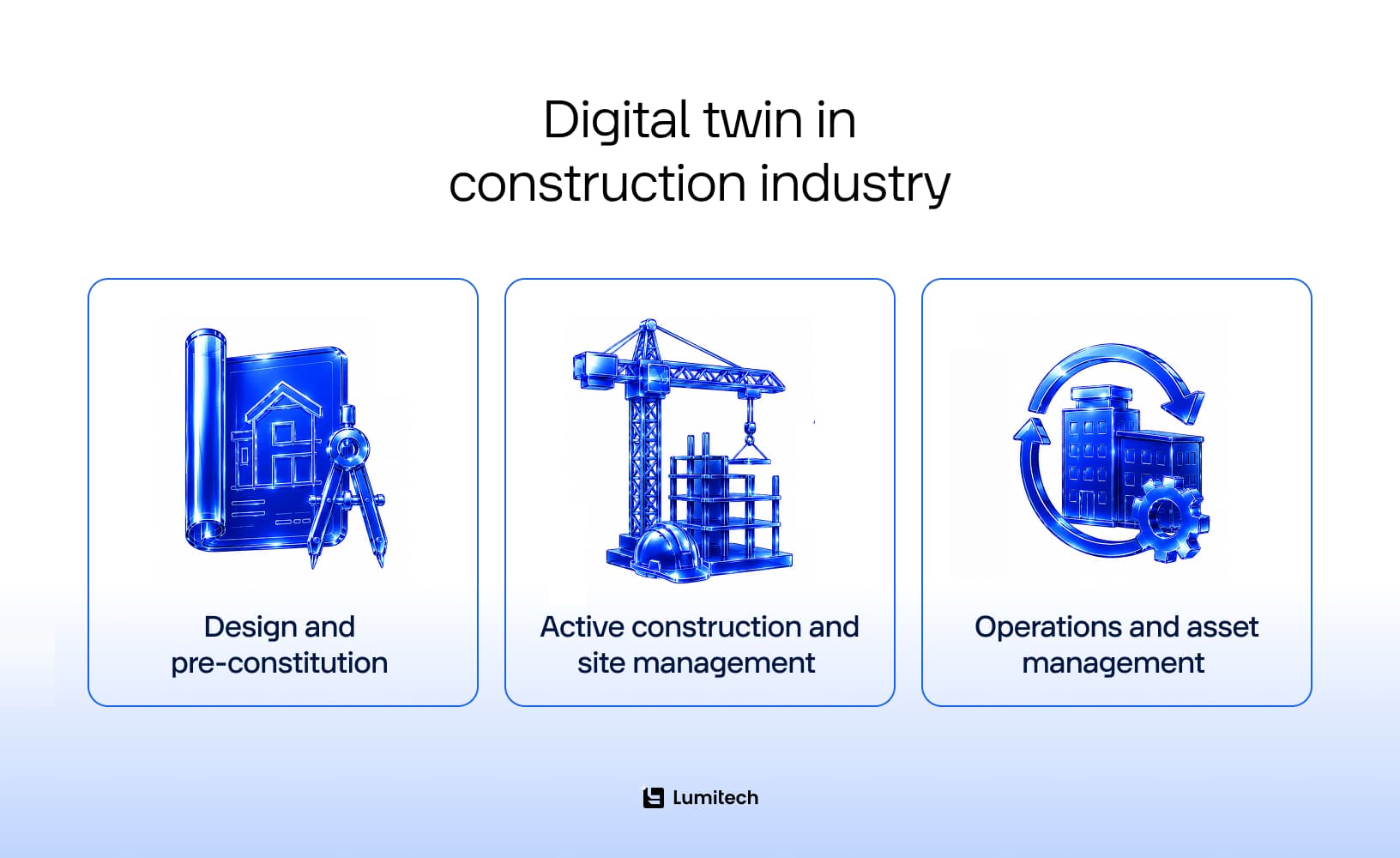
The argument for a twin becomes clearer when you follow it through the project and into operations. The same structure behaves differently at each phase, but the logic — one connected view instead of many partial ones — stays constant. That is also why you have to think beyond a single contract if you want the full value, especially in the digital twin in construction industry context.
Design and pre-construction
In design and pre‑construction, the twin is mostly a richer virtual model of a building. Clash detection and constructability analysis are already standard BIM practices, but when you treat the model as the starting point of a future twin, you are stricter about data quality and completeness. Scenario modelling — testing alternative sequences, methods or temporary works structures — can be done in a way that keeps results attached to the model elements, not just in separate reports.
The cost asymmetry is obvious: fixing an access problem in a meeting room is one thing; discovering it after steel is erected is another. Design intent, once validated, can be locked into the model and later used as the baseline to track deviations during construction.
Active construction and site management
During delivery, the picture shifts towards a live construction model. Planned vs. actual progress visualizations help planners and managers see delays or resequencing needs earlier than conventional reports. Real-time construction data from sensors and field apps highlight where work is happening, where equipment is idle, and where environmental or structural readings suggest potential safety issues.
This is also where many business cases are written — shorter programmes, fewer surprises, better utilisation. At the same time, it is the hardest phase to execute technically. Site conditions are noisy. Connectivity is patchy. Different contractors bring their own tools. Keeping the twin in sync under these conditions is where many implementations struggle, despite the potential benefits of digital twins in construction.
Operations and asset management post-handover
Post‑handover, a digital twin for construction projects can mature into an intelligent building model used by owners and facilities teams. Predictive maintenance is one obvious use: vibration or temperature patterns linked to specific equipment can trigger interventions before failure; repeated alarms in a specific zone can drive root‑cause analysis. Energy optimisation and comfort management are another: telemetry from HVAC, lighting and occupancy feeds into control strategies that reduce waste.
The same data principles we use for an industrial energy monitoring system — structured, high‑frequency measurements aligned with equipment and zones — applied here directly. Better space management, compliance tracking and lifecycle planning follow from the same foundation. For many owners, this phase is where the digital twin in construction industry stops being a project nice‑to-have and becomes a core operations tool.
If you recognise these lifecycle use cases but your data and tools still feel disconnected, aligning the architecture is the next step.

The Honest Case: Benefits of Digital Twin in Construction — and Where It Gets Hard
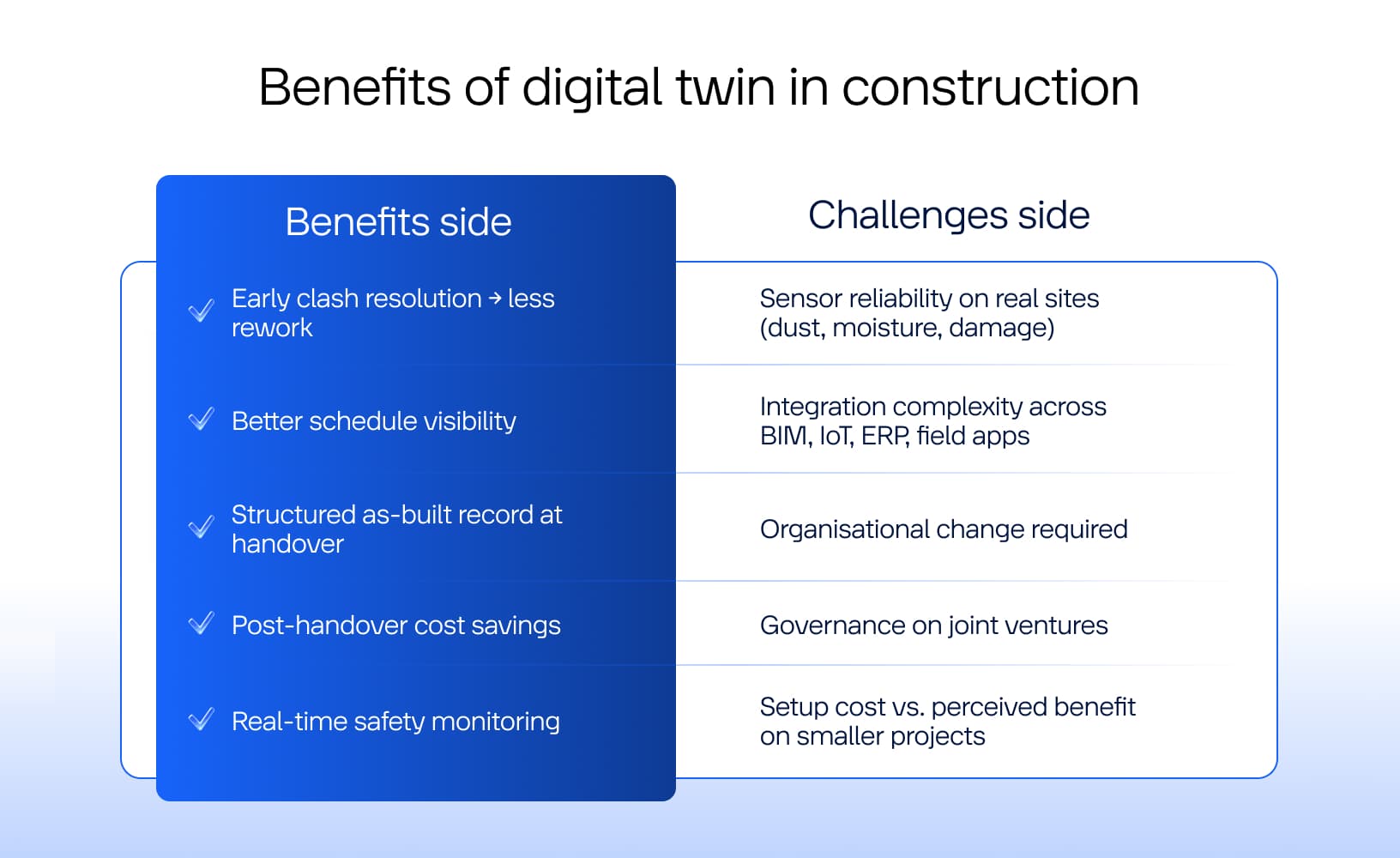
There is a real benefits of digital twin in construction story that teams on the ground will recognise. There is also a set of frictions that marketing slides usually skip. You need to keep both in view if you are the one sponsoring or designing an initiative.
Concrete benefits include:
Early clash resolution and reduced rework
Better schedule visibility and faster decisions during delivery
Structured as‑built record at handover instead of disconnected PDFs
Post-handover cost savings through predictive maintenance and energy management
Improved safety through real-time environmental and structural monitoring
On the other side, the challenges of digital twin in construction are serious. Data quality and sensor reliability are fragile on real sites; devices are exposed to dust, moisture, accidental damage and ad‑hoc relocation. If your twin expects perfect input, it will degrade quickly.
Integration is another hard problem. Connecting BIM tools, field capture apps, ERP, and IoT platforms means dealing with different schemas, identifiers and data habits. Many firms only discover the gaps when they start a data migration effort and realise how inconsistent their naming and structures have been across projects.
Organisational change is not trivial either. A digital replica of a building, or a broader dynamic building model for an infrastructure asset, only works if people change how they record and use information. Project managers must review deviations in the twin, not just in spreadsheets. Site engineers need to update status in ways the system can ingest, not just through ad‑hoc messages. For smaller projects, the cost of setting up a full digital twin for smart construction can feel high relative to perceived benefit, especially when clients are not yet demanding it explicitly.
Governance questions appear on joint ventures: whose standards apply, who owns which part of the twin, and how access is managed. Against that background, the companies that get the most benefits of digital twin in construction are usually not the ones with the largest budgets; they are the ones that scoped tightly, started with clean data, and treated the whole thing as an engineering problem rather than a software procurement exercise.
Digital Twin Software for Construction: What to Look for Before You Choose a Platform
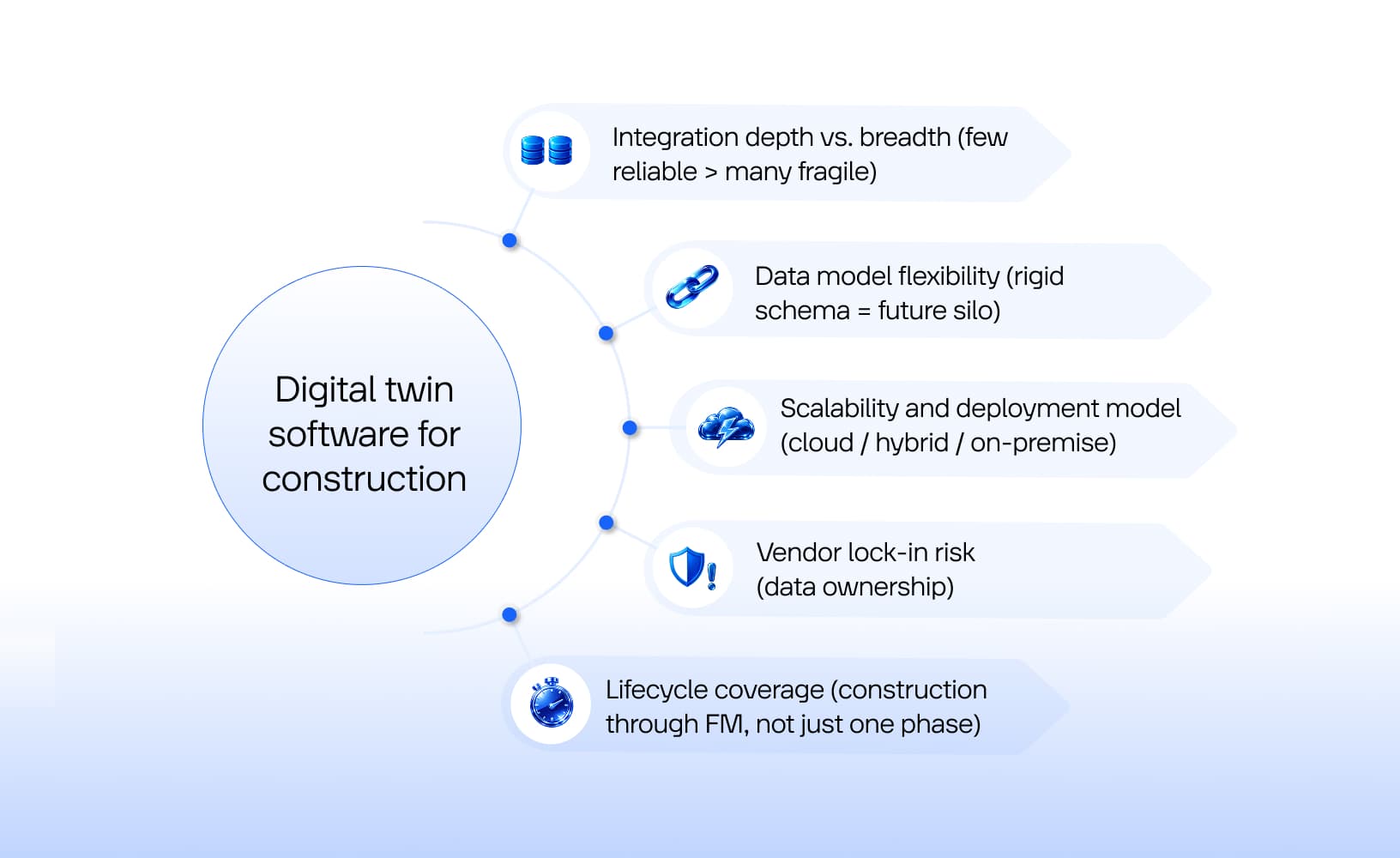
Selecting digital twin software for construction is less about finding the “most advanced” option and more about finding the one that fits your data environment and people. A long feature list is easy to produce; a platform that behaves sensibly inside your constraints is harder.
Integration depth vs. breadth
Some platforms connect to everything at a surface level. They can read a bit of BIM, a bit of schedule, a bit of sensor data — but sync is shallow and periodic, so the twin is always a little out of date. Others go much deeper with a smaller set of tools. In practice, a few deep, reliable integrations usually beat a catalogue of fragile ones, because teams can actually trust what they see.
Data model flexibility
Construction is not uniform. A hospital, an industrial plant and a residential tower organise information differently. A platform with a rigid data schema forces you into awkward workarounds, or leaves important attributes out altogether. If your integrated construction data platform cannot be extended to represent your actual assets and workflows, it will eventually become another silo rather than the backbone of your twin.
Scalability and deployment model
Cloud, hybrid and on‑premise deployments each have implications. For some infrastructure or defence‑related work, data sovereignty and security push you toward on‑prem or tightly controlled hybrid models. For others, cloud is the only realistic way to connect distributed teams and partners. Thinking this through early matters, because moving later is difficult — especially if you have not planned for how identity, access and monitoring will work across environments.
Vendor lock-in risk
The question of what happens to your data model and integrations if you need to move on after year two is not theoretical. If all your logic lives inside one proprietary system, exit costs are high. Many organisations pair platform adoption with legacy modernization services to standardise and clean core data before plugging it into any one twin product. That way, you own your structure, and switching becomes a painful but possible exercise, not a full restart.
Lifecycle coverage
Some tools shine during construction but do little for operations; others were designed primarily for FM and treat the build phase as an import task. If your client expects continuity, a platform that forces you to rebuild or migrate the model at handover introduces risk, cost and potential data loss. The right choice is the one aligned to your lifecycle needs, your existing systems and your team’s maturity — not just the most impressive demo at a conference.
Implementation in Practice: What It Actually Takes to Deploy a Construction Digital Twin
The projects that succeed with twins rarely start with a banner programme. They start with a well‑chosen pilot and a clear reason. From there, they grow. This is less glamorous than a big announcement, but much easier to make work in the real world.
Start narrow, prove value fast
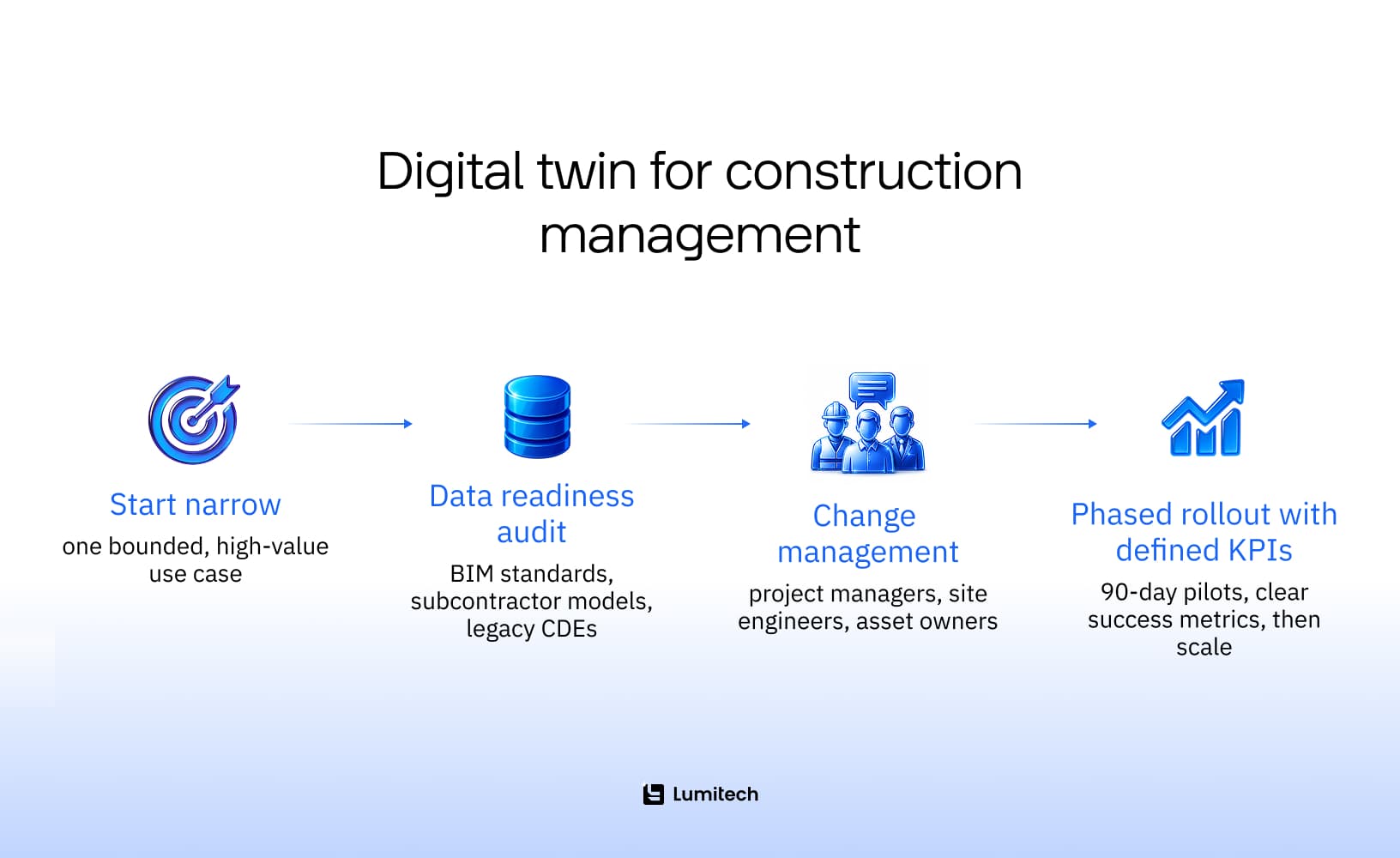
A good starting point for digital twin for construction management is one high‑value, bounded use case. It might be structural monitoring on a critical span, where sensors and models help you manage temporary works, or tight MEP coordination in a plant room that has historically generated clashes and delays. The point is to deliver something tangible in a few months. An overly broad scope — “we will twin the whole project from day one” — usually leads to delays, frustration and diluted focus.
Data readiness before platform selection
Before you sign a contract with any platform vendor, you need a hard look at your existing data.
Which BIM standards are you using?
How consistent are subcontractor models?
Where do schedules, cost data, and site logs live today?
For many firms, the honest answer involves legacy CDEs, custom databases and network drives that have grown organically for years. Because of this, twin initiatives often need to sit inside broader digital transformation programmes that rationalise how data is stored and shared. In our work on legacy modernization in Saudi Arabia, we have seen how regional firms carry large amounts of historical project data that must be cleaned and structured before any serious twin can be built.
Change management is half the work
From a pure engineering perspective, wiring up APIs and defining identifiers for a cyber-physical construction system is demanding but manageable. Getting people to trust and use the twin is harder. Project managers have to move away from spreadsheets‑only reporting. Site engineers need to record progress in ways that the system can ingest reliably. Asset owners must actually consult the twin for decisions on maintenance and modifications. Without this shift, you end up with a small BIM or “digital” team feeding real-time construction data into the model while everyone else continues with their old tools, and the value remains theoretical.
Phased rollout with defined KPIs
Finally, the pace and structure of rollout matter. A 90‑day pilot focused on one asset or workflow, with clear success metrics tied to time, cost, safety or information quality, gives you something concrete to judge. Scaling then becomes a question of replicating and adapting what worked, rather than trying to rescue a struggling, all‑encompassing programme. Over time, this incremental approach is how the digital twin in construction industry moves from experimentation to a normal part of project delivery and operations.
How Lumitech Approaches Digital Twin Projects in Construction
Lumitech does not sell a branded twin platform. Our role is to build the data and software infrastructure that makes a twin trustworthy and usable. In practice, that means we work on the plumbing: connecting BIM tools, IoT systems, field applications and enterprise platforms into one digital representation of physical assets that behaves consistently under real project load.
We come into construction and adjacent sectors with experience building custom systems where operations, data and field constraints all matter. In a mobile-first operations app for a digital-native painting startup, the goal was to give crews and coordinators a structured, real‑time view of work across sites without introducing friction that would push them back to messages and calls. In an offline app for painting contractors, the non‑negotiable constraint was low or intermittent connectivity — the tool had to function on real sites and sync later without corrupting state. These are the same constraints that any serious digital twin for construction or digital twin for buildings has to respect.
In twin‑related work, we usually start from a specific outcome — fewer clashes in a given area, better visibility on critical structural readings, cleaner handover for a portfolio — and design the integration and application layers needed to achieve it. Over time, those layers can support wider scenarios, forming an intelligent building model that outlives any single project. The emphasis stays on reliability, maintainability and measurable impact, not on showcasing technology for its own sake.
Building the Infrastructure That Makes Digital Twins Work
If you strip away the branding, a digital twin is only as strong as the infrastructure holding it together. The 3D view and dashboards are the visible part; the harder work sits underneath in the form of integrations, identifiers, sync logic and the custom software pieces that connect systems that were never designed to cooperate. Without a solid integrated construction data platform, the twin becomes a pretty interface on top of inconsistent information, and trust erodes quickly.
This is exactly the layer Lumitech focuses on. When the main difficulty in a digital twin initiative is not “which viewer should we use” but “how do we connect these systems, clean this data and make the model reflect reality without constant manual fixing”, that is where our engineering teams can help. We design and build the pipelines and services that keep a real-time digital building representation in step with the physical project, with attention to performance, observability and long‑term maintainability.
If you are planning a twin and the path from your current systems and data to that future state feels unclear, it usually means the infrastructure questions have not been fully surfaced yet. You can talk to the Lumitech team about the specifics of your environment — what you are running today, where your information lives, how your projects actually operate — and map out what kind of underlying architecture would make a digital twin worth trusting.
If your digital twin initiative needs more than a visual layer, Lumitech can help shape the infrastructure behind it.