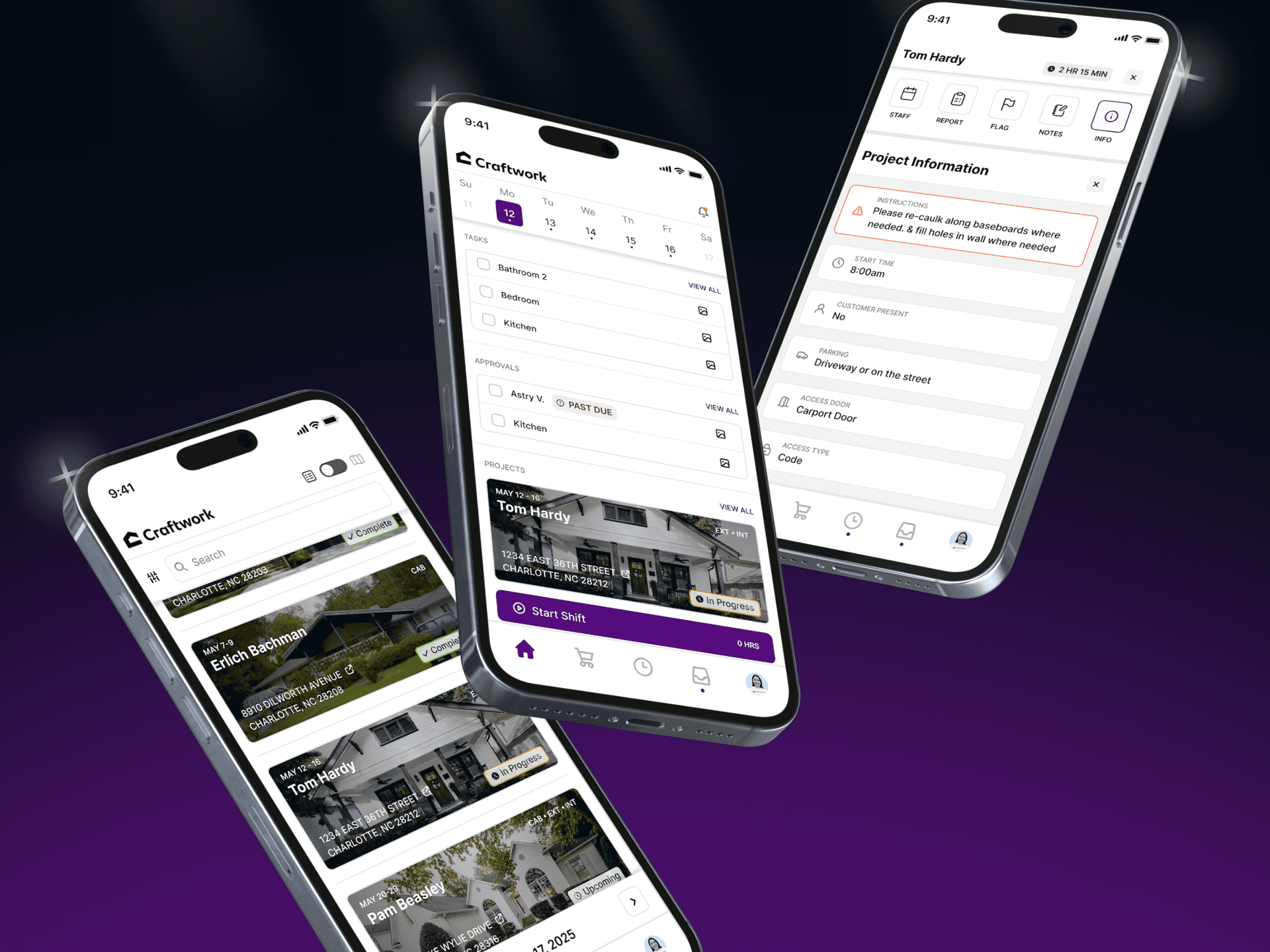


Craftwork did not ask for “just another contractor app”. They wanted an operational core – a mobile product that their painters, managers, and founders could rely on while they scale from one city to the entire U.S.
About the Client
Craftwork is a full‑service home painting company headquartered in Charlotte, North Carolina. They focus on residential interior and exterior painting, cabinet refinishing, and finishing work but with a very different mindset compared to the traditional painting market.
From the first look at their website and public profiles, it is clear they are building a digital‑native franchise, not a classic local crew. By the time Craftwork approached Lumitech, they had already gained a strong position in Charlotte and were actively expanding into nearby regions. With investor backing, including Y Combinator and other funds, the next step was clear – build software that can support growth across the U.S. market, not just one city.
Interesting Facts
Craftwork is a digital‑native painting franchise that couples a vertically integrated model (their own full‑time painters) with proprietary software for booking and managing projects.
Homeowners can receive instant online estimates and schedule projects without waiting for an estimator to visit, something that is still rare in the home services space.
The company positions itself openly as a tech startup – not just “another painter” – and has raised venture funding, including a Series A round, to invest in growth and technology.
Internally, Craftwork runs on multiple software systems and apps, with a clear goal to standardize and simplify painting industry workflows using mobile and web tools.
From Lumitech’s side, working directly with co-founder Mike (also acting as CTO) became one of the strongest collaboration experiences, with no micromanagement and a real sense of shared ownership over the product.
The Challenge
At its core, Craftwork’s business challenge was operational: how to manage a growing number of in‑house painters and active projects across multiple locations, without losing control or speed. When you have many crews, many addresses, and many shifts, simple tools break very quickly.
Typical pain points for a service company at this stage included:
Tracking visits and shifts, understanding who is working where and at what time.
Managing a constantly changing list of objects (homes and properties) across different neighborhoods and cities.
Preparing estimates and quotes in a consistent way that matches Craftwork’s pricing and scope standards.
Keeping costs, scope, and progress transparent for both customers and internal teams.
Maintaining real‑time or near real‑time operational control as the business grows beyond a single city.
Without a unified digital workflow, efficiency drops sharply once operations go beyond a tight local radius. Paper notes, spreadsheets, and ad‑hoc tools cannot keep up with a model that aims to become a nationwide digital‑first franchise. Craftwork’s goal was to create a single mobile tool that becomes the operational “brain” of the company.
On the technical side, the request was precise:
A mobile app to manage objects and staff.
Support for objects, visits, shifts, staff control, estimates, and quotes.
Architecture prepared for scaling across multiple U.S. regions.
UX that is simple enough for field employees who spend their day on sites, not in front of laptops.
High reliability, because the app is business‑critical, not optional.
In practice, this meant replacing disjointed processes with one coherent digital workflow without slowing down crews or making the app feel “corporate” and heavy.
Our Approach
Lumitech joined as an engineering and product partner in a hybrid team setup. The joint team looked roughly like this:
Three developers from Lumitech.
Several developers from the Craftwork side.
Around ten people in total, working as one unit.
Collaboration happened directly with co‑founder Mike, who served as CTO and product decision‑maker. There was no layer of heavy project management between the teams. Instead, there was trust, fast feedback, and shared responsibility for outcomes. The client later highlighted that the true ownership from Lumitech was clearly visible in how decisions were made and how problems were solved.
Compared to Paintbid (another painting‑related product Lumitech worked on), Craftwork’s app was significantly more complex:
More employees to coordinate.
More objects and parallel projects.
More operational scenarios, from shifts and routing to estimates and cost calculations.
A system that acts as the foundation of the business, not a supporting side tool.
The team had to strike a careful balance. On one side, business logic had to reflect real life: multiple crews, overlapping jobs, different shift models. On the other side, the interface had to stay clear enough for field teams who quickly check their phones between tasks.
To make that possible, Lumitech took full ownership of implementation and architecture, while the client’s design team handled UX and UI. The focus from Lumitech’s side was on:
Translating product ideas into robust, API‑driven mobile flows.
Keeping performance and reliability high in day‑to‑day field use.
Preparing the codebase and architecture for future U.S.‑wide scaling.
Technologies
The technology stack was chosen to match Craftwork’s needs and startup velocity:
Mobile: React Native – a good fit for a mobile‑first product that needs to run reliably on both iOS and Android devices used by field staff.
Backend: Ruby on Rails – a mature, productive backend framework that lets the team iterate quickly on APIs, business logic, and integrations.
Architecture: Mobile‑first, API‑driven – the mobile app is the main touchpoint for field teams, with a backend designed as a clear API layer that can support additional web tools and internal systems over time.
Product focus: Field operations, estimates, and staff management – every technical choice was evaluated against these three priorities. If it did not help crews work better, it probably did not belong in the first version.
Features
Over the course of the collaboration, the app evolved into a central hub for Craftwork’s operations. It is not a marketing app; it is the place where daily work happens. Its key capabilities include
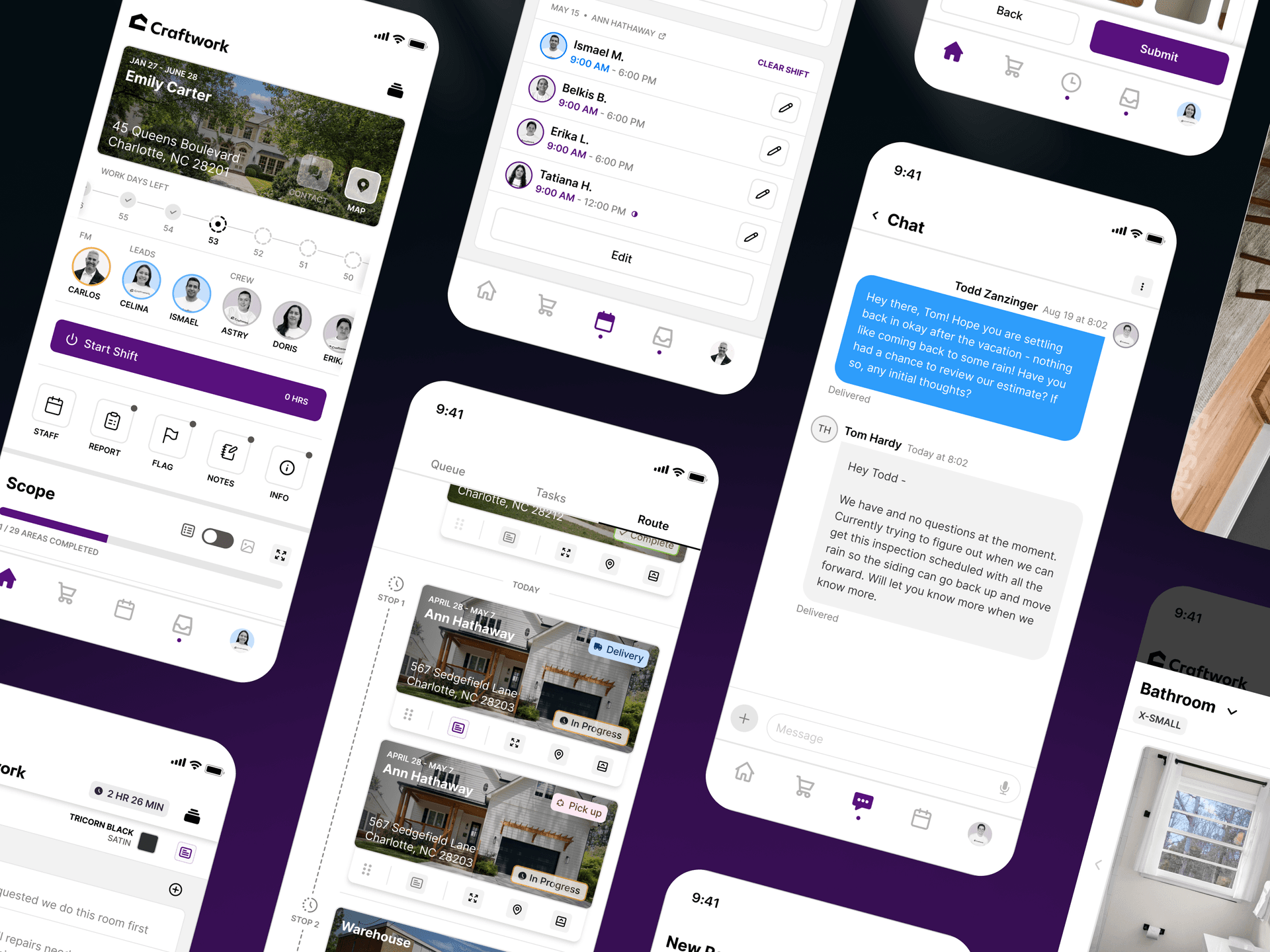
Object management. The app keeps track of objects – houses and properties where projects are planned or in progress. Crews and managers can see what jobs are active, which stage they are in, and how work is distributed across locations.
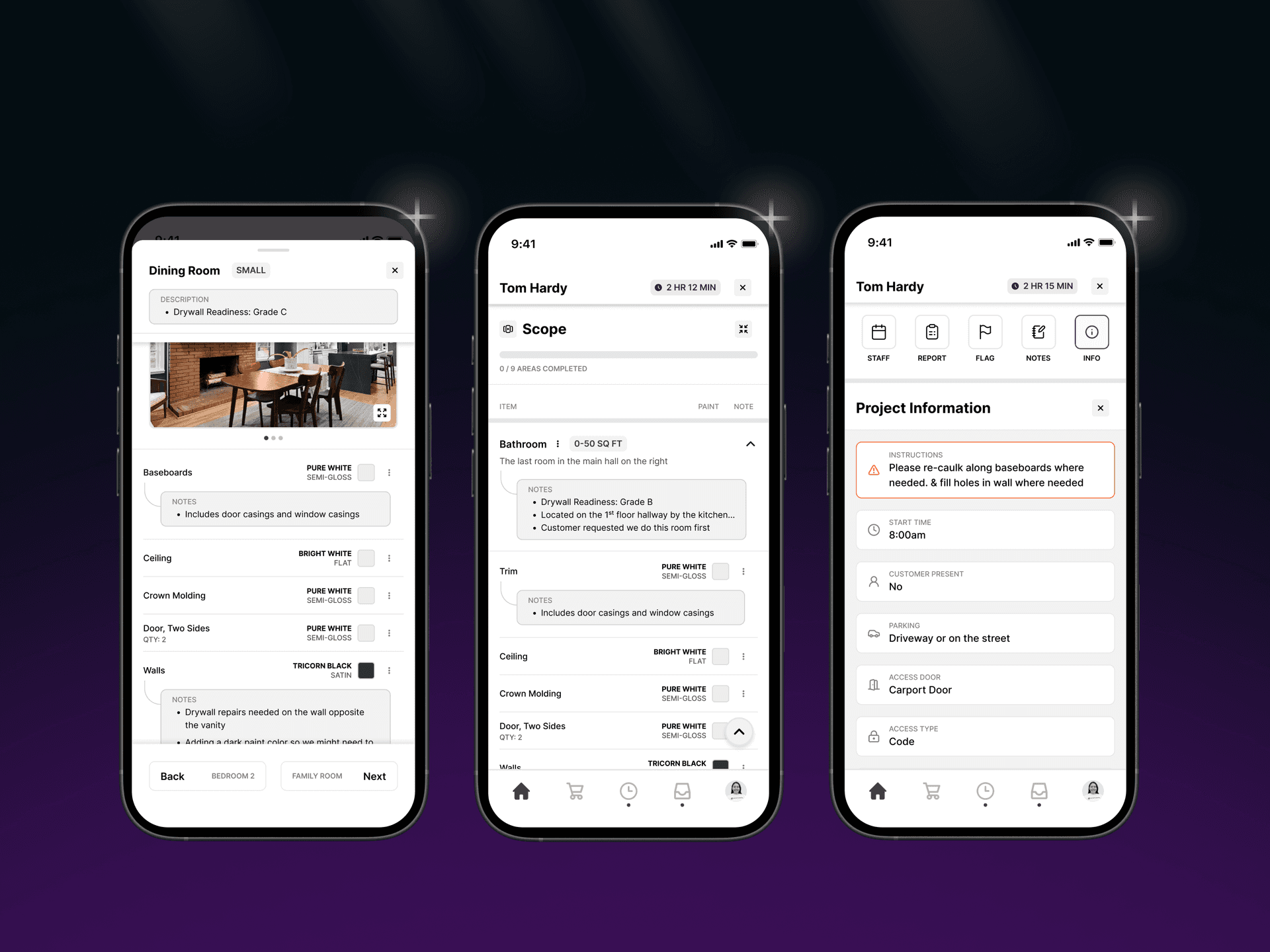
Visits and shift management. Field staff schedules, visits, and shifts are managed directly inside the app. It becomes clear who is going to which job, at what time, and how shifts are structured. This helps avoid confusion like “who was supposed to be on this site today?” – a common problem in more old‑school service businesses.
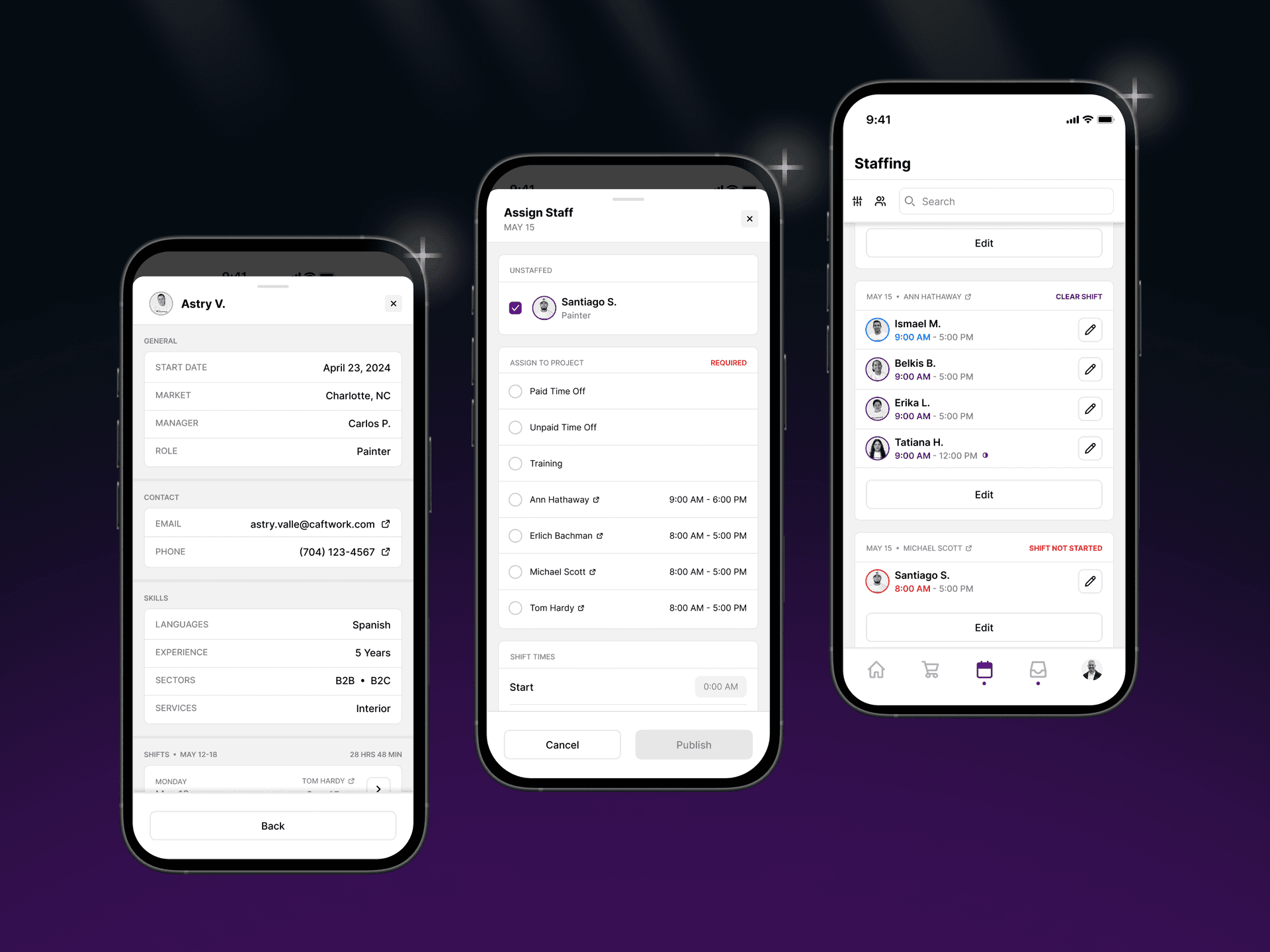
Staff activity control. Managers can see staff activity in a structured way, rather than piecing it together from calls and messages. This is especially important when you run only in‑house crews and want to build a long‑term team, not just temporary labor.
Estimates and quotes. Similar to Paintbid, but on a larger scale, the app supports preparing estimates and quotes for painting jobs. This includes what is being painted and how much it will cost, with logic that aligns with Craftwork’s pricing model and digital‑first approach.
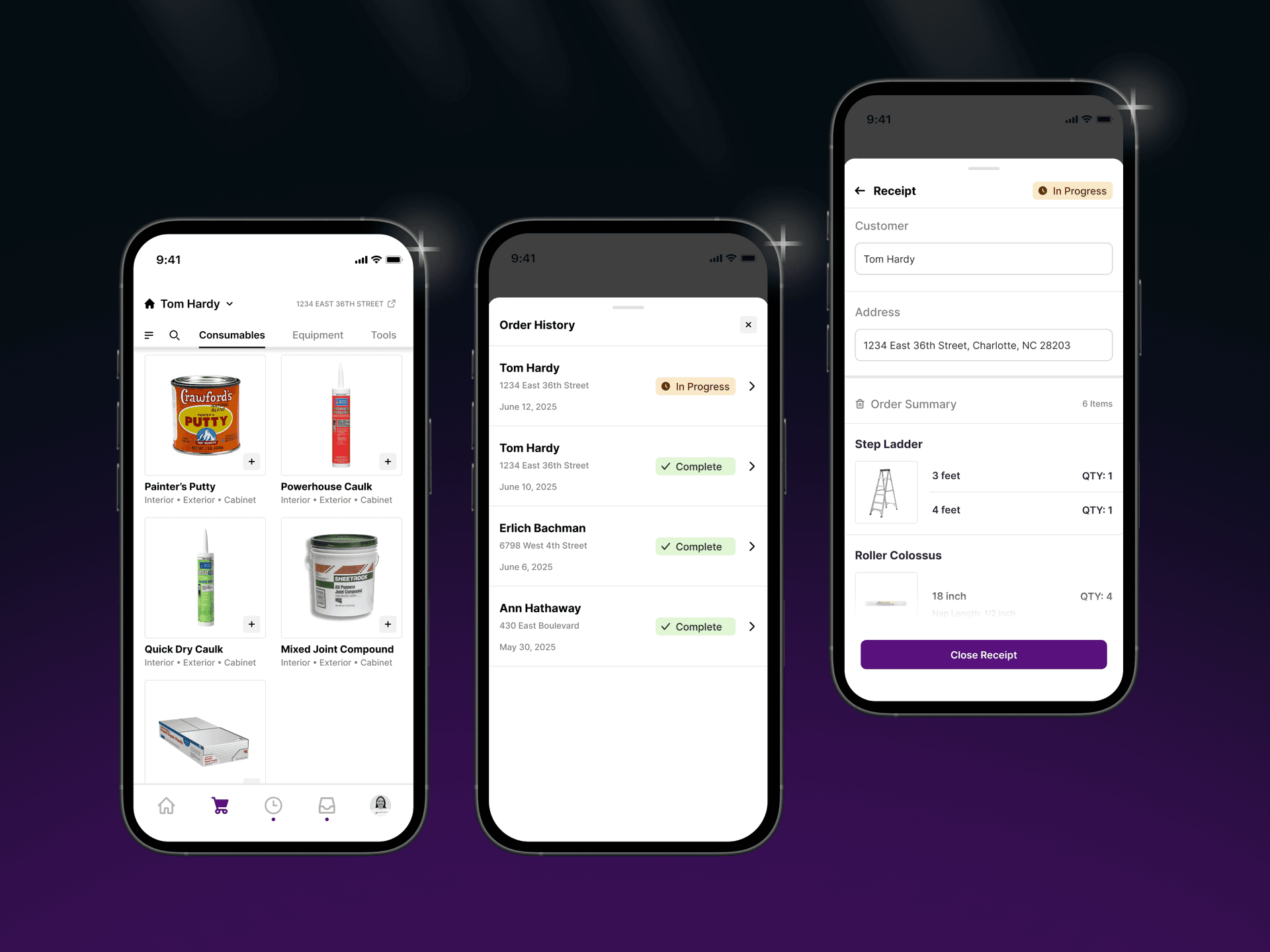
Cost calculation. The system helps calculate the cost of work based on job parameters. Instead of having every estimator or manager “guess” or rely on separate documents, the app centralizes this logic, which supports both transparency and margin control.
Centralized operational control. For founders and managers, the app acts as a control center. It brings together objects, shifts, staff, and estimates in one place, giving a clearer picture of how the business runs on any given day.
Mobile‑first for field teams. All of this is delivered through a mobile‑first experience. Field teams do not need to switch between multiple tools. Instead, they use one app as their main operational interface.
Our Results
The product is in active development and already lies at the core of Craftwork’s operations. It is not a prototype or a side experiment but a part of how the business runs and how it plans to expand.
Key outcomes so far include:
Significant digitalization of painting industry processes that traditionally run on calls, paper notes, and scattered spreadsheets.
Higher transparency and controllability of daily operations, both for crews and for management.
A mobile‑first workflow that matches Craftwork’s digital‑native positioning on the homeowner side.
A technical and product foundation prepared for scaling beyond Charlotte to other regions across the U.S.
A long‑term partnership between Craftwork and Lumitech, with further development phases planned as the company grows.
Despite being a service business in a very “offline” industry, Craftwork shows what happens when you treat software as part of the core product, not an add‑on. And Lumitech’s role here is simple – bring the engineering, architecture, and product thinking that turns this vision into something painters and managers can use every day on real jobs.