
Industrial Energy Monitoring System: Technologies Powering Sustainable Manufacturing
Most factories don’t waste energy on purpose. They just can’t see where it leaks. An industrial energy monitoring system reveals hidden inefficiencies and turns energy data into a strategic advantage. In this article, we will explain how.
- Software Development
- Big Data & Analytics
- Industrial
February 23, 2026
 AI Overview
Industrial energy monitoring systems use IoT sensors, edge devices, and cloud analytics to track kilowatt-hour consumption in real time, replacing fragmented meters and manual reports. Core components include equipment-level submetering, predictive load forecasting, and ISO 50001-aligned reporting. Poor visibility hides waste, since McKinsey estimates 5–15% of manufacturing energy use can be optimized without capital investment.


Turn off the lights to save!
Industrial production doesn’t just consume energy. It gobbles it up every second, every day, by the ton. And that’s the lifeblood of operating budgets.
If you think energy costs are just a few percent of your bill, you’ve either recently taken over a plant or you haven’t seen the morning energy bill yet, when the line is running “idle” and costs are skyrocketing.
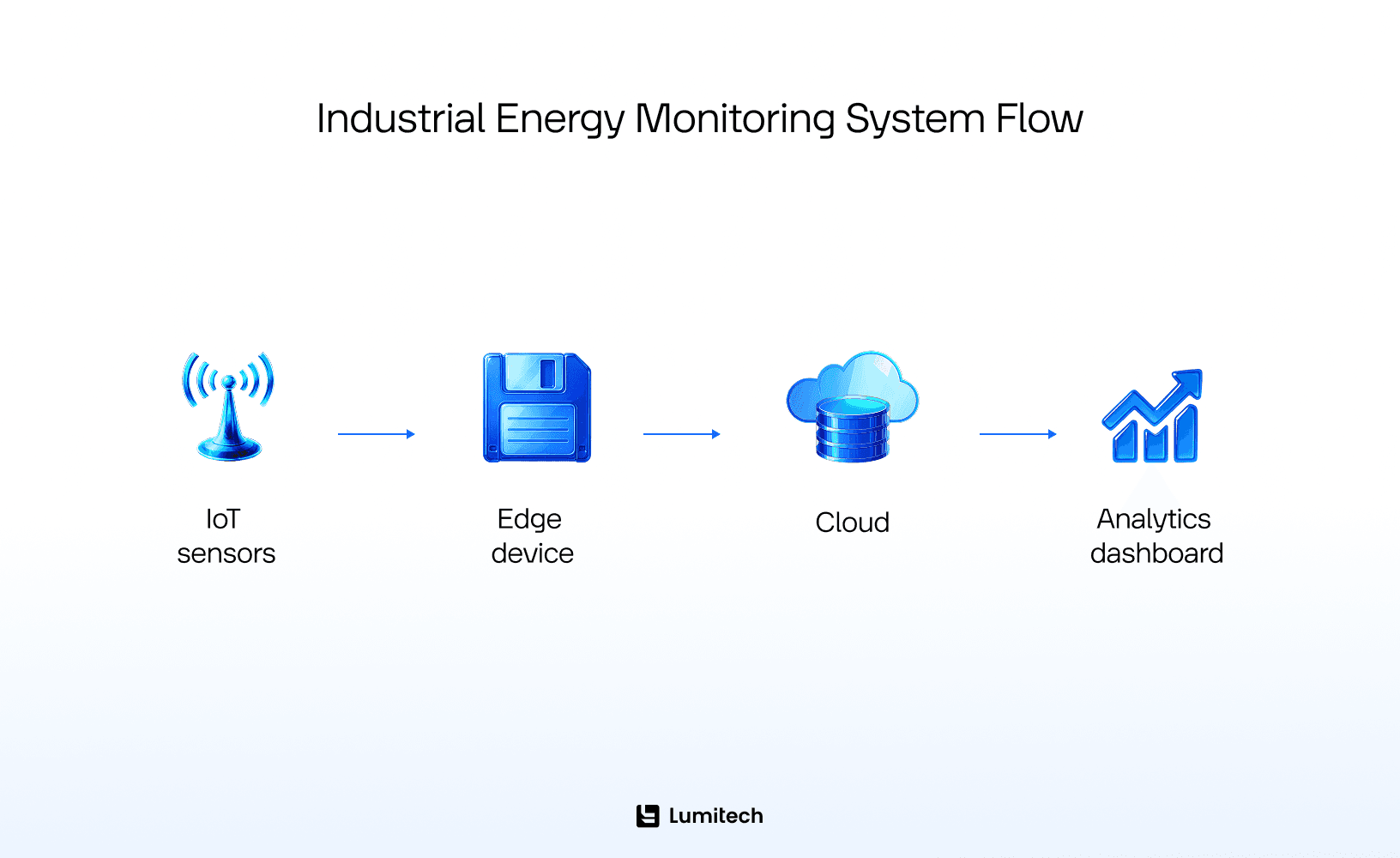
Today, plants that really compete in the market don’t turn off the lights. They monitor, measure, and forecast energy consumption at the kilowatt-hour level using industrial energy-monitoring systems.
This article examines how technology is transforming energy management into a strategic competitive advantage and how software engineering is enabling this transformation.
The Industrial Energy Monitoring Market: Growth, Pressure, and Structural Challenges
Why Industrial Energy Monitoring Is Becoming a Strategic Imperative
According to the International Energy Agency (IEA), the industrial sector accounts for about 37% of global final energy consumption and generates about 25% of global CO₂ emissions. In heavy industry, such as metallurgy, cement, and chemical production, energy costs can account for 30-50% of operating costs.
At the same time:
Electricity prices remain volatile following the 2022–2023 energy crisis.
Governments are adopting requirements for reporting on emissions and energy efficiency.
Investors are increasingly evaluating companies through the prism of ESG indicators.
The Energy Management Systems (EMS) market is estimated at over $40 billion and is growing at a 12-15% CAGR (Fortune Business Insights, MarketsandMarkets). The main drivers:
decarbonization of production;
integration of Industry 4.0;
spread of IoT in industry;
automation of operations and analytics.
At the same time, large enterprises will still work with fragmented systems: separate meters, local SCADA, Excel reports, and presenting centralized analytics.
Here, the main problem arises.
The Main Challenges Facing Industrial Companies
1. Volatility of Energy Costs
Energy costs have become less predictable. In many countries, industrial tariffs can vary depending on:
time-of-use tariffs;
peak load;
market conditions.
Without a real-time industrial energy monitoring system, companies cannot observe when peaks occur. Penalties for exceeding contracted capacity range from 5% to 10% of the monthly bill.
The problem is not only about payment; it is also about financial stability.
2. Lack of Transparency at the Equipment Level
Most companies know their overall consumption, but they don’t understand:
which specific lines or machines are the most energy-intensive;
which units are operating inefficiently;
where losses occur in standby or idle mode
According to McKinsey, in many manufacturing companies, 5-15% of energy consumption can be optimized without significant capital investment – simply through better monitoring and management.
But without granular data, it’s impossible to achieve this.
3. Legacy Infrastructure
Most plants have:
outdated PLCs;
local SCADA without a modern API;
isolated OT networks;
manual data collection processes.
Integrating a new industrial energy monitoring system into such an infrastructure is a complex technical task.
Often, hardware can be installed, but software integration with ERP, MES, and BI systems becomes a bottleneck. Without this, energy data remains disconnected from the business context.
4. Insufficient Analytics and a Lack of a Predictive Approach
Many enterprises already have basic EMS platforms from major vendors (e.g., Schneider Electric, Siemens, ABB). But these systems often:
focus on visualization;
do not provide deep custom analytics;
do not integrate with production KPIs;
do not use AI for forecasting.
As a result, the system shows “what happened”, but does not answer the questions:
what will happen tomorrow;
how to avoid the peak;
which equipment will fail;
how to optimize the production schedule for tariff windows.
5. ESG and Regulatory Pressure
In the EU, the US, and many other regions, companies must:
report energy consumption;
report CO₂ emissions;
comply with ISO 50001 standards.
Without a centralized data-collection industrial energy management system, reporting becomes a manual process with a high risk of error. For public companies, this is a matter of investment attractiveness and share value.
6. Lack of Internal Expertise
Another challenge is personnel.
Industrial energy monitoring is an intersection of:
electrical engineering;
OT;
IT;
data engineering;
cybersecurity;
business analytics.
Most companies lack internal teams capable of building an end-to-end architecture, spanning sensors, predictive models, and ERP integration.
This is where the need for a technology partner arises that understands both the industrial context and modern industrial energy monitoring software architecture.
Market Paradox
Today, almost all large manufacturers talk about sustainability, Industry 4.0, and digital transformation. But in practice:
data is scattered across systems;
decisions are made based on historical reports;
energy consumption is analyzed with a delay of months.
Companies invest in new equipment but often do not know whether it is more energy-efficient than the equipment they replace. This is what creates a gap between technological capabilities and real business outcomes.
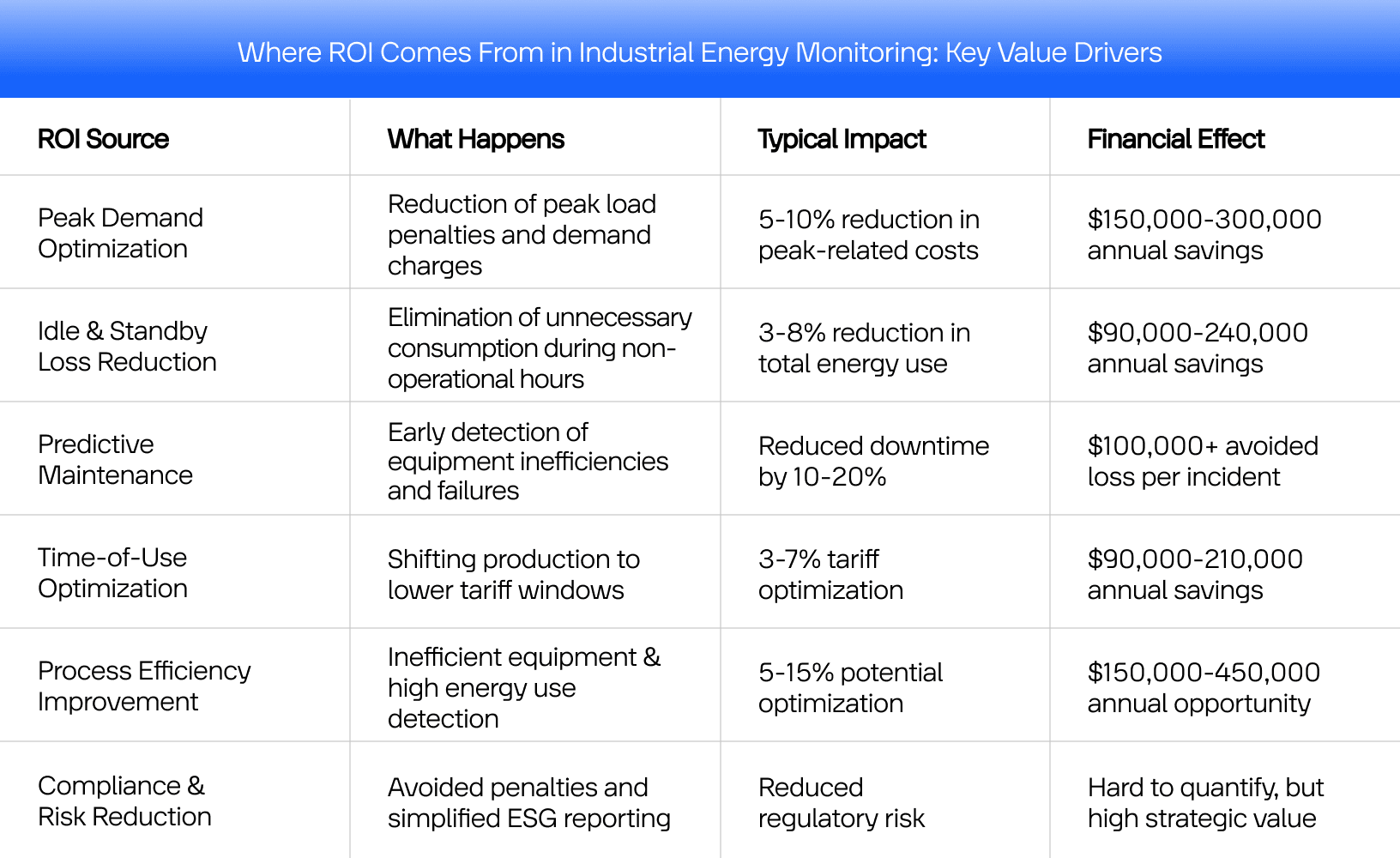
The Economics of Implementing an Industrial Energy Monitoring System: Cost Drivers and ROI Model
Industrial Energy Monitoring System: Key Cost Drivers
The cost of implementing an industrial energy efficiency and management program comprises several components. And the mistake many companies make is evaluating only the hardware.
Hardware (Measuring Devices)
This is the basic, but not the only, component of the budget. Typical costs:
Smart meters: $200-1500 per point
Power analyzers: $1000-5000
IoT gateways: $500-3000
Additional sensors (temperature, vibration, current): $100-1000
For an enterprise with 100 measurement points, the basic hardware costs $50,000 to $200,000, depending on the complexity of the power grid.
However, the meters themselves do not generate ROI; the data must be interpreted.
Installation & Engineering
This includes:
electrical installation;
network setup;
PLC/SCADA integration;
testing.
This is usually 20-30% of the total budget. In complex production facilities with a large number of legacy systems, even more.
Software Development & Integration
This is where the substantive strategic component of the budget is developed, including:
backend architecture;
data ingestion pipeline;
time-series storage;
dashboards;
KPI analytics;
ERP/MES integration;
role-based access;
audit logs;
cybersecurity.
If you use an off-the-shelf solution, the software component may be cheaper initially, but it often limits scalability, does not provide custom KPIs, does not account for production-specific factors, and requires expensive licenses.
A custom platform typically accounts for 20-40% of the total budget, but it determines the depth of analytics, scalability, flexibility, and real payback.
Ongoing Costs
Don’t forget:
Cloud infrastructure;
Maintenance & updates;
Security compliance;
Support.
Usually, this is 10-20% of the project cost annually.
Technologies Powering Modern Industrial Energy Management Systems
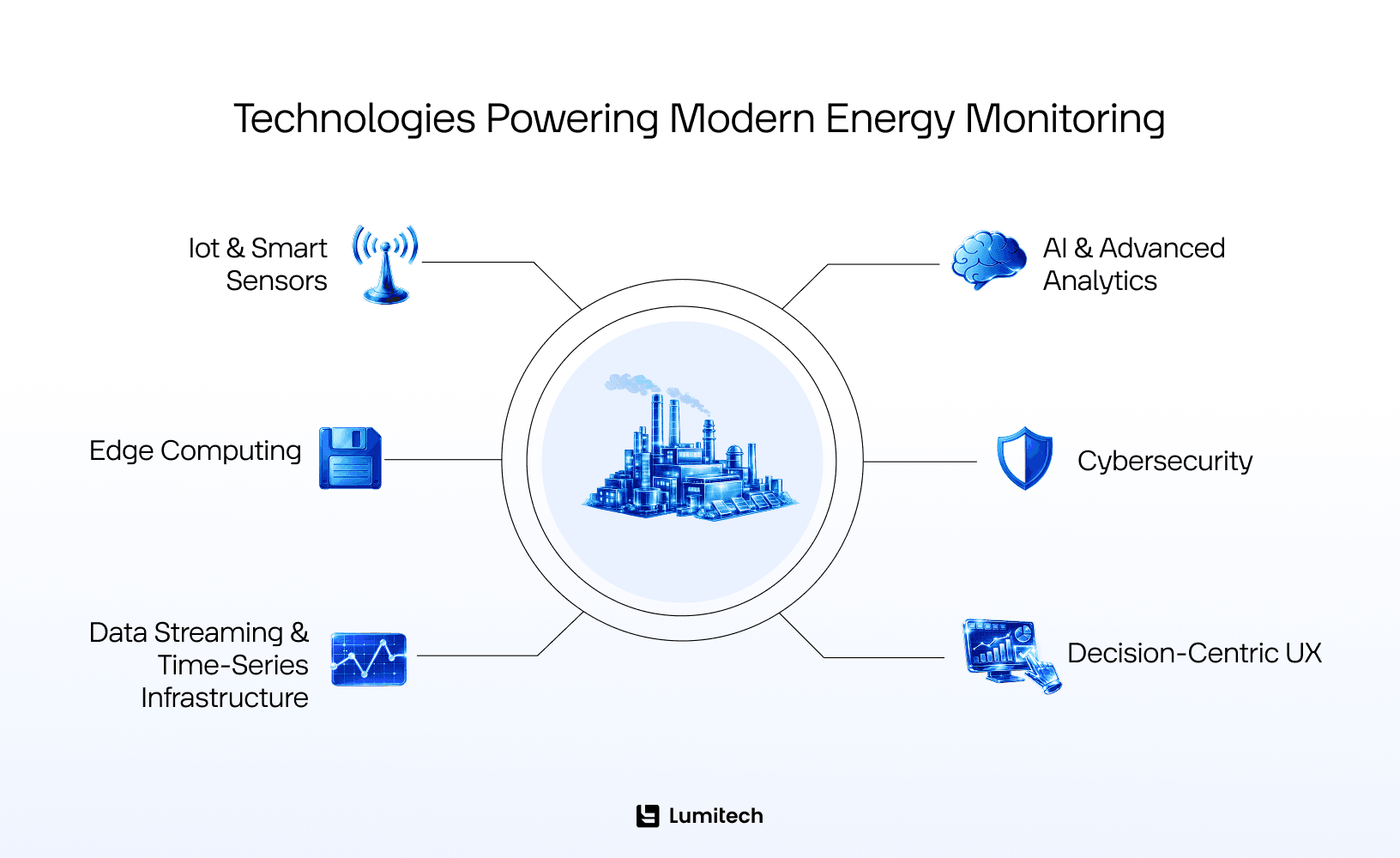
A modern industrial energy management system is a multi-layered digital infrastructure that combines OT (Operational Technology) and IT. It operates at the interface of physical equipment, streaming data, analytics, and cloud services. Let’s consider the key technological components.
Industrial IoT: Data Collection at Scale
The Industrial Internet of Things (IIoT) is the foundation of any energy management system in the industrial market. What happens at its level:
Installing smart meters and power analyzers.
Collecting data on voltage, current, frequency, and harmonics.
Monitoring consumption on specific lines or machines.
Measuring additional parameters: temperature, vibration, and load.
Typical protocols in an industrial environment:
Modbus TCP/RTU;
OPC-UA;
BACnet;
MQTT (for lightweight streaming).
Large enterprises can have hundreds or thousands of data collection points.
And this is where the scalability challenge arises. Without the right architecture, the IoT layer quickly becomes unstable.
Edge Computing: Processing Data Where It’s Generated
Transmitting all the “raw” data to the cloud is expensive, slow, and insecure. Edge computing embedded in the industrial power monitoring system solves this problem.
What does the edge layer do?
Pre-aggregation of data.
Noise filtering.
Local anomaly processing.
Buffering in case of loss of connection.
Minimizing latency.
Typical solutions:
AWS IoT Greengrass.
Azure IoT Edge.
Industrial gateways (Advantech, Siemens, Schneider).
Edge computing enables you to reduce cloud load, improve stability, and enhance security. This is critical for real-time peak detection.
Data Streaming & Time-Series Infrastructure Empowering Industrial Power Monitoring System
Any industrial energy tracking system produces a constant stream of data. In a large plant, this can be millions of records per day. Therefore, a standard relational database is not appropriate here.
The data architecture includes:
Streaming platforms: Apache Kafka, Apache Pulsar
Time-series databases: InfluxDB, TimescaleDB
Data lakes: AWS S3, Azure Data Lake
ETL/ELT pipelines
The key task is to ensure high throughput, low latency, scalability, and data integrity.
AI & Advanced Analytics: From Monitoring to Prediction
Basic monitoring shows “what’s happening.” AI answers the question:
What will happen next?
Is this an anomaly?
Will the equipment fail?
Will there be a peak load tomorrow?
AI for energy monitoring in manufacturing is used for:
1. Anomaly detection
ML models detect deviations from the normal consumption profile.
2. Load forecasting
Consumption forecasting based on historical data and production schedule.
3. Predictive maintenance
Analysis of energy signals as an indicator of equipment wear.
4. Optimization models
Automatic recommendations for load shifting.
Technologies:
Python (scikit-learn, TensorFlow, PyTorch)
AutoML
Feature engineering for time-series
Without AI development services, energy monitoring remains reactive. With AI, it becomes proactive. Additionally, you can also read our article about how AI mechanical engineering delivers efficient production in manufacturing.
Cybersecurity in Industrial Energy Tracking System
Industrial infrastructure is one of the most vulnerable to cyber threats. Connecting equipment to the network without proper security creates new attack points.
A modern energy monitoring solution for factories must account for network segmentation, encrypted traffic, role-based access control, and user action auditing. In an industrial context, this is a basic requirement.
As energy data is often integrated with ERP and financial systems, the issue of protection shifts from “IT risk” to “business risk”.
Decision-Centric UX: When Data Drives Action
Even the best multi-tenant SaaS architecture is worthless if data is not translated into management decisions. The interface of the energy monitoring solution for factories should be understandable to a range of roles, from energy managers to CFOs.
Dashboards should show not only consumption but also the impact on KPIs, including unit cost, line margin, and comparisons between shifts or plants.
The true value of energy monitoring lies in management's ability to make decisions based on real-time data, rather than after the quarter ends.
Lumitech Industrial Approach: From Architecture to Measurable Impact
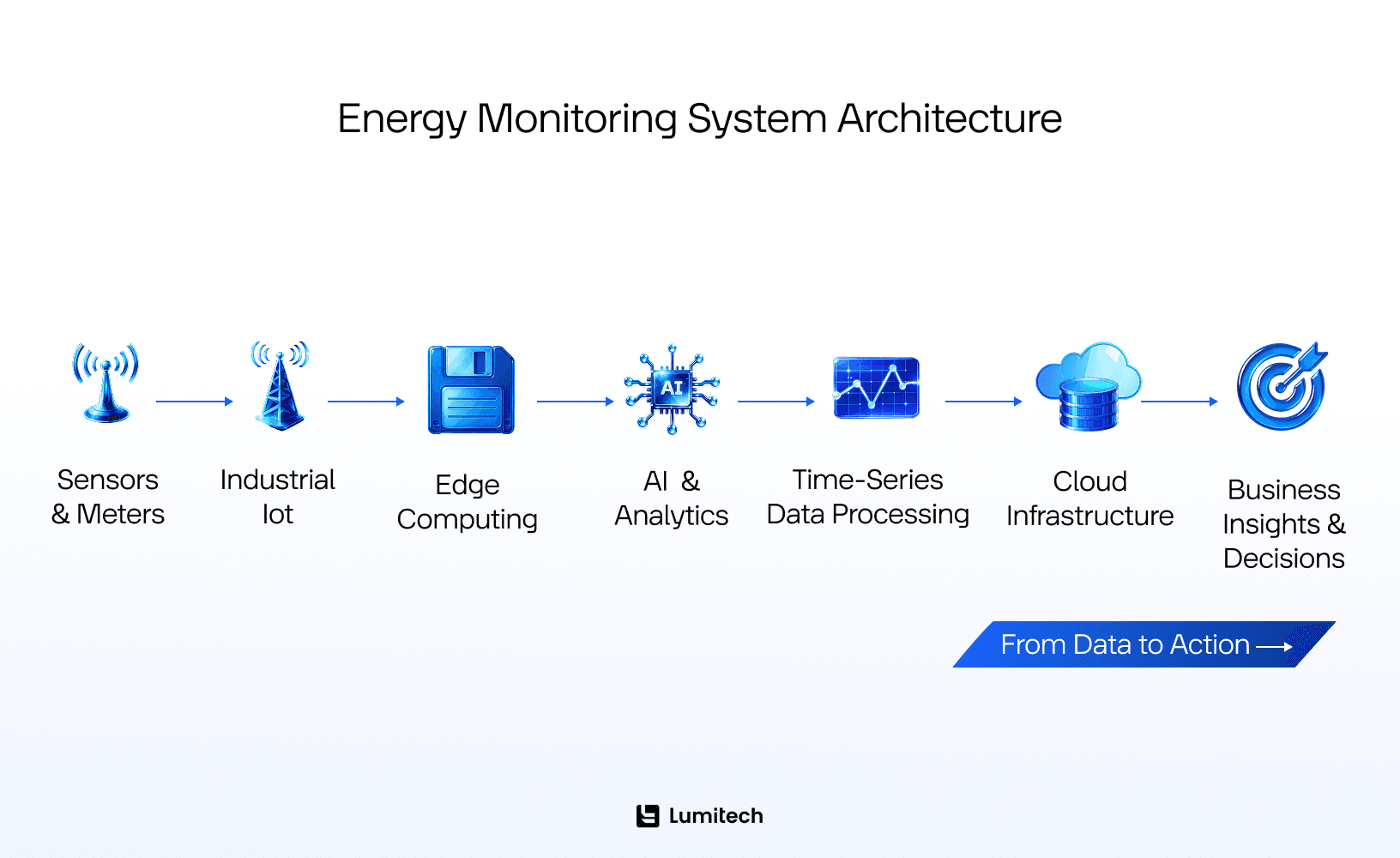
Energy monitoring is about building a digital infrastructure that changes the way decisions are made in production. In an industrial environment, the main challenge lies in integrating technologies into the operational context, including legacy PLCs, heterogeneous SCADA systems, isolated OT networks, security requirements, and business KPIs.
That is why, at Lumitech, we approach the development of the industrial energy monitoring and management system as an architecture-based task. And here is our practical approach.
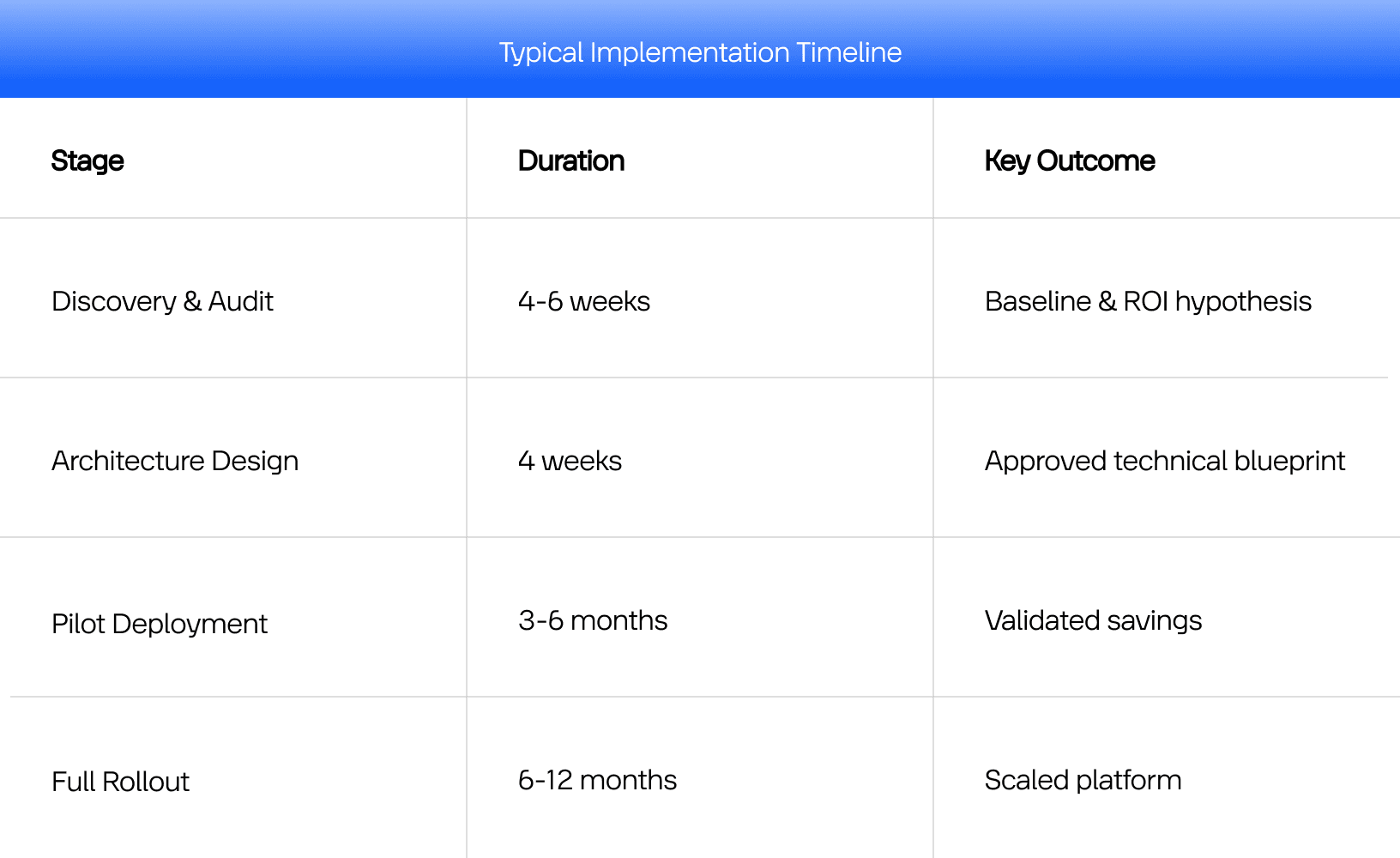
Phase 1: Industrial Discovery & Energy Mapping
Most companies start by choosing a platform. We start with an energy map of the enterprise. At this stage, we:
analyze the structure of the power grid;
determine critical measurement points;
identify energy-intensive lines;
identify peak risks;
assess the existing OT/IT infrastructure.
It is important to understand which KPIs are critical for the CFO, which metrics are critical for the plant manager, and how energy consumption affects production costs. At this stage, a baseline is established; without it, ROI will be merely an assumption.
Phase 2: Architecture Design: OT Meets IT
After discovery, we design the architecture of the industrial energy monitoring and management system. In the industrial sector, this means:
integration with PLC and SCADA;
building an edge layer for local processing;
creating a secure data channel;
choosing a time-series infrastructure;
designing a cloud architecture;
defining access and audit policies.
Lumitech has experience developing complex industrial systems, where the following are critical: scalability, fault tolerance, cybersecurity, and integration with ERP/MES.
Instead of building just a “monitoring panel”, we build a data platform.
Phase 3: Pilot Implementation: Controlled Validation
The biggest mistake is to launch the energy management system for manufacturing immediately for the entire plant. We implement a pilot:
on the most energy-intensive line;
or in a section with peak risks;
or in a site with the highest costs.
The pilot enables you to assess data quality, develop analytical models, measure initial economic effects, and test integration. The pilot lasts 3–6 months. This is enough to form an objective picture.
Phase 4: Advanced Analytics & Optimization
After stabilizing the data pipeline, we add intelligence and custom data science solutions to the energy management system for manufacturing. At this stage, the following are implemented:
anomaly detection;
load forecasting;
peak optimization logic;
Here, energy monitoring shifts from reactive to proactive. The energy SaaS solutions not only display metrics but also recommend actions.
Phase 5: Enterprise Integration & Scaling
Once the factory energy management system has proven effective, we scale it to other lines, other plants, and a multi-location structure. The key point is integration with business processes:
ERP;
BI systems;
financial modules;
ESG reporting.
At this stage, energy monitoring becomes part of the management ecosystem.
How We Differentiate in the Industrial Sector
Unlike other vendors that sell hardware with a template platform, Lumitech works with legacy OT infrastructure, builds custom analytics for a specific business, integrates energy data with production KPIs, provides enterprise-grade security, and designs scalable cloud architecture.
We provide development solutions for industrial sector, from complex systems integration to the development of analytical platforms. For us, energy monitoring is part of a broader industrial digital strategy.
If you’re looking beyond hardware and toward long-term digital strategy, we’re ready to architect it with you.

Energy Management System for Manufacturing: Key Real-World Cases
In industrial environments, digital energy monitoring systems are not merely theoretical; they are already yielding concrete results in real-world conditions. Below are examples of implementations in which monitoring systems have yielded clear economic and operational benefits.
Real-Time Energy Monitoring in a Manufacturing Plant in Italy
An Italian factory that manufactures valves and actuators for the oil and gas industry implemented real-time energy monitoring for manufacturing at the plant level. The factory had traditionally high energy costs due to welding, metalworking, painting, and pressure testing operations.
The system collected data from across the plant and created a map of energy consumption “hot spots,” which identified the most inefficient areas. Based on these data, the team implemented targeted optimization measures that reduced the company’s overall energy consumption and carbon footprint.
This case study highlights that plant-level monitoring is the basis for analysis and action that directly impacts energy efficiency.
Mitsubishi: IIoT Energy Monitoring and Air System Optimization
As part of a study to optimize energy and compressed air consumption in the production process, Mitsubishi Electric Air Conditioning Systems Europe Ltd. implemented an IIoT monitoring system for legacy machines.
The goal was not only to monitor power consumption but also to detect inefficiencies in compressed air, a critical resource available 24/7. After installing sensors and integrating them with the infrastructure, real-time tools were developed to visualize and analyze trends in energy consumption and air loss. In particular, the data revealed a significant issue with compressed-air leakage that had not been previously identified.
After implementing a smart solution that automatically shut off the air when consumption was inefficient, the company achieved up to 56% energy savings on the target equipment, a substantial result for older machines that had previously remained black boxes for analytics.
This case demonstrates the power of IoT tools combined with analytics, whereby even a single machine can generate new economic opportunities.
Comansa: Energy Consumption Reduction of Up to 74%
The Spanish company Comansa, which manufactures large-scale equipment, has become a case study in the successful use of an industrial energy monitoring solution to optimize the entire production cycle.
By implementing the Smart Energy Monitoring System, the company achieved a crushing reduction in energy consumption, up to 74% in certain production areas. In such cases, the system does not simply measure; it identifies measures with the greatest potential for savings and determines which processes should be prioritized for intervention.
Comansa's results demonstrate that when data underpins real decisions and operational changes, energy monitoring can lead not only to incremental optimization but also to substantial cost reductions.
Extensive Data from Over 300 Cases: Average Savings of 11%
A thorough review of more than 300 industrial cases across 40 countries shows that installing and operating energy management systems, on average, yields a 11% reduction in energy consumption in the first years after implementation.
In many companies, these savings are reflected directly in operating profit: one Indonesian mill reduced its annual electricity costs by more than $1 million in the first year alone.
This data confirms that energy monitoring systems are effective and deliver cumulative, long-term results.
What This Means for Production
These cases combine several common patterns:
Energy monitoring reveals hidden losses, for example, unobvious overspending or persistent malfunctions.
Smart data and actions yield savings primarily in the first year; average reductions of 10-30% in energy consumption are typical.
The result depends on the platform and analytics: the deeper the system is integrated into operational processes, the greater the economic impact.
These cases are real-world industry applications that demonstrate how the industrial energy monitoring solution and analytics translate into measurable business outcomes.
Conclusion: Building Intelligent Energy Infrastructure for Sustainable Manufacturing
Energy monitoring in industry today is a part of the enterprise's digital infrastructure. It provides transparency into costs and operational stability, and a basis for strategic decisions in energy efficiency and decarbonization.
Systems built on IoT, edge, analytics, and cloud architectures enable not only consumption control but also load prediction, reduced downtime risk, and optimized production processes. With the right architecture, the payback of such solutions is measured not in years, but in budget cycles.
At Lumitech, we consider energy monitoring as part of a comprehensive digital transformation in the industrial sector. We design scalable platforms integrated with production and financial systems that turn energy data into a management advantage. For example, you can check our customer story about the turnaround tracker for industrial sector.
Sustainable development in production starts with data. And it is a systematic approach to their collection and analysis that shapes long-term business efficiency.


