
Best AML Screening Software in the UAE: 10 Tools for 2026
Every AML vendor in the UAE promises coverage. Few will show you the audit trail behind a cleared alert. We compared ten platforms on the seven fields that determine fit under Federal Decree-Law 10 of 2025, starting with what the software must actually do.
- AML Software
- Finance & FinTech
September 10, 2026
 AI Overview
AML screening software in the UAE screens customers against sanctions and PEP lists, monitors transactions after onboarding, scores risk, and supports goAML reporting to the UAE FIU. Weak list coverage or an incomplete audit trail draws enforcement: the CBUAE imposed a financial sanction of AED 200 million on an exchange house in May 2025.

AML Software UAE: The Ten Products
Screening customers and beneficial owners. Watching transactions after onboarding. Working the alerts that come back. Getting a report to the FIU that still holds up when someone asks about it six months later. That is what AML software in the UAE has to do, and the ten platforms below go about it in very different ways. Compare them on sanctions and PEP coverage, Arabic-name matching, transaction monitoring, audit trail, goAML reporting support, implementation effort, and which regulator you actually answer to.
Key takeaways
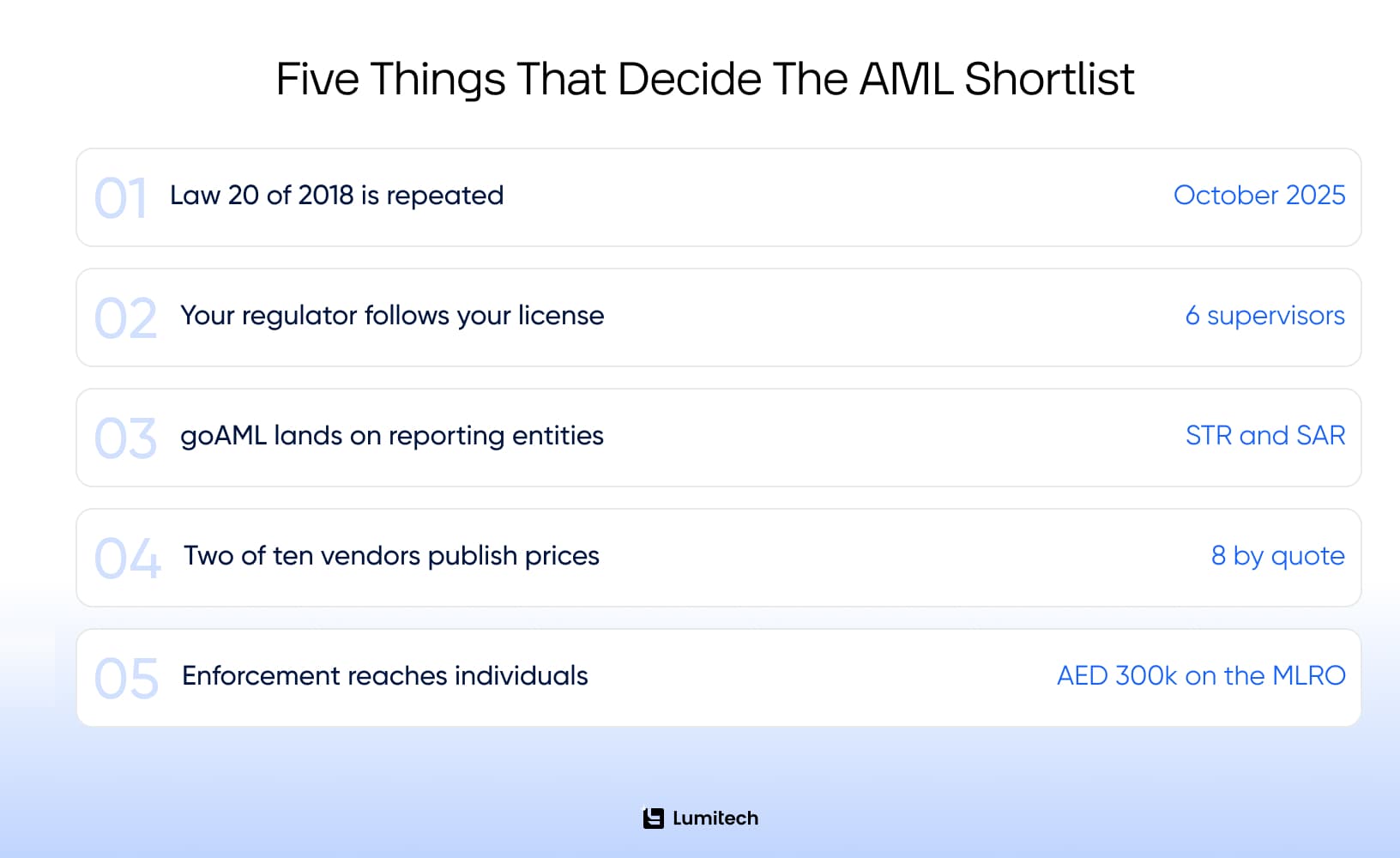
Law 20 of 2018 is gone. Federal Decree-Law No. 10 of 2025 replaced it, with executive regulations under Cabinet Resolution No. 134 of 2025. If a vendor deck still cites the 2018 law, that tells you how current the rest of the deck is.
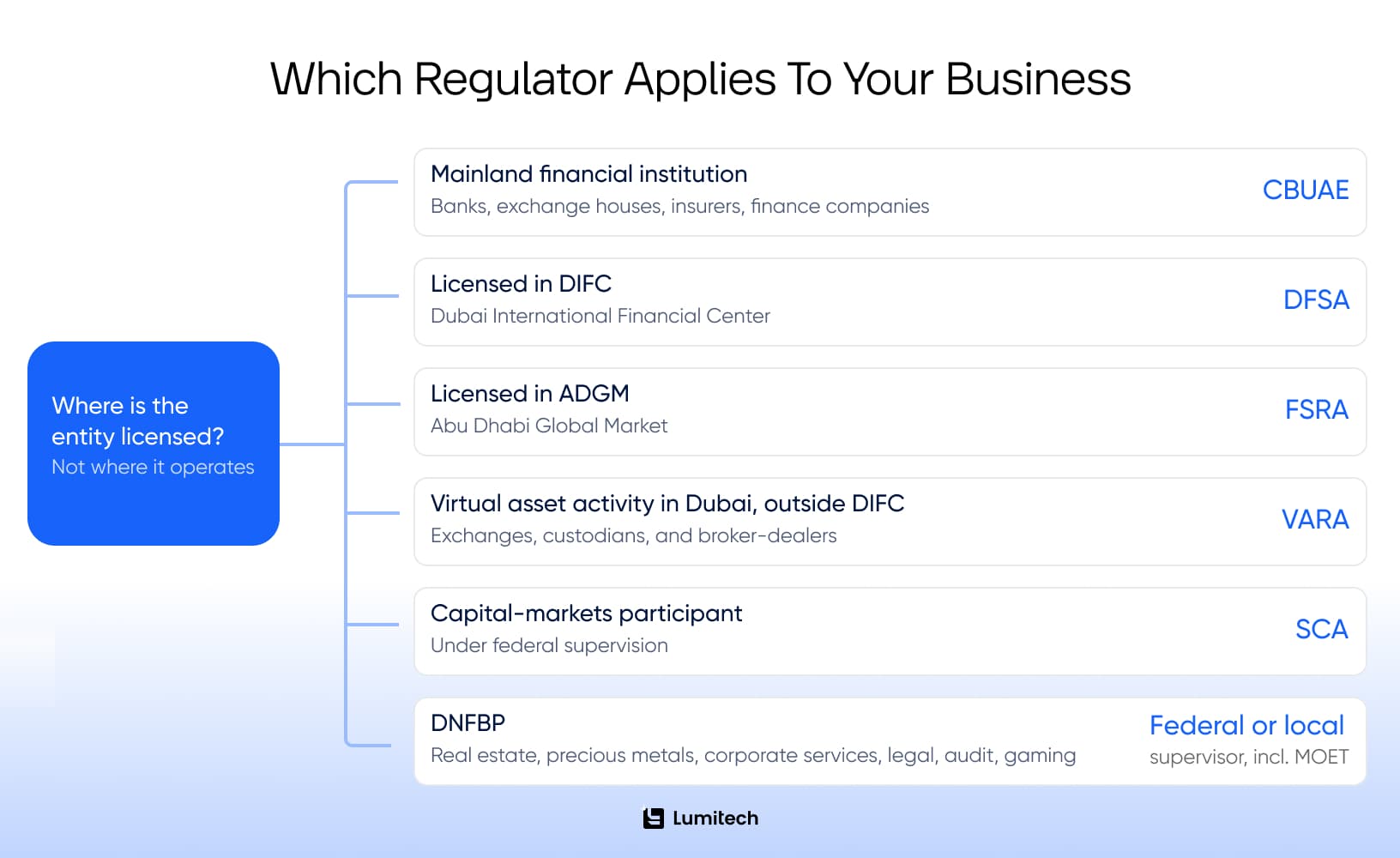
Your regulator follows your license, not your postcode: CBUAE, DFSA in DIFC, FSRA in ADGM, VARA for virtual assets in Dubai outside DIFC, and the relevant supervisor for DNFBPs.
goAML is the FIU’s portal, and the obligation lands on reporting entities. Vendor support ranges from “export a file and retype it” to structured report generation.
Ten products, seven identical fields. Two publish prices; eight want a call first.
In June 2026, the CBUAE personally fined a compliance officer. That month, the audit trail became a must-have.
How This AML Software List Was Built
Four different products get sold under the same three letters: screening data, screening and monitoring platforms, KYC/KYB onboarding suites, and custom builds. Ranking a data feed against a case-management platform on feature count produces nonsense, so every product here answers the same seven questions — best for; core capabilities across sanctions screening software, PEP and adverse media, transaction monitoring software, risk scoring, case management, KYB and UBO; UAE fit; goAML and reporting; implementation; pricing model; and potential limitations, filled in for all ten with no exceptions.
Claims come from vendor documentation, product and pricing pages, and public regulatory sources, and were checked in August 2026. Where a vendor documents a capability and says nothing about the UAE specifics, the field reads “local adaptation required” and stops there. No “UAE compliant: yes/no” column appears anywhere, because that answer depends on your license, your regulator, and your configuration — three things no vendor page knows about you.
Disclosure: Lumitech builds custom AML systems and sits at number ten on this list. Same seven fields, same scrutiny, and the guide says plainly where off-the-shelf SaaS is the better buy. The numbering groups products by category and ranks nothing.
UAE AML Regulatory Framework in 2026
Two documents set the rules your software has to serve.
Federal Decree-Law No. 10 of 2025 came into force on 14 October 2025 and repealed the 2018 law outright. It widened the definition of criminal property, pulled proliferation financing into the statute, named virtual assets and encryption technologies explicitly, moved targeted financial sanctions into primary legislation, and put managers, directors, and compliance officers personally on the hook.
Cabinet Resolution No. 134 of 2025 followed on 14 December 2025 with the operating details — 71 articles. Senior management owns the program. Beneficial ownership is identified at a 25% threshold, with fallback to senior managing officials. Transaction monitoring runs continuously. Gaming operators joined the DNFBP perimeter.
Which Regulator Applies to Your Business
Authority follows the license, not the emirate. UAE AML regulations are supervised by CBUAE for banks, exchange houses, insurers, and other licensed financial institutions; DFSA for DIFC firms; FSRA for ADGM firms; VARA for virtual asset activity in Dubai outside DIFC; SCA for capital-markets participants; and the relevant federal or local DNFBP supervisor, including the Ministry of Economy and Tourism for many mainland and free-zone DNFBPs.
A group with a mainland entity, a DIFC subsidiary, and a VARA license answers to three regulators holding three sets of expectations. Any platform built around one rulebook gets configured per entity, and that work belongs in the implementation estimate.
The concepts that decide a fit: the MLRO and the authority that role carries; CDD, EDD, and the triggers between them; the risk-based approach; ongoing monitoring; UBO and KYB verification at the 25% threshold; targeted financial sanctions; the audit trail behind every decision; and record-keeping. A platform that cannot show the evidence behind a cleared alert cannot support the risk-based approach the regulations require, whatever the feature list says.
The UAE came off the FATF list of jurisdictions under increased monitoring on 23 February 2024, after two years on it. That closed the increased-monitoring process and changed nothing else: the 2025 law, the 2025 regulations, and the fines since then all point one direction. Confirm your own obligations with your supervisor or a qualified UAE adviser before configuring thresholds, reporting workflows, or retention rules.
How AML Software Supports goAML Reporting in the UAE
goAML belongs to the UAE Financial Intelligence Unit. UNODC built it, more than 60 jurisdictions run it, and in the UAE it carries your suspicious transaction and activity reports, the other prescribed report types, and every request for information the FIU sends back.
The obligation lands on reporting entities. That distinction gets flattened constantly in AML compliance software in the UAE marketing. Financial institutions, DNFBPs, and virtual asset service providers register through the FIU and Ministry of Economy and Tourism process and name a UAE-resident compliance officer as primary user. A company outside those categories carries no automatic goAML obligation, whatever a sales deck implies.
AML software with goAML reporting support sits upstream of the portal. Depending on the product, it pulls the case file together — customer record, CDD evidence, transaction and alert history, MLRO assessment — pre-populates the report fields, generates the structured format the FIU accepts where the vendor has built that module, and keeps the audit trail behind the filing. The suspicion judgment, the decision to file, the accuracy of the submission, the tipping-off line, and retention stay with you. No platform takes those off your hands.
Four questions settle the reporting fit. Does it generate structured reports in the FIU’s format, or export data you retype? Are batch and XML workflows supported? Can the vendor produce a complete report package from a live case, in the demo, today? And what happens to the audit trail when a case closes without a filing — the decision supervisors examine most closely. Filing timing depends on your framework and the facts, so a vendor quoting a universal deadline has not read your rulebook.
Quick Comparison: AML Software in the UAE
A DNFBP filing four reports a year and a bank monitoring millions of transactions type the same search term and need completely different products. The best AML software in the UAE depends on which of the four product types your gap falls into. The table records what each vendor documents; the profiles add the exceptions worth testing before you sign anything.
Comparison table
Solution | Sanctions & PEP | Transaction monitoring | goAML support | Pricing model |
|---|---|---|---|---|
1. FOCAL by MOZN | 1,300+ global and local lists, Arabic-optimized | Rules engine plus ML models | Regional focus; confirm UAE output | Quote-based |
2. azakaw | Global lists plus UAE Central Bank and Cabinet | Configurable ongoing monitoring | goAML-ready SAR preparation | Quote-based |
3. Eastnets | SafeWatch Screening, real-time list loading | SafeWatch AML, scenario library | Built-in module, UNODC format | Quote-based, modular |
4. ComplyAdvantage | Sanctions, PEP, RCA, adverse media; rapid refresh | Real-time transaction and payment screening | Local adaptation required | Published entry tier |
5. Sumsub | AML screening and ongoing monitoring | Transaction monitoring module | Local adaptation required | Published per verification |
6. Feedzai | Watchlist screening within the suite | ML monitoring, alert prioritization | SAR workflow; confirm UAE format | Quote-based, enterprise |
7. LSEG World-Check | Sanctions, PEP, enforcement, adverse media | Not applicable — data layer | Not applicable — data layer | Licensing by volume |
8. Dow Jones Risk & Compliance | Sanctions, ownership data, PEP, adverse media | Not applicable — data layer | Not applicable — data layer | Licensing by content set |
9. LexisNexis Risk Solutions | Global watchlist and identity data | Enterprise monitoring modules | Local adaptation required | Quote-based, enterprise |
10. Lumitech | Built against the lists you license | Built to your scenarios | Built to your reporting workflow | Project-based |
Regional products put local lists and Arabic handling at the center. Global platforms cover the same functions with wider data and a shorter integration path, leaving the UAE reporting layer to configuration. Data providers supply the content both categories depend on.
AML Software Providers in the UAE: Ten Profiles
UAE and Regional Platforms
Put these on the shortlist when local list coverage, Arabic-name handling, and support in your own time zone carry the most weight.

1. FOCAL by MOZN
Best for: Regional banks and large fintechs with Arabic-language customer data and volume enough to justify AI-led screening.
Core capabilities: FOCAL screens customers and transactions against 1,300+ auto-updated global and local sanctions and PEP lists with Arabic-optimized name matching, plus ML models, a rules engine, risk scoring, case management, and an anti-fraud suite.
UAE fit: Riyadh-headquartered with a UAE office since 2023, and a Category Leader in Chartis Research’s RiskTech Quadrant 2025 for AML transaction monitoring.
goAML and reporting: SAR preparation is documented; confirm whether UAE goAML output is structured or exported for manual submission.
Implementation: Vendor-led configuration of rules, thresholds, and list sets.
Pricing model: Quote-based.
Potential limitations: Detection needs tuning on your own data before false-positive rates settle, and coverage is strongest for GCC cases.

2. azakaw
Best for: UAE real-estate brokers, precious-metals dealers, corporate service providers, law and audit firms, and DIFC or ADGM firms wanting local specifics built in.
Core capabilities: azakaw covers eKYC and KYB onboarding, video KYC, sanctions and PEP screening, adverse media, AI-assisted risk scoring, and ongoing monitoring, in Arabic and English.
UAE fit: Document screening against UAE Central Bank and Cabinet lists alongside UN, EU, and OFAC sources, recognition of Emirates ID and UAE trade licenses, and alignment with DIFC, ADGM, and CBUAE frameworks.
goAML and reporting: Documents SAR preparation and submission through the UAE goAML portal. Confirm whether the output is a structured file or a package for manual entry.
Implementation: Modular; effectiveness depends on how carefully you configure onboarding, screening, and monitoring.
Pricing model: Quote-based.
Potential limitations: Smaller scale narrows the integration ecosystem, and a lightly configured deployment will underperform.

3. Eastnets
Best for: Licensed financial institutions on SWIFT rails where payment screening, AML monitoring, and FIU reporting need to sit on one platform.
Core capabilities: SafeWatch Screening handles real-time and batch screening across message formats, with a certified SWIFT-compatible application, four-eyes detection management, and blockchain-delivered list updates. SafeWatch AML adds a scenario library, custom rules, and network analytics.
UAE fit: Long-standing Middle East presence, built around regional bank and exchange-house workflows, including ISO 20022 migration support.
goAML and reporting: A built-in module formats and submits reports to UNODC standards, the most explicit reporting claim here. Verify the UAE FIU schema version in your own environment.
Implementation: Enterprise project with real integration work across payment and core systems.
Pricing model: Quote-based, modular by product.
Potential limitations: Weighted toward SWIFT and payment infrastructure; smaller DNFBPs will find the scope larger than the requirement.
Global Screening and Monitoring Platforms
Wide data coverage, short integration path, and a UAE reporting layer that is a configuration question in every single case.

4. ComplyAdvantage
Best for: Fintechs, neobanks, and payment companies with high onboarding volume, an engineering team, and weeks to go live.
Core capabilities: The Mesh platform unifies customer and business screening across sanctions, PEPs, relatives and close associates, and adverse media, with real-time transaction and payment screening, AI risk scoring, and case management on one risk-intelligence layer. The vendor cites an average of 15 minutes for OFAC list updates.
UAE fit: Global coverage with strong list refresh performance; UAE local lists and reporting formats need configuration against your supervisor’s expectations.
goAML and reporting: Case management produces the evidence package; goAML output requires local adaptation. Confirm the export path before signing.
Implementation: API-first, and among the fastest routes to a live screening flow.
Pricing model: Published starter tier from around USD 99 per month for low entity volumes; enterprise is quoted. A free ComplyLaunch tier exists for qualifying early-stage startups.
Potential limitations: Workflow flexibility is narrower than a configured enterprise platform, and complex multi-jurisdiction approval chains outgrow the standard model.

5. Sumsub
Best for: Crypto exchanges, fintechs, and marketplaces wanting AML and KYC software under one contract with a public rate card.
Core capabilities: Sumsub combines identity verification, liveness and face match, reusable KYC, KYB, AML screening, ongoing monitoring, transaction monitoring, and fraud tooling across 14,000+ document types and 220+ countries, with FATF Travel Rule support.
UAE fit: Global platform; UAE list coverage and reporting workflows require adaptation. The strongest fit here is onboarding-led, and supervision-led requirements need a second layer.
goAML and reporting: No documented native goAML module. Case evidence exports feed a separate reporting step.
Implementation: Fast. Self-service signup and a short path from trial to production.
Pricing model: Published. Basic runs at USD 1.35 per verification with a USD 149 monthly minimum; Compliance, adding AML screening and ongoing monitoring, runs at USD 1.85 with a USD 299 minimum. Enterprise is quoted. Checked August 2026.
Potential limitations: Monthly minimums sit high at low volume, reviews recurringly cite over-flagging, and sanctions data depth is narrower than a dedicated provider.

6. Feedzai
Best for: Banks and payment institutions with high transaction volume and a data-science function to own the models.
Core capabilities: The Feedzai AML suite unifies customer risk profiling, watchlist screening, transaction monitoring, and case management, with alert prioritization driven by an ML model trained on past alerts, investigations, and filed reports.
UAE fit: Global platform; local list coverage and UAE reporting formats require adaptation.
goAML and reporting: SAR workflow is built into the case manager. Confirm whether UAE goAML schema output exists or whether the export feeds a manual filing step.
Implementation: Complex. Model tuning and scenario design need internal capacity or a delivery partner.
Pricing model: Quote-based, enterprise.
Potential limitations: Overscoped for mid-market buyers, dependent on data volume for detection quality, and narrower on screening data than a dedicated provider.
Risk Intelligence and Data Layers
These are data products. Each one feeds a platform or a custom system, and none of them is an AML system on its own — a distinction worth holding on to when a data license shows up in a platform shortlist.

7. LSEG World-Check
Best for: Firms with their own screening engine, or building a custom system that needs a licensed data source.
Core capabilities: World-Check provides structured records covering sanctions, PEPs, enforcement actions, and adverse media. World-Check On Demand delivers API access; World-Check One adds workflow and case management, with alerts when records change.
UAE fit: Strong as a data layer, carrying no view on your supervisory obligations.
goAML and reporting: Not applicable. The surrounding system owns reporting.
Implementation: API integration into an existing engine, or World-Check One where a workflow layer is also needed.
Pricing model: Data licensing by content set and volume; quoted.
Potential limitations: Watchlist screening data alone will not answer a supervisor on monitoring, case handling, or reporting, and match quality depends on the engine consuming the feed.

8. Dow Jones Risk & Compliance
Best for: Banks and enterprises whose screening engine is in place and whose gap is data quality and adverse media depth.
Core capabilities: Content sets cover global sanctions, ownership data on companies controlled by sanctioned parties, PEPs with relatives and close associates, state-owned entities, and adverse media from a large licensed news corpus. Secondary identifiers and consolidated profiles reduce repeat clearance.
UAE fit: Strong as a data layer. Confirm local list coverage against your requirements before contracting.
goAML and reporting: Not applicable. The surrounding system owns reporting.
Implementation: Feed integration into an existing engine, or a platform partner that already consumes the content.
Pricing model: Data licensing by content set; quoted.
Potential limitations: No workflow, monitoring, or reporting layer, and scope and pricing are oriented to large enterprises.

9. LexisNexis Risk Solutions
Best for: Tier-one and tier-two banks wanting data, screening, and analytics from one provider.
Core capabilities: Identity data, global watchlist screening, PEP and adverse media, KYB and beneficial-ownership research, transaction monitoring modules, analytics, and compliance reporting.
UAE fit: Global depth; UAE list sets, thresholds, and reporting formats are configured during implementation.
goAML and reporting: Reporting modules exist within the suite; UAE goAML output should be an explicit scope item in the contract.
Implementation: Multi-month program with a named internal owner for configuration and tuning.
Pricing model: Quote-based, enterprise.
Potential limitations: Overscoped for mid-market buyers, and operation assumes a team able to maintain rules, models, and feeds.
Custom AML Systems
When the workflow, the jurisdictions, or the product itself sits outside what a licensed platform will configure, building stops being the expensive option and starts being the practical one.

10. Lumitech
Best for: Firms with non-standard risk logic, high transaction volume, several supervisors, or an AML layer that forms part of the product.
Core capabilities: Custom AML development covering sanctions and watchlist screening against the sources you license, transaction monitoring built to your scenarios, dynamic risk scoring, UBO and KYB ownership modeling, case management, full audit trail, and reporting built to your supervisor’s requirements. Delivered work includes a legal AI assistant for a regional fintech institution and an Angel Syndicate investment platform. Where identity architecture forms part of the scope, secure identity verification systems are designed alongside the screening layer.
UAE fit: Built against the requirements applying to your licenses — CBUAE, DFSA, FSRA, or VARA — including firms under more than one supervisor.
goAML and reporting: The reporting workflow is specified during discovery: report format, evidence assembly, and audit-trail depth.
Implementation: Longest of the ten routes. Discovery, architecture, build, and testing precede launch, and the buyer owns the configuration.
Pricing model: Project-based, scoped in discovery, with no per-check license on the platform layer. Before committing, see how we deliver in production.
Potential limitations: Excessive for standard requirements and moderate volume, needs clearly formulated requirements at the start, and screening data still has to be licensed.
Best AML Software in the UAE by Business Type
The shortlist collapses fast once the business model is on the table. AML vendors in the UAE serve six buying cases.
Banks carry the deepest scrutiny and the heaviest requirements: full transaction monitoring, complex risk scenarios, an audit trail that survives an examination, integration with core banking modernization programs, and automated reporting. LexisNexis, Feedzai, Eastnets, and FOCAL all handle the volume. The real differentiator sits elsewhere — how deep the integration goes into the core estate, and who tunes the rules after the vendor’s implementation team leaves.
Fintech and payment services shortlist on speed. Onboarding in minutes, real-time screening, low latency, clean scaling. ComplyAdvantage and Sumsub get there quickly with ready onboarding infrastructure, and the standard workflow becomes the ceiling the moment approval chains or jurisdictions multiply. One distinction saves money here: KYC automation handles identity and onboarding; AML adds ongoing screening, monitoring, and reporting. Buying one and assuming it covers the other is the most expensive mistake in this category.
VASPs and crypto businesses need wallet screening, blockchain analytics, VARA compliance, and monitoring that runs in real time. Off-the-shelf coverage thins out fast, and these workflows regularly need custom blockchain integrations around wallet screening and on-chain data. The 2025 regulations attach detailed requirements to virtual asset transfers, which raises the bar on what the monitoring layer has to evidence.
DNFBPs — real estate, legal, and traders — work with fewer transactions and far more documents: KYC and KYB, UBO verification, sanctions screening, and a workflow a three-person team can actually run every week. azakaw and comparable UAE-native platforms cover this without enterprise infrastructure. Where the paperwork dominates, intelligent document processing cuts the manual extraction, and for legal and corporate-service DNFBPs, legal software development ties onboarding, document workflows, audit trails, and compliance logic into one system.
Startups and smaller firms can launch on the published rate cards from Sumsub and ComplyAdvantage without a procurement cycle. Check applicability before anything else, because whether AML obligations attach at all depends on whether the entity is a reporting entity, DNFBP, FI, or VASP.
Firms running their own screening engine treat World-Check, Dow Jones, or LexisNexis as the data layer and build the logic above it. That only works on top of solid data engineering and analytics unifying watchlists, customer data, transactions, and case signals. Skip that layer, and licensed data produces alerts nobody in the room can explain.
Not sure which case you fall into?
A 45-minute call with Lumitech covers your licenses, your supervisors, and which of the four product types your actual gap sits in.

Key Features to Look for in AML Screening Software
An inspector pulls one cleared alert out of your log and asks why it was cleared. Everything AML screening software in the UAE does underneath the interface exists to make that a short conversation.
Sanctions and watchlist coverage. OFAC, UN, and EU are the floor. UAE Central Bank and Cabinet lists, PEP data, and adverse media finish the picture. Ask for the list inventory in writing, with update frequency stated per list — a vendor who cannot produce that document has told you something.
Arabic-name matching. The most UAE-specific requirement on the page, and it earns its own checklist:
native Arabic script support, not transliteration alone;
documented handling of transliteration variants of the same name;
configurable match thresholds per list and per risk category;
explainable match scoring that shows why a name matched;
list-update latency, stated per list;
a measured false-positive rate on your own customer sample, run during the trial.
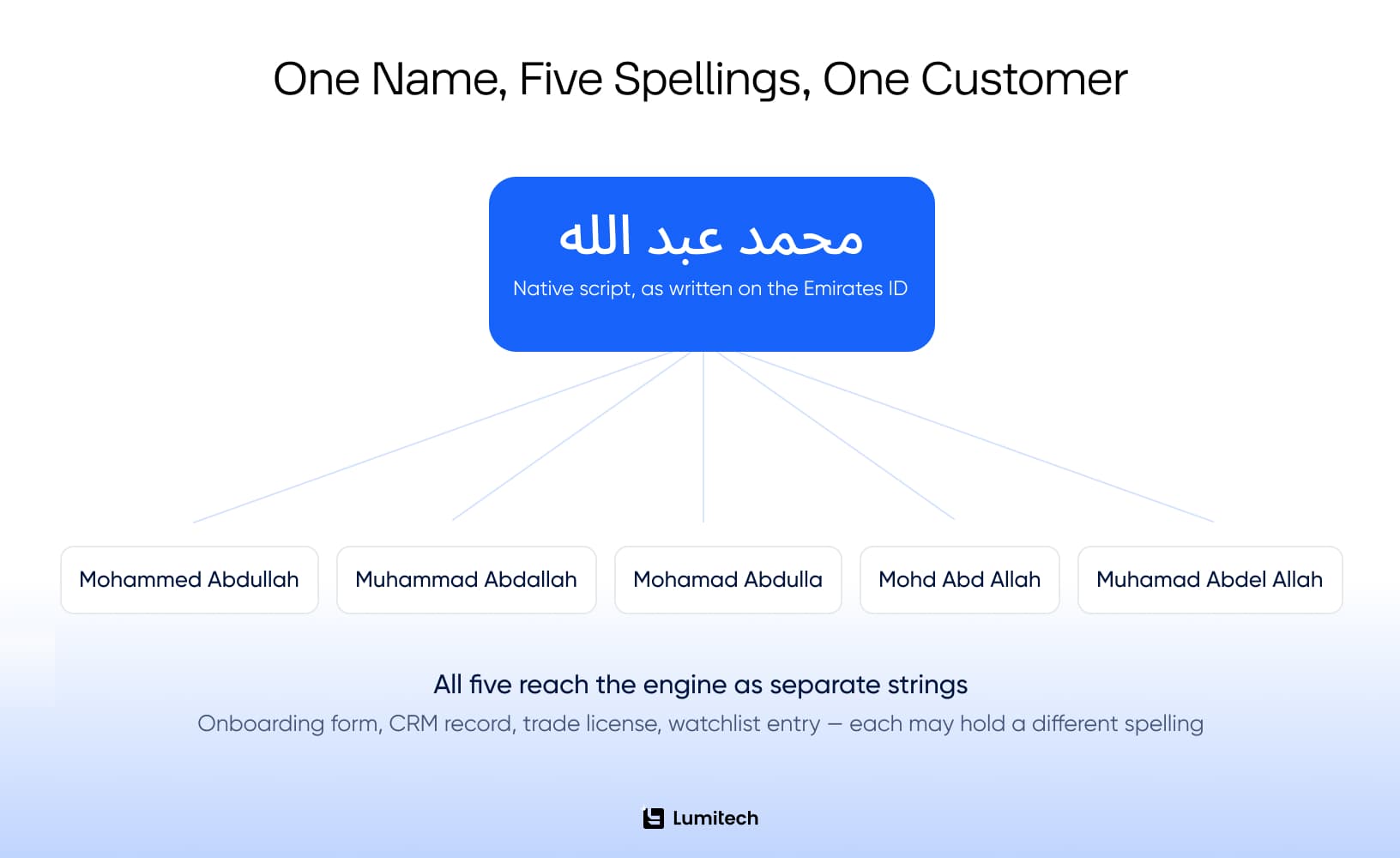
That last line is the one that matters. A vendor figure calculated on someone else’s portfolio predicts nothing about yours.
Monitoring, scoring, and evidence. Onboarding catches a fraction of the risk. Behavior shifts, new counterparties appear, and patterns change months into a relationship — which is exactly where the 2025 regulations put continuous obligations. Scoring has to respond to jurisdiction, customer type, transaction history, and network connections, and stay explainable when a supervisor asks. The system records what data was used, which rules fired, who reviewed the alert, and why. Senior management now carries explicit personal responsibility for the program, so the evidence layer is a governance requirement now. Where financial crime and payments risk sit in the same flow, fraud prevention and transaction monitoring belong in one program, and not in two parallel ones.
Data quality, integration, and scale. Data governance in banking decides whether customer, transaction, and ownership data reach the screening engine in a usable state. Where AML sits inside a financial product, fintech software development scoping and AML selection should read from one architecture. A system running beside the process gets bypassed manually within a quarter. And performance at 1,000 customers tells you nothing about 100,000, so test throughput and match latency against projected volume while you are still in the trial.
How Much Does AML Software Cost in the UAE?
Two of the ten AML software providers here publish a price. The other eight want a discovery call first. Averaging the two into a single UAE benchmark would produce a number that describes nobody’s situation.
Product | Published price, checked August 2026 | Included scope | Important note |
|---|---|---|---|
Sumsub | Basic: USD 1.35 per verification, USD 149 monthly minimum. Compliance: USD 1.85 per verification, USD 299 monthly minimum. | Basic covers ID verification, liveness, and face match; reusable KYC. Compliance adds AML screening, ongoing monitoring, and proof of address. | Charged on successful verifications; minimums apply regardless of usage; Enterprise is quoted. |
ComplyAdvantage | Starter tier from approximately USD 99 per month for low entity volumes. | Sanctions, watchlists, PEPs and RCAs, adverse media, company and customer screening, ongoing monitoring. | Usage-based above the entry tier; enterprise and monitoring scope quoted separately; free ComplyLaunch tier for qualifying startups. |
The models you will be quoted: per screening or API call; per monitored entity, which is a very different number from new customers per month; per seat on the case-management layer; transaction-monitoring volume in tiers, where the tier boundary is where the quote jumps; data and watchlist licensing, often a separate contract entirely; and the negotiated annual enterprise license.
Ask for these priced as separate lines: data licensing, seats, integrations into onboarding, CRM, core banking and payment systems, sandbox environments, implementation, data migration, rule tuning through year one, training, support tier, and whether goAML output sits inside the base price or outside it. Add them up, and you have the first-year total. The subscription line is rarely the biggest number on that list.
Build vs. Buy: SaaS AML Platform vs. Custom AML System
Process fit, integration load, regulatory scope, and whether AML logic is part of your product — those four decide it. Most UAE firms end up somewhere in the middle: a licensed platform with one clearly defined custom layer bolted on.
Dimension | SaaS AML platform | Custom AML system |
|---|---|---|
Time to go live | Weeks to a few months | Several months, discovery first |
Customization | Configuration within vendor limits | Defined by your requirements |
Data control | Vendor-hosted; residency by contract | Your architecture and hosting decision |
Regulatory change management | Vendor maintains the core; you validate | Your team owns updates and validation |
Integration depth | API-level, within published endpoints | As deep as the estate requires |
Total cost drivers | Per check, per entity, data license, seats | Build, data license, maintenance, ownership |
Vendor lock-in | Migration cost rises with configuration depth | Portable, with maintenance responsibility |
Scenarios decide this, and fixed thresholds do not. The top AML screening software in the UAE by feature count is frequently the wrong answer here. A single-entity DNFBP with a few hundred customers has no build case at all. A payments firm under two supervisors, running a proprietary risk model with screening embedded in the customer journey, has a strong one. And any claim that custom gets cheaper above some specific customer or transaction count is marketing until someone puts the model assumptions on the table.
Where the answer points to a build, a short product discovery phase maps workflows, supervisors, data sources, integrations, and reporting responsibilities before anyone commits to a cost or a date. It also settles the reporting format question, which otherwise surfaces three months in, when changing it is expensive. For an external delivery partner, software development in the UAE brings the regulatory context into the engagement from day one, and Lumitech's directory of IT outsourcing companies in Dubai covers the wider vendor-selection question.
Common Mistakes When Choosing AML Software
Buying on price alone. A cheap platform that generates noise costs more in analyst hours than the license ever saved. Work out the fully loaded cost, clearance time at your alert volume included, before comparing subscription lines.
Ignoring UAE specifics. Platforms built around European or US frameworks say nothing about CBUAE, DFSA, FSRA, VARA, or goAML, and the enforcement record shows what that gap costs. In May 2025, the CBUAE imposed a financial sanction of AED 200 million on an exchange house for significant AML and CFT failures, plus AED 500,000 on a branch manager who was permanently barred from any licensed institution in the country. On 24 June 2026, it imposed a financial penalty of AED 20 million on a branch of a foreign bank for significant, repeated failures across its AML, CFT, and sanctions framework — and a separate AED 300,000 on the Head of Compliance and Money Laundering Reporting Officer. Read the word "repeated" carefully. It means earlier remediation did not hold, which is precisely what an incomplete audit trail produces.
Screening only at onboarding. Point-in-time checks leave the whole ongoing relationship unwatched, and that is where the 2025 regulations put continuous obligations.
Weak integration and weak matching. A system sitting outside CRM and transaction flows gets worked around within a quarter, and those workarounds are invisible to the platform and perfectly visible to a supervisor. Meanwhile, excessive false positives burn out the team while weak fuzzy matching lets real risk through. Both are measurable on your own data during a trial, and both stop being measurable the day after you sign.
Treating the vendor as the accountable party. The MLRO files the report. Senior management approves the program. The regulator fines the entity and, as June 2026 showed, the person.
Every item on that list is verifiable in a week.
Lumitech checks your list coverage, false-positive rate, audit trail, and goAML output, then names the gaps in writing.

What to Ask AML Software Vendors in a Demo
Bring your own data sample and your own entity structure. A scripted demo running on vendor data won’t answer what you need to know.
Which UAE supervisory frameworks does the product support in production today: CBUAE, DFSA, FSRA, VARA, DNFBP?
Which sanctions and watchlists are covered, including UAE Central Bank and Cabinet lists, and how often is each refreshed?
How does fuzzy matching handle Arabic names in native script and transliteration, and can you explain the match score?
What false-positive rate does the system produce on our sample, and which levers reduce it?
How does transaction monitoring work — rules, behavioral models, or both — and who tunes them after launch?
Show the audit trail for a cleared alert, an escalated alert, and a case closed without a filing.
Does the platform generate goAML reports in a structured format, or export data for manual submission?
What is a realistic implementation timeline, and how does pricing scale across checks, entities, transactions, seats, and data licenses?
“That can be configured”, offered without a demonstration, is an open scope item. Open scope items belong in the contract before they belong in the project plan.
Conclusion
The best AML screening software in the UAE is whichever product can run your actual compliance process across every entity you hold, every supervisor you answer to, and every report you file. A strong vendor page earns a demonstration and nothing more. The contract comes after the platform has screened your data, produced a match it can explain, assembled a case file, and shown the reporting output your supervisor expects to see.
A single-entity DNFBP usually gets everything it needs from a UAE-native platform. A bank or a multi-supervisor group needs an enterprise platform sitting on a licensed data layer. A fintech or VASP with proprietary risk logic tends to end up building on top of whatever it licenses.
Working out which of those you are? Lumitech can map your entities, supervisors, data sources, and reporting obligations, then tell you whether the next step is a platform, a custom layer, or a build.


