
AI Patient Engagement Platform: Reminders, Follow-Ups, and Care Navigation
AI patient engagement is sold on time savings that the published studies do not show. A practitioner’s read on reminder evidence, post-discharge follow-up, Medicare navigation codes, and EHR write-back limits.
- Health & Wellness
- Software Development
October 23, 2026
 AI Overview
An AI patient engagement platform uses electronic health record events to automate appointment reminders, post-visit follow-ups, and care navigation. Models select timing, channel, and language, while staff handle exceptions. Randomized trials show messaging reminders raise attendance from 67.8% to 78.6%, though reach and EHR integration limits determine whether automation delivers that gain.

An AI patient engagement platform is software that, based on patient records, appointment data, and care-plan events, decides who to contact, when, on which channel, and in what language, then sends personalized reminders, follow-up messages, and navigation support automatically. Models are responsible for timing, targeting, and routing; clinical staff handle exceptions. The point is to close gaps between visits without adding to the clinical inbox.
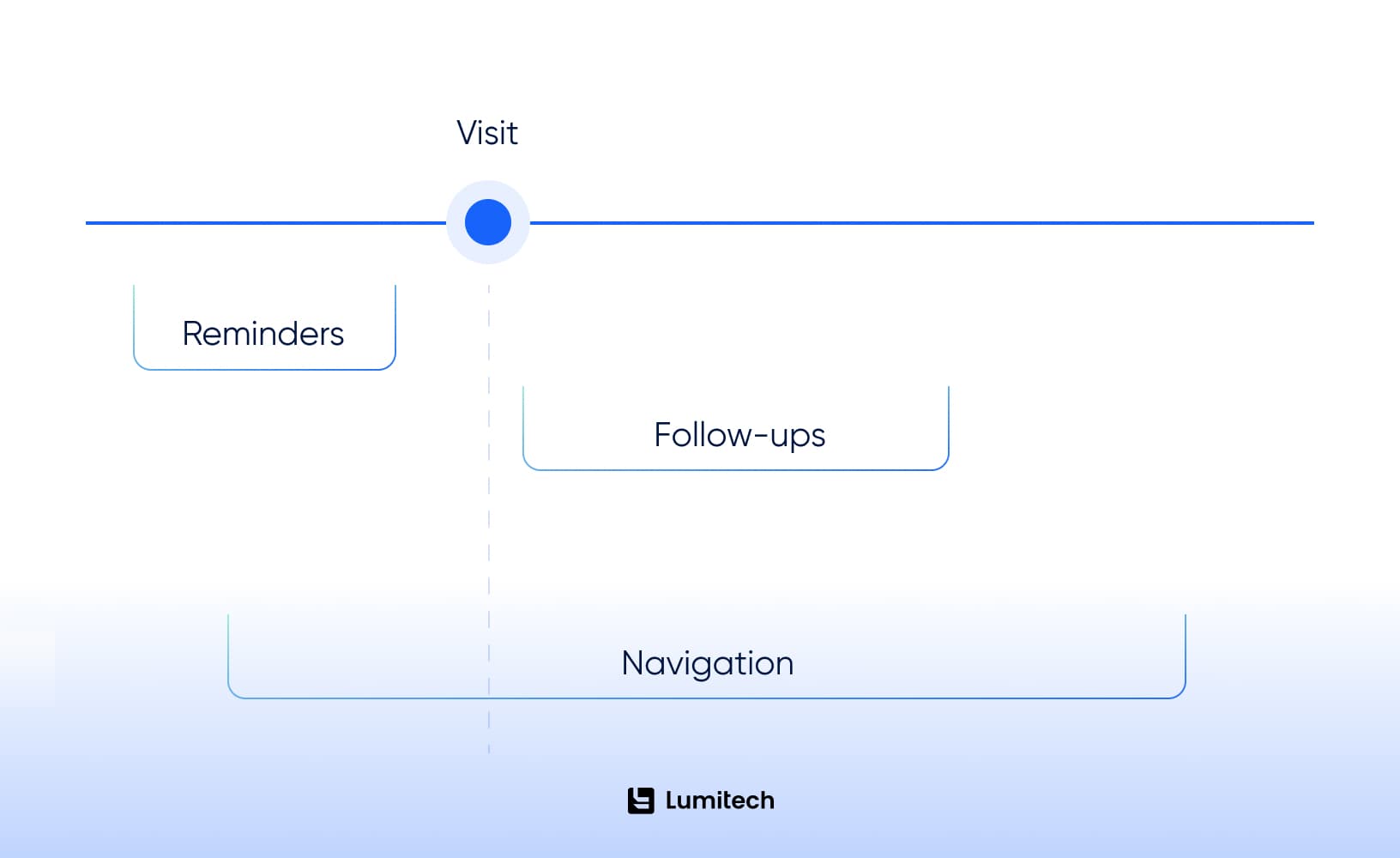
These three jobs are typically offered as a single product. Reminders run before a visit, follow-ups after it, navigation between episodes, and often for months. Each has its own evidence base, failure mode, and, in the United States, payment path. One of the main reasons why these programs fail to meet their business case is that they are treated as part of one category.
In brief
The strongest randomized evidence for appointment reminders comes from a Cochrane review whose literature search closed in August 2012. It supports a modest attendance gain, not the figures in vendor material.
Two 2024 studies of AI-drafted replies found no reduction in clinician reply time, and one found read time rose. Only one measured workload burden; it fell.
Since 1 January 2024, Medicare has paid for patient navigation under HCPCS codes whose documentation rules amount to a product specification.
How AI Patient Engagement Works Across Three Different Jobs
Before any model runs, the platform needs an event to respond to: an appointment booked, a discharge recorded, a result filed, a care-plan task due. The platform subscribes to these events, applies its rules and models in order to determine whether and how to take action, and then records the outcome back to the record.
The AI sits in a narrower place than the marketing suggests. It usually performs one of four tasks: predicting which patients are likely to miss a visit, deciding on the channel and timing, adjusting the message language, or classifying and routing incoming replies. Personalized patient engagement in this context means per-patient decisions about contact, not per-patient clinical advice. A system giving clinical rather than logistical guidance crosses into a different regulatory category.
All the rest is standard healthcare software development: templates, consent storage, delivery infrastructure, audit logs, queues. Those parts decide whether the program works at all; the models decide how much better it gets.
Personalized Reminders: Widely Deployed, Thinly Evidenced
Automated appointment reminders are the oldest and best-studied part of the category, and the evidence is older than the market implies.
A Cochrane review of mobile phone messaging reminders found that, across seven of eight trials covering 5,841 participants, text reminders increased attendance compared with no reminder (RR 1.14, 95% CI 1.03 to 1.26); attendance was 67.8% without reminders and 78.6% with them. The authors graded this as moderate quality and concluded the evidence “still remains insufficient to conclusively inform policy decisions.”
That review was published in December 2013, but the search it referred to ended in August 2012. For anyone evaluating patient appointment reminders now, the trials took place before the arrival of smartphone-era messaging practices, and they didn’t include testing of model-driven targeting. No comparable randomized evidence shows AI-personalized reminders outperforming well-timed generic ones.
What exists instead is deployment evidence. Mid and South Essex NHS Foundation Trust in England ran a six-month 2023 pilot of Deep Medical’s no-show prediction software across urology, dermatology, and pain management, then extended it trust-wide on 30 July 2024. After announcing the pilot in March 2024, NHS England reported that non-attendance fell by almost a third and that it prevented 377 missed appointments. These are pilot figures from a single trust, with no published control group, methodology, or independent evaluation.
Epic publishes a comparable figure from Ochsner Health, whose conversational AI for appointment messaging raised confirmation rates from 43% to 52% — one health system reporting its own deployment through its vendor, not independent proof of effect size.
For medical appointment reminders, the floor is well established, and the ceiling is not; whether a model-driven layer pays for itself depends on each organization’s baseline. Our guide to AI no-show prediction covers the modeling side.
Automated Follow-Ups After the Visit and After Discharge
Patient follow-up automation covers two often-conflated workflows: contact after an outpatient visit and contact after discharge. The evidence treats them differently.
A 2025 systematic review and meta-analysis in JAMA Network Open compared outpatient follow-up within 30 days against no known follow-up. Across 73 studies, it found a relative risk of 0.68 (95% CI 0.60 to 0.75) for 30-day all-cause readmission; among 21 studies at low to moderate risk of bias, 0.78 (95% CI 0.67 to 0.89). There was very high heterogeneity, and about five out of six of the studies were based in the United States. Two details matter more than the headline: in the low-risk-of-bias analyses, benefit was demonstrated only among patients aged 65 and over; and the reported intervals for follow-up within 7 or 14 days overlap those for 30-day follow-up, which the authors do not test formally but which sits behind their statement that earlier follow-up “may not be necessary for low-risk patients.” That is an argument against blanket scheduling, and the most actionable finding available for configuring post-discharge follow-up.
A 2026 quasi-randomized trial at all twelve Fraser Health acute hospitals in British Columbia tested a nurse call roughly 48 hours after discharge with 7,091 adults. Seven-day emergency department visits fell (IRR 0.719, 95% CI 0.617 to 0.837), while 30-day readmissions did not change significantly. The most revealing figure is not the size of the effect: only 1,752 of the 3,911 patients in the intervention group completed the call. Reach, not intent, is the binding constraint on patient follow-up software, and assuming contact is a design error.
The other half of follow-up work is inbound, and here the results run counter to the sales pitch. In a five-week 2023 pilot at Stanford Health Care covering 162 analyzed clinicians, AI-generated draft replies were available for 9,621 of the messages that received responses. Mean draft utilization was 20%, with no change in reply action time, write time, or read time. What changed was how the work felt: among the 73 clinicians surveyed before and after, task load fell from 61.31 to 47.26 and work exhaustion from 1.95 to 1.62, with no control group. A modified randomized waiting-list study at UC San Diego Health, covering 52 physicians and 10,679 replies against a contemporaneous control group, found read time rose 21.8% (95% CI 5.2% to 41.0%) while reply time did not change significantly; it did not measure burden at all.
Both studies are single-site investigations from 2023 that used models which have since been superseded and, as such, cannot be combined. They point the same way, and the direction matters for any business case built on automated patient communication: drafting moved effort from composition to verification. Evidence does not support a business case based on the number of minutes saved per message; a case based on a reduction in clinicians’ perceived burden rests on a single, uncontrolled survey.
When a follow-up message surfaces a symptom rather than a scheduling problem, the handoff rules resemble those used for AI in remote patient monitoring: tiered responses, defined thresholds, a named human owner.
Care Navigation and the Billing Codes That Pay for It
Navigation has the clearest business model in the United States, and the least vendor coverage. Since 1 January 2024, Medicare has paid separately for Principal Illness Navigation under HCPCS codes G0023 (60 minutes per calendar month, furnished by certified or trained auxiliary personnel under a practitioner’s direction) and G0024 (each additional 30 minutes), with G0140 and G0146 covering peer-support variants. Community Health Integration codes G0019 and G0022 cover unmet social drivers that limit a practitioner’s ability to diagnose or treat. All were established in the CY2024 Medicare Physician Fee Schedule final rule and apply to Medicare fee-for-service in the US only.
The requirements read like a specification. CMS requires an initiating visit personally performed by the billing practitioner, and services furnished incident to that practitioner under general supervision. For navigation, consent must be obtained before or when services commence and annually thereafter; for Community Health Integration it is obtained once, and again if the billing practitioner changes. Consent is documented, and cost-sharing explained, because the usual Part B deductible and coinsurance apply. Time and activities must be documented too, and while auxiliary personnel may enter that record, the billing practitioner must review and verify it.
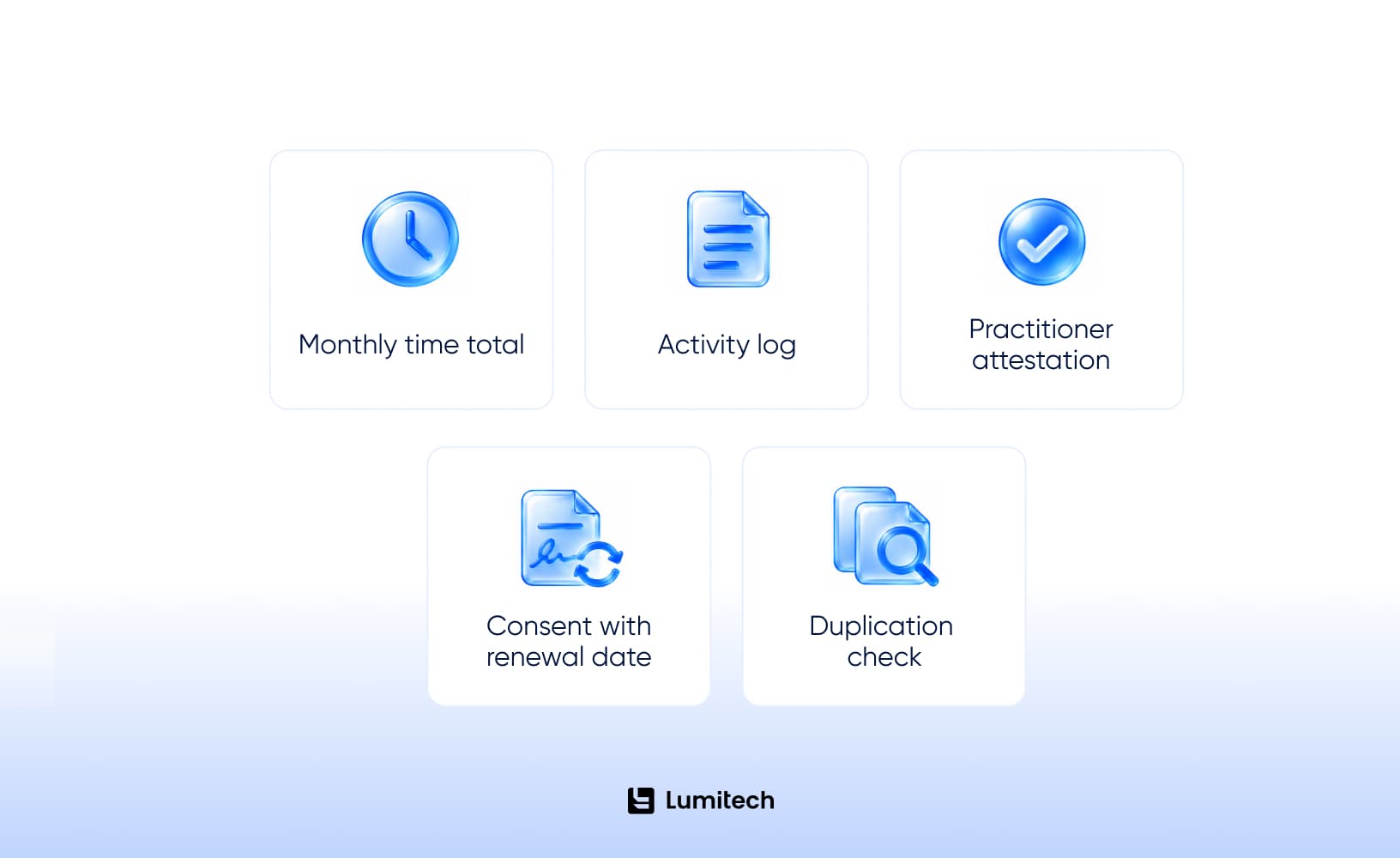
Any patient care coordination software designed for this workflow must include per-patient monthly time accumulation, activity-level logging, a practitioner attestation step, consent capture with the right renewal rule, and non-duplication logic against concurrent care management billing. A navigation module that can’t generate a defensible monthly time log does not qualify.
This is also the honest boundary of AI care navigation today. Identifying eligible patients, prioritizing caseloads, drafting outreach, and summarizing interactions all sit within AI and ML development services; the reimbursable work around them stays human, supervised, and documented. Care coordination software marketed as autonomous navigation describes something CMS does not pay for.
Navigation documentation is a build requirement, not a billing afterthought.
We can look at what your current stack captures per patient per month, and what it would take to make that hold up under review.

Integration Reality: EHR Events, Scheduling, and Identity
Delays usually come from integration rather than model quality. Reading data out of an EHR is routine; writing actions back is not.
What a Patient Engagement Platform Has to Connect to
At minimum: a subscription to clinical and administrative events, read access to demographics, appointments, care plans, and results, reliable identity matching, write access for appointment changes, and a consent store checked before every outbound message. The read side is well served by HL7 v2, C-CDA, and FHIR, covered in our guide to healthcare data interoperability.
Scheduling is the problem. The Argonaut Scheduling Implementation Guide, the US profile for appointment search and booking over FHIR, is still at Release 1.0.0, built on FHIR STU3 and released in 2018. It states that “additional patient input and more advanced conflict checking has been deferred,” treats rescheduling as a two-step process of canceling and rebooking, and leaves what a consumer may update as an open question. The underlying FHIR Appointment resource is at Maturity Level 3, Trial Use, and the guide publishes no adoption data.
So a digital patient engagement platform promising self-service rescheduling will usually run against vendor-specific APIs rather than a portable standard. Budget for per-EHR work, and confirm which write operations the EHR edition exposes.
Language and channel reach are the quieter risks. A 2025 audit of 511 US hospital portal login pages across 51 counties in 17 states with large limited-English-proficiency populations found that 29.4% offered English only, and only 4.7% supported the most common non-English, non-Spanish language in their county. In a study of 64 adults aged 50 and over at a San Francisco safety-net health system, automated texts were themselves a friction point: some participants ignored the embedded link or replied to a no-reply number.
Reach is something that teams tend to measure at the end but should actually measure first. If half your intended contacts never land, the model learns from the patients who were already easy to reach and keeps recommending more of them. Before tuning anything, I want delivery and completion rates broken out by age, preferred language, and channel.


Those barriers hit older patients hardest, the group where the discharge benefit was demonstrated, making reachability a prerequisite for the follow-up workflows above rather than a reporting detail.
Compliance: HIPAA, TCPA, and the EU AI Act
Three regimes have an effect on patient outreach automation, two of them moving now.
HIPAA
Communications related to treatment generally don’t require separate authorization. HHS states the Privacy Rule “generally allows PHI to be used or disclosed without restriction for treatment purposes,” and that such communications “may occur orally or in writing, by phone, fax, e-mail, or otherwise.” One aspect is often misinterpreted: the marketing exception for “refill reminders and other communications about a drug or biologic that is currently being prescribed for the individual” is narrow, and an appointment reminder is not a refill reminder. Any vendor handling PHI needs a business associate agreement. The Security Rule overhaul proposed on 6 January 2025 (90 FR 898) is still a proposed rule, so the existing Security Rule is unchanged.
TCPA
The FCC adopted a Report and Order on consent revocation on 30 September 2026. It replaces the earlier “revoke-all” default for informational messages with category-specific revocation, so that if a patient chooses to opt out of billing messages, they need not also lose access to appointment reminders. It also lets a business specify exclusive opt-out methods, clearly disclosed: an automated voice or key-press mechanism, a reply text using one of seven standardized keywords, or a designated website or number. Marketing revocation remains all-or-nothing. The order takes effect 30 days after Federal Register publication; as of 19 October 2026, that had not occurred, and the rules were not in force. A further notice asks whether to require a revoke-all option; that remains a proposal.
EU AI Act
Article 50(1) mandates that providers of AI systems which interact directly with people must make it clear to those people that they are speaking to an AI system, provided that this is not obvious to a reasonably well-informed observer, and Article 50(5) requires that information “at the latest at the time of the first interaction or exposure.” The Digital Omnibus on AI, Regulation (EU) 2026/1744, entered into force on 27 July 2026 and deferred Annex III high-risk obligations to 2 December 2027 (Annex I to 2 August 2028). Transparency duties were not deferred. Classification requires care: within the Annex III use cases, a system that profiles natural persons is always high-risk, and scoring individual patients to decide who receives outreach is profiling. In the US, California’s AB 3030 has required disclaimers on generative-AI patient communications containing clinical information since 1 January 2025, unless a licensed or certified provider has read and reviewed them.
Safety testing before a conversational channel goes live is a separate discipline, covered in our pre-launch guide to AI chatbots in healthcare.
What to Verify Before Buying an AI Patient Engagement Platform
Six checks separate the systems that survive contact with a health system.
Check | What to ask for | Why it separates vendors |
|---|---|---|
Evidence basis | The study or deployment behind every quoted outcome, with setting, size, and date | Deployment proof and outcome proof are routinely presented as one |
Write-back scope | Which appointment operations are supported per EHR edition; whether rescheduling is atomic | The scheduling standard defers this; answers vary widely |
Message taxonomy | Whether categories can be suppressed independently, per patient, with an audit trail | Required by the revised FCC consent rules once effective |
Reachability | Delivery, open and completion rates by age, preferred language and channel | Aggregate rates conceal the binding constraint |
Navigation documentation | Monthly time accumulation, activity logging, practitioner attestation, consent renewal | Determines whether navigation work is billable under Medicare |
Escalation | Thresholds, routing rules, human ownership, logging for anything clinical | Where patient-facing systems carry actual risk |
Two further notes on evaluating patient engagement software. First, the US certification floor for model transparency is moving: the HTI-5 proposed rule of 29 December 2025 would remove 34 of the 60 certification criteria now in effect and revise seven, including one that would “fully remove the artificial intelligence (AI) ‘model card’ requirements.” If it is finalized, transparency obligations move into the contract rather than the certification floor.
Second, the decision between building in-house and buying is made on a layer-by-layer basis. Messaging delivery, consent storage, and template management are commodity. Event capture, identity resolution, EHR write-back, and navigation documentation are where organizations differ, and where patient engagement solutions sold as complete platforms most often need custom work. Automation programs stall when that layer is scoped as configuration, and comparing patient engagement software on templates will not surface it. The same logic applies across AI solutions in healthcare: fund the workflow whose baseline you can measure today.
The hard part is rarely the model.
If you’re working through event capture, consent design, or EHR write-back, we can walk through what your current systems support and where the custom work actually sits.

Where This Leaves a Buying Decision
The evidence supports this category without flattering it. While reminders result in an observable but small increase in attendance, follow-ups are of help to patients who are already at risk. Assistance with drafting has changed how clinician inbox work feels, even though it hasn’t reduced the amount of work. None of that argues against building. It argues for building against a baseline you can measure, in one workflow, before widening the program.
The implementation risk has moved as well. It now sits in event capture, consent taxonomy, identity matching, and appointment write-back rather than model selection, and in the United States, care navigation carries documentation requirements that determine whether the work is billable at all. Teams that treat patient engagement automation as a messaging purchase tend to find that layer late. Scoping it early, with AI integration services matched to the EHR you actually run, is what separates a pilot from a program.


