
AI No-Show Prediction for Clinics: How to Reduce Patient No-Shows With Predictive Analytics
Every clinic runs a schedule that assumes patients turn up. When they do not, the loss is immediate and unrecoverable: a clinician waits, a room sits empty, someone further down the list keeps waiting.
- Health & Wellness
- AI Integrations
August 31, 2026
 AI Overview
AI no-show prediction uses machine learning on historical scheduling and patient records to estimate the probability that a booked appointment will not be attended. Models learn from prior attendance, booking lead time, and reschedule history, then return a risk score. One validated model flagged appointments at 18% positive predictive value, so scores suit targeted outreach rather than automated overbooking.

A growing number now try to identify in advance who is unlikely to arrive, on the promise that a model can reduce patient no-shows without extra staff. That makes attendance a data problem, and it lands with whoever owns healthcare software development rather than with the practice manager alone.
No-show prediction applies machine learning to historical scheduling and patient records to estimate the probability that a booked appointment will not be attended. Models learn mainly from prior attendance behavior, booking lead time, and whether the appointment was rescheduled, then return a patient no-show risk score that staff can act on beforehand.
What Counts as a Patient No-Show — and Why There Is No Single No-Show Rate
Ask two health systems for their no-show rate, and you will usually get two numbers you can’t compare because they count different events.
NHS England records a “did not attend” only when a patient gives no advance warning. Across 146.1 million outpatient appointments in England in 2024-25, 8.1 million were recorded as did not attend, a DNA rate of 5.6%. Patient cancellations (7.1%) and hospital cancellations (9.2%) are counted separately. NHS Scotland, on a comparable definition, recorded 8.2% for the year to March 2025.
US figures run higher, largely because of what they include. Northwell Health studied 4.37 million adult ambulatory appointments and classified 763,414 of them, about 17.5%, as non-arrivals — a measure that deliberately bundles late cancellations with genuine no-show appointments. A study of 15 family medicine clinics in Pennsylvania separated the two and found them almost equal: 6.9% missed appointments against 6.8% late cancellations across 1.12 million bookings. A review of 26 primary care studies across five countries found rates from 3.3% to 48.1%, with a median near 13%.
Any external benchmark means little until you know which events it counted. Measure your own no-show rate by specialty, and write down the definition.
Most clinics cannot report no-shows separately from late cancellations.
Fixing that is data engineering, and it comes before any model.

The Effects of No-Show Appointments
The effects of no-show appointments are usually counted in money, and that case is more weakly sourced than the industry’s confidence suggests. The figure most often quoted, $150 billion a year across US healthcare, traces to a 2017 trade article by a scheduling vendor’s chief marketing officer, which cited no study, and behind it to the same company’s 2016 report, which counted missed and unfilled appointments together on an assumed $200 per open hour. No federal agency or peer-reviewed publication appears to publish a US national figure.
Credible estimates are narrow. NHS England has costed a missed appointment at roughly £120 in hospital outpatients (2017/18) and £30 in general practice (2019), without publishing the derivation. A US Veterans Affairs analysis calculated $196 per no-show in 2008 dollars: peer-reviewed, but from a salaried, capitated setting unlike a fee-for-service clinic.
The stronger argument is clinical. A Scottish study of 824,374 patients and 11.5 million appointments found a dose-response relationship between missed general practice appointments and all-cause mortality: patients missing more than two a year had a hazard ratio of 3.11 against those missing none, and 8.37 among patients whose only long-term conditions were mental health conditions. That is association, not causation, but the patients who miss most often are those who can least afford to miss. Anything that responds to patient no-show risk by reducing access targets the wrong population.
How AI No-Show Prediction Works
Predictive analytics in healthcare is unusually mature for this use case, and among the wider set of AI in healthcare applications it has one of the shorter paths to production.
What a No-Show Prediction Model Learns From
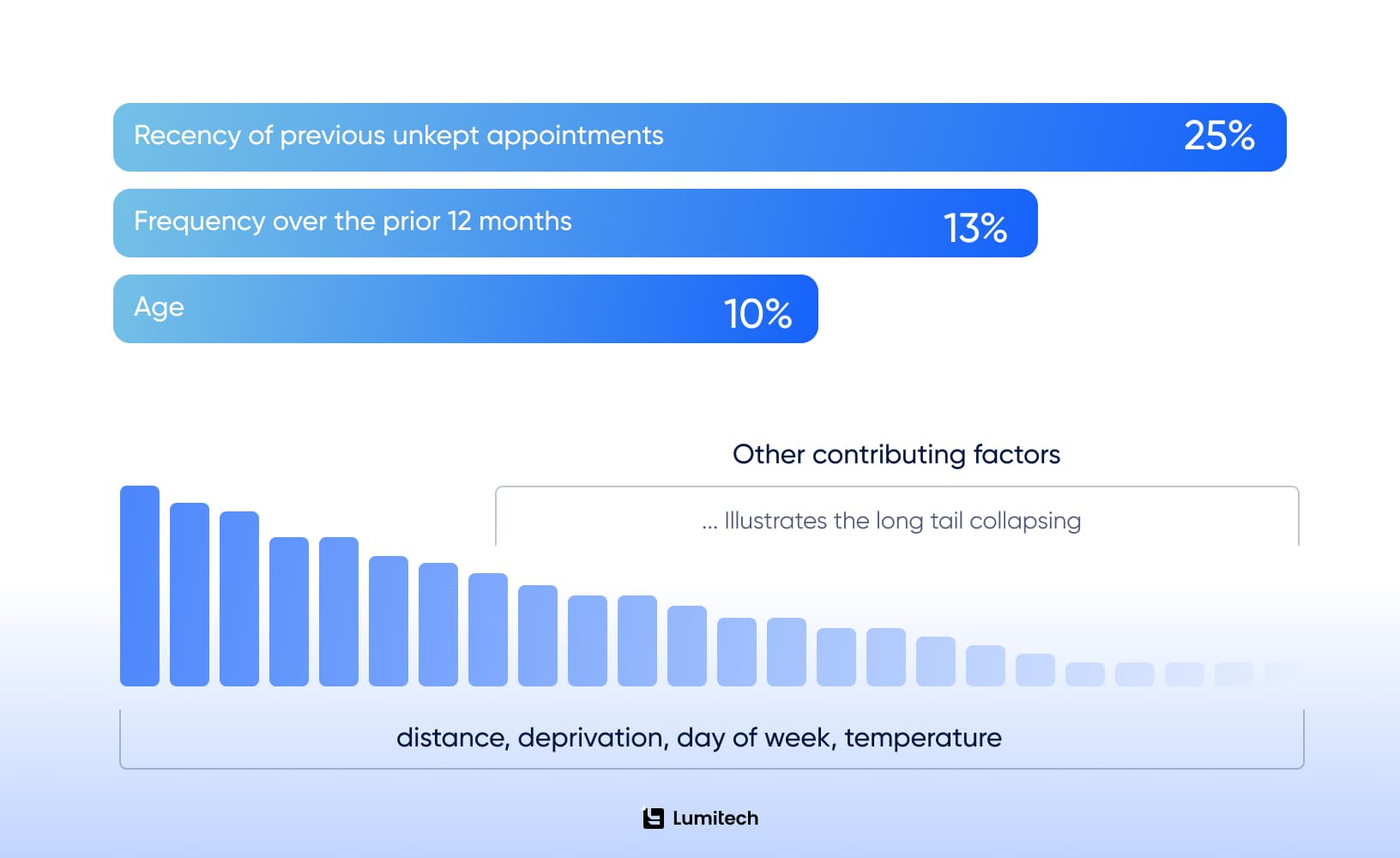
One signal dominates almost every published study: what the patient did last time. In the NHS analysis above, the recency of previous unkept appointments accounted for roughly 25% of model importance, their frequency over the prior 12 months a further 13%, and age about 10%.
The second consistent signal is scheduling lead time, the gap between booking and appointment. It was the most important predictor in the Pennsylvania study, where lead times beyond 60 days carried the most risk, and it ranked second at Northwell, where whether the appointment had been rescheduled ranked first. The direction is not universal — Northwell found short-notice bookings less likely to end in non-arrival — so treat lead time as a locally calibrated signal rather than a fixed rule.
Predicting patient no-shows well therefore does not require exotic data. It requires a clean appointment history that joins to the patient record, with reschedules and lead times captured — a data engineering problem before a modeling one.
From Risk Score to Scheduling Decision
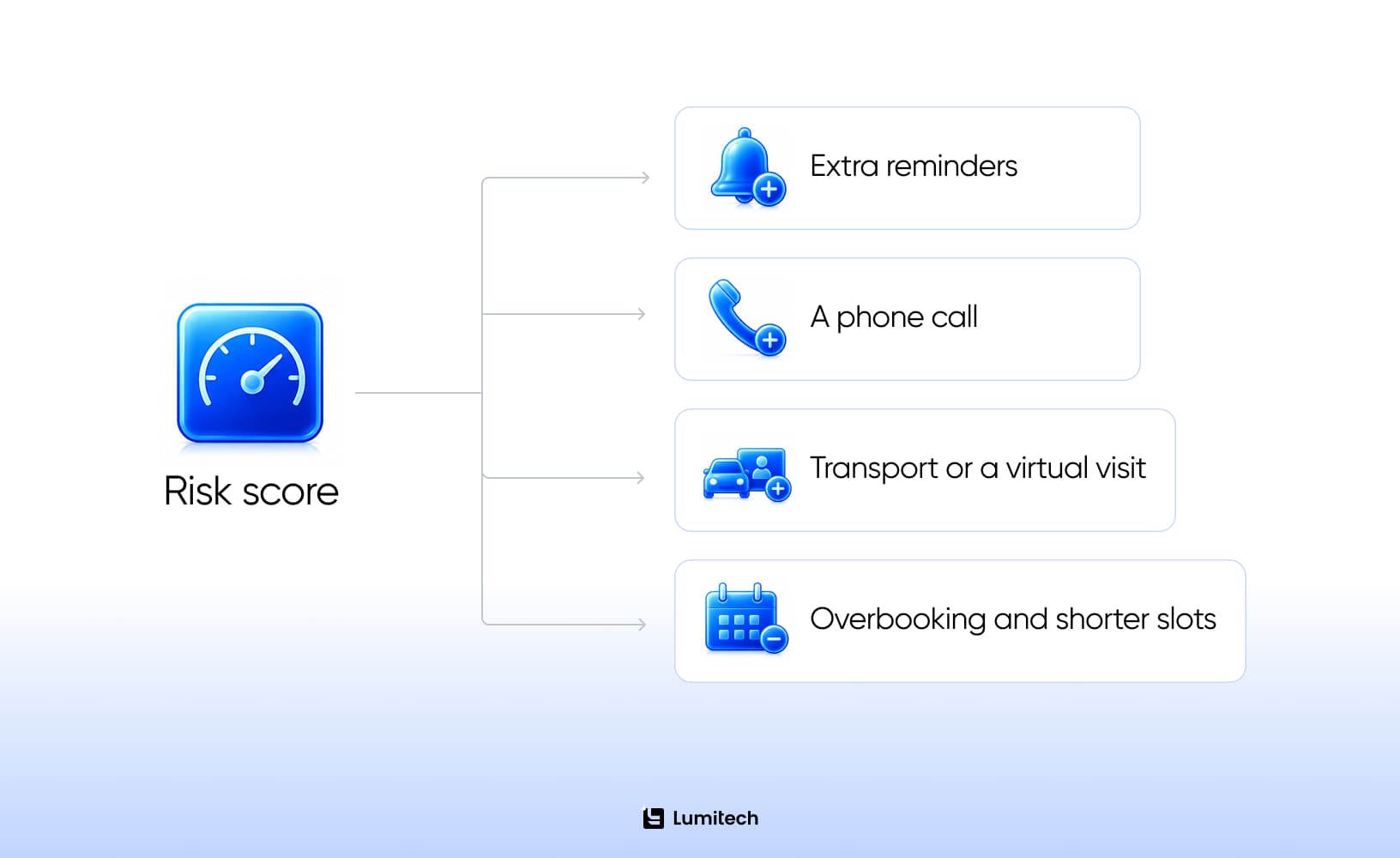
Clinics use no-show risk prediction in four ways: to trigger extra appointment reminders, prioritize live phone calls, offer practical help such as transport or a virtual visit, or adjust the schedule through overbooking and shorter slots. Where the alternative offered is a remote visit, the data discipline behind AI in remote patient monitoring decides whether it functions as a substitute or a deferral. The first three add something for the patient; the fourth takes something away, and that is where the evidence and the regulatory exposure divide.
How Accurate Is Patient No-Show Risk Prediction?
Two corrections are needed before reading any patient no-show risk figure.
First, accuracy is the wrong metric. At a 6% base rate, predicting that everyone attends scores 94%. A systematic review of 50 missed appointment prediction studies found only two that beat that trivial rule, and among the studies reporting AUC, only about a fifth exceeded 0.85.
Second, AUC does not tell you how often the model is right when it fires. A gradient-boosted model at a rural Wisconsin health system, trained on 1.26 million appointments, reached AUC 0.83 and caught 71% of no-show appointments at a positive predictive value of 0.18: a threefold lift that still means four in five flagged appointments were kept. In the NHS study, positive predictive value ran 37–47% in the best specialties and 16–29% in the worst, and the riskiest 10% of appointments held just 28.7% of non-attenders.
Three further findings should shape expectations. Complexity buys little: at Boston Children’s Hospital a neural network reached an F1 of 0.82 against 0.79 for logistic regression and 0.78 for a “predict what this patient did last time” rule, a gain the authors judged too small to justify the compute. Performance often fails to survive deployment, as with the University of Maryland radiology model that scored AUC 0.93 retrospectively and 0.73 prospectively. And external validation is almost entirely confined to the vendor model: no published study appears to have built a patient attendance prediction model in one health system and validated it at an independent second one.
That gap argues for local validation, most sharply for the no-show prediction model many clinics already own. A 2026 meta-analysis of externally validated Epic decision-support tools put its Risk of Patient No-Show model at a pooled AUROC of 0.62 (95% CI 0.54–0.68), weakest of the five tools reviewed, though from only two studies. In a JAMA Network Open validation at a safety-net system, it scored 0.58, with discrimination varying from 0.53 to 0.60 across racial and ethnic groups. At the University of Chicago, a locally built model scored 0.78 on HIV care visits, where Epic’s scored 0.63. A May 2026 endoscopy study found it tracked observed no-show rates closely at the group level, but did not test how well it separates individual patients.
Before the model, we want three things in place: the baseline it has to beat, monitoring that tells us when it drifts, and a named person who can override a score. Skip the third and the first operational surprise becomes a trust problem instead of a tuning problem.



Buy-versus-build therefore has an unusually well-evidenced answer: the native model is near-free and worth switching on, and unlikely to be enough alone, which is where AI/ML development services earn their place — validating a vendor score locally, then extending or replacing it.
How to Reduce No-Shows Once You Can Predict Them
Here the evidence is thinner than the marketing. A 2023 rapid review in JAMIA examined eight studies, seven randomized, of interventions driven by predictive models. Phone call reminders performed best, at a median risk ratio of 0.61. Patient navigators reached 0.55 and text appointment reminders 0.91, each from a single trial; the text estimate was the only one rated high certainty. Overbooking came last, with very low certainty of any effect.
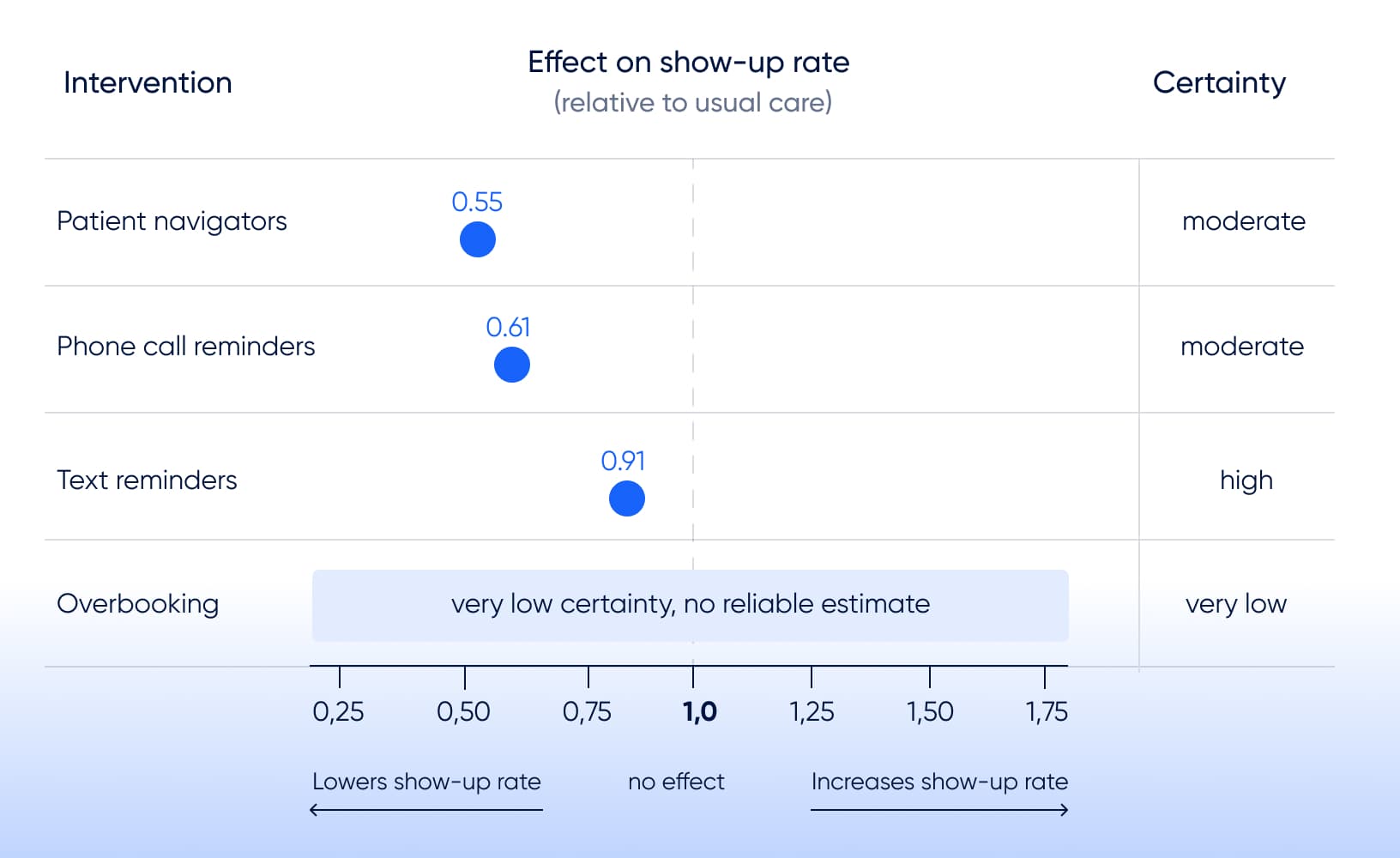
The same review holds the finding that should govern any business case: “We did not find any studies reporting a head-to-head comparison of targeted versus nontargeted interventions to reduce no-shows.”
That reframes what AI patient scheduling is for. Universal texting is cheap, and a 2013 Cochrane review found moderate-quality evidence that it modestly reduces missed appointments. Prediction earns its cost when the intervention is expensive — staff time on the phone, a booked taxi, a navigator’s caseload — because that is when you cannot give it to everyone.
The best outcome evidence fits that logic. At MetroHealth in Cleveland, a randomized quality improvement initiative used a random forest on EHR data to flag appointments above 15% predicted risk, then had schedulers place live reminder calls in addition to the standard automated ones. Across 5,840 appointments in 2022, no-shows ran at 33% in the called arm against 36% in the standard arm, and at 36% against 42% among Black patients, with no significant difference for White non-Hispanic patients. Three percentage points is modest, but it narrowed a disparity rather than widening one.
Prediction is also not always the strongest lever. A controlled program across 25 general practices in East London cut did-not-attend rates from 7.0% to 5.2% with no model at all, its biggest single win coming from one practice that cut its maximum forward-booking window from 28 days to one working day: 7.8% to 3.9%. Since lead time predicts strongly nearly everywhere it has been measured, any serious answer to how to reduce no-shows starts by testing the scheduling change before buying the model.
Where AI Appointment Scheduling Goes Wrong
The commercially obvious use of a risk score in AI appointment scheduling, overbooking the slots most likely to empty, has the weakest evidence and the clearest harm.
Because cost-minimizing schedulers assign the highest-risk patients to overbooked slots, and predicted risk correlates with race, the effect is systematic. Research published in Manufacturing & Service Operations Management in 2022, using roughly 40,000 appointments from a large US East Coast specialty clinic plus simulation, found Black patients’ in-clinic waiting times running 11.51% longer than non-Black patients' under a conventional scheduling objective. A fairness-aware objective cut the residual gap to as little as 0.72%, for about a 2.83% average cost increase.
Race and sex were features of the first version of Epic’s no-show risk prediction model and were removed over concerns about adverse effects on marginalized groups, a change documented by early 2022. Boston Children’s separately found that dropping race and its proxies — ethnicity, language, interpreter need — cost no statistically significant performance.
One rule should govern AI appointment scheduling: use the score to add outreach and remove barriers, never to allocate slots. NHS England’s guidance on reducing did-not-attends, last updated in 2023, warns against one-size-fits-all approaches, cautions that a low DNA rate can itself signal a service that discharges the patients most likely to miss, and names no AI product.
What It Takes to Deploy AI Scheduling for Clinics
Data and Integration
Deploying AI scheduling for clinics fails on data far more often than on modeling, and the label is the hardest problem. Deploying AI scheduling for clinics fails on data far more often than on modeling, and the label is the hardest problem. Where scheduling feeds sit alongside clinical and operational data, the trade-offs described in modern data platform architecture decide whether retraining and monitoring stay affordable.
FHIR defines an appointment status of noshow in both R4 and R5. Vendor reality is narrower. Oracle Health’s documented R4 status transitions do not include noshow, so the outcome your model trains on may not be writable through that API. Epic exposes appointment read and search at R4 but documents booking only through STU3 operations that open .epic labels prototype services. US Core 9.0.0 defines no Appointment, Schedule, or Slot profiles, and Appointment remains a Level 0 candidate in USCDI, excluded from the elements added in USCDI v7 in July 2026, so no certification requirement obliges a vendor to expose scheduling data.
Confirm three things before committing to a pipeline: that no-shows are captured distinctly from cancellations, that appointment history joins to the patient record, and that lead time and reschedule events are recorded. This is ordinary healthcare data processing work, and it is where most timelines slip.

Compliance and Governance
Under HIPAA, running an operational model on PHI generally falls within health care operations, so no patient authorization is required. The minimum necessary standard still applies to the feature set, and a third-party scoring vendor is a business associate needing an agreement with subcontractor flow-down.
The outreach layer is more constrained than the model. The FCC’s healthcare exemption permits appointment messages to the wireless number a patient supplied, without marketing or billing content, capped at one per day and three per week per patient, with a working opt-out. An AI patient scheduling workflow that escalates contact frequency for high-risk patients hits that ceiling, however accurate it is. A separate FCC rule, waived until 31 January 2027 and currently under reconsideration, would treat a patient’s opt-out from one message type as revoking consent for all of that provider’s automated calls and texts. Build the consent ledger now.
In Europe, administrative scheduling software sits outside medical device rules: MDCG 2019-11 Rev. 1 (June 2025) states that hospital information systems used to schedule appointments are not medical devices, and UK MHRA guidance agrees. That holds only as long as the intended purpose remains administrative; marketing copy claiming the tool helps clinicians prioritize who needs care soonest can change the classification. Under GDPR, a score driving an extra reminder is unlikely to be an automated decision, while one that automatically shortens or double-books a slot moves toward Article 22 on the reasoning the CJEU applied in SCHUFA — not settled by case law, and one more reason to keep the score away from slot allocation. Assume a data protection impact assessment is required. EU AI Act transparency obligations have applied since 2 August 2026, so patients speaking to an AI voice agent must be told. Its Annex III high-risk category, deferred to 2 December 2027 by the Digital Omnibus regulation, covers emergency triage and dispatch rather than administrative booking, so an ordinary no-show model is unlikely to sit inside it.
Where This Leaves a Clinic
Predictive analytics in healthcare has a real place in scheduling, and a narrower one than most vendors describe. The models are useful enough to be worth running, but not good enough to trust for a single appointment. Four checks decide whether a project is worth starting, and all four are data science services work rather than engineering work: your baseline by specialty, with the definition written down; the lift over a simple last-visit rule; positive predictive value at the threshold you would operate; and whether your intervention is expensive enough to justify targeting. If the answer to the last is a text message, fix your booking window first. If it is staff time, transport, or a navigator, patient attendance prediction is how you decide where it goes.


