AI Construction Estimating Software: How It Automates Quotes, Takeoffs, and Material Costs
AI construction estimating software uses computer vision, document parsing, and machine learning to convert drawings and specifications into quantities, match them to unit costs, and produce a takeoff and draft estimate for the estimator to review.
- Small Business
August 19, 2026
 AI Overview
AI construction estimating software turns drawings into quantities and draft estimates through element detection, document reading, and cost matching. Testing completed jobs against a contractor’s drawings and pricing data supports a sound buying decision. Nearly 70% of project managers and quantity surveyors worldwide expect artificial intelligence to add value.

At the start of a bid, estimating software reads drawings and specifications to prepare measured quantities, known as a takeoff, and a draft estimate based on unit costs. The estimator checks those quantities against the plans, resolves exclusions, prices labor and access, and adds risk, overhead, and markup. That review produces the quote the contractor sends to the client and is prepared to stand behind.
Different firms lose estimating time in different places, and that determines the purchase. If the hours go into measuring drawings, AI estimating software can recover some of them. If they go into pricing, revising a bid after an addendum, or retyping numbers into the accounting system, a faster takeoff will not help. That firm needs another estimator, better integration, or custom construction software development.
In brief
AI construction estimating tools detect repeated elements, extract model quantities, and read project documents. Estimators still decide scope, pricing, and risk.
Takeoff, quoting, and bill of quantities tools support different stages of estimating, even when product pages group them.
Accuracy changes with drawing quality and design maturity, and no independent benchmark compares commercial products.
Test each tool on your own drawings, including a poor-quality set, and confirm that its output reaches your accounting system.
The purchase pays back when the time saved in measurement exceeds licensing and implementation costs; higher win rates remain unproven.
What AI Construction Estimating Actually Automates Today
As of August 2026, commercial tools automate three inputs for an estimate: measurements from 2D drawings, quantities from 3D models, and requirements extracted from project specifications. The most established capability is 2D measurement. AI construction estimating software counts repeated elements such as doors, windows, fixtures, and outlets, then traces room boundaries to calculate areas. Autodesk Takeoff follows the usual workflow: the estimator marks one symbol, the system finds similar instances across the sheet, and the estimator reviews the results.
A 3D model provides quantities through a different route, since lengths, areas, and volumes already exist in the geometry and can be extracted directly. That predates the current AI wave, though vendors package it with the newer automation. Drawings still leave scope questions open, so language models scan specifications, addenda, and bid invitations for requirements, exclusions, and design changes.
Together, these capabilities reduce the time to assemble an estimate. They do not account for the conditions that set the final price. AI material takeoff software may calculate 340 linear feet of partition, but the estimator still has to price labor, third-floor access, and the risk of delay.
Handoff is testing whether it can remove the review step. On 21 July 2026, the company launched H1, an AI system it markets as autonomous AI construction takeoff software, and reported 81.6% accuracy on a vendor-designed benchmark using 15 residential drawing sets. Until an independent test reproduces that number, buyers should plan for human review and judge each product by how much verified takeoff work it removes.
How Takeoff, Estimate, Quote, and Bill of Quantities Fit Together
These four terms denote related outputs, and few tools cover all four equally well, so knowing what each produces lets you compare products on a common basis.
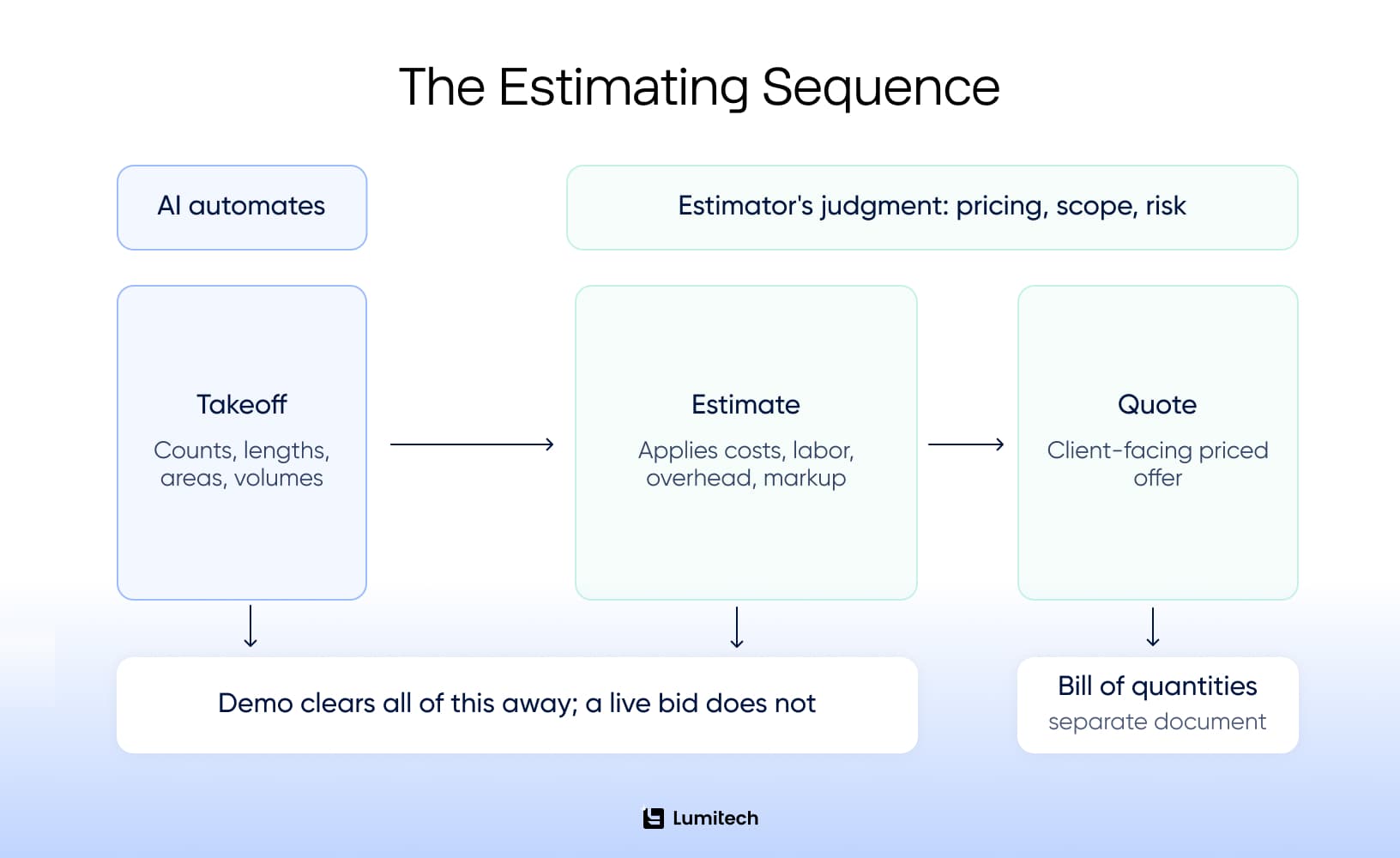
The first three form a sequence. A takeoff records quantities in counts, lengths, areas, or volumes. An estimate applies costs to those quantities to calculate the expected cost of the job. A quote turns that estimate into a client-facing offer and may use a different price for commercial reasons. A bill of quantities is a formally measured, itemized document used to obtain comparable tender prices. In the UK, the RICS New Rules of Measurement (NRM2) govern the preparation of measurements.
That sequence explains why a tool can measure accurately and still produce nothing a client will sign. The reverse can also happen: a tool may generate a polished proposal from weak measurements. Bill of quantities software occupies the formal end of the range because it produces a contractual document in accordance with a published measurement standard. That makes the bill of quantities software construction firms use for UK tendering a different product class from the quote-generation tools common in US residential work.
Where Construction Material Takeoff Software Fits
Measurement tools operate upstream of pricing. Traditional material takeoff software such as PlanSwift and On-Screen Takeoff was built for manual on-screen measurement, with symbol recognition added later. AI entrants including Togal.AI, Kreo, and STACK start with detection, then ask the estimator to correct the result.
Most contractor material takeoff software now includes some automated counting, so the correction process separates one product from another. Judge construction material takeoff software on that process. If verification takes as long as measuring by hand, the tool has added a step instead of removing one.
Where Construction Quoting Software Fits
Downstream tools handle the assembly, presentation, and follow-up that construction quoting software is built around. Quoting software for construction trades combines cost templates, markup rules, proposal formatting, e-signatures, and deposit collection. These products keep measurement light because they assume the contractor already knows the unit rates, a model suited to high-volume, low-variation work.
Construction small job quoting software serves this model directly. A painter pricing many similar jobs each month gains more from faster templates than from detailed drawing analysis.
The Three Technologies Inside Construction Estimating AI
These products combine three technology families: computer vision for drawings, language models for specifications, and machine learning for historical costs. AI software for construction estimating rarely separates them in its marketing, so two tools with matching feature lists can behave very differently on the same drawing set. Construction estimating AI has made the greatest progress in computer vision; cost prediction from a firm’s own history remains the least accessible capability for small contractors.
Computer Vision on Drawings
Detection models learn recurring graphical patterns: a door symbol, a hatch pattern, or a wall line weight. They perform best on vector PDFs exported from computer-aided design (CAD) systems, where the geometry is mathematically present in the file. Performance drops sharply on scans because the model must interpret pixels instead. Two contractors can evaluate the same AI powered construction estimating software and reach opposite conclusions: one provides clean architectural output, while the other uploads a scan of a marked-up print.
Language Models on Specifications
Large language models summarize specification sections, surface exclusions, and answer questions about a document set. They can also produce confident falsehoods, which the US National Institute of Standards and Technology (NIST) describes as confabulation in its Generative AI Profile, published in July 2024 alongside the AI Risk Management Framework. A fabricated inclusion or a missed exclusion can create financial liability upon contract signing.
Conversational interfaces of this kind are now common across construction platforms and use the same retrieval patterns that AI chatbot development services apply in other sectors. Ask whether the tool cites the source sentence behind every claim so a reviewer can check it.
Machine Learning on Historical Costs
The most ambitious use of machine learning is predicting cost or bid price from a firm’s own history. A deep learning framework published in Building Research & Information in 2023 reported a mean absolute percentage error of 11.60% for a general-purpose model covering several project types, a strong result under research conditions.
Most small contractors cannot reproduce that result because their job-cost history was never recorded with a model in mind. Cost codes get renamed between years, and similar jobs carry different labels. Strong performance on one firm’s data also says little about another firm’s projects. The capability appears in custom AI/ML development services engagements, where the data is cleaned first, and it rarely appears in off-the-shelf products at the small-contractor price point. AI construction cost estimating software that claims to learn your pricing needs enough consistently coded job-cost history to represent the work you actually bid.
How Accurate Is AI Construction Takeoff?
Published accuracy figures for construction estimating tools range from roughly 95% to 99%, but none has been independently validated. Part of the problem is that AI construction estimating software lacks a shared test set, a neutral benchmark, or third-party certification, leaving no common basis for comparison.
Your completed projects can provide that missing basis. Run each product on the drawings your team has already estimated, and compare its output with the verified takeoff at the same design stage.
Design Maturity Sets the Accuracy Ceiling
That comparison is valid only if the software output and the verified takeoff use drawings from the same design stage. As the project becomes better defined, the possible accuracy range narrows. AACE International formalized this relationship long before AI arrived through its cost estimate classification system.
The table below uses recommended practice 18R-97, which covers process industries and remains the most widely reproduced version of the framework. Recommended practice 56R-08 applies the same five-class structure to building construction but uses a separate matrix, so exact percentages for a building project should come from that practice.
Estimate class | Project definition | Typical low range | Typical high range |
|---|---|---|---|
Class 5 | 0–2% complete | −20% to −50% | +30% to +100% |
Class 4 | 1–15% complete | −15% to −30% | +20% to +50% |
Class 3 | 10–40% complete | −10% to −20% | +10% to +30% |
Class 2 | 30–70% complete | −5% to −15% | +5% to +20% |
Class 1 | 70–100% complete | −3% to −10% | +3% to +15% |
The ranges are based on AACE International Recommended Practice 18R-97 and use an 80% confidence interval. AACE presents them as guidance, not a standard, and states that project-specific accuracy should come from risk analysis.
The classification gives context to every software accuracy figure. No software produces a Class 1 estimate from Class 5 information. A tool that measures a schematic plan perfectly still inherits every uncertainty in that plan, which sets the ceiling on what AI construction estimating can do at the concept stage. When a product page quotes 98%, ask what was measured and at which stage of the design process.
What the Accuracy Numbers Measure
Published accuracy figures usually describe quantities extracted from drawings, not the accuracy of a final estimate. A 2025 comparative study found that AI-assisted takeoffs stayed within 5% of conventional digital takeoffs after manual correction, while lower-quality scans produced more errors. Because the result included human review, test each product on your own drawings and record the required corrections.
Cost prediction produces a different kind of accuracy number. Published studies of AI estimating software for construction mostly examine pre-construction estimating using curated data, while external validation against other organizations’ projects is uncommon. Reported error rates show that the method can work on the study data; they do not tell you what error to expect on your jobs.
Project scale affects what an accuracy figure can tell you because every estimate reflects the conditions of the work. Research on major infrastructure projects involves complex contracts, mature designs, and risk profiles that differ sharply from those of a residential remodel. A small contractor will learn more by testing AI estimating software on completed jobs that resemble the work it plans to automate
Choosing Estimating Software for Small Contractors
Small contractors need different estimating tools because they lose time at different points in the workflow. A two-person remodeler may spend hours turning a familiar price into a document a client can sign, while a 60-person mechanical subcontractor may spend them measuring repetitive sheet sets. Firm size and workflow can narrow the choice before trade-specific features do.
Test candidates on recent work, including one poor drawing set. Check whether the output reaches your accounting system without re-entry, then compare the subscription cost with the labor hours saved. These checks show whether the product removes work or moves it to another step.
The best estimating software for small contractors addresses that specific delay. For a firm losing time to coordination, construction project management for small business may deliver a larger return than a specialist takeoff product. If poor sequencing erodes the margin, evaluate construction scheduling software before AI estimating software.
Tool | What the AI does | Best fit | Public or reported entry pricing |
|---|---|---|---|
Contractor Foreman | Minimal AI; templates and job costing | Small GCs wanting one system | From $49/month, flat tier |
Kreo | 2D and BIM auto-takeoff | Trades bidding frequently | $35/user/month entry tier excludes AI; AI tiers near $170/user/month |
Buildxact | Plan-based takeoff with auto-measure | Residential builders and remodelers | Go: free with five AI credits; Foundation: $199/month; AI takeoff requires a higher tier or add-on |
Togal.AI | Space, area, and object detection on PDF drawings | Commercial pre-construction teams | Scale: $719/month billed annually; custom API pricing |
Handoff | H1, which the company markets as autonomous plan takeoff | Residential remodelers | Free account with seven-day Pro access; Paid plans use 12-month terms, and FloorPlan AI requires Premium |
STACK | Symbol-detection assist | Mid-size trade contractors | Free entry tier plus paid annual plans |
Autodesk, Forma Takeoff | Symbol detection inside a wider platform | Firms using Autodesk products | From $108/month |
Procore Estimating | Area detection and repeated-symbol auto-count inside the wider platform | Firms already using Procore | Quote required |
Pricing and plan descriptions were checked on 5 August 2026. Togal.AI figures come from software-directory listings; verify all tiers directly before purchasing.
The table also exposes a cost difference that headline prices hide. Per-user pricing compounds quickly, so that a flat-tier product can cost less at 5 seats, even with fewer features. Construction estimating software for small contractors increasingly appears as a module within an all-in-one platform, and its depth of estimating varies widely. AI features often sit above the entry tier, as the Kreo and Buildxact rows show. Calculate the seats and AI tier you will need in year two before comparing headline prices. If packaged products leave a workflow or integration gap, Lumitech's construction technology team works with contractors and construction software companies on extensions and custom systems.

Why Implementations Underperform
Construction AI estimating software tends to underperform for a few recurring reasons. Demos use clean files; everyday estimating rarely does.
Drawing quality sets the first limit. Scans, incorrect scales, inconsistent layers, non-standard legends, and hand markups reduce detection accuracy. A pilot based on your cleanest drawings will overstate daily performance, while a wrong scale can produce plausible quantities that escape notice.
An addendum then tests revision control. The tool must rerun the takeoff on the new sheet and identify each change, or the estimator must maintain two versions of the job. Even an updated drawing may conflict with the specification, and the contractual requirement often lives in the spec, not the drawing. Resolving that disagreement still requires an estimator.
After the job closes, the problem shifts from review to learning. For AI software for construction estimating to improve on your numbers, actual costs must map back to the estimate lines that produced them. Estimates use assemblies, while accounting systems use expense categories, so building that connection requires data engineering.
Real projects expose the gaps between drawings, specifications, revisions, and cost data. We placed human review between quantity extraction and pricing, giving estimators one clear point to resolve those gaps before the numbers became a bid.


Contractual responsibility remains with the firm. Approval thresholds, named reviewers, and an audit trail must form part of the workflow.
Assess AI estimating software for contractors against these conditions before comparing feature tables. Products with similar functions may perform very differently once they encounter your drawings, accounting structure, revisions, and review rules.
Data and Compliance Controls
Two obligations remain after the workflow review: control over project data and the system’s regulatory status. Both are easier to settle before procurement. When client drawings and pricing pass through a third-party platform, review its confidentiality, data-use, and intellectual property terms.
The US National Institute of Standards and Technology AI Risk Management Framework provides a structure for that assessment. For firms operating in the European Union (EU), Regulation (EU) 2026/1744 moved the application date for high-risk systems covered by Article 6(2) and Annex III to 2 December 2027. Article 50 transparency obligations began applying on 2 August 2026.
Based on the uses described here, most estimating tools do not appear to match the high-risk categories in Annex III, although classification depends on the system’s intended use. Article 50 may still apply to conversational interfaces or generated content. For many estimating products, transparency is therefore the more immediate EU requirement.
Buy, Configure, or Build
Contractors have three options: buy a product, configure a system they already use, or commission a custom build. Workflow fit, data quality, and integration requirements determine which one deserves investment.
Buy When the Workflow Is Standard
Buying carries the lowest risk when the contractor’s process resembles the workflows existing products support: standard drawing sets, trusted unit rates, and no dependence on production data held only by the firm. A subscription may cost less than the hours of estimator time it saves, and owning the measurement technology adds little when an existing product already handles the work.
Configure Before You Build
Configuration comes next and is often skipped. Restructuring cost codes and assemblies inside a system you already own can capture much of the available benefit without adding another product. It also creates the consistent data structure that later machine learning work will require.
Build for Proprietary Workflows and Data
Building earns its cost under narrower conditions: no existing product supports the workflow, estimates depend on proprietary production data, or a construction software company needs a differentiated capability inside its product. These conditions can justify AI estimating software for construction companies as a custom build, and integration alone can justify it too: connecting AI estimating software for construction to enterprise resource planning (ERP), supplier catalogs, and field data requires project-specific engineering, whatever model runs underneath.
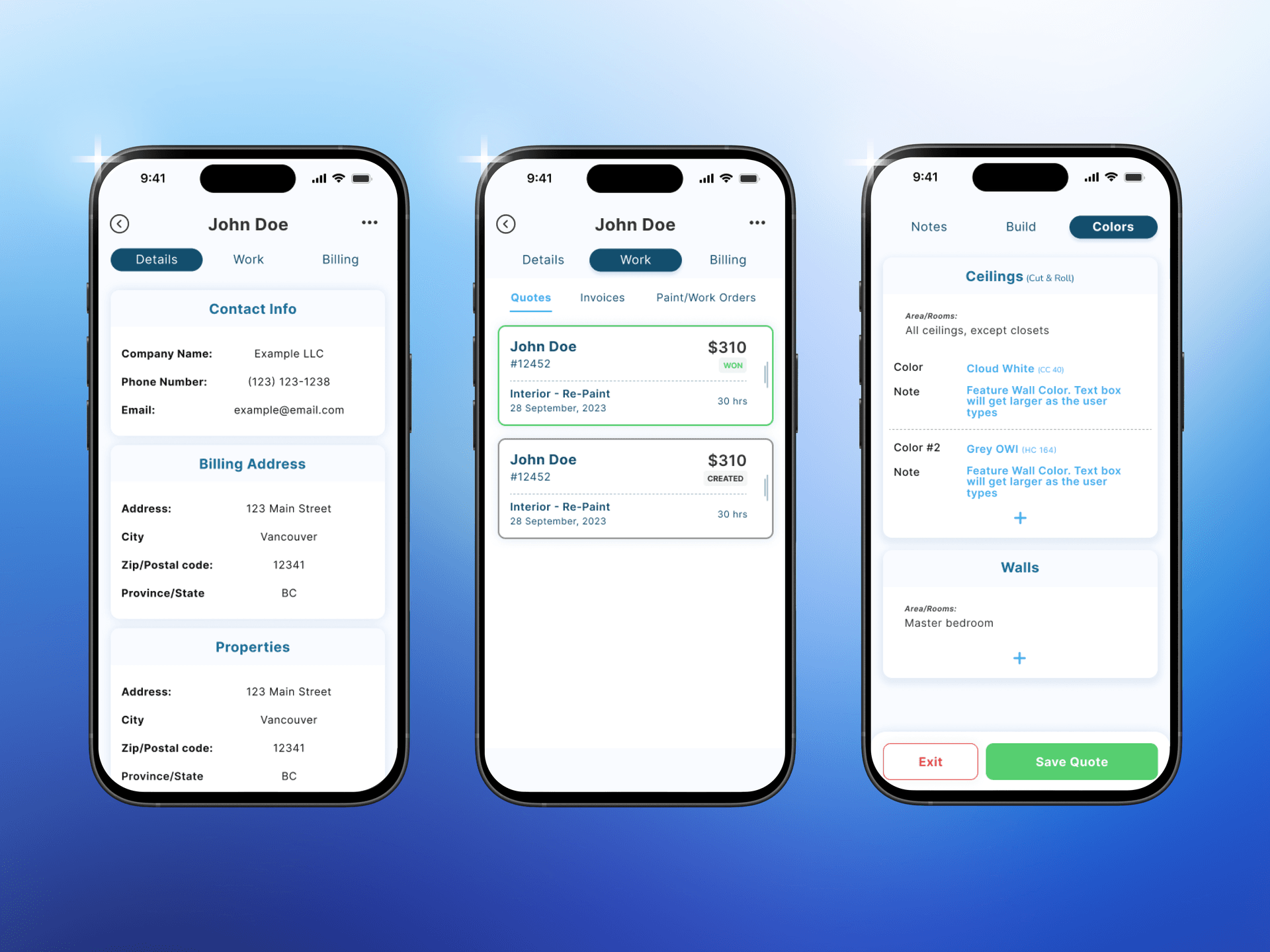
Lumitech's own work here is on the delivery side. PaintBid, an offline-first estimating app for a painting contractor, kept structured on-site estimates available where connectivity was unreliable, and around 50 employees used it daily within the first year. A mobile app for a digital painting startup operated on the same priority: get a working product into users’ hands first, then refine the model behind it. Both point to the same lesson for estimating tools, which often have to solve data capture and field access before predictive features add value. Our overview of AI in construction covers how these capabilities connect with scheduling and analytics.
Customer Stories
Explore What We've Built
Painting
Offline‑First Estimating App for a Growing Painting Business
Helping a Vancouver painting company move from guesswork and spreadsheets to fast, standardized on‑site estimates – in a mobile app that works even when there is no signal at all.
Client Location

Vancouver
Duration
Dec '23 — Now
Platform
Mobile
What It Costs and When It Pays Back
The prices above make payback a spreadsheet calculation. Specialist AI estimating software typically costs $50 to $300 per user per month, while broader contractor platforms can be more expensive. Multiply the monthly hours saved by the estimator’s loaded hourly cost, then compare the result with the subscription price across every required seat. That tells you whether AI estimating software for small contractors earns its place.
Subscriptions are one cost model. Managed takeoff services that charge per trade per year require sufficient bid volume to cover the fee. Commercial cost databases such as RSMeans add another annual expense when your unit rates are unreliable.
Custom construction software development requires a separate calculation. Data cleanup comes first, followed by integrations and the interface estimators use to review and correct the output. Each adds cost before the model reaches production.
The evidence supports one purchase case: fewer hours spent measuring drawings. It does not yet establish higher win rates or margins. Base the decision on time saved, then measure any effect on bid performance across your own jobs.