
AI in Construction: Use Cases, Benefits, Challenges, and Real-World Examples
Businesses are turning to AI because it helps bring more control into an industry that rarely feels predictable. From smarter scheduling to automated reporting, AI in construction helps teams react faster and manage projects with fewer surprises.
- Construction
- AI Development
- Digital Transformation
May 19, 2026
 AI Overview
AI in construction helps companies improve predictability, safety, cost control, and project visibility. The article explains key use cases such as scheduling, inspections, BIM analytics, digital twins, predictive maintenance, and risk monitoring, plus implementation steps, challenges, benefits, and real-world examples.


AI applications in the construction industry are gradually moving from experimental technologies to practical business tools. Firms that invest in modern development solutions for the construction industry are using AI to improve scheduling, inspections, and operational visibility.
Deloitte’s research shows that companies in the construction industry are actively using AI. In the Asia-Pacific alone, adoption surged from 26% to 37% in two years. Every new digital tool boosts revenue by about 1.14%.
At the same time, construction companies face labor shortages, rising material costs, stricter compliance requirements, and the demand for sustainable infrastructure. Smart construction technologies help to transform chaotic data into actionable operational insights. In this article, we will explore the use cases of AI in the industry, uncover the benefits and challenges, and provide steps for implementing relevant technologies.
Why Construction Is Betting on AI
Construction has never been a calm industry. One delayed delivery — and the entire schedule shifts. One missed dependency — and the budget starts burning faster than the team can update status reports. And when the project still has dozens of subcontractors, ERP, BIM, procurement systems, and field teams in different locations, chaos very quickly becomes the new norm.
That is why AI in construction market is growing so aggressively now. Сompanies are simply tired of managing multimillion-dollar projects through spreadsheets and endless WhatsApp chats. They are integrating AI into project management systems, BIM platforms, drone inspections, ERP ecosystems, and procurement workflows to get what construction has desperately lacked for years — predictability.
And the numbers show it well. According to Grand View Research, AI in the construction market could exceed $17 billion by 2030. The fastest-growing segments are predictive analytics, computer vision, digital twins, and AI-powered scheduling. Simply put, businesses are actively investing in technologies that help them identify problems earlier, make decisions faster, and reduce rework and delay costs.
AI adoption in the construction industry is currently accelerating due to several very painful factors:
workforce shortage;
more expensive materials;
more complex infrastructure projects;
tighter compliance requirements;
constant pressure on margins and delivery timelines.
AI is quickly entering large infrastructure and public sector projects. Smart city initiatives, urban digitalization, and connected infrastructure are creating a serious demand for government software development services related to BIM ecosystems, digital twins, IoT platforms, and predictive analytics.
But what is interesting is that AI is actively entering even narrower segments of the construction ecosystem. For example, software development for painting companies already includes AI-powered scheduling, workforce coordination, route optimization, and automated operational planning. Previously, this seemed like “too difficult for such a business”. Today, it is already a normal operational advantage.
AI in construction is gradually becoming part of the entire operational infrastructure along with BIM, ERP, IoT sensors, field reporting apps, and predictive analytics. And companies that start building this system now will have a completely different level of efficiency, scalability, and control over delivery in a few years.
Use Cases of AI in Construction
AI in construction is no longer a technology of the future. Today, it is used for practical tasks such as delay forecasting, safety monitoring, cost estimation, inspections, and resource management. And most importantly, AI is starting to solve one of the construction industry’s biggest problems: the lack of predictability.
According to Buildots, 62% of construction activities are regularly performed more slowly than planned, and a quarter of tasks are almost twice as slow as expected. AI-powered forecasting tools help identify such risks before they turn into cascade delays throughout the project.
AI in Construction Project Management
Managers use AI to foresee delays, budget overruns, and resource bottlenecks to avoid the impact of these factors on critical operational phases. AI focuses on analyzing weather forecasts, delivery schedules, and workforce availability. After that, it alerts the team that a delay in concrete delivery, combined with predicted rain, poses a high risk of disrupting the timeline.
According to PwC, AI-powered forecasting and analytics are already helping companies improve project predictability and respond more quickly to operational risks.
AI for Construction Site Safety
Computer vision systems are already being actively used for safety monitoring on construction sites. AI-powered cameras can automatically detect workers without PPE, unsafe approaches to equipment, or violations of restricted zones.
For example, AI can send notes to managers to inform when a worker enters a hazardous area without protective equipment. This allows for an immediate response rather than waiting for an incident report.
According to OSHA, construction consistently remains among the most dangerous industries in the world, so AI is increasingly being used as a proactive safety layer.
AI in Quality Control and Inspections
AI speeds up inspections and defect detection. Drones and computer vision systems can scan construction sites daily and automatically compare progress with BIM models or approved designs.
For example, AI can detect that a part of a steel structure is installed with deviations from design specifications, even before the next construction phase begins. This helps reduce rework costs and avoid cascading delays.
McKinsey highlights that rework, inefficiencies, and low productivity remain major cost drivers in construction projects.
AI for Equipment and Resource Management
Another use case is predictive maintenance and smarter resource allocation. IoT sensors on equipment collect telemetry data, and ML models predict potential failures before they occur.
For example, AI can detect that an excavator is beginning to exhibit abnormal vibration patterns and will need maintenance in the coming days. This helps avoid expensive downtime and schedule disruptions.
According to Deloitte, predictive maintenance can increase equipment uptime by 10–20% while reducing maintenance planning time by up to 50%.
AI with BIM, Drones, and Digital Twins
One of the most powerful use cases for AI in construction is combining BIM, drones, IoT sensors, and predictive analytics into a single ecosystem.
For instance, drones can scan a site daily, AI can analyze progress, and digital twins can show deviations between planned and actual construction status. So, teams get better visibility, faster reporting, and more accurate forecasting for large-scale projects.
AI in Construction Cost Estimation
Cost estimation in construction has always been painful. It can be explained by material price volatility, labor shortages, and constant scope changes. Artificial intelligence helps improve forecasting accuracy by analyzing historical project data, supplier pricing, procurement timelines, and market trends.
For example, AI systems can automatically detect that a construction phase will exceed the planned budget due to rising steel costs and delivery delays. Project teams receive warnings before the problem becomes critical.
AI development services are also used for automated quantity takeoffs and budget monitoring. Computer vision and BIM analytics help calculate materials faster, and predictive models can foresee future cost overruns based on real project conditions.
According to McKinsey, large construction projects exceed budgets by 80% on average, so even a few percentage points of more accurate forecasting can have a significant impact on profitability.
Benefits of AI in Construction
Construction firms derive the most value in three areas: predictability, operational efficiency, and risk reduction. For an industry where even a small delay can cost millions of dollars, AI is becoming a powerful tool for reducing chaos. Let’s examine AI’s potential benefits in construction in more detail.
Better Project Predictability
One of the biggest challenges in the construction industry is unpredictability. Schedule disruptions, procurement bottlenecks, rework, and labor shortages often appear gradually but become visible only when the critical path starts to burn.
AI-powered predictive analytics helps identify risks much earlier. For example, Autodesk Construction IQ uses machine learning to analyze RFIs, submittals, inspection logs, and issue tracking, automatically identifying high-risk areas in projects. Construction managers receive a prioritized list of potential problems that could impact the timeline or budget.
Wrike, in its AI in construction project management study, also notes that AI systems are already actively used to predict schedule drift by analyzing historical productivity patterns, procurement latency, and change activity.
This allows construction teams to respond to problems before they turn into delay claims or expensive overtime.
Lower Rework Costs
Rework remains one of the most expensive problems in construction. Installation errors, deviations from BIM models, or delayed defect detection can create a cascading effect across the entire project.
AI-powered computer vision systems are changing quality control workflows. The systems compare drone imagery, laser scans, BIM models, field photos, and design specifications and automatically identify discrepancies.
At Skanska London, AI-driven BIM analytics helped reduce design errors by 20% and save about £2 million in rework costs.
AI quality inspection tools also speed up validation processes. Instead of manual review, inspectors receive automatically marked problem areas that need attention.
For large-scale infrastructure projects, even a few percent reduction in rework can mean millions of dollars in savings.



Improved Construction Site Safety
While construction is a dangerous field, AI technologies help to keep it secure. Computer vision systems can detect missing PPE, unsafe worker behavior, fall hazards, unauthorized access, and equipment proximity risks in real time.
Boston-based Shawmut Design and Construction, which simultaneously manages more than 150 active worksites and is responsible for the safety of about 30,000 workers, has been using AI for risk evaluation, worker compliance monitoring, and incident forecasting for several years. The company analyzes weather conditions, staffing changes, and field data to predict safety risks before incidents take place.
AI helps monitor safety by using drones, wearables, equipment telematics, and IoT sensors. For example, wearables can track fatigue indicators or heat stress, allowing AI models to automatically flag high-risk situations.
It’s reached the point where construction firms are joking: “AI has eyes everywhere. It’s good at spotting the one guy without a hard hat.” And frankly, the joke is more fact than fiction.
Faster Decision-Making
AI systems help managers make faster decisions by automating reporting, generating intelligent alerts, providing predictive recommendations, and prioritizing risk.
Companies use generative AI solutions to draft RFIs, meeting summaries, compliance documentation, and project communications.
Some construction firms also invest in AI chatbot development for internal knowledge management, field support, and faster communication between site teams and back-office operations.
Wrike notes that AI-powered tools are already enabling construction managers to significantly reduce time on administrative tasks and process RFIs and submittals faster. For project teams, this means less manual work and faster operational response.
Smarter Resource Allocation
AI helps companies manage workforce allocation, equipment, and materials more efficiently. Machine learning models analyze how equipment is used, how quickly the team is working, and where delivery bottlenecks occur. Instead of guessing, companies can keep their fleet moving, cut out downtime, and always know when to order more supplies.
RTS Labs describes AI agents as digital site managers that analyze schedules, supplier feeds, and sensor data to detect disruptions before they affect project delivery. This directly impacts profitability.
Sustainability and Operational Efficiency
Sustainability drives construction innovation. Organizations use intelligent solutions for energy optimization, reducing material waste, carbon tracking, lifecycle planning, and predictive maintenance.
Digital twins and AI analytics enable infrastructure operators to model long-term asset performance and optimize maintenance strategies. This approach is gaining traction in smart city initiatives and large-scale infrastructure ecosystems.
According to OpenAsset, AI technologies help construction companies improve sustainability metrics and operational efficiency through intelligent resource management and predictive maintenance.
Challenges of AI in Construction
Despite rapid advances in AI in the construction industry, practical barriers hinder its widespread implementation across most companies. The primary obstacles are often less about the AI tools themselves and more about organizational issues such as fragmented workflows, outdated legacy infrastructure, and poor data quality. For example, older ERP and operational platforms often require legacy system modernization solutions in Saudi Arabia before AI systems can be implemented at scale.
Challange | Impact on Construction Operations | Possible Solution |
|---|---|---|
Fragmented data systems | Project data is scattered across spreadsheets, PDFs, ERP systems, BIM platforms, and emails | Implement centralized data platforms and system integrations |
Legacy infrastructure | Older systems often lack APIs, cloud compatibility, and real-time analytics capabilities | Gradual legacy modernization and cloud migration |
Poor data quality | Incomplete or inconsistent data reduces Al model accuracy | Establish data governance and standardized reporting processes |
High implementation costs | Al adoption requires investments in software, infrastructure, and workforce training | Start with pilot projects focused on measurable ROI |
Workforce resistance | Employees may be hesitant about automation and workflow changes | Introduce change management programs and employee training |
Cybersecurity risks | Connected ecosystems increase the potential attack surface | Strengthen cybersecurity frameworks and access control policies |
Skills gap | Many firms lack internal AI, ML, and data engineering expertise | Partner with experienced technology providers and invest in upskilling |
The AI Construction Workflow Explained
Building connected AI workflows often requires broader digital transformation services to unify fragmented operational systems. Similar approaches are used across niche construction and renovation businesses, including projects focused on transforming a modern painting startup through AI-powered workflows and mobile operational platforms.
AI in construction works as a single connected ecosystem, where data from various sources is continuously collected, analyzed, and transformed into actionable insights for project teams. Instead of relying solely on manual reporting and static dashboards, construction companies gain real-time visibility into safety risks, project delays, budget issues, and operational bottlenecks.
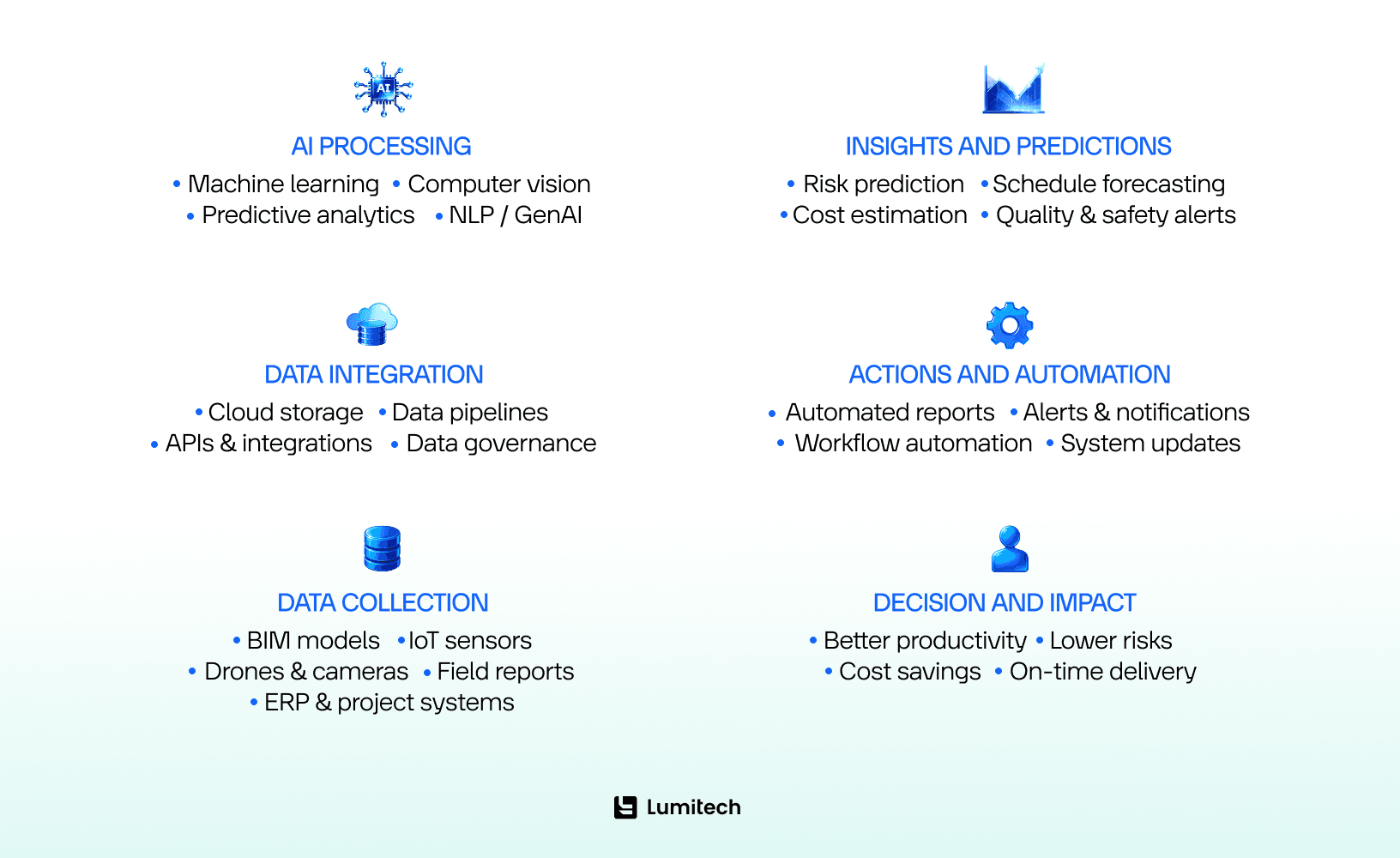
For most construction companies, the challenge is to get all the systems, spreadsheets, BIM models, field reports, and project tools to finally talk to each other without dozens of manual updates and endless Excel files named final_version_v18_REAL_final.xlsx.
This is where AI starts to bring real value. At Lumitech, we help construction and infrastructure companies build connected workflows that integrate BIM platforms, ERP systems, IoT sensors, drones, computer vision, and predictive analytics into a single ecosystem. Many enterprises also face significant data migration challenges when using legacy modernization solutions.
Our teams develop AI-powered solutions for scheduling, inspections, safety monitoring, forecasting, and operational analytics. The goal is always practical: less manual reporting, faster decisions, better visibility into the project, and fewer “how did this issue go unnoticed for so long?” surprises.

How to Implement AI in Construction
Successful implementation begins with defining a specific business problem. Companies achieve the best results when AI solves measurable operational challenges, such as delays, rework, safety incidents, inaccurate forecasting, or inefficient resource allocation.
Step 1. Identify the use case
First, you need to choose the process with the greatest potential for optimization. Companies most often start with schedule forecasting, PPE detection, AI-powered inspections, cost estimation, predictive maintenance, or document automation.
At this stage, it is important to identify KPIs such as reduced delays, reduced inspection time, lower rework costs, or improved forecasting accuracy.
Step 2. Prepare the data foundation
Garbage in, garbage out: AI and construction performance depend on data quality. Construction firms typically work with data from BIM models, ERP systems, project management platforms, drone imagery, IoT sensors, and RFIs and inspection logs.
Before implementation, you need to assess data quality, system integration, cloud readiness, and data consistency. For computer vision and safety monitoring workflows, some companies also use synthetic data generation to improve AI model training and testing.
Popular technologies: Autodesk Construction Cloud, Procore, Primavera P6, SAP ERP, Microsoft Dynamics, Power BI, AWS, Azure, Google Cloud.
Step 3. Choose AI technologies
Different tasks require different AI approaches.
Use Case | AI Technology |
|---|---|
Schedule prediction | Machine learning, predictive analytics |
PPE monitoring | Computer vision |
Cost estimation | Regression models, ML forecasting |
Document automation | NLP, Generative Al |
Equipment maintenance | loT + predictive analytics |
Digital twins | Real-time simulation + Al analytics |
For computer vision, common choices include TensorFlow, PyTorch, and OpenCV. For generative AI workflows, we recommend GPT models, LangChain, or vector databases.
Step 4. Launch a pilot project
Automating everything at once is the wrong solution. The best approach is to start with one workflow or construction site.
For example:
AI safety monitoring on one facility;
predictive maintenance for an equipment fleet;
AI scheduling for one portfolio.
Make sure a pilot has a clear scope, measurable ROI, feedback loop, and success metrics.
Step 5. Integrate AI into workflows
Artificial intelligence in construction cannot operate effectively in isolation from operational systems. The most effective implementation scenarios integrate AI into BIM environments, ERP systems, field reporting apps, project management software, and dashboards and notifications.
For example, AI alerts can be automatically sent to site managers in Procore or Teams.
Step 6. Train teams and scale the solution
The use of AI in construction and its adoption are highly dependent on user trust. Teams need to understand how the system works, how to interpret AI recommendations, and where human oversight remains necessary.
After a successful pilot, companies can scale AI across projects, departments, and regions, gradually forming a unified smart construction ecosystem.
Demand for AI-powered construction platforms continues to grow rapidly across the Middle East, especially among companies looking for a reliable software development company in Dubai or scalable software development solutions in Saudi Arabia for smart infrastructure and construction projects.
As regional digital infrastructure projects scale, many businesses also evaluate partnerships with leading IT outsourcing companies in Dubai to accelerate AI implementation and cloud modernization initiatives.
Real-World Examples of AI in Construction
Skanska: AI-Powered BIM Analytics for Reducing Rework
Skanska, one of the world’s largest construction companies, used AI-driven BIM analytics to automatically detect design conflicts and coordination issues before critical construction phases began.
AI construction software analyzed BIM models and project documentation to help teams quickly identify potential clashes across engineering disciplines.
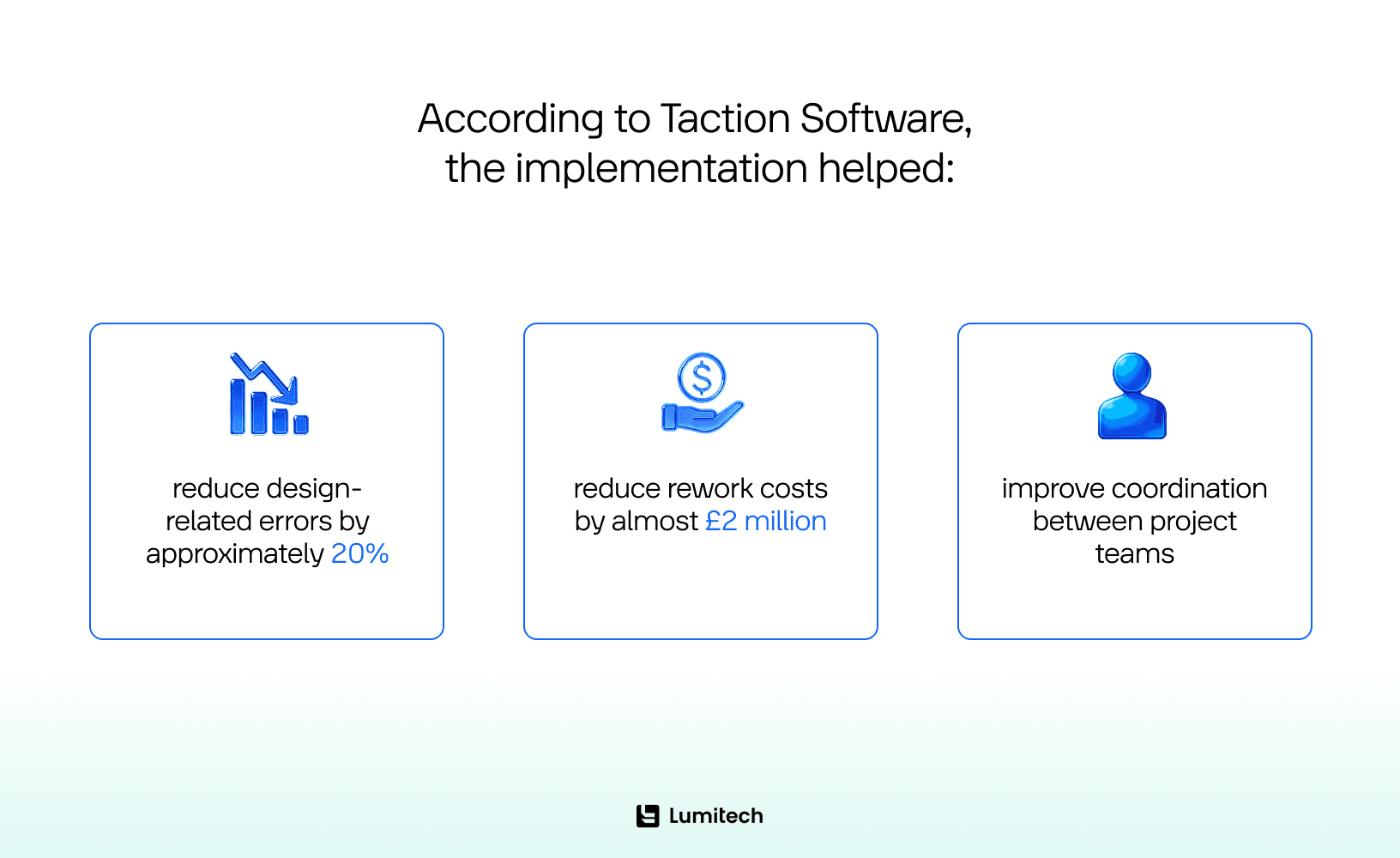
This makes sense for large-scale construction projects, as even minor design inconsistencies can create cascading delays.
Shawmut: AI for Safety Risk Prediction
Shawmut uses AI to proactively manage safety on more than 150 active construction sites. AI systems analyze weather conditions, staffing changes, field reports, incident history, and worker compliance data. Based on this data, the system predicts high-risk scenarios and helps safety teams react before incidents occur.
According to Business Insider, Shawmut is responsible for the safety management of approximately 30,000 workers across projects and actively uses predictive analytics to reduce risk.
This is a good example of how AI moves construction safety from reactive to predictive workflows.
Buildots: Computer Vision for Construction Progress Tracking
Israeli startup Buildots has become one of the most prominent AI players in construction progress monitoring. The company uses 360° cameras, computer vision, BIM integration, and AI analytics.
Site managers wear helmet-mounted cameras, and artificial intelligence automatically compares captured site data with BIM models and project schedules. The system allows for tracking construction progress, identifying delays, detecting unfinished work, and improving reporting accuracy.
According to the company, Buildots has helped clients reduce schedule delays by up to 50% through faster issue detection and improved visibility. Buildots has already worked with companies such as Intel, VINCI Construction, and Sir Robert McAlpine.
Autodesk Construction IQ: Predictive Risk Analytics
Autodesk Construction IQ uses machine learning to analyze RFIs, submittals, inspections, and issue logs to automatically identify project risks. The AI engine prioritizes high-risk issues, quality concerns, safety patterns, and coordination problems.
Construction and AI managers gain actionable insights without manually reviewing thousands of project records.
Autodesk notes that AI-driven risk analysis helps teams respond faster to critical issues and improve project predictability.
Komatsu: Autonomous Construction Equipment
Komatsu has a Smart Construction platform for developing autonomous construction equipment. They use AI-powered machinery for autonomous hauling, grading optimization, site mapping, and equipment coordination. The system combines drones, IoT sensors, machine telemetry, and AI analytics.
On mining and infrastructure projects, autonomous equipment helps reduce fuel consumption, increase operational efficiency, improve safety, and reduce downtime.
This becomes especially valuable in remote or hazardous environments, where workforce availability is limited.

Final Thoughts
The role of AI in construction will only grow in the coming years. The development of digital twins, autonomous equipment, connected job sites, and real-time analytics is shaping a new standard for intelligent construction operations.
For businesses, this means fewer manual routines, more accurate forecasting, and more predictable management of large projects. And while AI won’t take all the chaos out of the construction industry — construction still loves surprises — it is already helping companies control them much better.


