
MVP Development for Startups: How to Validate, Build, and Launch Without Burning Runway
We’ve prepared this guide to walk you through the entire MVP lifecycle: what an MVP actually is, how to create an MVP for a startup and prioritize the features, how much it costs, who should build it, and when you’re ready to move beyond it.
- MVP Development
July 06, 2026
 AI Overview
MVP development validates a startup's riskiest business assumption with real users before committing to full-scale engineering, since most failed products stem from insufficient market need rather than poor execution. Core stages include distinguishing proof of concept, prototype, and MVP, each testing feasibility, UX, or actual market behavior. CB Insights found 42% of startups failed due to lack of market need, a risk MVPs are built to catch early.

Most startups don’t fail because they can’t build. They fail because they build the wrong thing. MVP development for startups exists to solve exactly that problem — it gives founders a structured way to validate their riskiest assumptions before committing months of engineering time and hundreds of thousands of dollars to a product the market may not want. If you’re looking for MVP development services that go beyond writing code and actually help you validate what to build, that distinction matters from day one.
What MVP Development Actually Means — and Why Most Startups Get It Wrong
CB Insights analyzed 110 startup post-mortems and found that 42% failed due to a lack of market need. Not bad engineering. Not poor execution. The product was built for a problem that wasn’t painful enough — or didn’t exist at scale. An MVP is the mechanism that catches that before it becomes a $500k mistake.
The word “minimum” is routinely misread. It refers to scope, not quality. “Viable” is harder to get right — the product has to deliver enough real value that actual users engage with it under real conditions, not during a guided demo. Most teams fail in one of two directions: they build so little that no one can experience the value, or they build so much that the signal gets buried in complexity.
The working definition: what is MVP in startup terms is the version of your product that answers your single riskiest business question at the lowest possible cost.
Dropbox validated demand for a product that didn’t exist yet with a three-minute explainer video — waitlist signups jumped from 5,000 to 75,000 overnight.
Airbnb’s founders rented out their own apartment before writing a line of code for the marketplace.
Zappos founder Nick Swinmurn posted photos of shoes from local stores without owning any inventory — when someone ordered, he’d buy the shoes at retail and ship them.
All three were testing a real question before building the real answer.
One thing worth getting straight before going further: the MVP prototype vs. MVP distinction matters — POC, prototype, and MVP are used interchangeably, but they do different jobs.
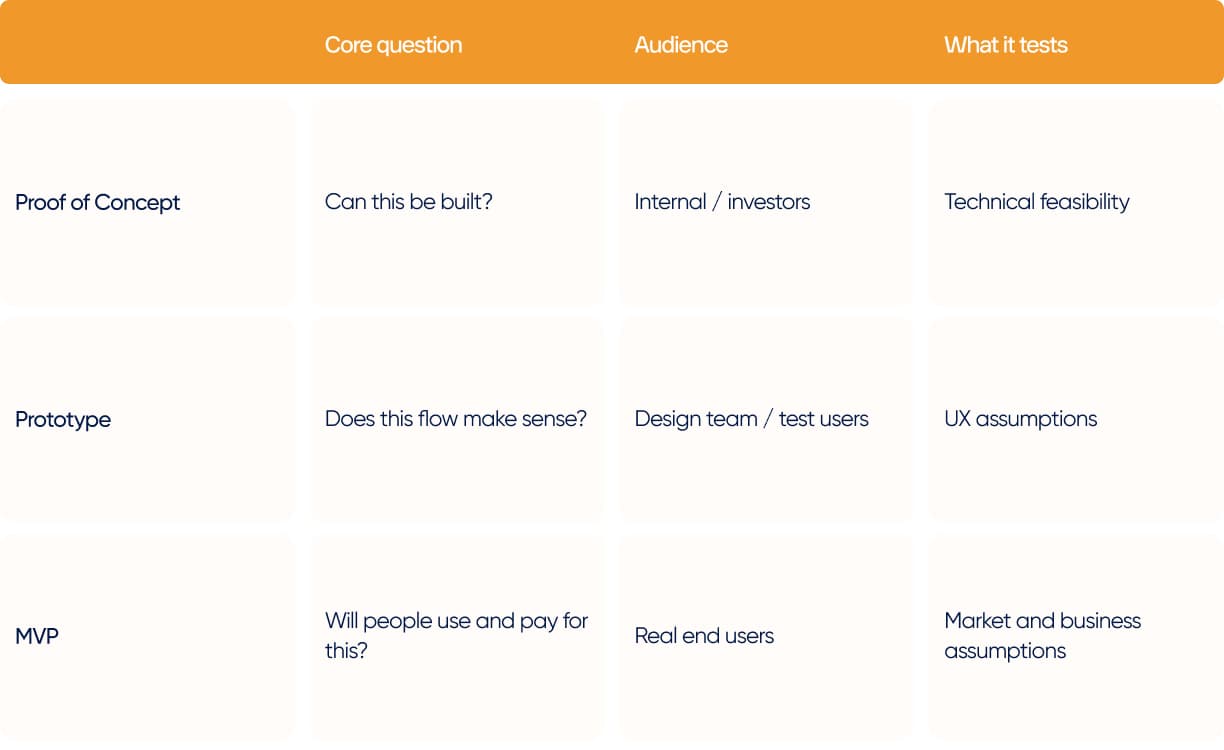
A POC validates engineering. Going from prototype to MVP means shifting from testing design assumptions to testing real market behavior with production users. Confusing them — specifically, shipping a polished prototype and calling it market validation — is one of the most expensive ways to lose four months without learning anything useful.
Why Startups Need an MVP Before Full Product Development
The benefits of MVP for startups aren’t just about saving money on development. They’re about structuring the entire early stage of a company around learning instead of assumptions.
Validating Demand Before Scaling
The most dangerous assumption in product development is “people will want this.” MVP development forces founders to test that assumption with real users, real behavior, and — ideally — real money, before scaling anything. Demand validation isn’t about running a survey. It’s about watching people actually use your product and make decisions based on it.
Achieving Product-Market Fit Faster
Product-market fit MVP isn’t a destination you reach by building more features — it comes from understanding which specific users have which specific problem, and how tightly your product solves it. MVPs accelerate that discovery loop because they’re small enough to change quickly. You can run three iterations in the time it would take to build one full-featured product.
Reducing Development Costs
Custom MVP software development is expensive when scoped wrong. A well-scoped MVP typically costs 3–6x less than a full product and can be built in a fraction of the time. More importantly, learning from an MVP often significantly redirects the full-product roadmap — meaning the money you save isn’t just in the MVP itself, but also in avoiding expensive features that users wouldn’t have wanted anyway.
Improving Investor Readiness
Investors at the pre-seed and seed stage are making bets on teams and ideas, but they’re far more confident when you can show them a working product with real user data. An MVP with early traction — even modest traction — converts investor conversations from “here’s our hypothesis” to “here’s our evidence.” That shift has a material impact on both your ability to raise and your valuation.
Accelerating Time-to-Market
Speed matters in competitive startup environments. Building an MVP for startups lets you establish market presence, start building a user base, and generate word-of-mouth before a slower, more feature-rich competitor can catch up. First-mover advantages are real in software — not because being first guarantees success, but because early users provide data that shapes a product in ways a later entrant can’t easily replicate.
Have a startup idea but aren’t sure what to build first?
Talk to our team to get a clear MVP roadmap, a feature prioritization plan, and a realistic development estimate.

The Biggest Startup Risks an MVP Helps Solve
The 4-Risk MVP Framework
Most startup failures trace back to four categories of risk. A well-designed MVP is structured to test whichever of these is most dangerous for your specific business before you invest in scale.
Market Risk — Do users need the product?
This is the most common killer. You’re solving a problem that either doesn’t exist, isn’t painful enough to change behavior over, or belongs to a market that’s too small. Market risk testing means putting your core value proposition in front of real users and observing whether they engage, return, and eventually pay.
Usability Risk — Can users use it successfully?
Even if the problem is real, a product that confuses users won’t retain them. Usability risk is highest in complex domains — fintech, healthcare, B2B workflow tools — where workflows have many steps and user expectations are high. Testing usability early prevents building features on top of a broken foundation.
Monetization Risk — Will users pay for it?
Lots of people will use a free product. Far fewer will pay. Monetization risk is about whether there’s a viable business model, not just a useful product. The best MVPs test willingness to pay directly — through gated features, early pricing experiments, or manual sales processes.
Technical Risk — Can it be built and scaled efficiently?
Some products depend on technology that hasn’t been proven at the required scale or cost. AI-powered products, real-time data platforms, and marketplace matching algorithms all carry meaningful technical risk. A technical MVP (sometimes aligned with a POC) tests whether the core architecture works before you build everything on top of it.
Before you define your MVP scope, identify which of these four risks is most likely to kill your business. Build your MVP to answer that question first.
We see the same pattern constantly: a founder arrives with a 40-feature spec and calls it an MVP. Our first conversation is always about subtraction — what’s the one thing you need to prove before any of the rest makes sense to build?



MVP Development Steps: End-to-End Process
The MVP development process isn’t a linear checklist — it’s a loop. But knowing how to create an MVP for a startup in a structured sequence of MVP development steps prevents the two most common failure modes: building before validating, and validating without ever building.
1. Start the MVP Development Process Right: Define the Core Problem
Start with a problem statement. It shouldn’t sound like “we’re building a project management tool”. It should sound like “small agency project managers lose 4–6 hours per week chasing client approvals over email.” The more specific the problem, the easier it is to define the minimum solution.
2. Identify the Target Audience
“Everyone” is not a target audience. For MVP development for startups, pick the single most specific user segment that experiences your problem most acutely. Early adopters are your best source of learning — they’re willing to tolerate rough edges in exchange for real value. Define them by role, industry, behavior, or pain, not by demographic.
3. Validate the Business Idea
Before writing a line of code, do at least 15–20 customer discovery interviews. You’re not pitching your solution — you’re learning how they currently solve the problem, how much it costs them, and what they’ve tried before. This step is how you validate startup idea with MVP thinking before any engineering budget is committed. It’s also where the discovery phase does the most work: surfacing wrong assumptions before they become expensive architecture decisions.
4. Prioritize MVP Features
One filter: does removing this feature prevent a user from experiencing the core value? Yes — it stays. No — it goes. Apply it to every item on your list before development starts.
Customer Stories
Explore What We've Built
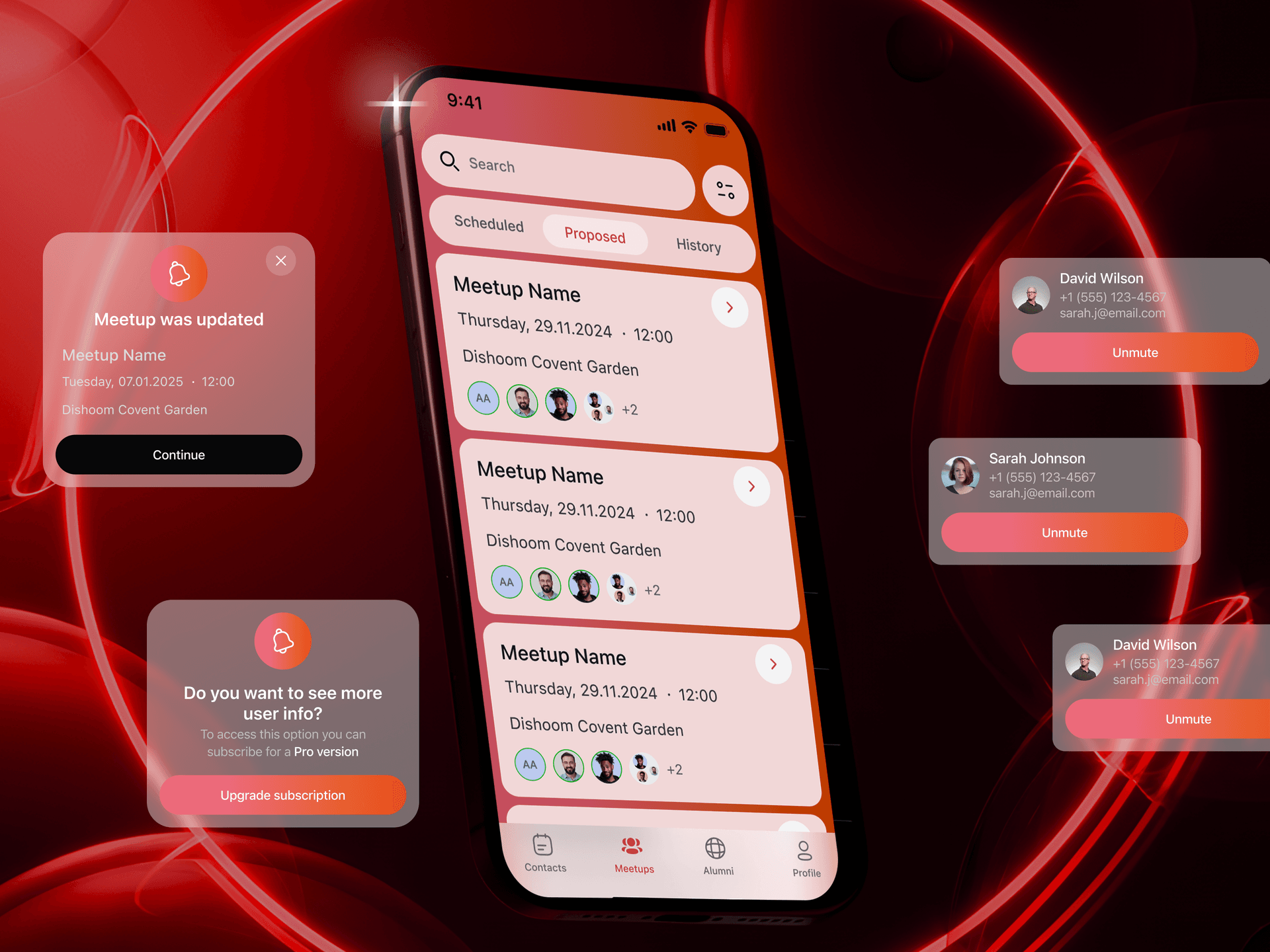
Building Personal and Professional Communities in the Real World
When the pandemic era shifted us all into remote mode, we helped our clients from the United Kingdom create a unique mobile application that brings people back together in the offline world.

Birmingham
Dec ’24 – May ’25
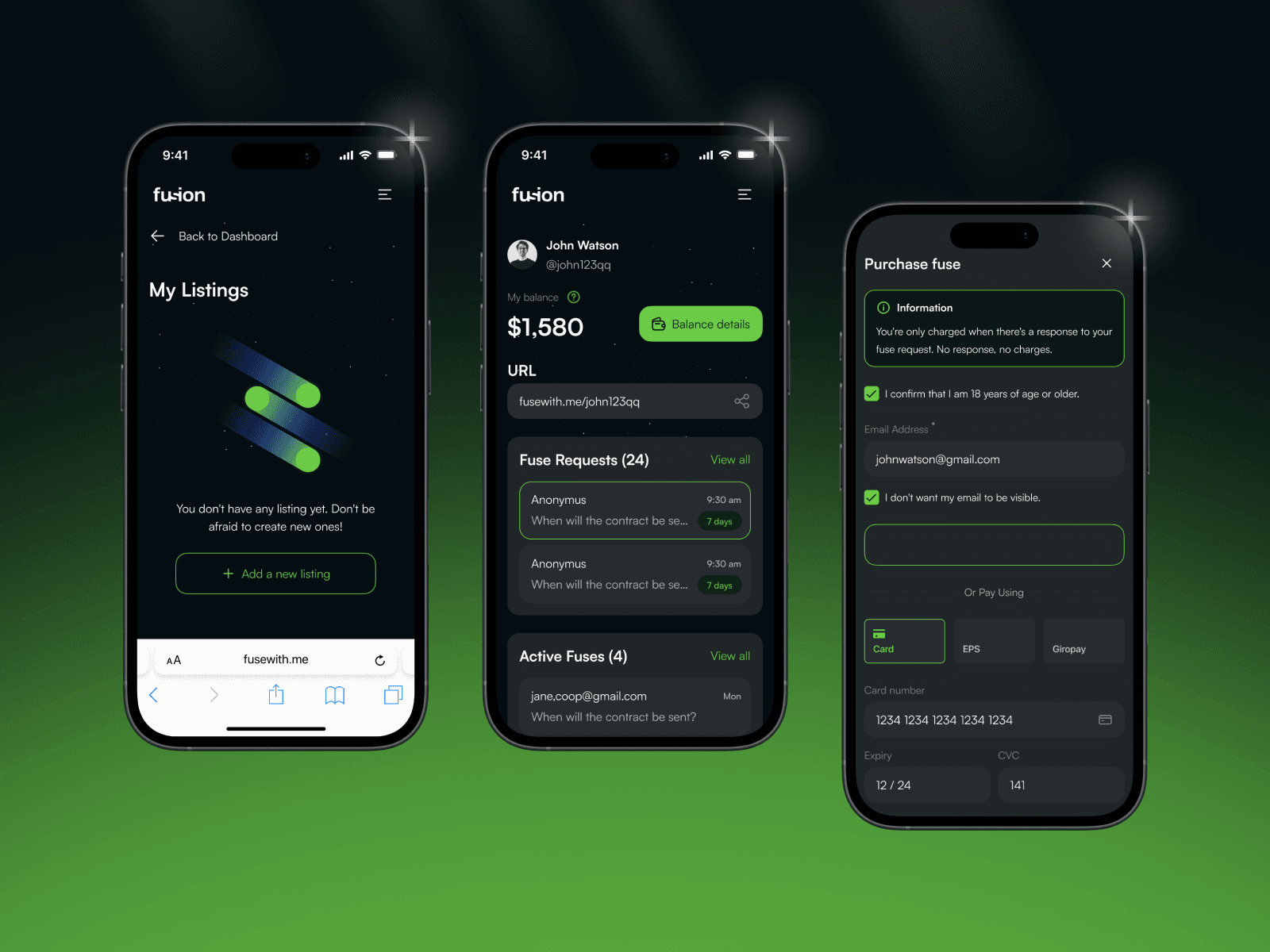
Mobile-First MVP for Interactive Engagement with Artists
How Lumitech helped launch a platform that turns engagement into opportunity – bridging the gap between creators and fans with a monetization model built on value and connection.

Berlin
Feb '24 — May '24
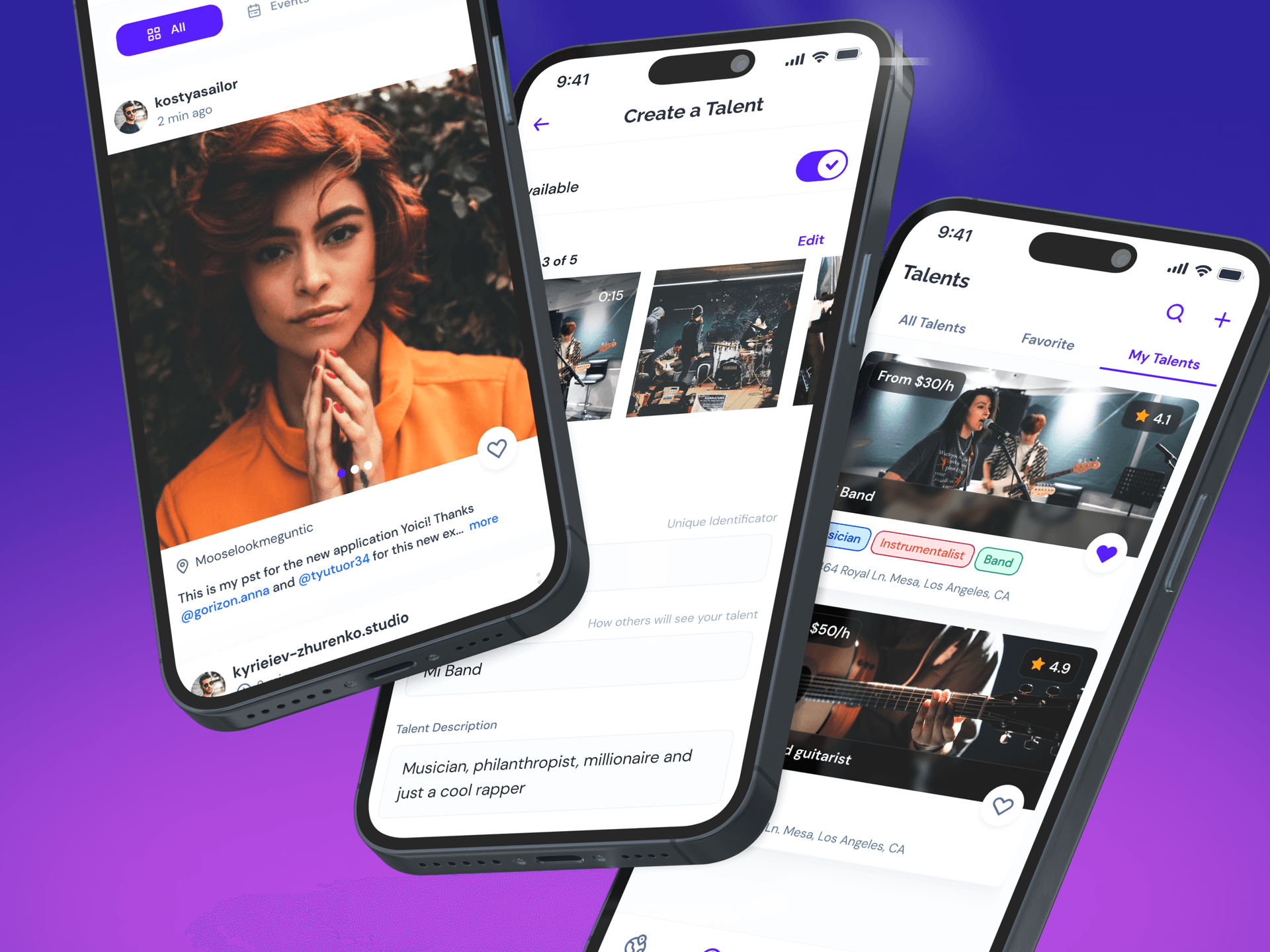
All-in-One Event Management and Ticketing App
Discover how we built a modern event management platform that simplifies bookings, connects professionals, and transforms how events are organized.

Los Angeles
Aug '22 — Jun '23
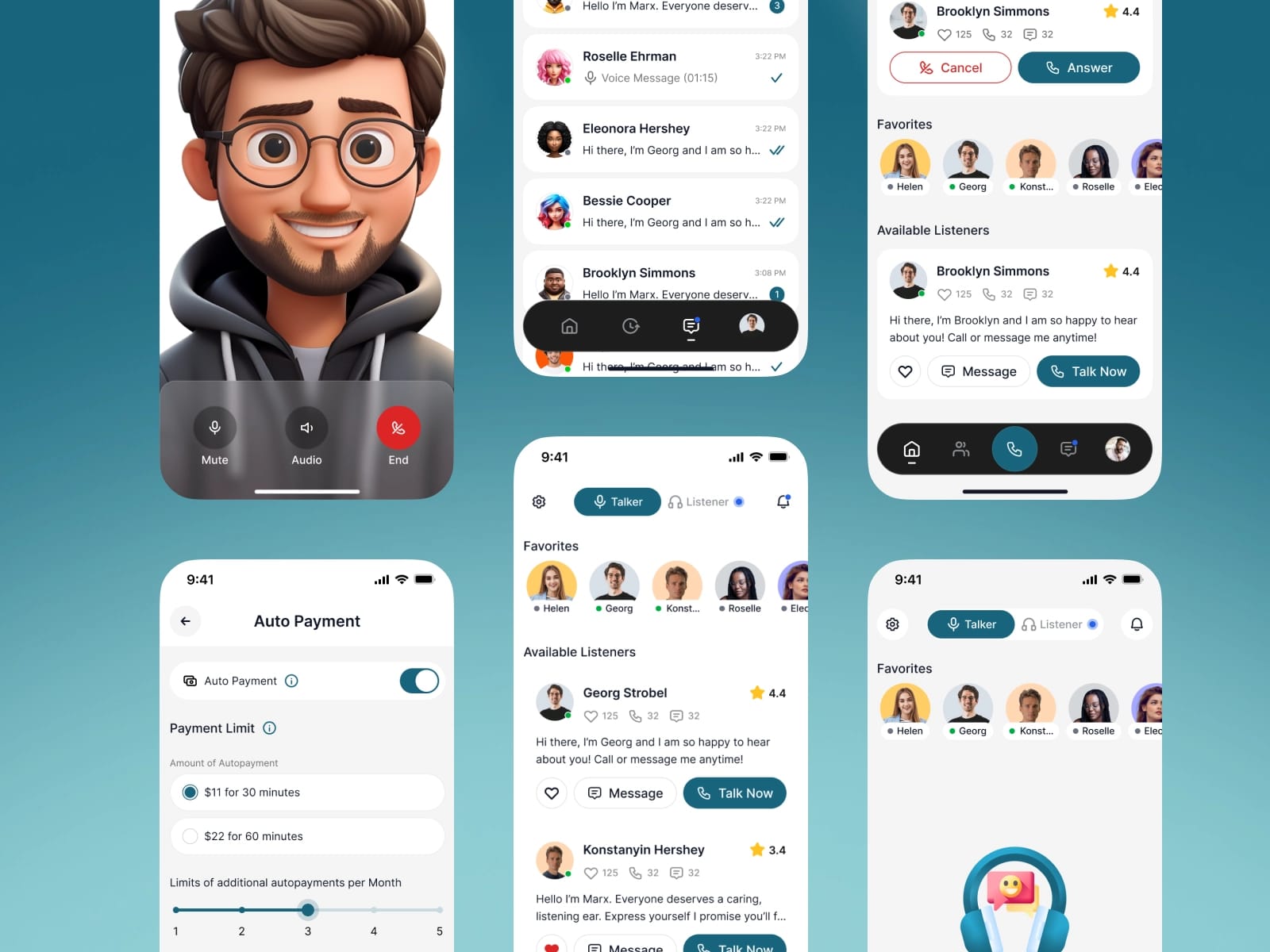
Mental Health App Built for Wellness and Real-Time Support
Learn more about our mental health app development process, the technology behind this powerful application, and how we helped a first responder from the Second City create it.
Chicago
Jun ’24 – Oct ’24
Social & Media Platforms
Building Personal and Professional Communities in the Real World
When the pandemic era shifted us all into remote mode, we helped our clients from the United Kingdom create a unique mobile application that brings people back together in the offline world.
Client Location
Birmingham
Duration
Dec ’24 – May ’25
Platform
iOS / Android
Mobile-First MVP for Interactive Engagement with Artists
How Lumitech helped launch a platform that turns engagement into opportunity – bridging the gap between creators and fans with a monetization model built on value and connection.
Berlin
Feb '24 — May '24
All-in-One Event Management and Ticketing App
Discover how we built a modern event management platform that simplifies bookings, connects professionals, and transforms how events are organized.
Los Angeles
Aug '22 — Jun '23
Mental Health App Built for Wellness and Real-Time Support
Learn more about our mental health app development process, the technology behind this powerful application, and how we helped a first responder from the Second City create it.
Chicago
Jun ’24 – Oct ’24
5. Design the User Experience
MVP design and development don’t have to be sequential — good teams run them in parallel. MVP design doesn’t mean bad design; it means focused design. A clean, simple flow that handles the core use case well will outperform a cluttered interface that covers every edge case. Invest in UX quality for the core journey. Everything else can be rough.
6. Build the MVP
Going into development without locked scope, stack, and timeline is how MVPs quietly become six-month projects. The technology decision is simpler than most technical founders make it out to be: use what your team already knows, choose what gets the core use case shipped most cleanly, and ignore the urge to architect for a scale that doesn’t yet exist. You can always refactor. You can’t get back the weeks you spent building the wrong thing at perfect scale.
7. Launch to Early Users
Your MVP launch strategy should start with 10–20 users. Ideally, it should be people you’ve already spoken with during the discovery stage. Give them a direct line to your team. This phase is a controlled experiment with a specific hypothesis that you try to either confirm or disprove.
8. Collect Feedback
At this stage of the MVP development process, instrument your product with analytics from the very beginning. Track activation, retention, and the specific user actions that correlate with value delivery. Supplement quantitative data with qualitative sessions: user interviews, screen recordings, and direct conversations.
9. Iterate or Pivot
Based on what you learn, either iterate (refine your current approach) or pivot (change a core assumption). The ability to change direction quickly is one of the core advantages of MVP product development over building a full product. Don’t skip this step by assuming your first version was right.
How to Decide Which Features Belong in an MVP
Core Features vs. Nice-to-Have Features
MVP feature prioritization starts with one question: what is the minimum set of core features of MVP that lets a user experience the product’s actual value? Everything else — dashboards, admin panels, integrations, notification preferences, dark mode — is post-MVP.
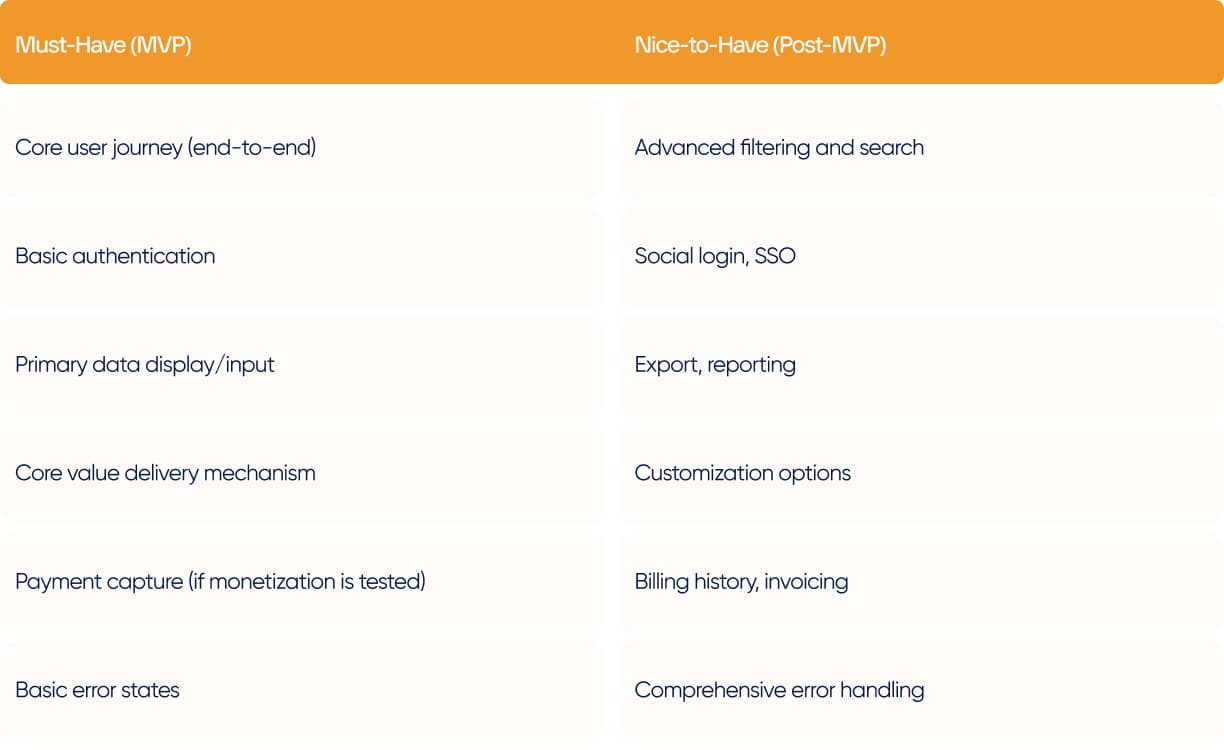
Feature Prioritization Framework
Use a 2x2 matrix with user value on one axis and implementation effort on the other. High-value, low-effort features are MVP essentials. Features that are low-value and high-effort are cut without discussion. Features that are high-value and high-effort need to be evaluated critically — sometimes they’re at the core of your product; sometimes they’re scope creep.
An alternative: force-rank every proposed feature by asking, “If we removed this, would a user fail to experience the product’s core value?” If the answer is no, the feature can wait.
Common Features Startups Should Exclude from an MVP
Analytics dashboards, team admin controls, notification preferences, multi-language support, API integrations beyond the single most essential one, mobile apps (if a web app validates the concept), advanced security features, and comprehensive onboarding flows. These all make a product better — none of them validate your core hypothesis.
MVP Development Cost for Startups
How much does it cost to build an MVP is the question every founder asks, and the honest answer is: it depends on what you need to validate. MVP development cost is driven by four variables — complexity, team structure, platform choice, and integrations. That said, here are the real ranges most MVP for startup companies fall into.
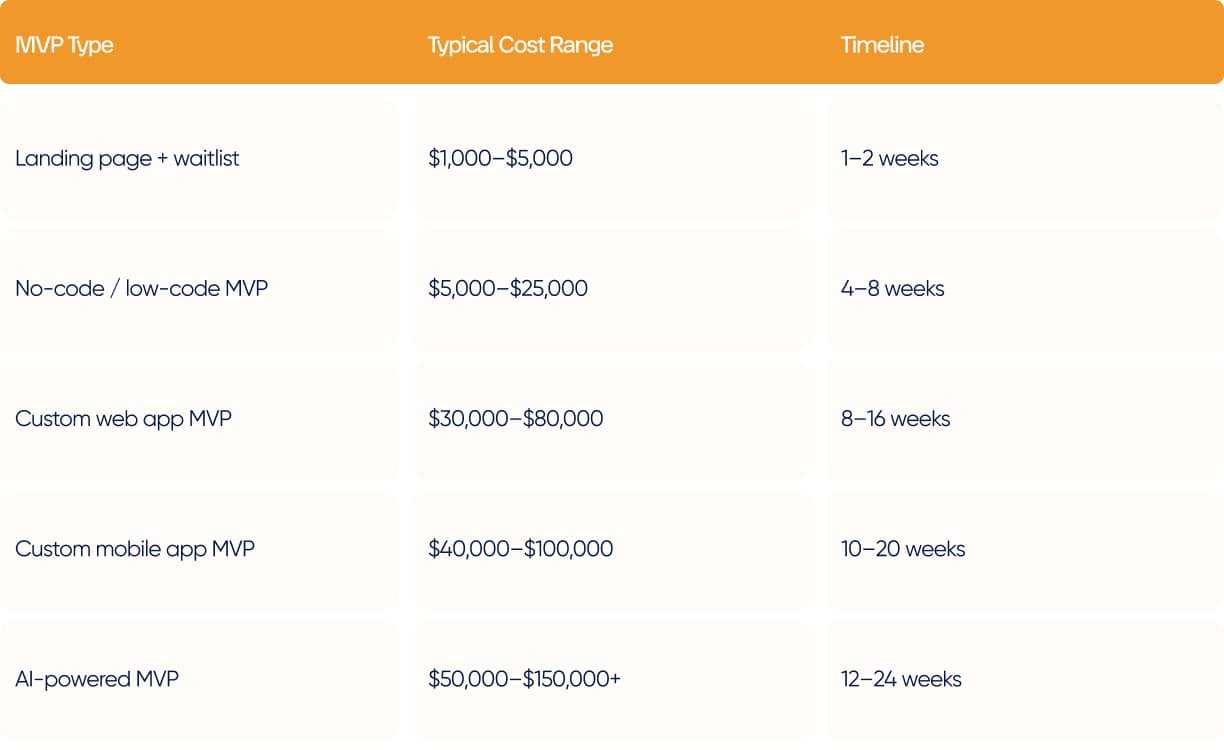
How Much Does It Cost to Build an MVP: Key Cost Factors
MVP development cost for startups varies significantly across four dimensions:
Product Complexity
A single-sided SaaS app with five screens costs far less than a marketplace with buyer and seller flows, or an AI product requiring model fine-tuning and custom inference infrastructure. MVP app development cost also scales with the number of user roles — every additional role adds its own flows, permissions, and edge cases.
Team Structure
Freelancers cost less per hour but add coordination overhead and product-thinking gaps that founders end up filling themselves. Agencies cost more but bring a pre-assembled team and a process — for most startups that means faster delivery and fewer decisions landing back on your desk mid-sprint.
Platform Choice
Web-first is almost always the right default for an MVP — faster to build, easier to iterate, and cheaper to maintain. React Native or Flutter close most of the gap if mobile is genuinely core to the value proposition, but “we should also have an app” is not a good enough reason to double the build scope before you’ve validated anything.
Integrations and Third-Party Services
Every integration is a hidden cost — payment processing, authentication, CRM connections, and communication APIs each add 1–3 weeks to scope. The MVP question isn’t “what integrations would be useful” but “what single integration is required for the core value to work.” Everything else waits.
AI Features
If the MVP development process for startups involves integrating AI functionality — not just an API call, but custom prompting, RAG pipelines, fine-tuning, or model evaluation — expect to add 30–60% to your base development estimate. For startups exploring this, our AI development services page covers what’s realistic at MVP stage versus what belongs in a later build.
Ready to get a realistic number for your specific MVP product development? We’ll scope it honestly, without overpromising.

MVP Development Timeline
How long does it take to build an MVP depends on complexity, but the phase structure is consistent. A realistic MVP development timeline for a custom software product looks like this:
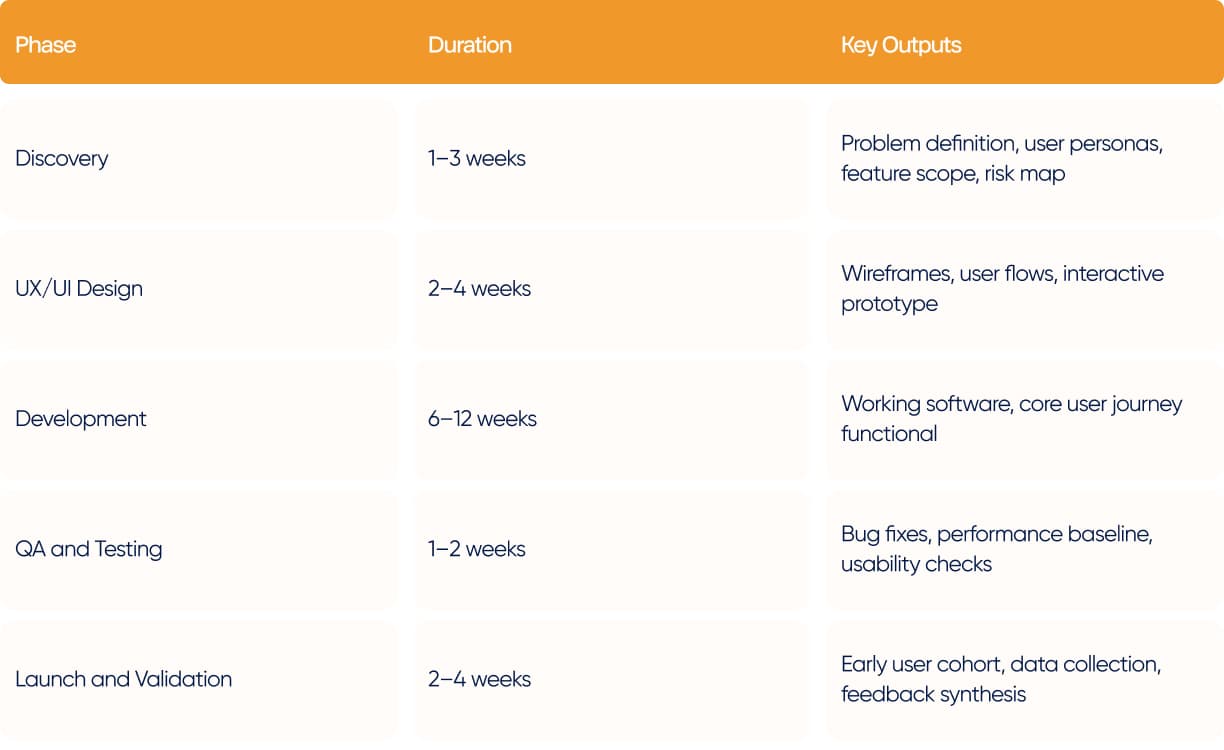
Total: 12–25 weeks from kick-off to validated learning. The MVP development roadmap beyond launch — what gets built next, based on what you learned — should be shaped by user data, not internal assumptions. Attempts to compress this timeline below 8 weeks usually sacrifice either discovery (and produce the wrong product) or QA (and produce an unstable one).
How to Build an MVP for a Startup: No-Code vs. Custom MVP Development
When No-Code Works
Low-code and no-code development tools — Webflow, Bubble, Glide, Softr, Retool — have matured enough to support many real MVP use cases. If your core user journey can be built on top of existing no-code primitives, this path dramatically reduces cost and time. Minimum viable product software development on no-code platforms typically costs 3–5x less than a custom build and ships 2–3x faster.
No-code MVPs are ideal for: B2B internal tools, marketplaces with simple matching logic, content platforms, workflow automation products, and any SaaS where the core value is data organization.
When Custom Development Is the Better Choice
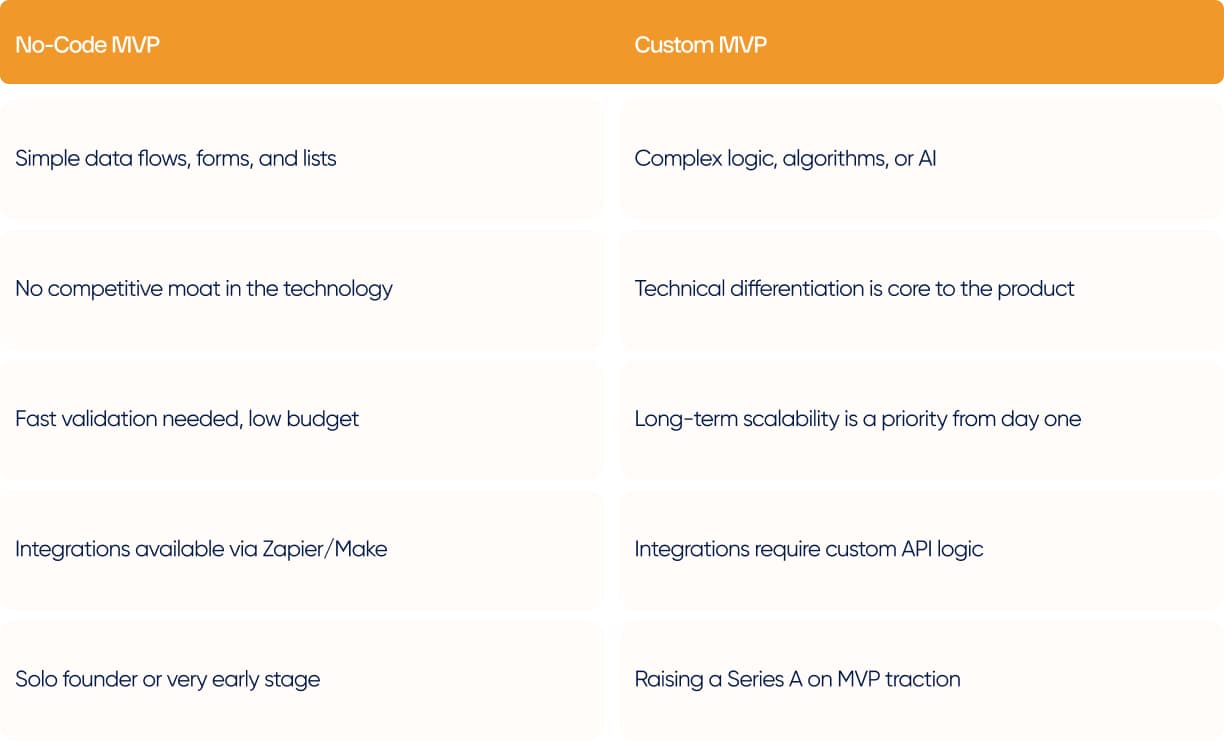
The honest limitation of no-code MVP development for startups is that they often hit a ceiling. If your product depends on custom logic that the no-code platform can’t support, you’ll eventually rebuild from scratch. Factor that cost into your decision.
Who Should Build Your MVP?
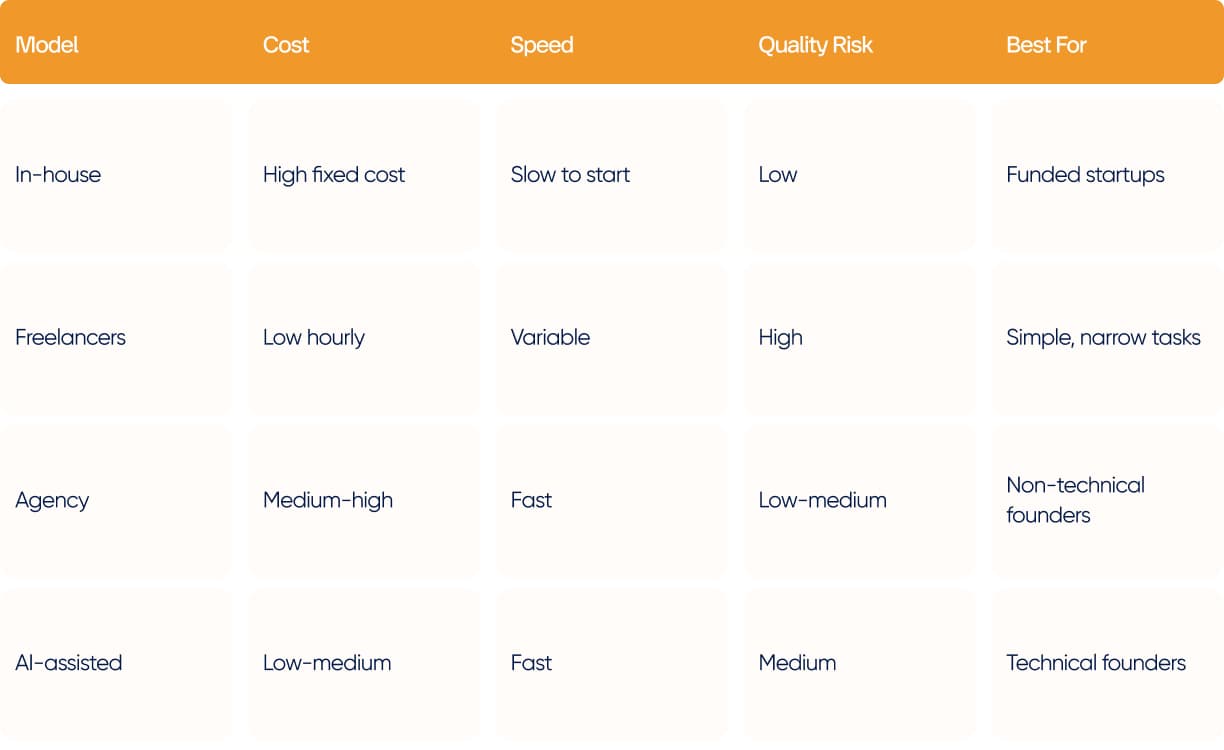
Startup MVP development requires more than engineers — it needs product thinking, UX judgment, and someone who’s seen what works. Here’s how the options actually compare.
In-House Team
Best for: well-funded startups with an existing engineering team, or technical co-founders with full bandwidth.
Upside: maximum alignment, deep product context, fastest iteration after initial build.
Downside: hard to assemble the right MVP development team skills (product, design, frontend, backend, QA) without significant hiring, and opportunity cost of pulling senior engineers into early-stage uncertainty.
Freelancers
Best for: very narrow technical tasks, budget-constrained early founders, or filling specific skill gaps.
Upside: lowest hourly cost, flexible engagement.
Downside: coordination overhead, inconsistent quality, availability risk, and lack of product thinking. Most freelancer MVPs require heavy founder involvement to stay on track.
MVP Development Agency
Best for: non-technical founders, startups preparing for fundraising, and teams that need to move fast with high quality.
Working with an MVP development agency means your MVP development team comes pre-assembled — PM, design, engineering, QA — with a process that’s already been tested across dozens of products. For non-technical founders especially, an MVP development agency removes the hardest coordination problem: you don’t have to manage five separate freelancers to get one coherent product. The tradeoff is cost and the time it takes to transfer product context.
For software development for startups specifically, an agency’s cross-functional structure often closes faster than a freelancer arrangement for the same scope.
AI-Assisted Development
Best for: technical founders who want to move faster, or agencies augmenting their delivery capacity.
AI coding tools (GitHub Copilot, Cursor, Claude, etc.) have meaningfully accelerated MVP development timeline — particularly for boilerplate, frontend components, and test generation. But AI-assisted development still requires experienced engineers to architect, review, and debug. It reduces cost and time; it doesn’t replace judgment.
Common Startup MVP Development Mistakes
Building too many features. The most common mistake, and the most expensive. Every feature added to an MVP is a hypothesis that delays testing your core one. Scope creep in MVPs usually comes from founder anxiety rather than user need.
Skipping customer discovery. Building before talking to real users is building in a vacuum. Discovery interviews don’t add weeks — they typically save months by catching wrong assumptions before they become wrong architecture.
Ignoring monetization validation. Free users are not product-market fit. If your MVP doesn’t test whether people will pay, you’re deferring the most important business question until after you’ve built everything.
Launching too late. Perfection is the enemy of learning. A product that ships in 10 weeks and generates real feedback is worth more than a product that ships in 20 weeks with extra polish.
Measuring vanity metrics. Signups, page views, and social likes don’t tell you whether your product works. Measure activation (did users complete the core action?), retention (did they come back?), and conversion (did they pay?).
Deciding on tech stack before validating demand. Decisions like “we’re building in Rust” are engineering preferences. Technology choices made before you validate the market demand often become expensive constraints on future flexibility.
MVP Development for Startups: Real-World Examples
These MVP examples for startups cover four product types — each one illustrates a different validation strategy and a different answer to the question “what’s the minimum we actually need to build?”
SaaS MVP Example
Dropbox didn’t build the product first. They built a three-minute demo video explaining the concept and put up a waitlist. Overnight, signups went from 5,000 to 75,000. The MVP was the video — it validated demand for a product that hadn’t been built yet. For MVP for SaaS startups, this remains the cleanest validation model: prove demand before writing infrastructure.
Lesson: Your MVP doesn’t have to be software. It has to answer the question “does anyone want this?”
Marketplace MVP Example
Airbnb’s first version was a website where the three founders rented out their own apartment. No search, no map, no reviews. Just photos, a price, and a contact form. They manually handled every booking. This is the Concierge MVP model — you fake the automation until you’ve proven the concept is worth automating.
Lesson: Marketplaces can validate supply and demand before building the matching infrastructure.
Mobile-First MVP Example
Instagram launched with a single feature that nobody expected: filters. The original app (Burbn) was a complex location-sharing product. The founders noticed users only cared about the photo-sharing part. They stripped everything else, added filters, and rebuilt in eight weeks — a textbook mobile-first MVP. The refocused product grew to one million users in two months.
Lesson: Your original MVP idea might not be right. Be willing to follow the signal.
AI MVP Example
A common pattern for startup MVP development in the AI space: manually deliver the AI output first, then automate. Build a product where a human (using AI tools internally) produces the output, sell it to early customers, and only build the automated pipeline once you’ve validated that the output has enough value to pay for. We’ve applied this approach in practice — our AI-based MVP work for a fan engagement platform started with exactly this model before the real-time pipeline was built. For a sector-specific take, see how this plays out in AI MVP for logistics.
Lesson: Don’t build expensive AI infrastructure for a use case nobody has proven they’ll pay for yet.
Key Lessons from Successful Startup MVP Examples and Launches
The best startup MVP examples share three traits: they do one thing exceptionally well, they launch to a narrow and specific user segment, and they treat early users as partners rather than customers. Growth comes after product-market fit — not before.
Have a startup idea but aren’t sure what features to build first? Our team helps you scope, prioritize, and validate before you spend a dollar on development.

How to Measure MVP Success
MVP validation isn’t about hitting a number — it’s about having enough signal to make a confident decision about what to do next. Vanity metrics don’t give you that. These do:
Activation Rate — What percentage of new users complete the core action that delivers value? Low activation is almost always a product problem, not a marketing one.
User Retention — Do users come back? Day 1, Day 7, and Day 30 retention are the most important early product health metrics. Retention measures whether you’ve solved a real, recurring problem.
Customer Feedback Quality — Are users giving you specific, actionable feedback? Vague feedback (“it’s nice but not for me”) signals weak product-market fit. Specific feedback (“I need X because I can’t do Y without it”) signals real engagement.
Conversion Rate — For MVPs testing willingness to pay: what percentage of activated users convert to paid? Even low conversion rates are useful data if you understand why.
Willingness to Pay — Have you tested pricing directly? This doesn’t require a full billing system — you can pre-sell access, use a Stripe payment page, or manually invoice early customers. What matters is that you’ve seen real money change hands or real resistance at a price point.
Revenue Validation Signals — Monthly recurring revenue, even at $1,000–$5,000, tells you more about product-market fit than 10,000 free users.
When Is Your Startup Ready for Full Product Development?
Signs of Product-Market Fit
The best signal: retention is strong, and users share their thoughts about your product with other people without being asked. Secondary signals: users are upset when features break, they’re requesting specific improvements (not just vague praise), and you have at least a handful of users who would be “very disappointed” if the product disappeared.
Sean Ellis’s benchmark — 40% of your user base saying they’d be “very disappointed” if the product went away — is a useful threshold for early-stage SaaS.
Validation Metrics That Matter
Before scaling minimum viable product development for startups into a full product build, you should have clear answers to: What is our 30-day retention rate? What is our activation rate for new users? What is our average revenue per user? What is our Net Promoter Score with early customers? If you can’t answer these with real data, you’re not ready to scale.
When to Scale Development
Scale when repeating the same pattern produces consistent results. If your acquisition, activation, and retention metrics are stable and positive across multiple user cohorts, you have enough signal to invest in scaling. That’s when the decision to build MVP for startup validation gives way to a full product roadmap. If any of those metrics are inconsistent or unknown, additional development won’t help — more discovery will.
Building a Roadmap After MVP
The post-MVP roadmap should be shaped almost entirely by user data. Group user feedback by frequency and revenue impact, sequence features by the constraints they remove for your best users, and maintain a bias toward retention improvements over new feature development. For teams scaling into a full web product, our web development services are built around exactly this kind of data-informed sequencing. Retaining existing users is almost always higher leverage than acquiring new ones.
Future Trends in MVP Development
AI-Assisted Product Validation
AI tools can now synthesize hundreds of customer interviews, generate and test landing page copy variants, analyze behavioral data for activation patterns, and even run automated usability tests. Founders who use these tools systematically will complete discovery and validation cycles in weeks. For teams exploring what’s possible before committing to a full build, AI prototype development is the fastest path to a defensible hypothesis.
AI-Powered Development Workflows
MVP software development for startups timelines are compressing. Engineering teams augmented by AI coding tools are delivering in 6–8 weeks what previously took 12–16. This raises the stakes for product and UX quality — when building is faster and cheaper, the competitive advantage shifts to teams that most accurately validate assumptions. For a broader view of where AI fits into MVP development for tech startups, see how leading teams are using it at the best SaaS development companies.
Lean Product Teams
The trend toward smaller, more focused product teams will continue. AI handles more of the execution layer — code generation, QA, documentation — which means the highest-value work shifts toward problem definition, user research, and strategic prioritization. Small teams with strong product instincts and AI tooling are increasingly able to compete with larger, slower organizations. This is also redefining what how to build an MVP for a startup means in practice: less about assembling a large team, more about assembling the right questions.
Continuous Validation Models
The “build MVP, launch, learn, iterate” model is evolving into continuous validation — where instrumentation, experimentation, and feedback loops are permanently embedded in the product, not just activated during the MVP phase. The best product teams treat every release as a hypothesis and every user interaction as data. For businesses operating in regulated or specialized industries, this model has specific applications — including IT solutions for small business and sector-specific platforms like real estate development services, where validated incremental delivery reduces compliance and integration risk significantly.
Key Takeaways
An MVP isn’t a shortcut to a full product — it’s a structured bet on the riskiest assumption standing between your idea and a real business. The startups that use it well don’t just build less; they build with a specific question in mind and stop when they have the answer. Scope is determined by what you need to learn, not by what would make a good product. Cost and timeline follow from that scope, not the other way around. And the team you choose — whether agency, in-house, or AI-assisted — matters less than whether anyone on that team is asking the right questions before the first line of code gets written.


