How AI Changed Software Development at Lumitech
Every software company now says it "does AI." The claim has become so common it carries almost no information — a client reading it learns nothing about how the company builds software, what it charges for, or what it does differently from three years ago.
- For New Clients
September 14, 2026
 AI Overview
AI-assisted software development cuts the cost of writing code at Lumitech, but not the cost of understanding what to build, verifying it, or taking responsibility for the result. In response, Lumitech now leads with clickable prototypes instead of long proposals, cuts implementation-heavy estimates by roughly half while leaving discovery and QA nearly unchanged, and runs smaller teams built around a new role — the AI Product Engineer. AI made the least difference in domain expertise, on-premise environments, non-technical stakeholders, and procurement, where human judgment still decides the outcome.

This article answers that question for our company. At Lumitech, AI changed four things, in this order: how we prototype before a contract, how we estimate projects, how we structure engineering teams, and how we run internal operations. By the end of this introduction you already know the shape of the whole piece.
We are a custom software development company based in Dubai, with engineering teams in Eastern Europe, working this way since 2022. Over the last two years the tools we use, the way we estimate, and the way we staff teams have changed substantially — some planned, some forced on us by clients who stopped accepting the old way.
How AI Changed the Economics of Software Development
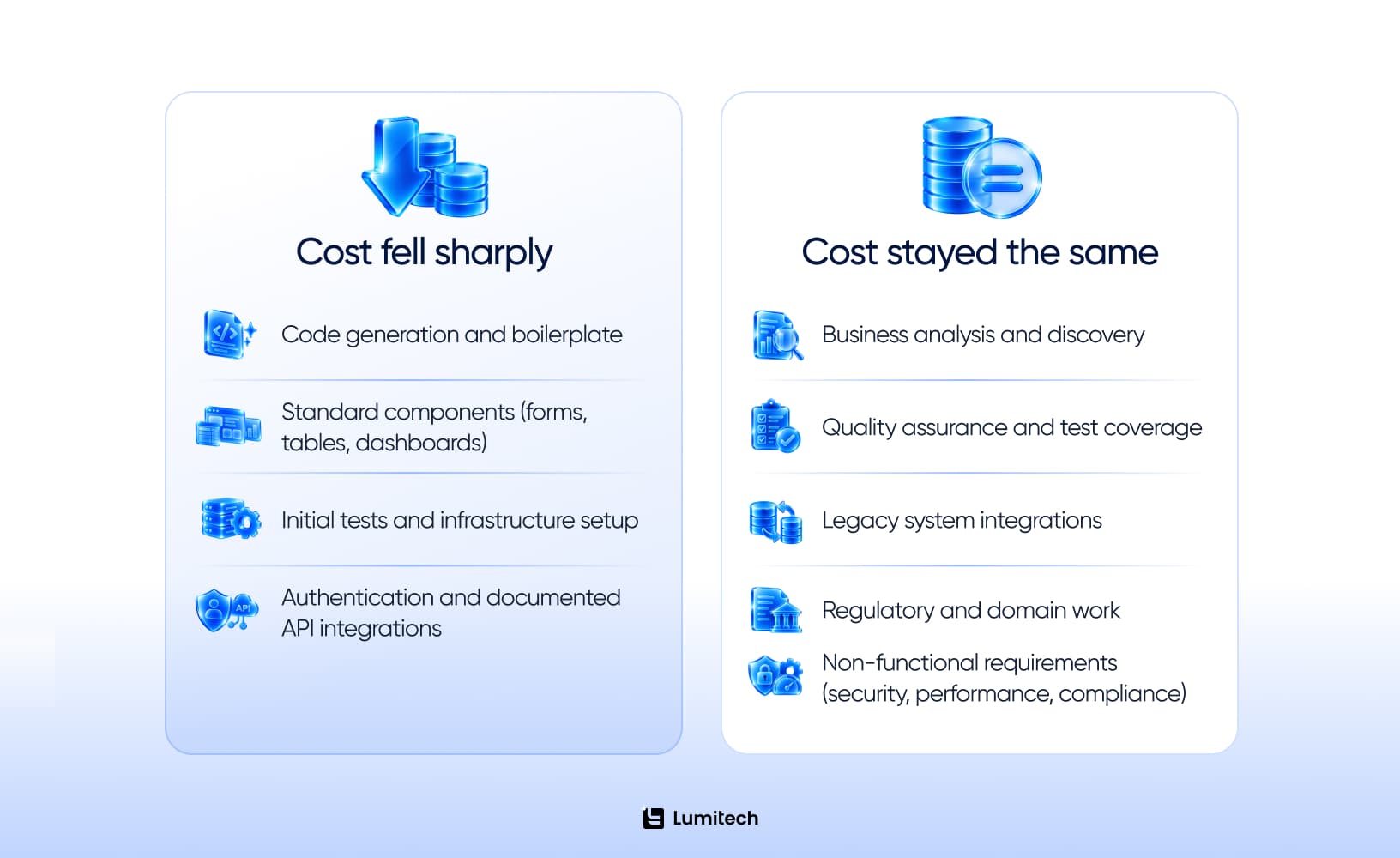
Central thesis at the bottom: "The cost of writing code fell. The cost of understanding what to build did not."
AI-assisted development has reduced the effort Lumitech engineers spend on repetitive implementation work — but it has not removed discovery, architecture, validation, integration, or engineering accountability, moving value from producing code toward deciding what to build and verifying it works in production.
In the projects we scope, AI-driven software development speeds up code generation, boilerplate, standard components, initial tests, and infrastructure setup. Business understanding, architecture, edge cases, validation, security, maintainability, and integrations barely move — we think of the result as AI-native software development, where production is delegated to tools and judgment is not.
This is the single idea behind every change below: the cost of writing code fell sharply, the cost of understanding what to build did not. In software development in the AI era, the stable value is design, judgement, and verification.
Prototype Before Contract
AI-powered software development changed how Lumitech sells, not only how it delivers — when a client sends a brief or RFP, we respond with a clickable HTML prototype of the key screens within a few days, not a thirty-page proposal, so the client sees real flows and surfaces misunderstandings before any contract is signed.
The traditional way to win a custom software project is a proposal — thirty or forty pages describing the problem, architecture, team, timeline, risks, and price, which the client reads, compares, and tries to imagine. The weakness is basic: the client pays for something they cannot see, while two vendors can write equally convincing documents and deliver completely different results.
We now lead with a working prototype instead — not a finished product, with no real backend or data, but it shows the structure of the system, the main user flows, the admin panel, and the reports, so the client can click through it and say "this is what I meant" or "this is not what I meant" before any contract is signed.
We have used this on very different bids. A psychometric assessment platform for a government-linked programme, where the prototype showed how six candidate personas map to different test modules. An event registration platform for a government office, with separate flows for publishers, schools, and general visitors. A project management application for a real estate developer.
This was only possible because prototyping became cheap: a clickable prototype of a fifteen-screen admin panel took a week of a front-end developer's time three years ago, now — a day, sometimes less. For teams exploring AI MVP development, the same economics apply — a prototype built early lets the client react to a real screen, not an abstract document. A focused PoC development engagement takes this further, turning the prototype into a testable slice before the full build is scoped. Either way, the prototype reduces uncertainty before the project begins.
How AI Changed Project Estimates
AI does not reduce every line in a software estimate equally — at Lumitech, the largest savings come from implementation work, while discovery, QA, integrations, compliance, and non-functional requirements remain far more dependent on human expertise.
A classic software estimate is built from hours: break the scope into features, estimate each, add a percentage for business analysis, project management, and QA, and multiply by rates. We still use this structure, but the numbers inside have changed unevenly.
Development hours fell substantially. For a typical business application, AI-assisted coding now produces front-end and back-end work that used to take a given number of hours in roughly half the time. The reduction is largest for standard components: forms, tables, dashboards, authentication, notifications, and documented API integrations.
Other categories did not fall, or fell much less:
Business analysis — understanding requirements, running discovery, resolving contradictions in client documents. AI can draft, but it cannot attend the meeting where the client changes their mind.
Quality assurance — the volume of code needing testing has not decreased; generated code needs more careful review, because it can look correct and be wrong in subtle ways.
Integrations with legacy systems — when the other side is an undocumented ten-year-old ERP, no tool makes that faster; someone still has to read the schema and talk to the person who built it.
Regulatory and domain work — compliance, bilingual content, accessibility, and domain-specific validation require human expertise AI can support but not replace.
Non-functional requirements — security, performance under load, and deployment to restricted environments are engineering problems, not code generation problems.
In one representative estimation model described by Lumitech, a project once estimated at roughly 3,000 hours came out closer to 1,600–1,800 hours — with the savings concentrated almost entirely in development, not analysis or testing.
We did not simply cut all estimates in half and call it "AI efficiency" — the reduction is specific and explainable line by line, with AI-assisted software development compressing implementation while leaving understanding, testing, and integration almost untouched.
What Is an AI Product Engineer?
At Lumitech, the role means one engineer owns a feature across database, backend, frontend, and deployment — AI handles the repetitive implementation work, while the engineer keeps responsibility for architecture, correctness, and fit with the client's business. AI does the production work; the human keeps the accountability.
The traditional software team has specialists: front-end, back-end, and DevOps developers, sometimes a separate database specialist, each requiring deep knowledge of its own tools. This specialisation existed because each area was hard enough to fill a career — at the highest level it still is. But at the level most business applications require, the boundaries have thinned, because the tool handles most syntax and framework-specific details.
This is not a claim that the role replaces front-end, back-end, or DevOps developers; our experience does not support that. But a project that once needed a front-end developer, a back-end developer, and a part-time DevOps engineer can now be delivered by two AI product engineers and a technical lead. In our AI software engineering practice, that means a smaller team, simpler communication, and fewer things falling between roles.
It also changed how we think about seniority. The common claim that "we only use senior engineers" is not one we make, and it is not the right goal. The right team is sized for the project, not maximized for seniority — some projects need an experienced lead and two mid-level engineers who execute well, some need a domain specialist more than a senior developer. Insisting on all-senior teams raises cost without always raising quality; what matters is that the person making architectural decisions has the experience to make them well.
For work beyond application code — model training, retrieval pipelines, document processing — our AI and ML development services sit alongside this role, with the same right-sizing principle.
How Lumitech Uses AI Internally
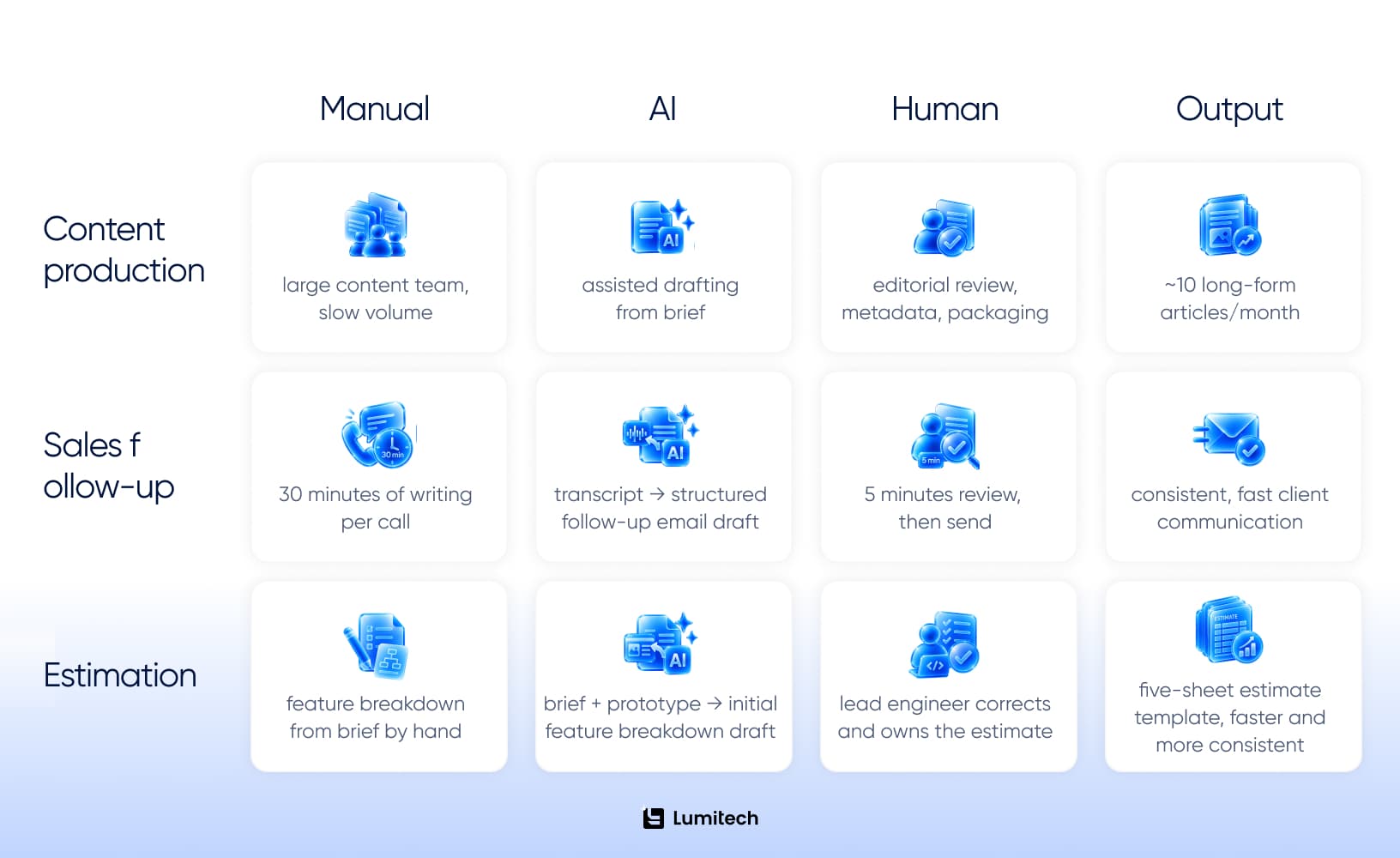
Lumitech applies the same AI tools to its own operations — content production, sales follow-ups, and estimation — each following the same pattern: an old manual process, an AI-assisted drafting step, and a human who reviews and takes responsibility before anything ships.
Content production is one example. We publish roughly ten long-form articles a month on topics relevant to our clients, each going through AI-assisted drafting, then editorial review by a person, then packaging with metadata and images. Without these tools, this volume would require a content team several times larger than the one we have.
Sales follow-up is another. After a client call, the transcript goes through a tool we built ourselves that produces a structured follow-up email: what was discussed, what was agreed, the next steps. The salesperson reviews and sends — this used to take roughly thirty minutes of writing per call, now roughly five minutes of review.
Estimation is a third. Our estimate template is fixed — five sheets, standard cost categories, minimum and maximum hours per feature. Much of the initial breakdown of a client brief into features can be drafted automatically from the brief and prototype, then corrected by the engineer who will lead the project. That is the same AI development workflow we recommend to clients, applied to our own estimating.
None of this is remarkable on its own; we mention it as a test of sincerity — a company that recommends AI adoption to clients but runs its own operations the old way is not credible. At Lumitech, we use what we sell.
Where AI Did Not Help
In four areas, AI in software development made no meaningful difference to Lumitech's work — domain expertise, restricted on-premise environments, non-technical stakeholders on the client side, and contracts and procurement — because these are problems of understanding, environment, and responsibility, not code production.
Domain Expertise
On the psychometric assessment platform mentioned earlier, the hardest part was not software. It was assessment design: how many test items per scale, which response formats are valid, how to adapt English items into Arabic without changing what they measure, which published frameworks can be used commercially and which cannot.
AI could draft candidate items, but it could not validate scale design, confirm response formats, adapt items without distorting what they measure, clear commercial use of published frameworks, or take responsibility for the design. We brought in professional psychometricians, and their work was the critical path of the project.
Restricted Environments
Several government and enterprise clients require deployment to their own on-premise infrastructure, with no managed cloud, no external APIs, and a stack fixed by the client. Here the productivity gains of AI-native software development mostly disappear — you cannot use a managed database, a serverless function, or a hosted queue. You build the way people built in 2015, and the hours reflect that.
Non-technical Stakeholders
On some projects, the client side has no single technical owner. Decisions pass through project managers, procurement, and middle management, none of whom are engineers, and AI tools do not help here directly. What helps is showing a working prototype early, so the discussion centers on a real screen rather than an abstract document — the underlying challenge is human, not technical.
Contracts and Procurement
Reading a purchase order carefully, noticing the delivery date in the contract contradicts the date agreed in email, spotting that penalty clauses pass through from the end client to the subcontractor — this is careful, slow, human work that does not get faster.
AI can assist domain experts; it does not remove the need for domain authority.
What Stayed the Same
Three things stayed the same at Lumitech despite the shift to AI — the dual-shore model of leadership and software development in the UAE and engineering in Eastern Europe, milestone-based payment for new builds, and warranty and post-launch support — because AI changed the tools, not the business model.
We still work with a dual-shore model: leadership and client-facing roles in Dubai, engineering in Eastern Europe. This gives clients a local contact in their time zone and a delivery team with a strong engineering culture at reasonable cost. As a software development company in UAE, we found AI did not make this model obsolete — if anything, it strengthened it, because smaller teams communicate more easily across distances.
We still structure most projects around milestones with defined outcomes. The client pays for a working, accepted piece of the system, not hours logged. Some engagements are hourly retainers, particularly ongoing support and small iterative work, and we do not pretend otherwise — but for new builds, outcome-based milestones remain the default.
We still include a warranty period after delivery and still expect to support systems after launch.
The point is that AI is a method of working, not a business model. The business model is the same: understand the problem, agree what success looks like, build it, take responsibility for the result. The tools changed; the commitment did not — in software development in the AI era, that distinction separates a credible partner from a vendor reselling tools.
Where This Leaves Us
As of this year, more than twenty AI-based features run in production across our client systems — document processing, retrieval-based question answering, conversational interfaces, classification and extraction pipelines. Roughly fifty written case studies cover our work in healthcare, finance, and industrial sectors. Nearly every new project we scope now has at least one AI component, and most have several. We are rated 5.0 on Clutch and listed as the top IT consulting company in the UAE on that platform — evidence that these changes have been tested with real clients and held up.
The most useful thing we learned is that adapting to AI was not mainly about adopting tools — it was about accepting that the value of our work moved, and reorganising around where it went. As an AI software development company UAE clients trust, we see this clearly: companies that only adopt the tools get faster at the part of the work that is becoming cheap, while companies that reorganise can sell the part that is not.
This is why we frame the conversation around judgment, not tooling — tools are the easy part; deciding what to build and taking responsibility for it is what holds its value. The same logic sits behind our enterprise AI strategy work.
As an AI software development company in UAE, we will not send you a forty-page proposal and ask you to imagine the result. For AI-driven software development engagements, we ask you to send us a brief — we send back a clickable prototype so you see the product before you commit to the build. The same applies to custom software development: you see the product, not a promise, and that is as true for AI-assisted software development as for any engagement we take on.