What Is Fraud Analytics and How to Use Data for Fraud Detection?
A fraudulent payment can be confirmed by the customer themselves. Identity checks pass. Authorization succeeds. The transaction looks completely valid — and still moves money to a scammer.
- FinTech & Finance
October 01, 2026
 AI Overview
Fraud analytics in banking combines transaction, device, and behavioral data to score payment risk in real time, using rules, predictive models, and network analysis together, since no single method catches every pattern. Without combined data, banks risk false positives on legitimate customers or missed scams — UK authorized push payment fraud rose 19% in 2025, to £576.4 million.

This is the shift behind today's fraud problem. According to the UK Finance report published in June 2026, covering 2025 UK market data: unauthorized fraud losses fell by 5% in 2025, while losses from authorized push payment (APP) scams — where the customer themselves authorizes the payment after being deceived — rose by 19%, to £576.4 million.1 That raises the question this article answers: how does analytics catch fraud when a single transaction looks completely normal on its own?
The other side matters too. IBM identifies false positives, dependency on data quality, and integration complexity as significant constraints on banking AI fraud systems. That’s why this article is not a pitch for a perfect system. It is a guide to the trade-offs: what data a bank combines, how it scores risk, and what it does after flagging suspicious activity.
What Is Fraud Analytics in Banking?
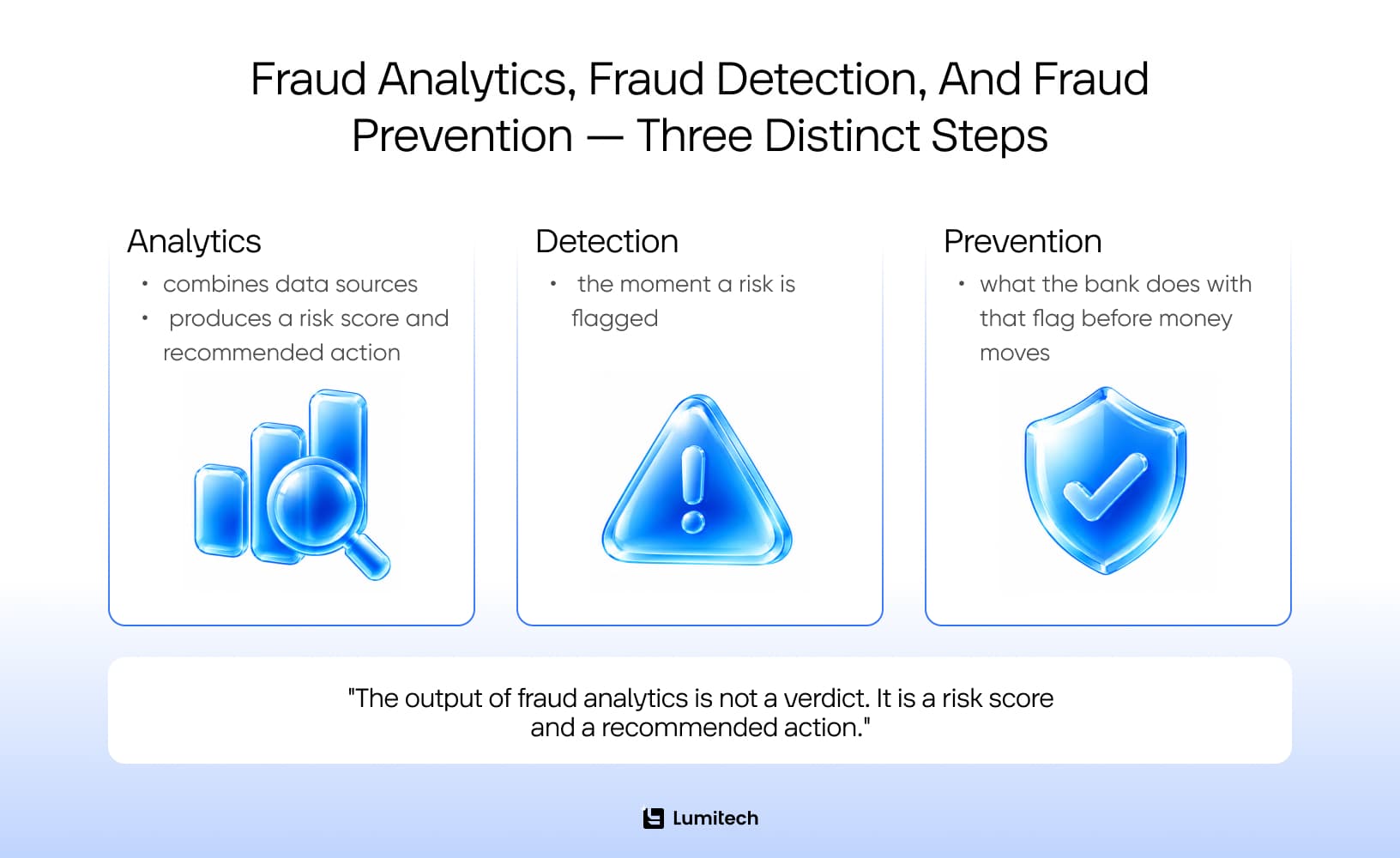
So, what is fraud analytics? Fraud analytics in banking is the practice of combining transaction, device, behavioral, and counterparty data to produce a risk score for each payment or account action.
Fraud analytics, fraud detection, and fraud prevention are related but distinct. Analytics produces a risk assessment and a basis for action. Detection is the moment a risk is flagged. Prevention is what the bank does with that flag before money moves.
The output of banking fraud analytics is not a verdict. It is a risk score and a recommended action, handed to a system or a person who decides what happens next.
Why Banks Need More Context to Detect Fraud
Customer-confirmed fraudulent transfers, AI-assisted scams, and fast or instant payments explain why a single transaction can look completely valid and still be fraud. A single transaction can look valid and still be fraud for several specific reasons:
The customer authenticated and authorized the payment themselves, so the authentication step succeeded even though the payment itself was a scam.
Instant and real-time payment rails often settle before a bank has time to review the transaction.
AI-assisted social-engineering scripts coach the customer through a call or chat, so their own behavior looks intentional rather than coerced.
A transaction amount within the customer's normal range doesn't reveal that the recipient is brand new or has no prior relationship with the customer.
A login from a familiar, trusted device can still be the tail end of a scam that started with a phone call, not a hack.
This is why digital identity verification matters — and why it is not enough on its own. It confirms who is paying, not whether the payment itself is safe.1
The UK Finance figures show the pattern clearly. From the UK Finance report published in June 2026: unauthorized fraud losses fell by 5% in 2025, while losses from authorized push payment (APP) scams — where the customer themselves authorizes the payment after being deceived — rose by 19%, to £576.4 million. This is UK-market data from a specific report period, not a global figure, and a 2026 report describes 2025 activity.
European data corroborates the same trend. According to the EBA and ECB's joint 2025 Report on Payment Fraud, manipulation of the payer — where the payer is deceived into initiating the transaction themselves — accounted for 74% of the total value of fraudulent credit transfers in the EU/EEA in 2024, up from 65% in 2023.
And the pressure is increasing. According to Deloitte research cited in Mastercard's 2026 payment fraud prevention report (US market), generative-AI-enabled fraud could fuel $40 billion in US fraud losses by 2027, up from $12.3 billion in 2023.
What Data Do Banks Need for Financial Fraud Analytics?
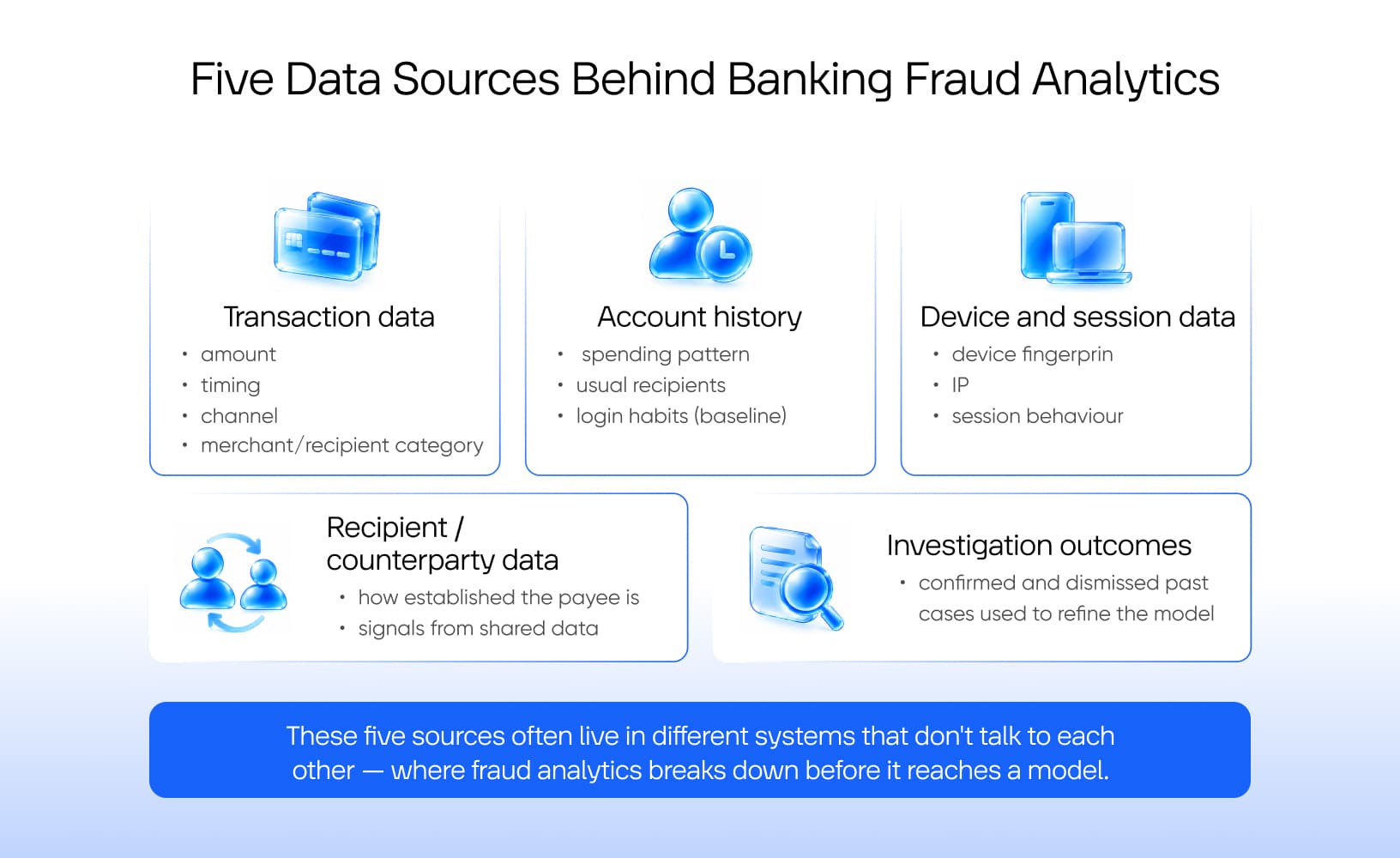
Financial fraud analytics depends on five data sources.
Transaction data — amount, timing, channel, and merchant or recipient category, to establish what "normal" looks like for this customer.
Account history — the customer's typical spending pattern, usual recipients, and login habits, as the baseline any anomaly is measured against.
Device and session data — device fingerprint, IP address, and session behavior, to check whether this login matches the customer's past pattern.
Recipient/counterparty data — how established the payee is, and any signals tied to that account elsewhere in the bank's own data or shared industry data.
Investigation outcomes — the record of past confirmed and dismissed fraud cases, used to refine what the system treats as suspicious going forward.
These five sources often live in different systems that don't talk to each other, which is exactly where data analytics for fraud detection in banking breaks down before it even reaches a model. This fragmentation makes data governance in banking as critical as the modeling itself.
Transaction fraud detection depends on having these sources accessible and complete. Without them, even the best model learns from an incomplete picture.
Fraud Analytics Techniques: Rules, Predictive Models, and Network Analysis
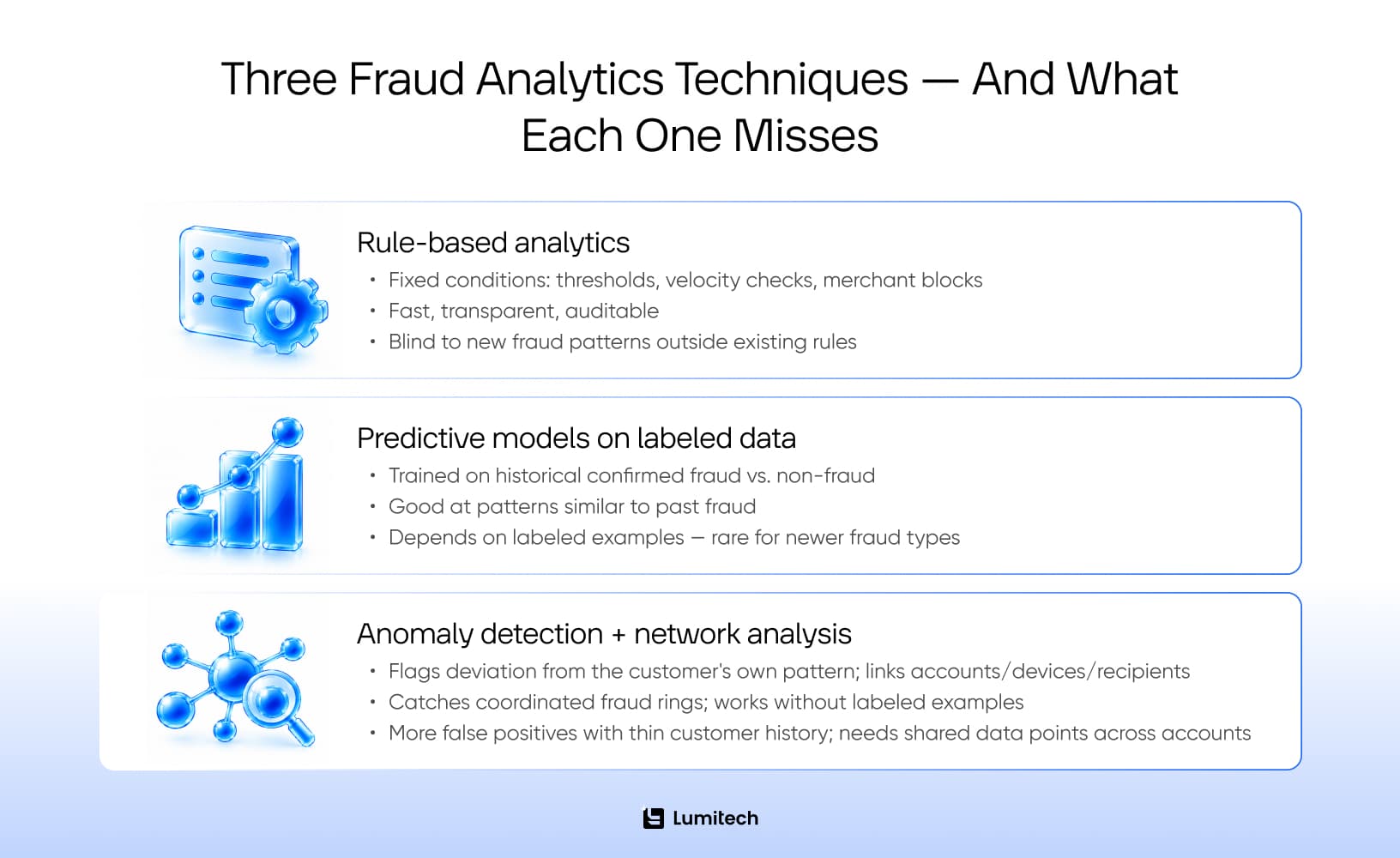
Fraud analytics techniques fall into three broad approaches: rule-based systems, predictive models trained on labeled data, and anomaly detection with network analysis. Each is good for different patterns, and banks usually combine them because no single method catches every fraud type.
How do fraud detection algorithms work? They take the data sources above, apply one or more of these methods, and output a risk score with a recommended action.
Rule-Based Fraud Analytics
Rule-based fraud analytics uses fixed conditions — for example, transaction amount thresholds, velocity checks, or blocks on certain merchant categories. Rules are fast to implement and transparent, which helps with explainability and audits. But they are blind to new fraud patterns that don't match an existing rule.
Predictive Models on Labeled Data
Predictive models are trained on historical labeled fraud and non-fraud data. Predictive fraud analytics is good at catching patterns similar to past fraud, but dependent on having enough labeled examples, which most banks don't have in volume for newer fraud types. This is especially true for predictive fraud analytics in banking, where labeled fraud cases are rare relative to the total transaction volume.
Labeled-data scarcity is a core constraint, and synthetic data generation methods offer one way around it — creating artificial fraud scenarios to augment training data, though this requires careful validation. Building and training these models also demands solid AI and machine learning development practices, from feature engineering to model monitoring.
Anomaly Detection and Network Analysis
Anomaly detection flags behavior that deviates from a customer's own pattern, without needing labeled fraud examples. Network or link analysis looks at connections between accounts, devices, and recipients to catch coordinated fraud rings that a single-transaction view would miss.
Both approaches matter for cross-border patterns. According to the same EBA/ECB 2025 Report on Payment Fraud, roughly 70% of card payment fraud in the EU/EEA in 2024 involved cross-border transactions, by both value and volume — even though most card payments themselves were initiated domestically. A single-transaction rule would never surface that pattern; a network view can.
The limitation is plain: both approaches produce more false positives when the customer's own history is thin, and network analysis needs enough shared data points across accounts to find a link at all.
Fraud Detection Use Cases in Banking
Fraud analytics use cases in banking cluster around four scenarios: card fraud, account takeover, authorized push payment scams, and account opening fraud. Each uses a different mix of data and methods, and each has its own limitation. Fraud detection in banking depends on matching the method to the scenario, not applying one model everywhere. Real time fraud detection is most critical for card fraud and APP scams, where decisions must happen in seconds.
Fraud Use Case | Data Required | Analytical Method | Possible Response | Limitation |
|---|---|---|---|---|
Card fraud | Transaction data, device/location data, merchant category history | Rules + predictive models on labeled data | Decline, step-up authentication, temporary hold | Struggles with fraud patterns not seen in training data |
Account takeover | Device/session data, login behavior, account history | Anomaly detection | Step-up verification, temporary account lock, alert to customer | High false positives when customer's own baseline behavior is thin or highly variable |
Authorized push payment (APP) scams | Transaction data, recipient data, behavioral sequence before the transfer | Anomaly detection + network analysis | Warning message, delayed release, escalation to a specialist | Customer authorized the payment themselves, so confidence is lower and false positives carry a real customer-friction cost |
Account opening fraud | Identity verification data, device data, application behavior | Rules + network analysis (linking applications to known fraud patterns) | Manual review, additional identity verification, application decline | Depends heavily on the quality and completeness of identity data available at onboarding |
Card Fraud
Card fraud covers stolen or cloned card usage. Credit card fraud analytics typically combine transaction amount, merchant category, location, and device signals to flag anomalies against the cardholder's usual pattern.
Account Takeover
Account takeover fraud detection focuses on a fraudster gaining access to an existing account via phishing, credential stuffing, or SIM swap. The key signals are device changes, unusual login times or locations, and sudden changes in transaction behavior.1
Authorized Push Payment (APP) Scams
APP scams are where the running illustrative example lives. Consider this scenario: a customer, using their own device, transfers money to a new recipient shortly after communicating with a scammer.
Fraud analytics asks four questions:
How well does this transaction match the customer's own history? (amount, recipient, timing, channel)
What does the bank already know about the recipient, from data it has access to? (new payee, reports tied to this account elsewhere, how recently the payee was added)
Is there a suspicious sequence of actions leading up to the transfer? (a new payee added right before a large transfer, unusual login behavior, a pattern seen in other confirmed scam cases)
What response fits the level of risk — letting the transaction through, showing a warning, requesting additional verification, or escalating to a human specialist?
A single anomaly — new payee, higher-than-usual amount — does not by itself prove fraud. The point is how multiple weak signals combine into a risk assessment, and how the response is proportional.
Account Opening Fraud
Account opening fraud covers synthetic identities and stolen-identity account openings. This is where identity verification platform modernization matters — combining identity data, device signals, and application behavior to flag high-risk onboarding.
Implementing Fraud Analytics: A Step-by-Step Roadmap for Banks
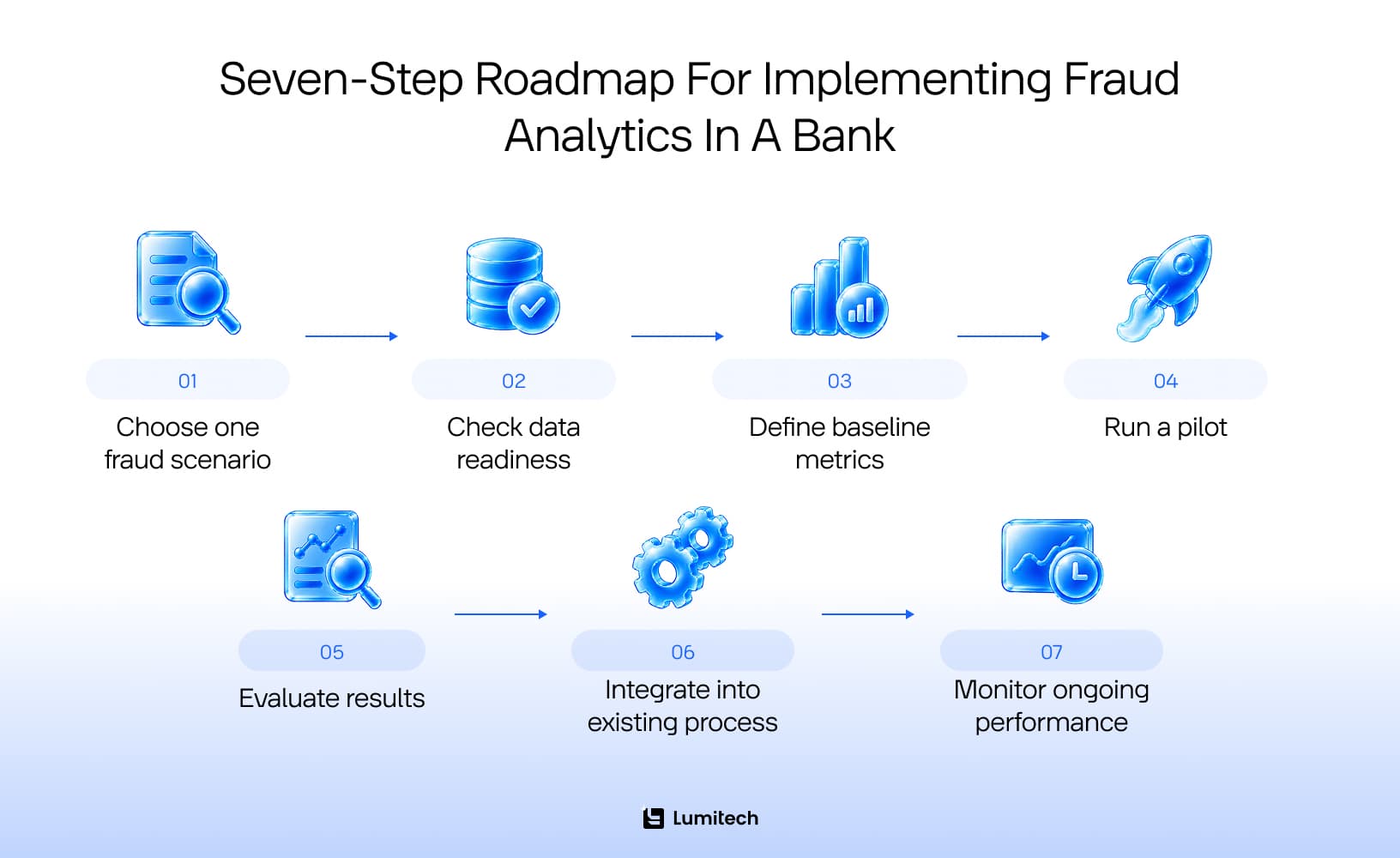
Choose a Fraud Scenario. Start with one scenario — for example, APP scams or account takeover — not every fraud type at once. This keeps the pilot measurable.
Check Data Readiness. Confirm the five data sources from the earlier section actually exist, are accessible, and are complete enough to use. This is where data engineering services come in, making those sources accessible and usable before any model is built.
Define Baseline Metrics. Set the starting numbers before building anything: current fraud losses, current false positive rate, current average review time. These are what the pilot will be measured against.
Run a Pilot. Test the chosen method — rules, a predictive model, or anomaly detection — on real data, in a contained scope, before wiring it into daily operations.
Evaluate Results. Compare the pilot's precision, recall, and false positive rate against the baseline from step 3. This is a preview of the fuller breakdown in the next section.
Integrate into the Existing Process. Wire the model or rules engine into the bank's actual transaction flow and case-management process, not run it in isolation. This is the broader engineering work of custom fintech software development — connecting a fraud model to existing banking systems and workflows.
Monitor Ongoing Performance. Fraud patterns shift, so a model needs regular review, not a one-time launch. According to the same Mastercard/FT Longitude 2025 research, organizations that have used AI for fraud prevention for more than five years report saving $4.3 million in fraud losses, compared with an average of $2.2 million among all respondents.
Before a bank launches fraud analytics, we ask them to map every place a signal about a transaction actually lives — the core banking system, the fraud team's case notes, device fingerprinting, KYC records — because a model trained on one clean feed and three broken ones learns the wrong lesson. Moving a pilot into production isn't a technical milestone, it's a trust milestone: the fraud team has to agree the false positive rate is tolerable, the escalation workflow for a flagged case has a clear owner, and the model's decisions can be explained to an auditor, not just to a data scientist.


How to Measure Fraud Detection Performance
Out of 100,000 transactions, 100 turn out to be fraudulent. A system that labels every single transaction as legitimate would score 99.9% accuracy — and catch zero fraud cases. This is why accuracy alone is a misleading metric for fraud detection.
After this walkthrough, define plainly:
Precision — of everything the system flagged, what share was actually fraud.
Recall — of everything that was actually fraud, what share the system caught.
False positive rate — what share of legitimate transactions were wrongly flagged.
Business outcome — how losses, review time, and the number of wrongly blocked legitimate transactions actually changed as a result.
This combination of numbers, not accuracy alone, is what a bank should ask a vendor for when evaluating a pilot or a proposal. Industry data shows the payoff of getting this right. According to Mastercard's 2025 payment fraud prevention report, produced with Financial Times Longitude (a survey of 300 payments-industry executives), 83% of respondents said AI has significantly reduced false positives and customer churn in the past year.
Conclusion
Fraud analytics isn't about catching every anomaly. It's about combining enough context to act proportionally, so a bank stops more fraud without stopping more customers. In the EU/EEA in 2024, payment service users bore roughly 85% of credit transfer fraud losses, per the same EBA/ECB 2025 Report on Payment Fraud — which is why getting this right matters for the customer, not just the fraud team.
If you're evaluating fraud analytics for your own scenario, start with the data you already have access to and the integration work a pilot would require. We can discuss your specific fraud use case, the signals available in your systems, and what it would take to wire a model into your existing transaction flow.