Digital Identity Verification: Methods, Platforms, and Implementation Guide
Digital identity verification is now a strict business requirement for many businesses. Companies use it to confirm user identities online, reduce fraud, accelerate onboarding, and support compliance across regulated environments.
- Data Privacy
- Big Data & Analytics
May 15, 2026
 AI Overview
Digital identity verification confirms a user's identity online using document scanning, biometric face matching, liveness detection, and database cross-checks to prevent fraud and meet KYC, AML, and GDPR requirements. Core components include automated workflows, risk scoring, and device intelligence, replacing manual review with instant validation. Biometric liveness detection reduces fraud cases by up to 80% in banking and fintech.

In industries such as banking, healthcare, HR, e-commerce, and government services, it has become an integral part of delivering secure, scalable digital experiences.
For fintech, banking modernization, healthcare, HR, e-commerce, travel, and government services, online identity verification is now a core part of digital trust. A strong ID verification system helps companies meet KYC, AML, and privacy requirements while preventing identity theft, account takeovers, synthetic fraud, and deepfake-based attacks.
The main digital identity verification methods used today include ID document scanning, biometric face matching, liveness detection, cross-database checks, and automated verification workflows. These methods are built to balance security, compliance, and usability across web and mobile products.
This guide is written for teams building or improving digital verification flows, including executives, security leaders, compliance teams, HR platforms, and product owners. It explains what digital identity verification is, why companies need it, which methods are most common, and how to approach implementation more effectively.
What Is Digital Identity Verification?
Digital identity verification is the process of confirming a person’s identity online using digital data, government-issued documents, biometrics, liveness detection, database checks, and risk signals. Generally speaking, it is the process of proving that an online user is genuinely who they claim to be. It usually relies on a combination of personal information, identity documents, biometric data such as facial recognition or selfies, liveness detection, device intelligence, and cross-checks against trusted databases. Depending on the use case, the process may also include behavioral signals or risk scoring to detect fraud, impersonation, or synthetic identities.
The business value is clear: companies use digital identity verification to strengthen security, streamline onboarding, and meet compliance requirements. Done well, it helps organizations build trust while decreasing manual effort, fraud risk, and friction for legitimate users.
Why Digital Identity Verification Matters
Digital identity verification matters because it helps businesses solve several problems at once. First, it plays a major role in preventing identity theft and synthetic fraud. Fraudsters no longer rely only on stolen documents — they also create fake identities by combining real and fabricated data. Verification systems help detect these attempts before a fake account is approved or a transaction is completed.
It also reduces the risk of account takeover. When identity checks include biometrics, liveness detection, device data, or risk-based verification, it becomes much harder for unauthorized users to gain access to someone else’s account. This is especially important for platforms that handle payments, personal records, or sensitive business data.
Another key reason is speed. Strong verification does not have to slow users down. In many cases, automated checks make customer onboarding much faster by replacing manual review with instant document, database, and biometric validation. That means less friction for legitimate users and fewer operational bottlenecks for internal teams.
Finally, digital identity verification supports compliance. Businesses in regulated industries need reliable ways to meet KYC, AML, and privacy requirements without turning every onboarding flow into a manual process. A well-designed verification process helps companies stay compliant, reduce risk, and build more trust from the first interaction.
Key Components of ID Verification System
Modern organizations face an ongoing challenge: maintaining digital services that are convenient, open, and accessible while also verifying each user’s real identity. A secure online identity verification system lies at the heart of this balance. Currently, businesses apply advanced verification workflows and procedures to protect users and minimize fraud. Outdated manual identity verification, password checks, or physical documents have already been rendered obsolete. Let’s examine the key components of a solid digital verification strategy.
Verification Procedures & Workflows
A secure identity verification platform starts with concise workflows that define how a client’s data is collected, validated, and approved. The verification process includes several stages that combine document scanning, data verification, and behavioral analysis to prevent errors and stop fraudulent activity. The financial services sector utilizes online ID verification (eKYC), which begins with uploading an ID document and is followed by immediate database identification verification. Learn more about how automation transforms KYC workflows in our detailed guide on KYC automation.
The system provides an optimized workflow, provides secure consistency, and ensures regulatory compliance, while minimizing friction for authorized users. Organizations can utilize dynamic design to create authentication processes that adjust their level of complexity in response to risk assessments. The system requires advanced verification for high-risk transactions, yet uses basic verification for low-risk onboarding procedures.
Identity Proofing and Liveness Detection
Identity proofing is a verification process that confirms a person's identity. It goes beyond just confirming a name and birth date; you need to verify official documents, biometric patterns, and behavioral cues. Identity proofing and liveness detection are additional security layers that ensure the verification process is not based solely on a static photo.
Top-tier platforms utilize AI-driven biometric face recognition, fingerprint authentication, voice verification, or even subtle movements to confirm authenticity. For instance, asking a user to blink, smile, turn their head, or speak using a specific phrase. This method prevents fraudsters from passing verification using stolen photos. It is of great importance to provide such services for sectors such as healthcare, HR platforms, and government services, where secure access is a must.
Manual Identity Verification vs. Automated Verification
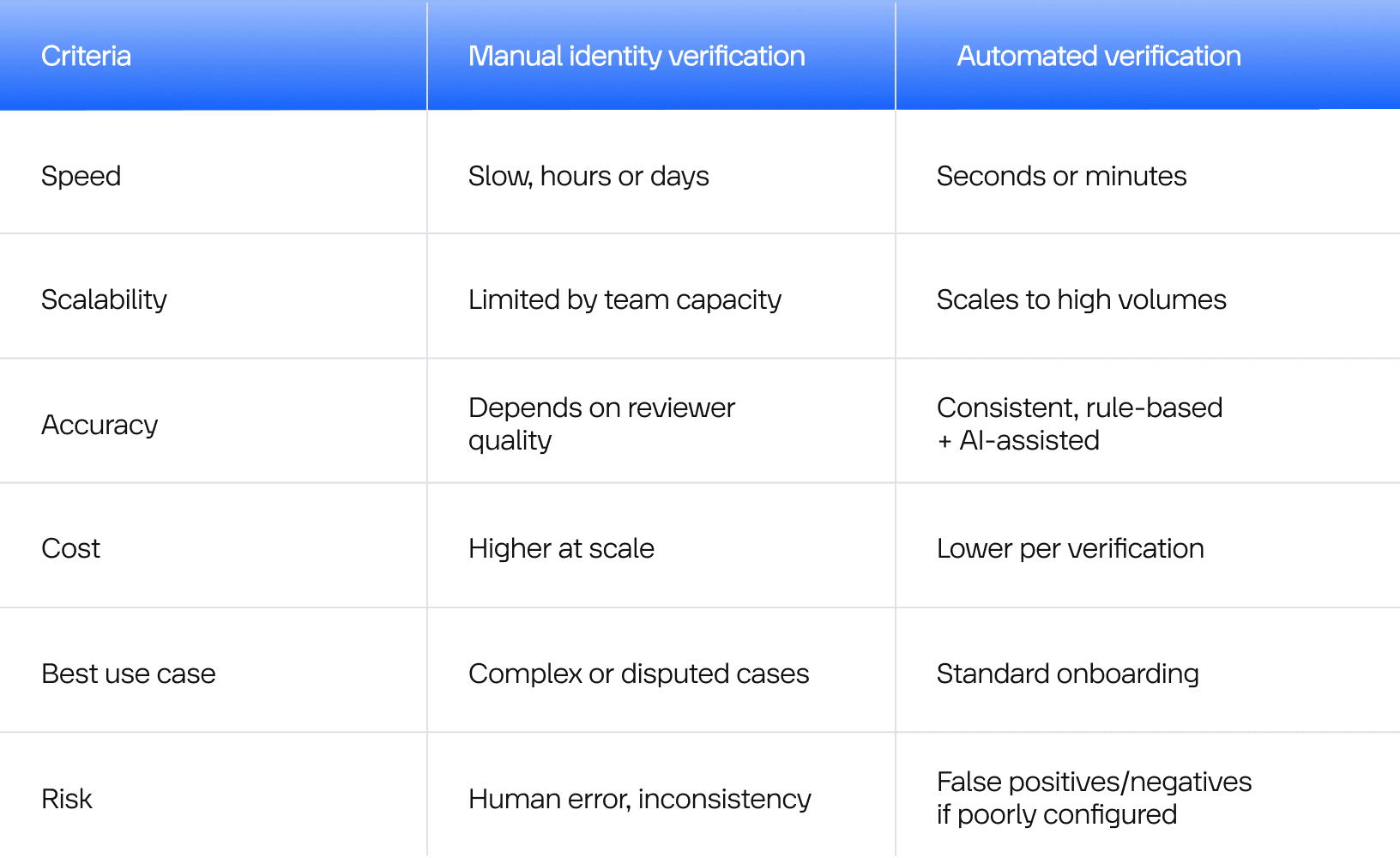
Earlier, identity checks were manual, and employees’ duties included verifying documents, photos, and phone calls to confirm the information. Manual review remains useful, especially for complex or disputed cases, but it is time-consuming, expensive, and prone to errors.
Automated verification, powered by connected databases and machine learning, greatly speeds up the process. An online identity verification service can instantly confirm an ID. Automation is easy to scale. It can handle millions of transactions without losing precision. Most businesses nowadays employ both methods: automation for speed and security, and manual checks for exceptions.
Role of AI & Biometrics in Reducing Fraud
Artificial intelligence and biometrics revolutionize digital operations. It helps businesses fight fraud. AI plays a key role in detecting small anomalies, such as unusual login patterns, document inconsistencies, or mismatched data points that humans may miss.
Currently, AI and biometrics stand as a strong barrier and a solid defense layer within a wider digital verification strategy. Financial institutions leverage them to prevent account takeovers, E-commerce platforms deploy them to combat payment fraud, and governments utilize them to reach citizens. For users, this is an excellent opportunity to create a quick, secure, and trustworthy experience. See also how AI can power large-scale data analysis in our AI patent analysis case study.

Digital Identity Verification Methods: How Does It Work?
Cutting-edge identity verification services integrate top-notch technologies, including biometrics, AI, and database validation, to secure a seamless, efficient, and secure workflow. The online workflow for verification of identity comprises several validation layers to confirm a person’s authenticity.
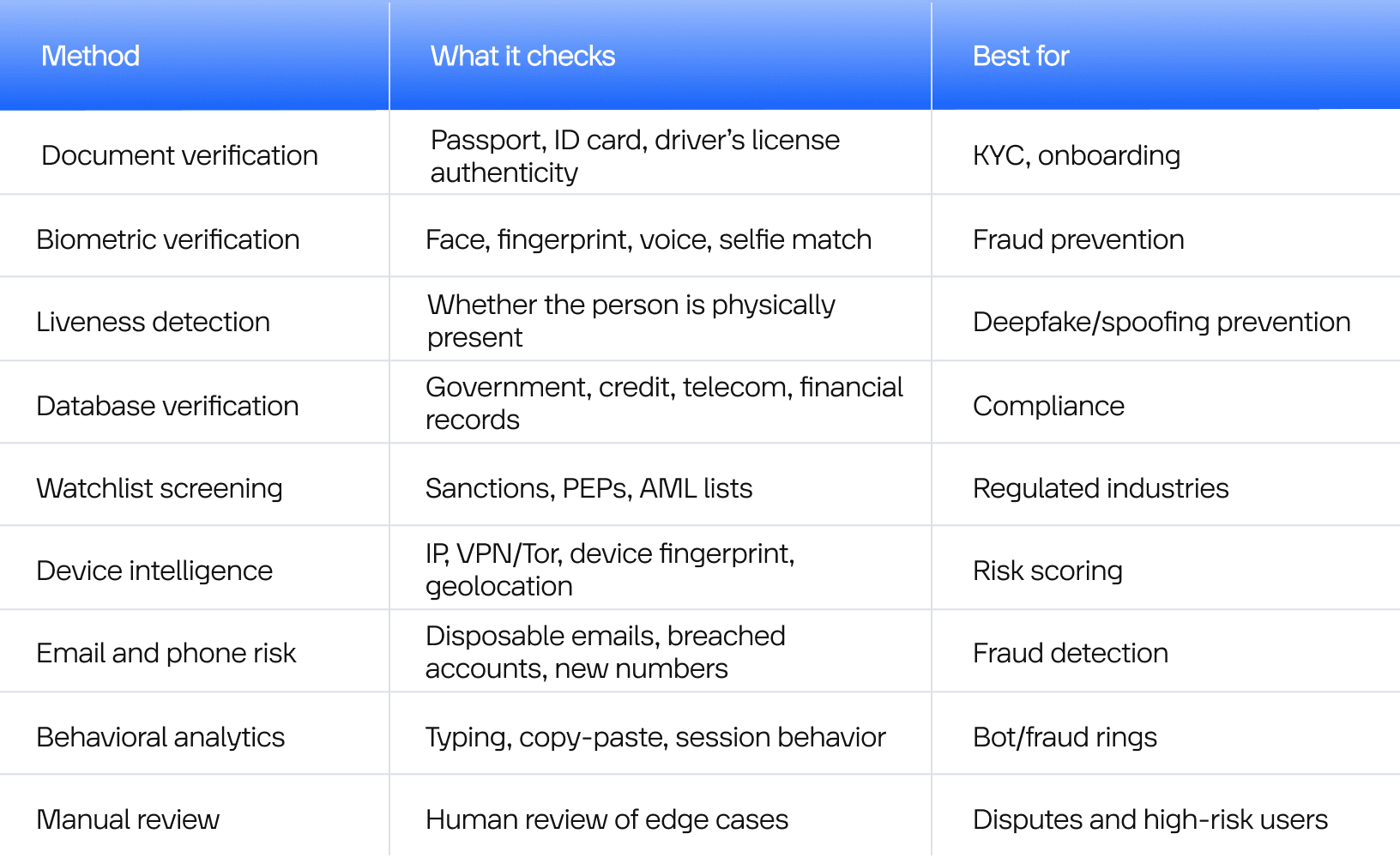
Below, we outline the most widespread verification procedures leveraged by leading digital identity verification vendors, and compose them into a usable workflow:
1. Data Collection in ID Verification System
The initial step is to gather basic information, such as name, surname, date of birth, and address, along with an official ID document, typically a passport or driving license. This is typically done during the registration or onboarding stage on a company’s website or app.
2. Document Authentication
By utilizing AI and OCR (Optical Character Recognition), the ID a customer uploads is compared with verified templates from global databases. To ensure the documents are legitimate and have not been altered, the system detects holograms, watermarks, fonts, and microprint features.
3. Biometric Verification
The selfie or live video of a customer must match the data provided in the ID to ensure it’s a valid person, that the documents are not stolen, a deepfake, or an impersonation attempt. ID verification system utilizes voice recognition and fingerprint scans for multi-factor authentication.
4. Cross-Database Matching
Verified data is then compared with trusted sources, such as:
Government registries and tax databases
Credit bureaus and telecom operators
Sanctions and watch lists (to meet AML and KYC compliance)
This helps confirm that the identity exists, the data is consistent, and the user is not linked to suspicious or fraudulent activity.
5. Liveness Detection
The platform checks whether the user is physically present during the verification process, rather than relying on a static photo, video replay, or deepfake. To do this, the system may instruct the user to blink, turn their head, smile, or complete another simple action in real time. This step introduces an added layer of protection against spoofing and identity theft attempts.
6. Device and Behavioral Risk Analysis
Beyond document and biometric checks, the system also evaluates contextual risk signals. These may include IP address, device fingerprint, VPN or Tor usage, email and phone reputation, geolocation mismatches, and unusual user behavior during the session. This helps discover suspicious patterns that may indicate fraud, account abuse, or synthetic identity activity.
7. Risk Scoring and Decisioning
Once all verification signals are collected, the platform assigns a risk score and determines the next step. Depending on the result, the system may approve the user, reject the verification attempt, request additional information, or send the case for manual review. This allows organizations to better balance security, compliance, and user experience.
8. Digital Identity Verification Solutions & Audit Trail
Validation workflows return a confidence score and an auditable trail for use in internal compliance, customer onboarding, or when resolving disputes. This last step guarantees transparency and regulatory consistency.
Benefits of the Identity Verification System
The modern world is steadily evolving and constantly demands instant and secure access to services. Here, an adequate digital identity verification service bridges the gap between compliance and convenience by verifying identity.
Unlike manual identity verification, which usually involves paperwork or an in-person visit and can also have lengthy approval times, automated verification tools utilize real-time data and biometrics (such as face recognition technologies) along with device intelligence to verify that each user is genuine. This frictionless method further improves the conformance of industries like banking, fintech, insurance, and software development for healthcare industry.
1. Faster, Frictionless Onboarding
With the help of digital verification, users can quickly prove their identity. Identity proofing and liveness detection help confirm that the person is real, physically present, and matches the submitted ID document.
2. Advanced Security and Fraud Prevention
Advanced systems incorporate multiple data points — including device data, biometric verification, email reputation, and behavioral analytics — to build a solid barrier against impersonation and synthetic identities. Real-time alerts and risk scoring make it harder for fraudsters to slip through, ensuring stronger customer trust and data integrity.
3. Global Accessibility and Inclusivity
Identity verification breaks regional barriers. There is no need for customers to send physical documents or visit branches — a win-win for remote employees, travellers, and locations with limited banking infrastructure. For example, European neobanks like N26 and Revolut rely on an online ID verification service in order to onboard millions of customers without extra paperwork. A similar approach is employed in our crypto indices platform, where real-time analytics facilitate transparency and compliance across digital assets.
4. Cost Efficiency and Scalability
Manual identity verification may be suitable for startups, but it becomes increasingly inefficient as the user base expands. Automated verification scales easily — a key advantage for enterprise software development and high-growth teams. It reduces onboarding time to mere seconds, helping teams to focus on high-value risk management and product innovation.
5. Seamless Digital Experiences
User experience depends on brand loyalty. Through integrating online ID verification (eKYC) into their web and mobile apps (web development services), businesses are able to increase conversion rates and establish trust from the very first interaction. When users can instantly and safely establish their identity, they’re much more likely to complete sign-ups, purchases, or loan applications — as proven by our personalized SaaS platform, which has gained user trust and achieved faster onboarding.
The Competitive Edge of Automation
By adopting a digital identity verification service, firms can strike a balance between speed and security. Real-time identity proofing and liveness detection ensure the user is legitimate, while automation reduces operational costs and lowers compliance risk.

How to Choose an ID Verification Platform
Choosing the right ID verification platform is about compliance, user experience, integration effort, and long-term scalability. The best platform should fit your industry, risk profile, and onboarding flow rather than forcing every user through the same process.
Use this checklist when comparing providers:
Document coverage Check how many countries, regions, and ID types the identity verification platform supports. A strong solution should verify passports, national IDs, driver’s licenses, and residence permits across the markets where you operate.
Biometric and liveness capabilities Look at how the platform handles facial matching and liveness checks. It should be able to detect spoofing attempts, replay attacks, and deepfakes rather than relying on static selfie comparison alone.
Database and watchlist checks Review whether the platform supports KYC, AML, sanctions screening, PEP checks, and broader risk screening. This is especially important for regulated industries that need to verify identity and screen users in one workflow.
Risk scoring and workflow customization A good verification platform should allow businesses to define separate flows for low- and high-risk users. That flexibility helps reduce friction for legitimate customers while applying stronger checks where needed.
Manual review fallback Not every case can be resolved automatically. Make sure the platform can route unclear or edge cases to a human reviewer instead of forcing an instant pass-or-fail decision.
API/SDK integration Integration should be practical for both web and mobile products. Evaluate whether the platform offers clear APIs, SDKs, documentation, and support for embedding verification into existing onboarding journeys, especially in finance environments that rely on banking APIs and connected services.
Compliance and data privacy Check whether the provider supports GDPR, SOC 2, ISO 27001, audit logs, and retention controls. Strong compliance features matter not only for legal protection, but also for internal governance and vendor due diligence.
UX and conversion rates Verification should be fast, mobile-friendly, and easy to complete. Localized flows, clear instructions, and low drop-off rates are just as important as detection accuracy.
Analytics and reporting The platform should give teams visibility into pass and fail reasons, fraud patterns, review queues, and operational bottlenecks. Good reporting makes it easier to improve workflows over time.
Pricing model Compare whether pricing is based on per verification, per check, monthly platform fees, or enterprise contracts. When evaluating digital identity verification vendors, look beyond headline pricing and check what is included in screening, manual review, support, and reporting.
Digital Identity Verification for Regulatory Compliance
Currently, regulatory compliance is among the primary drivers of the adoption of digital verification strategies. Global regulations, including KYC, AML, and GDPR, have significantly changed how companies verify user identities — particularly across the finance, government, and fintech sectors, where generative AI in banking is also changing how risk and compliance workflows are designed.

Why Compliance Drives Adoption?
Global regulators have increased oversight of financial institutions, online marketplaces, and, more specifically, economic sectors such as cryptocurrency, insurance, and real estate.
The main rule for organizations to remain compliant is:
Verify user identity precisely before the onboarding stage, sticking to KYC requirements.
Keep track of transactions in real time for suspicious activity (AML).
Protect customer data in compliance with privacy laws, such as the GDPR
Ensure audit trails and transparent reporting for regulators.
Traditional verification methods — such as manual reviews and document uploads — can’t scale quickly or meet security requirements. This is why enterprises are integrating digital verification platforms with AI-powered analytics, automated ID checks, and liveness detection into their compliance networks.
Financial Sector Case Study: AML in Action
In the financial industry, AML checks are a cornerstone for risk prevention. For instance, central European banks, such as HSBC and Deutsche Bank, have deployed digital ID verification services that combine document validation and risk detection to spot suspicious activity more quickly.
This shift has led to:
A 40–60% reduction in manual compliance costs
Faster onboarding times (from days to minutes)
Stronger fraud prevention and customer trust
Through integrating an ID verification platform with real-time analytics, banks and development services for fintech can automate AML reporting while continuing full audit trails, meeting the regulatory demands, and elevating operational agility.
GDPR & Data Privacy: Protecting User Trust
In Europe and other countries, the GDPR establishes strict guidelines for how organizations collect, store, and process personal data. Up-to-date verification strategies are built with data privacy, ensuring:
Sensitive data is encrypted and preserved securely
Users have full control over consent and data access
Verification providers comply with global standards, including ISO 27001 and SOC 2.
Information is processed only for legitimate compliance purposes.
By complying with identity verification workflows and GDPR guidelines, companies show transparency and maintain lasting customer relationships and trust — a key factor in a fast-paced digital market.
Cutting Down On Legal and Operational Risks
A single minor compliance breach can result in millions of dollars in fines, damage to a company's reputation, and loss of customer confidence. Our development solutions for legal industry help organizations ensure alignment with regulations. A well-designed identity verification workflow helps companies reduce legal, operational, and reputational risks by documenting each onboarding decision and applying consistent checks across users. These goals can be achieved by:
Ensuring every onboarding step is aligned with KYC/AML/GDPR requirements.
Reducing errors that are related to manual identity verification
Detecting anomalies through AI risk evaluation
Providing automated record-keeping for audits.
Consequently, compliance-driven digital verification secures both users and enterprise — transforming regulation into a competitive advantage.