
Assessment Length and Reliability: How Short Can an Assessment Be?
Everyone wants a shorter assessment, but every question cut adds error to each person’s score. See what shorter tests really cost, when a quick quiz is enough, and how to set length by the decision your score has to support.
- Software Development
October 16, 2026
 AI Overview
Assessment length affects assessment reliability because each question adds an observation of a trait. Fewer questions per construct raise measurement error and weaken individual score interpretation; subscores built on fewer than about 10 items rarely add value. The right length is the shortest form that supports the product’s decision, whether screening, feedback, or selection.

Each meeting begins in the same way — sales claims the demo is dragging, UX presents the drop-off chart, and then a client requests “ten minutes at the most”. No one asks what the score will be able to say when the test has been shortened.
That is the real issue with assessment length: you can shorten almost any assessment, but what you give up is precision. Fewer questions per trait means more error in each person’s score, and past a certain point an individual report becomes a guess. Group averages may hold up fine, but the profile you hand to one candidate, employee, or student may not.
That is why assessment reliability belongs in the product conversation from the start. The right length isn’t the shortest anyone will tolerate, and it isn’t the longest the research team prefers. You need to aim for the shortest one that still supports the decision your product makes with the score.
Why Everyone Wants a Shorter Assessment
The pressure is real: longer surveys cause people to drop out before they start and exhaust them before they finish, lowering completion rates. Sales feels it in demos, UX — in drop-off, and clients feel it in their own rollouts. However, respondent burden is not simply a question of minutes, and that means you need to decide what to cut.
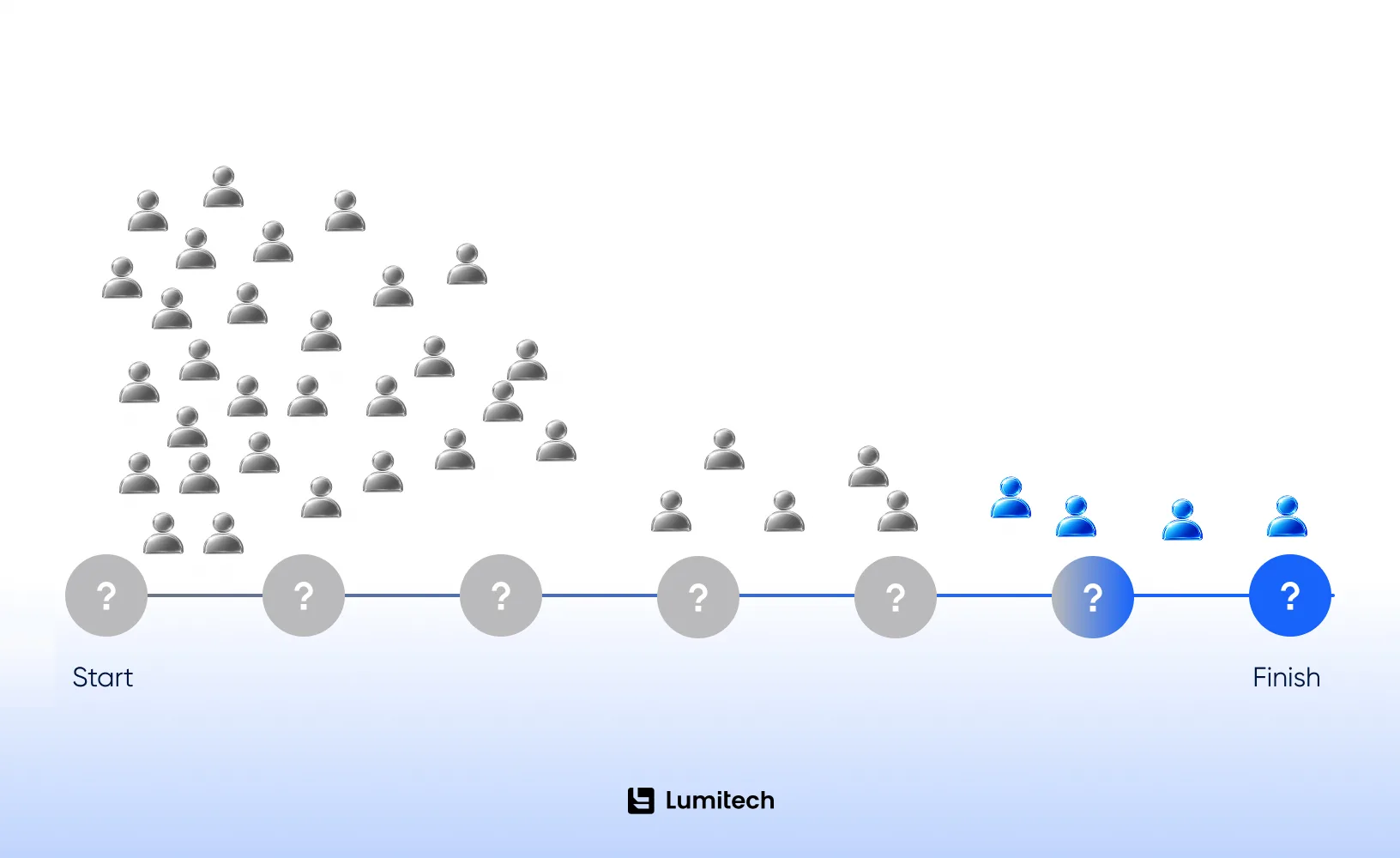
The research behind the instinct holds up. In a randomized web survey, informing participants that the time required was 30 minutes rather than 10 reduced both the number of responses given and the number of responses completed. Later answers from the people who stayed were faster, shorter, and less differentiated. That is respondent fatigue in its plainest form: the person is still answering, but each answer carries less information.
The hiring process reflects the commercial aspect: assessment vendor Criteria reports about 80% completion for assessments up to 40 minutes, with more drop-off beyond that. The vendor’s documentation for validated hiring tests also indicates that even the shorter ones take approximately 15 to 36 minutes. So a realistic assessment completion time for a tested hiring product usually sits above the “10 minutes, max” a client may ask for. How long an assessment people will accept clearly depends on who is answering and what is at stake.
Large testing programs have moved the same way: the Digital SAT and the GRE both got shorter. That is part of the backdrop for any education software development project today, because shorter high-stakes tests now exist and are easy to point to. How adaptive tests work, and what they cost, comes later in the article.
Burden Isn’t Only About Length
Before cutting anything based on test length alone, check whether length is the real problem. A meta-analysis of response burden found that longer questionnaires do get lower response rates. The authors also note that separating content impact from length is impossible, and they advise choosing instruments based on content rather than length. Most of those studies were health questionnaires, so read this as a caution rather than a law.
A second finding points the same way. In two experiments (244 and 461 participants), scales placed at the end of a 300+ item survey kept their convergent and criterion validity. Assessment fatigue is real, but it is not a fixed function of item count. Wording, relevance, and the interface all change how much effort a person feels they are spending.
So the hypothetical stakeholder’s request is reasonable, but length is only one lever. It is also the one whose cost does not show up on the drop-off chart, but in the score instead.
What Is Reliability in Assessment, Actually?
Reliability reflects how much of a score is signal rather than noise. In practice, it shows you how much a person’s score would change if they took a similar test tomorrow. If reliability is high, the score would stay near its current value; if it is low, some of what you read is due to chance.
That noise has a name: measurement error. It refers to anything that causes a score to differ from the trait you intended to measure, for instance, mood, vague wording, or a noisy room. Psychometric reliability describes how much such error exists. Reliability in assessment is not a single number, though, because it comes in types that answer different questions.
Three types matter in practice. Internal consistency asks whether the questions intended to measure the same trait agree. Test-retest reliability asks whether the same person would score similarly on a second occasion, which matters more for stable traits than for moods. Decision consistency relates to cases where a pass/fail decision is being made: would the same person end up on the same side of the cut score on two separate occasions?
One idea to carry forward: assessment reliability belongs to a score as it is used, not to the questionnaire as a whole. The Standards for Educational and Psychological Testing put it this way: “The need for precision increases as the consequences of decisions and interpretations grow in importance.” A scale may be accurate enough for comparing team averages but at the same time too noisy to provide specific guidance to an individual employee.
Why Assessment Length Matters
Each question is one more observation of the trait. Fewer observations mean random error averages out less, so scores get noisier, and they get noisier faster than people expect. That is why test length is better read as a measure of evidence than of effort. The useful question is not “How many questions are there?” but “How much evidence supports each score we intend to report?”
A single weighing may be inaccurate for reasons that are entirely unrelated to you, whereas the average of ten readings is more stable. Questions work the same way. Psychometricians turn this into the standard error of measurement (SEM): roughly, the typical size of the error in one person’s score, expressed in score points. Although reliability and SEM refer to the same concept, SEM is easier to explain to a stakeholder since it is measured in score units.
The table below shows what halving a test does to both. It uses the classic Spearman–Brown formula, which assumes the removed items resemble the ones kept.
Reliability of the full test | Reliability after halving | 95% score band, full test | 95% score band, halved test |
|---|---|---|---|
.90 | .82 | ±9.3 | ±12.5 |
.80 | .67 | ±13.1 | ±17.0 |
.70 | .54 | ±16.1 | ±20.0 |
Illustration on a scale with a standard deviation of 15 (an IQ-type metric). The bands are approximate, and the numbers are not predictions for any specific test.
At .70, a reported score of 100 is consistent with a true score anywhere from roughly 84 to 116. Cut a test at .80 in half, and the band widens from about ±13 to ±17. That is wide enough for a 100 and a 115 to look like the same result. The number of items behind each reported score is what sets that band. A total score may rest on 40 items while one of its subscores rests on four.
More Items, Smaller Gains
The curve runs both ways, which means the solution of simply adding more questions is not effective either. Assessment reliability rises fast at the short end and flattens at the long end. Starting from a 10-item scale at .80, doubling to 20 items gives about .89, 40 items about .94, and 80 items about .97. Each doubling buys less.
Moving from .80 to .90 takes 2.25 times as many items, and moving from .70 to .90 takes about 3.9 times as many. These figures represent the best possible scenario since they are based on the assumption that each new question is of the same quality as the ones already present. So the product question is not whether longer is better. It is where on this curve the decision you support needs you to sit.
There Is No Universal “Right Number of Questions”
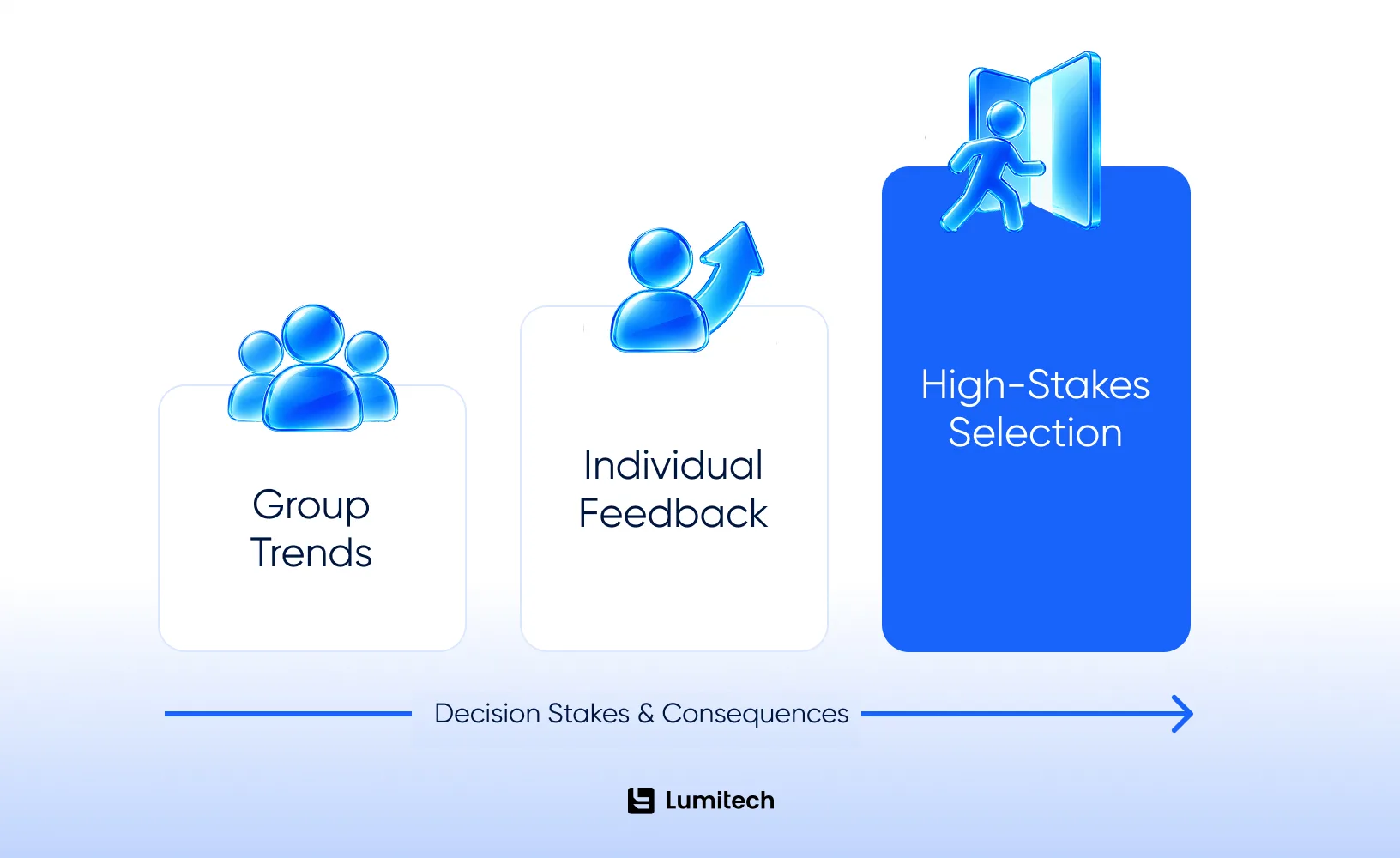
The right length depends on what the score has to support. Group research tolerates noise, because random errors in individual scores partly cancel out across many people. Decisions about one person get no such help, so the same questionnaire can work for one purpose and be too noisy for another. “How many questions?” has no universal answer, because no universal minimum number of items makes an assessment reliable.
An item is a single question or task. How many you need depends on:
The complexity of the construct, meaning the trait or skill being measured. A narrow one needs fewer questions than a broad one.
Item quality, especially item discrimination. Items that separate stronger from weaker respondents carry more information than items that do not.
The number of constructs. Each reported score needs its own evidence, so a 30-item form covering six constructs leaves about five questions per score.
The population. A form that works in one language or culture can behave differently in another, so a shortened adaptation needs its own evidence.
The intended use of the result and the precision it requires. Group insight, individual feedback, and pass/fail decisions each set a different bar.
Where .70 Really Comes From
The best-known threshold in the field is .70, often cited as the point at which a scale is considered reliable. Nunnally meant it for early-stage research. For important decisions about individuals, he called .90 “the minimum that should be tolerated” and .95 “the desirable standard,” as Lance, Butts, and Michels quote.
European test reviewers apply a similar logic. The EFPA Test Review Model (2025) gives example thresholds for internal consistency reliability: below .70 is inadequate, .90 or above is excellent, and every bar rises by .10 for high-stakes uses such as personnel selection. The model states that these figures are to be treated as guidance only.
Even a high figure needs care. Cronbach’s alpha, the statistic most often used to report internal consistency reliability, rises simply as items are added. At an average inter-item correlation of .30, it climbs from .72 with 6 items to .84 with 12 and .88 with 18. With more than 20 items, it can pass .70 even when items barely correlate (Cortina, 1993). A high alpha can mean “long” as easily as “good.” Psychometric test reliability is therefore a requirement set by the decision, not a pass mark to clear.
Items per Construct Matter More Than Total Questions
Reliability is determined on a per-score basis. A 30-question assessment that reports six traits gives each trait only five questions, so the number that matters is items per construct, not the total. The first question to put to a stakeholder should not be “How many questions can we cut?”, but rather “What exactly are we trying to shorten?”
Take a fictional team-skills assessment: 30 questions and six scores (collaboration, ownership, planning, adaptability, communication, and learning agility). A product lead sees one form. A psychometrician sees six five-question scales, each needing its own scale reliability evidence. When the form is reduced to 18 questions, each score is based on three questions.
The Standards for Educational and Psychological Testing (Standard 2.3) call for reliability evidence for every score and subscore you report. Research on subscores suggests that those built on fewer than about 10 items “almost never have added value,” and that about 20 items is a practical floor. A common heuristic in scale development is 4 to 6 items per construct (Hinkin, 1998). Statistically, two items can’t properly define a construct, and three only just do.
When a form has to get shorter, a narrower assessment that measures fewer things properly is often the stronger choice. Reliability lives at the level of each reported score, so each trait we keep needs enough questions to support what its report says. Going from six traits to three means that an 18-question form can provide six questions for every trait.


Near-Duplicate Questions
There is a trap when trying to increase the number of questions for each trait. Questions that simply repeat each other make answers agree, which pushes alpha up while narrowing what the score covers. Five rewordings of “I enjoy working in teams” would give the collaboration score a lovely alpha and ignore sharing credit, handling conflict, and asking for help. This is Loevinger’s attenuation paradox: near-duplicate items inflate alpha while shrinking construct coverage.
It is also where reliability and validity part ways. Reliability investigates whether a score remains consistent, while psychometric validity examines whether it actually measures what you say it measures, entirely. A high alpha on near-duplicates proves the first and says nothing about the second.
When Short Becomes Too Short
An assessment is considered too short when it can no longer consistently place an individual on one side of a decision, even if its alpha value is still acceptable. At the group level, more cutting can be tolerated than at the individual level. So the test is not whether the form still clears a reliability threshold, but whether the same person would get the same answer twice.
The research points the same way. In a simulation study of personnel selection, shortening tests substantially reduced decision accuracy, especially when selection was competitive. On the personality side, one- or two-item Big Five measures can increase both false positives and false negatives, while slightly longer measures improve validity at little cost. The problem is rarely item reduction itself. It is a short-form assessment built for group trends and then used to judge individuals. Warning signs that assessment reliability has been traded away for length:
Individual reports with confident labels. In the fictional team-skills assessment, concluding that a person is 'low on adaptability' based on just three questions goes beyond what the data can justify.
Cut scores. When a score near the line can flip with a small error, people get the wrong outcome for reasons unrelated to ability.
Rankings. Candidates separated by less than the error band are ordered by noise.
Subscores on two or three items. This is well below the roughly 10 items where subscores begin to add value.
Know what you can cut before you cut it.
We can build the analytics that show where respondents drop off, which questions add the least information, and how much error each cut adds.

Why a 2-Minute Quiz Is a Different Product
A very short test can be a good product, but it does a different job. It screens, sorts, or engages; it does not diagnose or select. First, decide what you’ll use the score for, because that, not a target completion time, determines how long the assessment needs to be.
Each job asks for something different. Screening flags who needs a closer look. Sorting routes people into broad groups. Engagement gives a visitor something to reflect on. Diagnosis and selection need a score you can defend for one person. The PHQ-2, a two-question depression screen, is built for the first kind of work: a positive result leads to the longer PHQ-9 or an interview, not to a conclusion.
The ten-item TIPI, a short Big Five measure, reports alphas between .40 and .73, and its authors “do not encourage the use of very brief measures.” That candor is useful, because it tells you what the instrument is for: a rough read, not a verdict on one person.
Apply that to the fictional team-skills assessment. A two-minute version could be a good demo or landing-page quiz that starts a conversation. It could not be the report an employee receives in a development review. None of this means a very short instrument is poor. The reliability of a test has to be judged against its job.
The AI cognitive training platform Lumitech built follows the same pattern. A short onboarding assessment across memory, attention, and processing speed sets a baseline, and adaptive daily plans refine it. That is the kind of role-first thinking behind our psychometric assessment platform development.
How to Shorten an Assessment More Safely
Shorten using data, not instinct, and treat the short version as a new test that needs its own evidence. A form with fewer questions is not the original with a few lines removed. It has its own error, coverage, and meaning. The process below moves from the decision the score supports to the evidence that the shorter form still supports it.
- 01
Decide which interpretation the score must support, and set a precision target for it before touching a question.
- 02
Use item-level data: how well each question separates stronger from weaker respondents, how much information it gives near the cut score, and how long it takes to answer.
- 03
Protect coverage within each trait. In the team-skills example, a three-question collaboration score should still touch sharing credit, handling conflict, and asking for help.
- 04
Do not pick questions just to maximize alpha. Stepwise selection on that logic produced short forms that were “highly reliable but [with] poor validity” (Schroeders et al., 2016).
- 05
Consider optimization-based item selection, such as ant colony optimization, which searches many candidate short forms for one that balances several criteria at once. In the same study, these methods produced short forms that were both reliable and valid, and open-source tools such as the ShortForm R package implement them.
- 06
Validate the short form on an independent sample, as a new test. The classic “sins” of short-form development are assuming the full form’s validity carries over, not showing overlap with it, and not reproducing its factor structure (Smith, McCarthy, and Anderson, 2000).
- 07
Report the error band and classification consistency, not just alpha, so the reliability of assessment scores is visible where decisions are made. The Standards call for both.
If the assessment exists in more than one language, each version of a short form needs its own evidence. Our guide to Arabic assessment adaptation covers why.
Can Adaptive Testing Make an Assessment Shorter Without Losing Precision?
Sometimes, if the item bank and measurement model allow it. Shortening by deleting questions is not the same as shortening through intelligent item selection. Adaptive testing, which picks each next question based on a person’s earlier answers, changes the question from “how many items?” to “how precise must each score be?” The test stops when it reaches that target.
That is why it often reduces test length by 50% or more. The catch is a large calibrated bank: a pool of questions whose difficulty and information have been measured on real respondents. A licensed pool may be too small to support it, so check its size and calibration first (see our assessment item pool licensing article).
Named programs show the range:
PROMIS: In Dutch-Flemish versions, adaptive tests stop when a score’s standard error reaches about 0.3, roughly reliability .90, after 4 to 12 items (Luijten et al., 2025). In a physical-function simulation, a 10-item adaptive test matched the precision range of a 20-item fixed form (Fries et al., 2009).
Digital SAT: 2 hours 14 minutes instead of about 3 hours. College Board states that it retains the precision and reliability of longer linear tests.
GRE: about 1 hour 58 minutes instead of nearly 4. ETS states that it retains “an appropriate level of reliability for high-stakes decisions.”
NCLEX: 85 to 150 items, stopping once the test is 95% confident whether a candidate is above or below the passing standard. The decision sets the length.
What adaptive solves | What it costs |
|---|---|
Shorter tests at equal precision | A calibrated bank, often 1,000+ items |
Precision targeted to each person | Exposure and security control; adaptive tests “can be quite vulnerable to covert item theft” |
Less respondent fatigue | Unidimensionality assumptions: one trait per adaptive scale |
Length driven by a precision target | Build complexity: scoring, content balancing, stopping rules |
Build complexity is the cost teams underestimate. AI-assisted software development can speed up building the item analytics and the adaptive engine, but not the psychometric judgment about what belongs in the bank. Adaptive testing does not dodge the trade-off. It spends questions where precision is needed.
Shorter tests, same precision? Let’s map what it takes.
We build the item-bank tooling, adaptive selection logic, and monitoring for adaptive delivery needs. Bring your use case, and we’ll map what to build.

Assessment Length Is Also a Product Architecture Decision
Form length is a configuration of the platform, not a fixed list of questions. If the platform stores constructs, item pools, forms, scoring rules, reliability data, and versions as separate things, length can change with evidence. If it hard-codes Question 1 to Question 40, every length decision becomes a rebuild.
The model has six parts, each stored separately: the construct being measured, the item pool tagged to it, the forms drawn from that pool, the scoring specification, the reliability data collected on each form, and the version history that ties them together. With that in place, psychometric reliability can be checked per construct, form, and version. In the team-skills example, the 30-question, six-trait form and an 18-question, three-trait form are two configurations of one pool, not two codebases.
A platform built this way typically needs:
Configurable form lengths and short-form configurations.
Item pools, with items tagged by construct.
Scoring specifications and form and version management.
Item performance statistics, post-launch item analysis, and retirement or replacement of weak items.
Adaptive selection logic, when the use case calls for it.
This is how we approach assessment platforms. We plan the measurement design, item bank, scoring engine, and software together, and we write the form length into the specification before production work starts.
How to Make the Trade-off a Product Decision
Length becomes a product decision when the team decides what the score must meet, sets a precision target for that use, and then examines trade-offs based on data rather than personal opinion. That turns “can we cut it to ten minutes?” into a question with an answer: what does the product promise, to whom, and how much error can that promise tolerate?
Use tier | Precision target | Length strategy | Metric to show stakeholders |
|---|---|---|---|
Screening | Moderate; positives get a follow-up | Quiz or very short form | Completion rate |
Group insight | Adequate for group averages | Short form | Completion rate, plus reliability of the group score |
Individual feedback | High enough for one person’s report | Full form, or short form with enough items per trait | Error band per trait |
High-stakes decision | Highest, set by the consequences | Full form or adaptive | Classification consistency near the cut score |
Illustrative. Set real thresholds with a psychometrician.
To make that table usable, the platform should surface:
Drop-off by item, to see where people leave.
Time per item, to find questions that cost the most effort.
Error band by score range, to see where scores are least precise.
Consistency near the cut score, to see where decisions can flip.
A/B testing of length variants, to compare versions on evidence.
Use the team-skills assessment this way: where the product provides team-level insights, the 18-question form will be sufficient; but if it is being used to feed individual development reviews, then the 30-question form or an adaptive one is justified by its longer length.
Go back to the meeting from the start. Sales still wants the demo shorter, UX still has the drop-off chart, and the client still wants “10 minutes, max.” The difference is that the room now has the question nobody asked before: what will the score still be able to say? Treat assessment reliability as a product requirement with an owner, tied to a decision, not as a number to defend after launch. Form length should be specified before engineering locks it into the product.


