
Assessment Item Pool Licensing: Can You Actually Use That Item Pool?
Can an existing item pool go into a commercial platform? Yes, but only if rights cover every planned use and the items still measure what they should. Here’s how to check.
- Software Development
- AI Integrations
October 12, 2026
 AI Overview
Assessment item pool licensing determines whether you can use, modify, and deliver existing test questions digitally in a commercial product. Checks cover ownership, license scope, validity evidence, and AI use. Digital delivery is often licensed separately, so paper-only scope blocks app use, and the EQ-5D health questionnaire costs about 50% more for a digital commercial license than for paper.

An existing assessment item pool of test questions looks like the fastest route to a working assessment product. But can you put it into a commercial platform? Yes, but only if your rights cover every use you plan, from modifying the items to selling and integrating them, and the items still measure what they were designed to measure.
The Mini-Mental State Examination (MMSE) shows the risk. This widely used “free” clinical test became a paid test in 2001, when its copyright holders gave PAR exclusive rights, and PAR began charging per use.
That’s why you can’t settle assessment item pool licensing by reading the contract alone. A clear license does not mean that the modified items are valid; an AI rewrite may violate the terms of the license, and if a platform is unable to enforce the scope of the license, then you are left vulnerable. For teams in education software development, HR tech, and health tech, you must check provenance, psychometric validity, AI-generated content, and architecture together.
Publicly Available Assessment Items Are Not Necessarily Free to Use
“Public,” “released,” “free,” and “open” each describe access, not permission, and none of them means public domain. An item you can read online may still be copyrighted, license-restricted, or barred from commercial products. Before an item from any item pool in assessment enters your platform, sort it into one of seven categories, because each one changes what you may do with it.
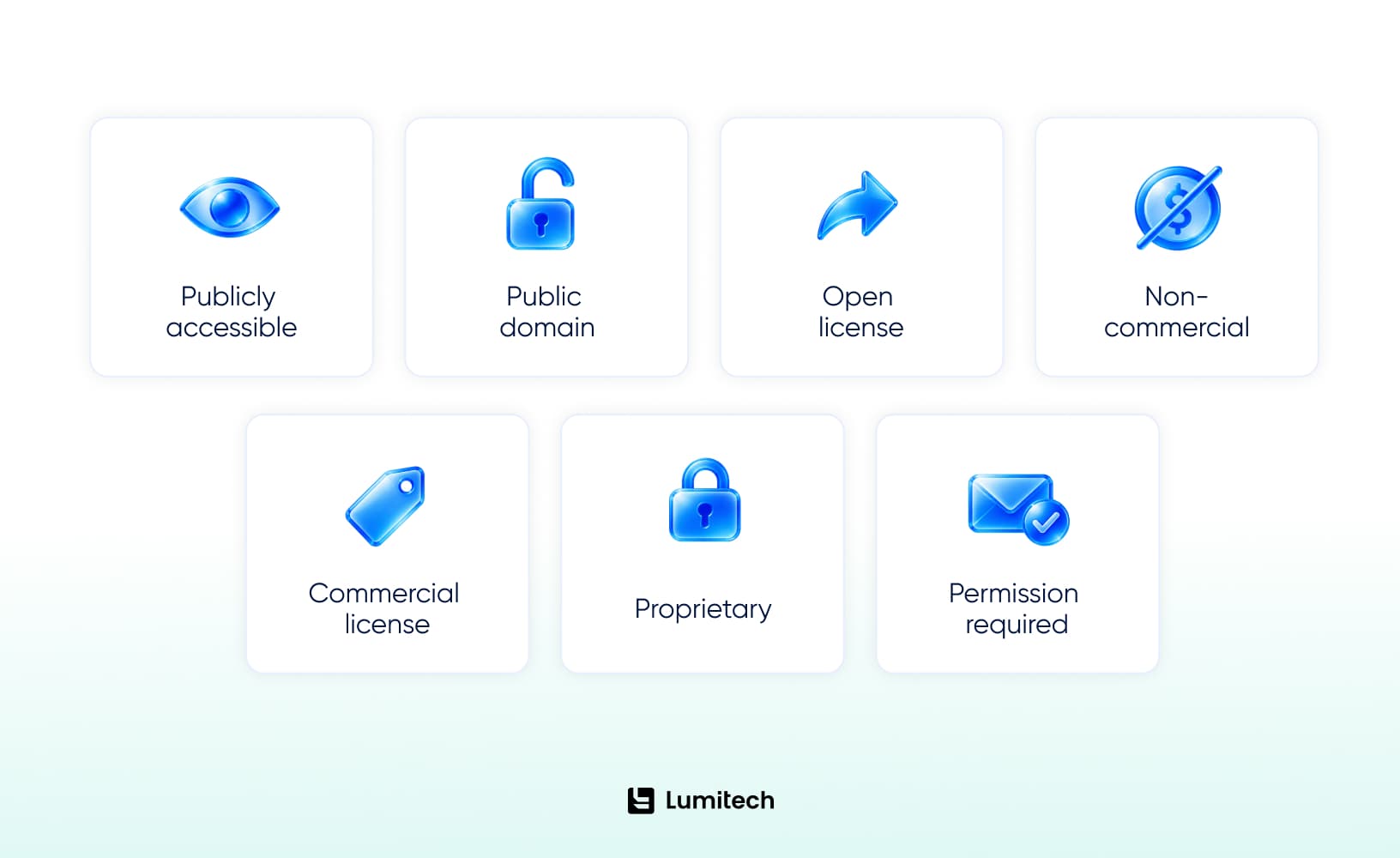
Publicly accessible: viewable online, no rights granted. Released state test items are a classic trap.
Public domain: no copyright restrictions. True public domain assessment items are rare; IPIP personality items are a cited example.
Creative Commons/open license: reuse on stated conditions, for example by giving appropriate attribution or by not making any modifications.
Non-commercial license: acceptable for use in a study and not for use in a paid product.
Commercial license: paid, scoped permission, sometimes priced per administration, as with Pearson.
Proprietary content: the owner has control over copying, adaptation, and the use of AI.
Explicit permission required: even PROMIS measures, free on paper, need written approval for commercial use and integration into proprietary software.
Verify assessment content rights in the license text itself, not in a summary like this one. Terms change by licensor and jurisdiction, and this is not legal advice.
Decision Framework: Can We Use This Assessment Item Pool?
Think of the decision as consisting of five separate gates. An item pool can only be used when ownership is clear, the license covers your planned use, any change keeps scores valid, AI involvement is allowed, and your platform can enforce the terms. Skip one, and you may discover after launch that you never had permission to use assessment items the way you built the product.
Gate | Question | What to check |
|---|---|---|
1. Ownership | Who holds the rights, and is the chain of ownership clean? | Rights in each item; possible separate rights in the bank. |
2. License scope | Does the license cover what you plan to do? | Use, modification, commercial use of assessment items, digital delivery, translation, stakes, geography, term. |
3. Validity | Does your planned change trigger re-validation? | Permission to adapt is not proof that scores still hold. |
4. AI exposure | Will AI generate, rewrite, or score these items? | Who owns AI output; whether the license allows AI. |
5. Enforceability | Can the platform enforce the terms? | Mode, language, country, stakes, and expiry as system rules. |
Outcomes
Go: all five gates are clear.
Go with conditions: gaps are fixable, such as limiting delivery to licensed countries.
Renegotiate: your assessment item usage rights fall short of your product.
Replace: ownership is unclear, or the terms rule out your use.
IP counsel and a psychometrician sign off on gates 1 to 4; then the psychometric assessment platform development team writes those decisions into one specification the platform enforces.
Got an item pool and a launch date?
Tell us which license terms your platform has to enforce. We build the delivery rules, access controls, and provenance tracking around them.
Can You Rewrite a Licensed Assessment Item and Make It Your Own?
Here’s a quick answer to this question: generally, you can’t. A rewrite of a licensed item is usually a derivative work, and most licenses forbid that without written permission. Even Creative Commons “no derivatives” licenses treat translation as an adaptation. So derivative assessment items can carry the original’s restrictions, however many words you change. “Made it my own” rarely survives a read of the license.
Permission Isn’t Proof
The fact that an assessment has been approved does not mean that it is valid, only that it is legal. Adapted assessment items still need evidence that they measure the same thing. The ITC adaptation guidelines require permission from the rights holder first, then statistical equivalence evidence. Your item reuse rights cover only the first step.
The ISPOR framework, from patient-reported outcomes research, scales the evidence to the change: in the case of minor edits, only cognitive debriefing and usability testing are needed; for moderate ones, equivalence testing is required; and for substantial ones, a full psychometric evaluation is necessary.
Digital migration is in fact the same issue. Unchanged assessment items can behave differently on screen. For self-report scales, a meta-analysis of 72 studies found paper and electronic scores mostly agree. Ability tests show documented mode effects, though not always. Rewrite or migrate, the test is identical: did the change alter what the item measures?
Can AI-Generated Assessment Items Solve the Licensing Problem?
You should not expect this. Although AI can speed up item generation, it replaces one licensing risk with two others — those relating to ownership and breach — and just because something has been generated doesn’t mean that it is validated, protected, or compliant. A fast draft is still just a draft until subject matter experts review it, a pilot tests it, and you record its provenance.
US law requires human authorship, so purely AI-generated items may not be protectable. Your intellectual property rights likely hinge on documented human contribution; without it, competitors could freely copy your assessment IP. Breach is the second risk: feeding licensed items to an LLM can violate the license, and Pearson’s terms bar using its test content with AI. And even without a license clause, fair use is not a safe fallback. The 29 Sep 2026 ROSS ruling, a non-generative case, rejected fair use for training a competing AI on others’ content.
Regarding validity, a randomized study from 2026 discovered that AI-generated items discriminated less effectively; in another, they were found to be comparable following expert review. Typical flaws are weak or ambiguous distractors and multiple defensible answers. Experts should review every item before it enters your item bank, and piloting with the intended population is still required.
Regulation matters only if AI makes assessment decisions: AI that evaluates candidates or learning outcomes is high-risk under the EU AI Act, with obligations from 2 Dec 2027. For platform context, see Lumitech's AI readiness assessment page.
Item Provenance Register Comes Before Importing Content
You need to build an item provenance register before any item is imported: a per-item record of where it came from, what you may do with it, and what happened since. Standards won’t do this for you; QTI 3.0 calls its own rights fields “highly problematic.” A licensed item bank is only as safe as its metadata.
Field | What it records |
|---|---|
Source and licensor | Supplier and rights holder |
License ID | SPDX-style, e.g. CC-BY-NC-ND-4.0 |
Permitted uses | Use, modify, commercialize, translate |
Mode, language, country scope | Where it may be delivered |
Stakes allowed | Formative or high-stakes |
Expiry and usage caps | Term dates, administration limits |
Lineage | Derived from, translated, AI-rewritten |
AI involvement flag | Whether AI touched it, and which model |
Human reviewer | Who approved it, and when |
Psychometric status and parameters | Pilot and calibration results |
Attribution text | Credit the license requires |
Lineage can follow W3C PROV-O; C2PA extends content provenance to text, in principle. In 2025, the California State Bar disclosed that a vendor used AI to help develop some exam questions. Record that upfront.
Why Licensing Requirements Affect Assessment Platform Architecture
Assessment item licensing terms become platform rules. A clause like “per administration,” “this country only,” or “no high-stakes use” is an access-control requirement the moment items are delivered on screen. If the system is unable to enforce a particular term, it has to depend on human memory, and since memory does not constitute an audit trail, it is the architecture that determines this.
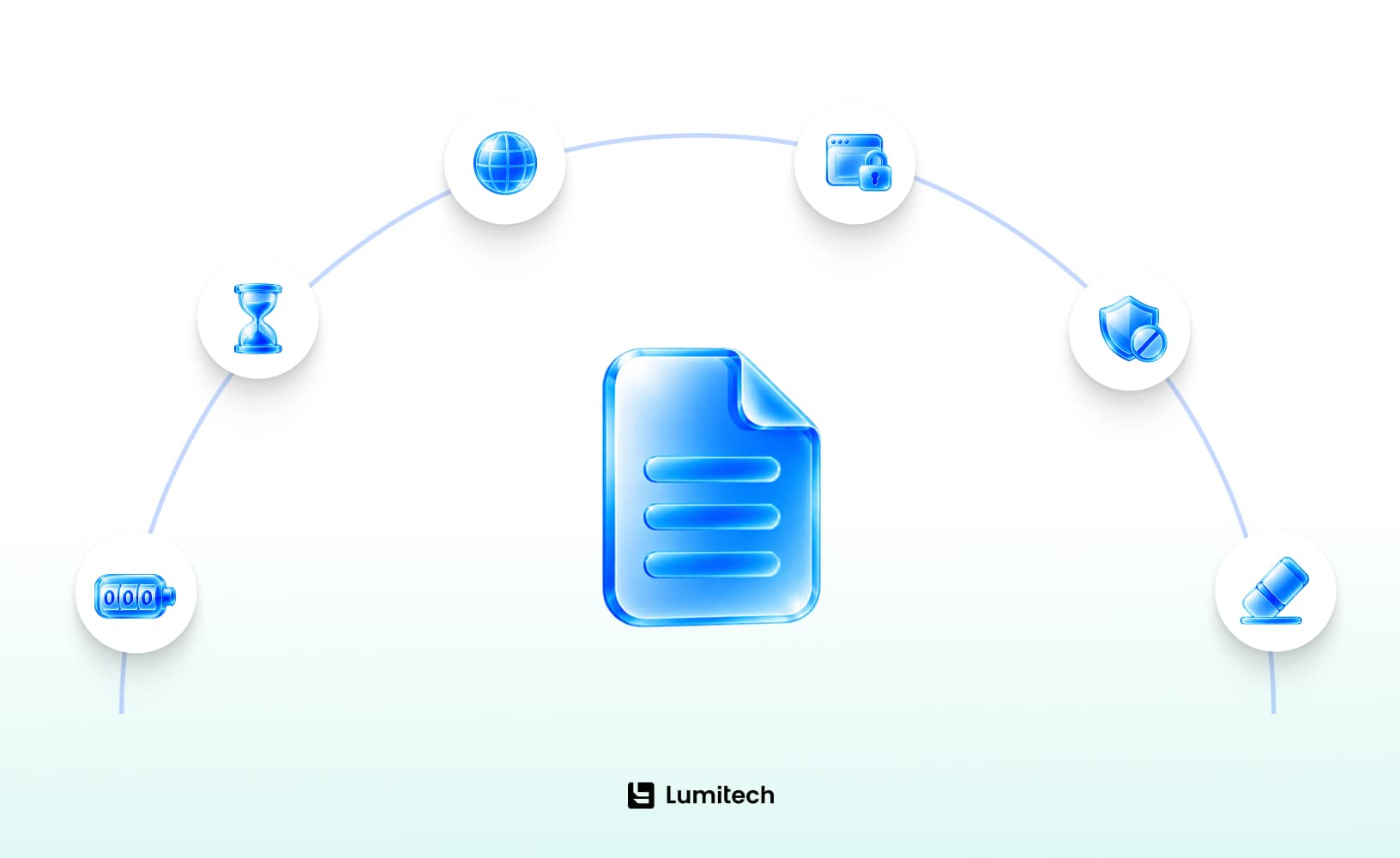
Pearson sells usage per administration and subscriptions with fixed terms, so the platform needs administration counting and expiry dates.
EQ-5D licenses by language, country, and mode, and requires approved screen layouts; deviations are “at the risk of the Licensee/Vendor.” That means entitlement checks and locked templates.
Instructure’s Mastery Item Bank excludes high-stakes use and requires deleting copies at termination, so you need a stakes flag and a deletion workflow.
As noted above, QTI’s rights fields can’t carry this, so the rights model has to live in your platform. Moodle’s license tags, for instance, don’t restrict who can see assessment items; tagging is not enforcement. Licensors rarely require usage reporting; counting is a design choice. When you scope psychometric assessment platform development, put these rules in the data model from the start.
An item pool isn’t an asset until its rights and provenance are machine-readable. Until then, it’s a folder of content with an expensive open question: are we allowed to do this? Build the answer into the data model from day one, and the system answers it, not someone’s memory.



License, Build, or Use a Hybrid Item Bank?
Licensing buys speed, building buys control, and a hybrid buys some of each at the price of managing two kinds of content. Item bank licensing usually launches fastest but limits changes; building takes longer and costs more. Assessment item ownership follows the same split, so many teams end up hybrid.
Criteria | License | Build | Hybrid |
|---|---|---|---|
Time to launch | Usually fastest | Slowest | In between |
Cost | License fees | Highest; NAEP figures: $1,000–3,500 per item before piloting | Fees plus targeted build |
IP ownership | Typically licensor’s | Yours, with documented authorship | Split by item |
Validity evidence | Inherited; may not survive edits | You generate it | Mixed |
Flexibility | Limited by terms | Highest | Moderate |
Choose based on speed to market, the uniqueness of the assessment, the volume of items, the markets involved, localization, update frequency, long-term IP value, vendor dependency, and portability. Unique, localized, IP-heavy products lean toward building.
Pool size matters: a common rule of thumb is a pool equal to 6–8 full-length forms to support adaptive tests about half as long. A small pool of licensed assessment items may fall short, a reason to go hybrid.
Have a licensed item bank and a platform plan?
Show us both. We’ll talk through how the rights, access, and delivery rules could work in your build.

Where Item Pool Licensing Gets Stuck: Three Illustrative Scenarios
The five gates look different for every assessment item pool and the product built on it. While these scenarios aren’t based on actual client experiences, each one follows a pattern that teams frequently encounter: items that are easy to obtain, which fall outside the scope of the terms, and for which the solution involves both legal and engineering efforts. None replaces reading the actual license.
Scenario 1: HR-Tech Hiring Product
Situation: an HR-tech hiring product built on IPIP items.
Blocker: IPIP’s rights are clear (any use, no fee), but the score validity for hiring isn’t settled: generally speaking, hiring decisions will require separate evidence to prove their validity, and AI scoring introduces the scope of the EU AI Act together with bias checks on the data behind it.
Path: plan selection-use validity evidence with a psychometrician, and have counsel map any AI scoring against the Act.
Scenario 2: EdTech Practice App
Situation: an EdTech practice app built on released state test items.
Blocker: released is not free. Assessment item copyright still applies, and Texas, for one, requires a license outside the state, possibly with royalties.
Path: treat test item licensing as a launch dependency. Request a license or commission original items.
Scenario 3: Health-Tech App
Situation: a health-tech app delivering PROMIS or EQ-5D.
Blocker: free paper forms don’t cover electronic delivery. PROMIS requires a fee-based review; EQ-5D prices digital above paper, and screens must match approved layouts.
Path: budget a commercial license and review; build templates from approved screens. With third-party assessment content, the screen is part of the license.
Item Pool Licensing Checklist: What to Lock Down Before You Build
The decision framework will indicate whether or not to use a pool. This checklist covers what to finish before import and build. Treat assessment item pool licensing as a pre-build workstream with owners and sign-offs, not a clause someone reads after the first sprint. Each item should have a named owner and a done date.
Get written scope covering use, modification, commercialization, and digital integration, so your assessment item usage rights are on paper, not assumed.
Confirm the chain of ownership for each item and, in appropriate cases, for the bank as well.
Create a provenance register entry for every item before import.
Check translation rights for every language you will deliver, such as Arabic alongside English, plus country, stakes, and term limits, against your launch plan.
Adjust the plan’s re-validation on a scale corresponding to each planned change.
Get written sign-off on any AI use: generating, rewriting, or scoring items.
Map license terms to platform rules: usage counts, expiry, entitlements, and required layouts.
Define what happens to a licensed item bank at contract end: deletion duties, exports, and what you may keep.
Test enforcement before launch: try to deliver an item outside its licensed scope and confirm the system blocks it.
Finally, bring in IP counsel and a psychometrician. They sign off; your build team makes sure the system never lets anyone forget it.
Wrapping Up
Assessment item pool licensing is a product decision, not a legal footnote. Rights decide what you may do, validity decides whether scores still mean anything, AI changes who owns the content and who may touch it, and architecture decides whether any of it survives production. Teams that treat these as one question and keep content provenance from day one find the gaps before launch instead of after it.
Counsel and psychometricians settle the terms. What remains is a system that enforces them. To see how we build that, explore our assessment platform development services.


