
Arabic Assessments: Why Translation Is Not Enough
An English assessment translated into Arabic is not automatically an Arabic assessment. To work, it has to keep five things intact: linguistic meaning, cultural relevance, construct validity, scoring equivalence, and technical usability.
- Software Development
October 13, 2026
 AI Overview
An Arabic assessment is an assessment adapted, not merely translated, through four steps: translation, cultural adaptation, psychometric validation, and platform configuration. Skipping validation lets a translated version pass expert review while measuring a different construct, and skipping configuration can break scoring, timing, and digits by market. TIMSS 2023 used seven national Arabic versions, so each market needs separate testing.

An English assessment translated into Arabic is not automatically an Arabic assessment. To work, it has to keep five things intact: linguistic meaning, cultural relevance, construct validity, scoring equivalence, and technical usability. The first four are judged by linguists and psychometricians. The last, technical usability, is where the platform decides whether the other four survive.
A 2025 Tunisian validation of an Arabic health-lifestyle questionnaire, which was based on a sample of 300 patients with diabetes, achieved a content validity score of 0.994. Although it had passed the expert review, factor analysis revealed nine factors rather than the original five. The translation cleared review and still measured something different.
For teams building Arabic assessments for the UAE, KSA, and the wider MENA region, that gap lands in the product. This article moves from discussing the language to addressing validity, then to the regional requirements, and finally to the platform decisions which are expensive to alter.
Modern Standard Arabic or Local Dialect: Which Should an Assessment Use?
Written items should usually be in Modern Standard Arabic (MSA), because it is shared across countries and has a standard written form. But MSA is no one’s home language, so its wording must be checked with speakers from each target market. There is no universally correct Arabic version: the right variety depends on who is assessed, where the test is used, and what construct it measures.
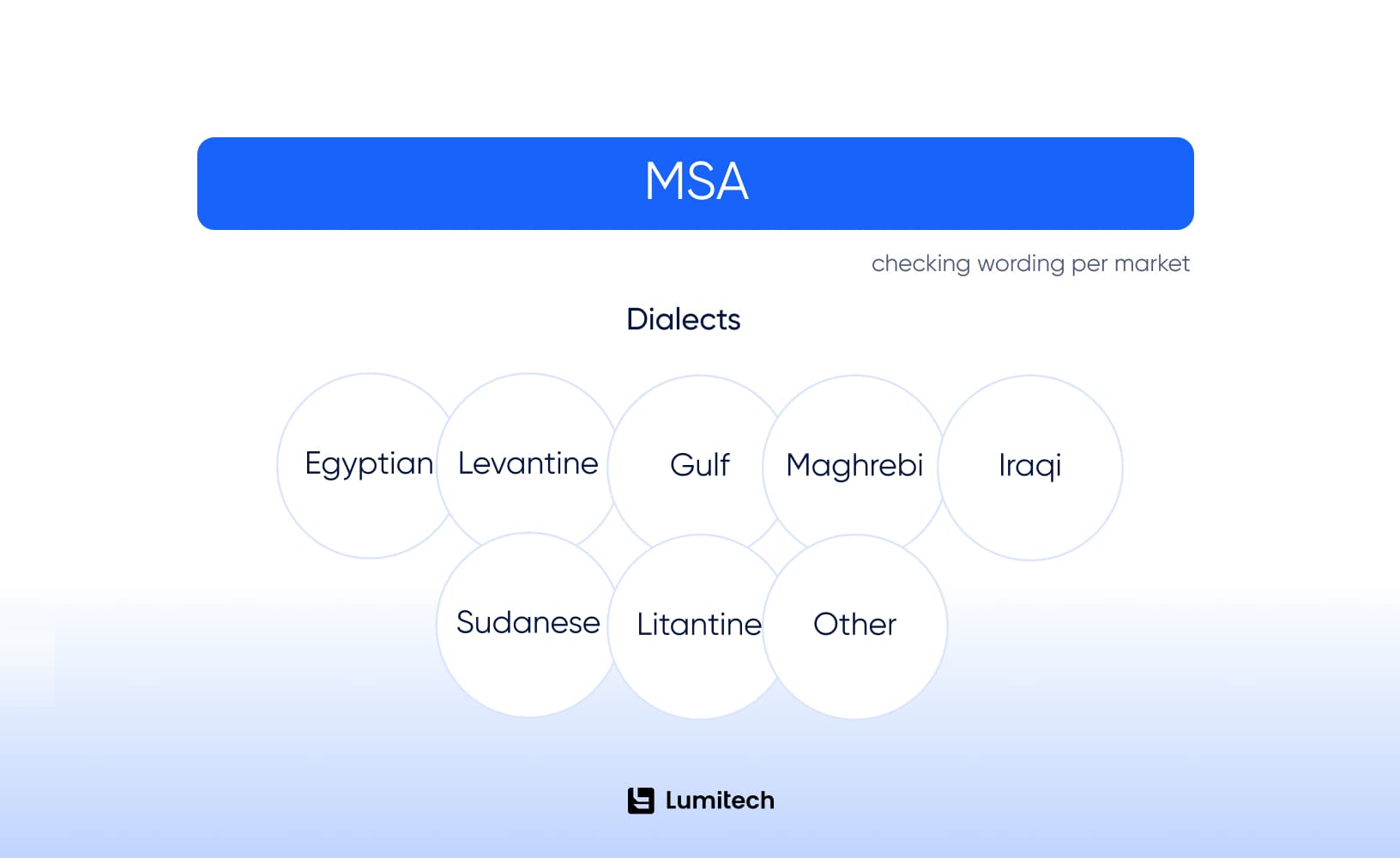
The Tunisian study chose MSA “to ensure neutrality across regional dialects.” Yet in an Algerian test, five respondents did not understand the MSA word مرن (“flexible”). Distance is not the whole story either: among 112 Palestinian third-graders, morphological awareness best predicted Standard Arabic reading comprehension.
We found no psychometric-equivalence or invariance study that compares MSA and dialect versions of the same test. What follows is a rule of thumb for linguistic adaptation of assessments, not a research result:
MSA for items and scored content
Dialect only for audio or onboarding, and only with a reason
No vocabulary that belongs to one dialect
Translation vs Cultural Adaptation vs Psychometric Validation
In psychometric test adaptation, translation, cultural adaptation, and validation are three separate checks, and passing one does not pass the next. Translation keeps the meaning. Cultural adaptation of assessments keeps the relevance. Psychometric validation, the statistical testing of whether scores mean the same thing for the target population, confirms the result still measures what it should.
Translation | Cultural adaptation | Psychometric validation | |
|---|---|---|---|
What it checks | Meaning is preserved | Items are relevant and understood | Scores mean the same thing |
Who does it | Translators | Local reviewers and respondents | Psychometricians |
Typical method | Forward and back translation | Cognitive interviews | Pilot data, factor analysis, item-bias checks |
What it can’t catch | Concepts that don’t carry over | Whether the structure holds statistically | Why an item fails |
Adaptation work is not a formality. Cognitive interviews on a work personality questionnaire led to 67 revisions across three languages, including Arabic. In Saudi pretesting of the Arabic CIDI 3.0 mental health survey, indirect probes flagged sensitive topics more often than direct ones. Back translation alone is not the answer either: the International Test Commission’s guidelines on psychological test adaptation warn it can yield an “awkward target language version”.
In the Tunisian questionnaire, two items needed explanatory glosses: “aerobic exercise” and “organic foods.” A term can be translated accurately yet still fail to convey the same concept, so an accurate translation does not necessarily mean that it is equivalent in measurement. And none of it starts without permission: the first precondition of the ITC is the rights holder’s consent, which is why assessment item pool licensing applies.
How Do You Validate an Arabic Assessment?
Validation shows statistically that the Arabic version measures the same thing as the original and reports scores on the same scale. Expert content review alone does not count. For an Arabic psychometric assessment, the evidence must come from the population that will actually take the test, not from the source country.
Validating a psychometric assessment in Arabic usually climbs seven rungs:
Expert review of items and instructions.
Cognitive debriefing with 5–8 respondents (the ISPOR range, set for patient-reported measures).
Pilot in the target market.
Factor structure: do items group as they do in the original?
Item bias checks, or differential item functioning (DIF): does an item behave differently across groups at the same trait level?
Equivalence across groups, or measurement invariance: do items work the same way everywhere, so scores can be compared?
Local norms from the target population.
Each rung fails somewhere. In an Omani sample of 180 heart-failure patients, an Arabic scale’s reverse-worded items formed a separate weak factor, and invariance held only after three items were dropped. Saudi Arabia’s General Aptitude Test held equivalence between public- and private-school students on every subtest except Word Meaning. One test, but vocabulary items deserve early scrutiny.
A typical Arabic test adaptation workflow follows these steps:
Source assessment
Forward translation
Reconciliation
Back translation
Cultural review
Arabic SME review
Cognitive interviews/pilot
Field testing
Psychometric analysis
Approved Arabic version
The platform should manage this lifecycle, with versions, sign-offs, and evidence per item, instead of exporting a PDF of translated text.
Same Text, More Seconds
In a study of Israel’s entrance-test texts, native Arabic readers needed 85 seconds per 200 words on complex passages; native Hebrew readers needed 69. Comprehension was comparable. This compares Arabic and Hebrew in Israel, and it shows that assuming a timer taken from the English version is wrong. Timed versions in Arabic may therefore have to be recalibrated.
Building Arabic Assessments for UAE, Saudi Arabia, and the Wider MENA Region
“Arabic” is not one market. Although it is possible to achieve equivalence between different Arab countries, this must be verified, and rules and defaults must vary from country to country. One Arabic assessment test may serve several markets only where the evidence supports it, meaning that language rules, data protection regulations, digit formats, and weekends all require separate settings for each market.
Even TIMSS 2023, the international math and science study, ran seven national Arabic versions, each independently verified. Cross-country equivalence is possible because the Arabic form of the WHO-5 well-being index was used in six countries (Fekih-Romdhane et al., 2025) and a workplace justice scale in nine (Gadelrab et al., 2018), although item-level gaps remain in KSA, Oman, and Algeria. However, samples from the UAE are mostly absent from this body of literature; therefore, equivalence for the UAE cannot be taken for granted.
UAE | Saudi Arabia | Wider MENA | |
|---|---|---|---|
Language rules | Federal platforms: Arabic and English, Arabic as main landing page | 2026 policy makes Arabic primary in public-entity work | Set by each country |
Data protection | Federal PDPL in force; executive regulations still pending (Oct 2026) | PDPL enforceable since Sep 2024 | Each country has its own regime |
Default digits (CLDR) | Western (3) | Arabic-Indic (٣) | Mixed |
Weekend | Saturday–Sunday | Friday–Saturday | Varies |
National Arabic test | EmSAT dropped for admissions in 2024 | GAT: separate Arabic and English versions | Varies |
For education software development, the lesson is to plan country-level Arabic forms from the start. Bilingual use is the norm: Saudi Arabia’s 2022 census counted 41.6% of residents as non-Saudi, and in the UAE roughly nine in ten residents are expatriates (older figures, around 2010). Hosting, data residency, and governance should be decided market by market, especially for enterprise deployments and government software development.
What Arabic Assessment Adaptation Means for Platform Development
The decisions above must be included in the assessment engine, specifically in the item data model, scoring rules, timing, and market configuration. A language setting in the interface cannot hold them. Consider Arabic as consisting of a number of market configurations, so that each market can alter its settings without anyone having to rewrite the items or the scoring.
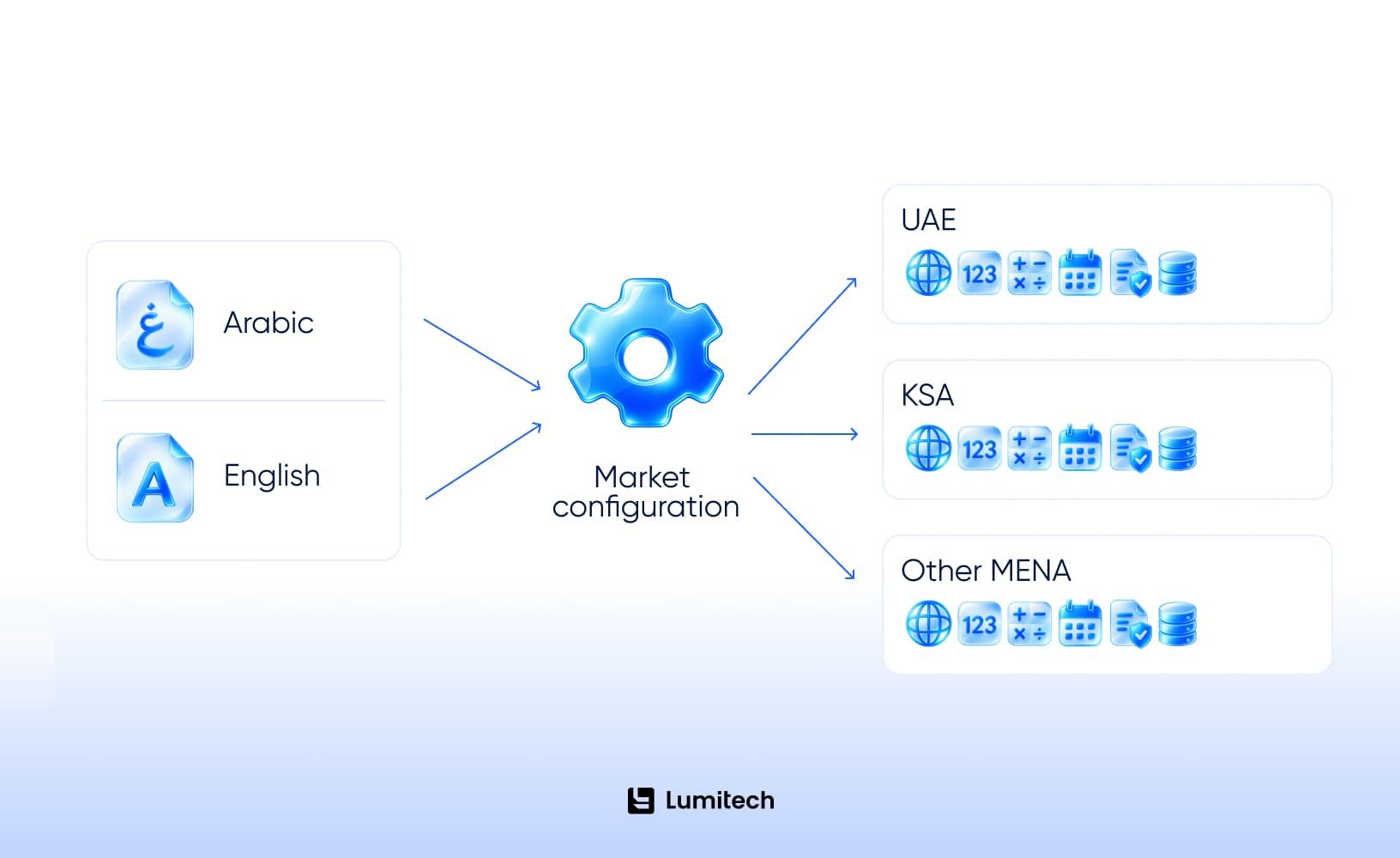
In psychometric assessment platform development, the process begins with the item. Each item has an Arabic version and an English version, and each version maintains its own statistics on difficulty, item-bias results, and response times. Both versions are included in the item bank, which is the stored collection of items, metadata, and statistics from which test forms are put together. A market configuration then selects the variant and applies its settings.
Market setting | What varies |
|---|---|
Language variant | Arabic and English forms, each with its own data |
Digit system | ٣ or 3 |
Math notation | Differs by region |
Schedule | Weekend and calendar |
Norms | Local reference scores |
Data hosting | Residency per market |
RTL, or right-to-left text direction, is more than a mirrored layout. In Arabic items, it also covers mixed-direction content such as numbers and Latin terms, so a stem like “x = 5 cm” can render in the wrong order unless bidirectional text is isolated. Short-answer scoring needs Arabic text normalization, which unifies letter variants such as the alef forms, with a strict mode for spelling items. And QTI 3.0 supports language and direction per item, but only if authoring tools write them and the player honors them.
Arabic is not a language dropdown.
Planning an assessment product for the UAE, KSA, or wider MENA? Talk to our engineers about the item model, scoring, and market configuration before they are fixed.

Designing Item Banks for Arabic and Bilingual Assessments
An item bank built for an Arabic assessment is not a spreadsheet of translated strings. Arabic assessment adaptation creates new records, and each one needs provenance, status, and evidence.
Field | What the bank holds | Why it matters for Arabic |
|---|---|---|
Source item ID and source–adapted link | Every adapted item points to its source | A change in the source flags each adaptation for review |
Variants | Arabic, English, and regional variants | Regional variants only where pilot evidence calls for them |
Translation, SME approval, and psychometric review status | Three separate statuses per variant | An item can be translated without being approved, or approved without being validated |
Difficulty and discrimination data | Statistics per variant and per population | English-version statistics do not transfer |
Version history | Each wording change, with date and author | Statistics belong to one wording, so an edit can void them |
Ownership and licensing | Rights holder, license terms, adaptation permission | Adapting an item needs the rights holder’s consent |
Retired and revised items | Retired items kept, revisions linked to predecessors | Old scores stay interpretable |
Why Arabic Assessment UX Requires More Than RTL Text
Arabic UX should be designed as a native layout direction from the start, not mirrored visually at the end of development. Setting direction: RTL on the whole interface is not enough, because Arabic assessments constantly mix right-to-left text with left-to-right fragments such as product names, numbers, formulas, email addresses, and code.
Each one breaks in its own way:
An English product name in an Arabic sentence: surrounding punctuation can reorder. Isolate the name with <bdi> or dir="auto".
An Arabic sentence with 20%: the percent sign can land on the wrong side. Isolate the number and format it per locale.
An Arabic question with a formula: operators and operands can swap places. Keep the formula a left-to-right isolate.
Arabic text with an email address: the address can come out scrambled. Mark it dir="ltr".
Arabic text with a code snippet: brackets and operators can flip. Render it as a left-to-right block.
In the candidate interface, question layout, radio buttons and checkboxes, progress indicators, pagination, and tables should follow the reading direction, and timers need a digit system per market. Answer scales need a deliberate anchor order. Charts, reports, and PDF exports must clearly indicate the direction of the axes and legends, and since PDFs follow a separate rendering path, they require their own checks. Mixed-language content needs lang markers so screen readers pronounce English terms correctly. Mobile layouts should use logical properties, rather than left and right. The admin interface is harder: reviewers edit Arabic and English side by side, so each field needs its own direction.
Should Candidates Be Allowed to Switch Between Arabic and English?
Only if each item’s two versions have been shown to be equivalent, or if the switch is logged and accounted for in scoring. A language toggle is a scoring decision, not just a UI feature: a psychometric test in Arabic that flips to English mid-test mixes two forms in one score. And offering the toggle does not prove the two versions are psychometrically equivalent.
Bilingualism is a common situation in both the UAE and KSA, but it does not carry weight as a factor. In Gulf TIMSS 2019 data, language of instruction explained differences in math and science performance among Arabic-speaking primary students (Hentati & Smaali Bouhlila, 2023), which means that a candidate is likely to perform better in the language in which they were taught.
The design decides what scoring has to handle:
Separate forms: one language per assessment. The Saudi Arabian GAT has separate forms in Arabic and English, and each of these is scored and normed separately.
Switchable items: candidates are allowed to change language mid-test. This needs item-level equivalence evidence, or logged switches modeled in scoring.
Interface-only: menus and instructions change, items do not, so item scoring is unaffected.
Translation is part of the workflow, and Arabic is a product requirement. Once a team accepts that, the engineering question changes from ‘which language file do we load?’ to ‘which version of this item did this candidate see, in which market, with which timer, and what evidence supports it?'



The reports should indicate the language and flag switches associated with each response. For an Arabic assessment, norms need the same care: separate reference scores per form and market unless equivalence supports pooling.
Lumitech built a WhatsApp commerce platform for GCC retail that handles customers who mix Arabic and English, which is the engineering side of this problem; whether scores match is a psychometric one.
Can AI Translate or Generate Arabic Assessment Items?
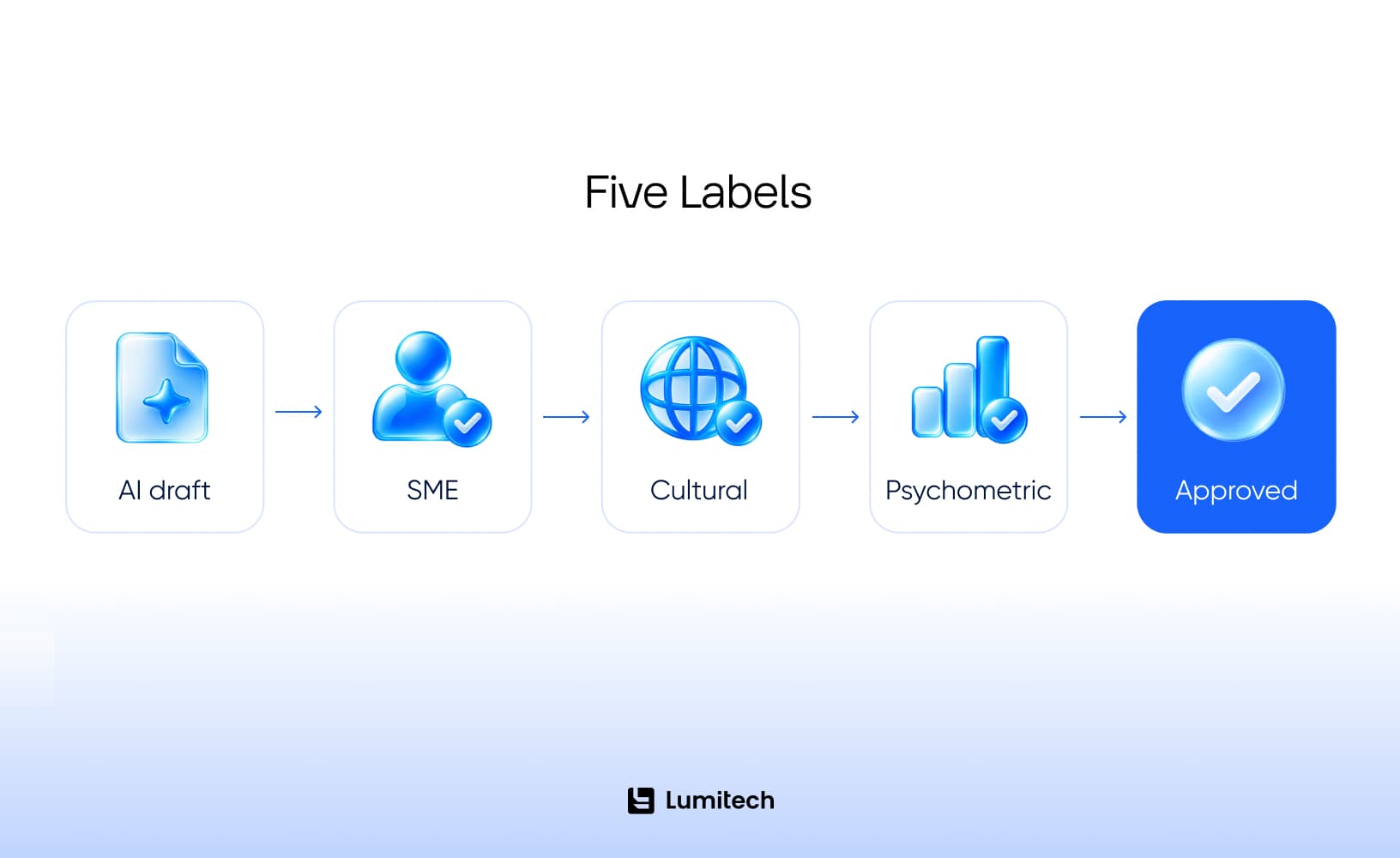
While AI may be able to produce first drafts, it cannot replace adaptation or validation. We found no peer-reviewed study that validated AI translation of Arabic psychometric test items, and the fact that an item sounds natural does not mean that it has been validated. Treat model output as a draft for reviewers, not as evidence of equivalence.
The evidence so far points the same way:
Arabic-centric models such as Jais 2 and Fanar-2 exist, and their model cards warn against high-stakes use. Fanar’s model card says the model is “not suitable for high-stakes decision-making.”
Western cultural bias appears even in Arabic-specific models, across 16 models tested.
Performance varies substantially across dialects, including Emirati and Saudi.
An audit carried out in 2026 by the UAE’s Technology Innovation Institute found incorrect answer keys and translation artifacts from English sources in the Arabic benchmarks.
In essay scoring, a general LLM trailed a fine-tuned BERT model: 0.67 against 0.88 agreement with human raters.
Where AI helps: initial Arabic variants, terminology checks, draft parallel forms, duplicate-item flags, and reviewer workflows. Before any of it enters the item workflow, an AI readiness assessment should settle whose items the model may see, who reviews its output, and where the data lives.
Planning to use AI for Arabic item drafts or scoring?
Talk to our team about review gates and data handling before the first item is generated.

What Development Teams Should Build: Decisions to Lock Into the Engine
Teams building an Arabic assessment must lock in seven decisions in the assessment engine before any item is written, because each one is expensive to change once data, scoring, and reports depend on it. Treat them as configuration that the platform enforces and records, not notes in a project document.
Language variety per market: MSA for items; wording or audio exceptions set per country.
Item variant model: one item, linked variants, separate statistics.
Toggle policy: separate forms, logged switching, or interface-only.
Digit and math conventions: set per market, not hard-coded.
Timing calibration: timers set per form, recalibrated on Arabic pilot data.
Data hosting: residency and governance decided per country.
AI role and review gates: what AI may draft, and who approves before release.
In psychometric test adaptation, Lumitech's part is the engine, not the linguistics. Translators, Arabic SMEs, and psychometricians make the adaptation and validation decisions; the platform has to store them, enforce them, and show the evidence behind each one. That means an item bank with linked variants and review statuses, per-market configuration, bidirectional-safe candidate and admin interfaces, logged language switching, and approval gates for AI output.


