
AI Fraud Detection in Banking: How AI Helps Banks Detect and Prevent Fraud
Fraudsters use AI to fake identities, manipulate victims, and move money in seconds. See how banks fight back with AI fraud detection, from choosing the right models and scoring transactions in real time to tracking performance and deploying systems safely.
- AI Development
- Fraud Detection
November 04, 2026
 AI Overview
AI fraud detection in banking combines supervised machine learning, anomaly detection, behavioral analytics, and graph analysis to give each payment a real-time risk score. Rule-only systems miss coordinated mule networks and block legitimate customers, so fraud passes while false declines rise. In the BIS Project Aurora proof of concept, graph-based machine learning cut false positives by up to 80%.

Fraudsters aren’t just moving faster. They’re getting better at impersonating people and manipulating victims. In 2025, the FBI’s Internet Crime Complaint Center received over one million complaints involving $20.877 billion in reported losses — 26% more than in 2024 (FBI IC3 2025 Internet Crime Report). The report also broke out AI-enabled schemes for the first time, documenting 22,364 complaints and around $893 million in losses. In the UK, payment fraud cost victims £1.28 billion in 2025, with APP scam losses climbing 19% to £576.4 million (UK Finance Annual Fraud Report 2026).
Three changes are making financial fraud harder to detect. Instant payments give banks less time to stop suspicious transfers. Scammers convince real customers to send the money themselves, so their account activity looks legitimate. Deepfake documents also challenge onboarding checks designed for older types of forgery. FinCEN has noted an increase in suspicious activity reports involving this type of activity since 2023.
AI models are only one part of fraud detection in banking. Behind every real-time decision is a system that brings together data pipelines, detection models, decision engines, and analyst review. This guide breaks down the technologies involved, the fraud types banks face, the metrics that measure performance, and the steps to implement an effective system.
What Is AI Fraud Detection in Banking?
AI fraud detection in banking uses machine learning and related analytics to estimate how likely a transaction, login, or application is to be fraudulent, then routes each event to the right action.
Banks can use predefined rules to flag transaction patterns, like making 5 transfers within 10 minutes. Their logic is clear, and implementation is relatively simple, but fraudsters can change the way they behave to avoid triggering alerts.
Transaction risk models combine hundreds of data points, such as device fingerprints, typing rhythm, payee history, and relationships between accounts. Similar approaches help financial institutions assess credit risk and identify potential money laundering.
AI fraud detection raises the odds of catching fraud, with no guarantee of catching all of it. A score is a probability, and people still decide where thresholds sit and when a human steps in.
Why Traditional Fraud Detection in Banking Falls Short
Plenty of legacy bank transaction fraud detection still runs on rule engines configured years ago. The cracks show up in four places.
Static rules. Flag transfers over $10,000, and fraudsters start sending $9,800. Each new scam adds another rule, and the library swells into thousands of overlapping conditions.
False positives. To a rigid rule, a customer buying a laptop abroad looks no different from someone using a stolen card. Unnecessary declines cost revenue and leave customers less confident in their bank.
Disconnected data. Spotting fraudulent activity gets easier when correlating data from various sources: card platforms, wire transfers, and KYC records. A password reset followed by a phone request to add a payee may not raise concerns on its own. Viewed together, however, these events could point to account takeover. Siloed systems make these connections harder to catch with rules alone.
Real-time decisions. Card authorization leaves just milliseconds to evaluate transaction risk. With FedNow, settled payments are final and irrevocable. If fraud is detected afterward, banks must act quickly to coordinate with the receiving bank and freeze the funds before they are transferred out.
How AI Fraud Detection Works
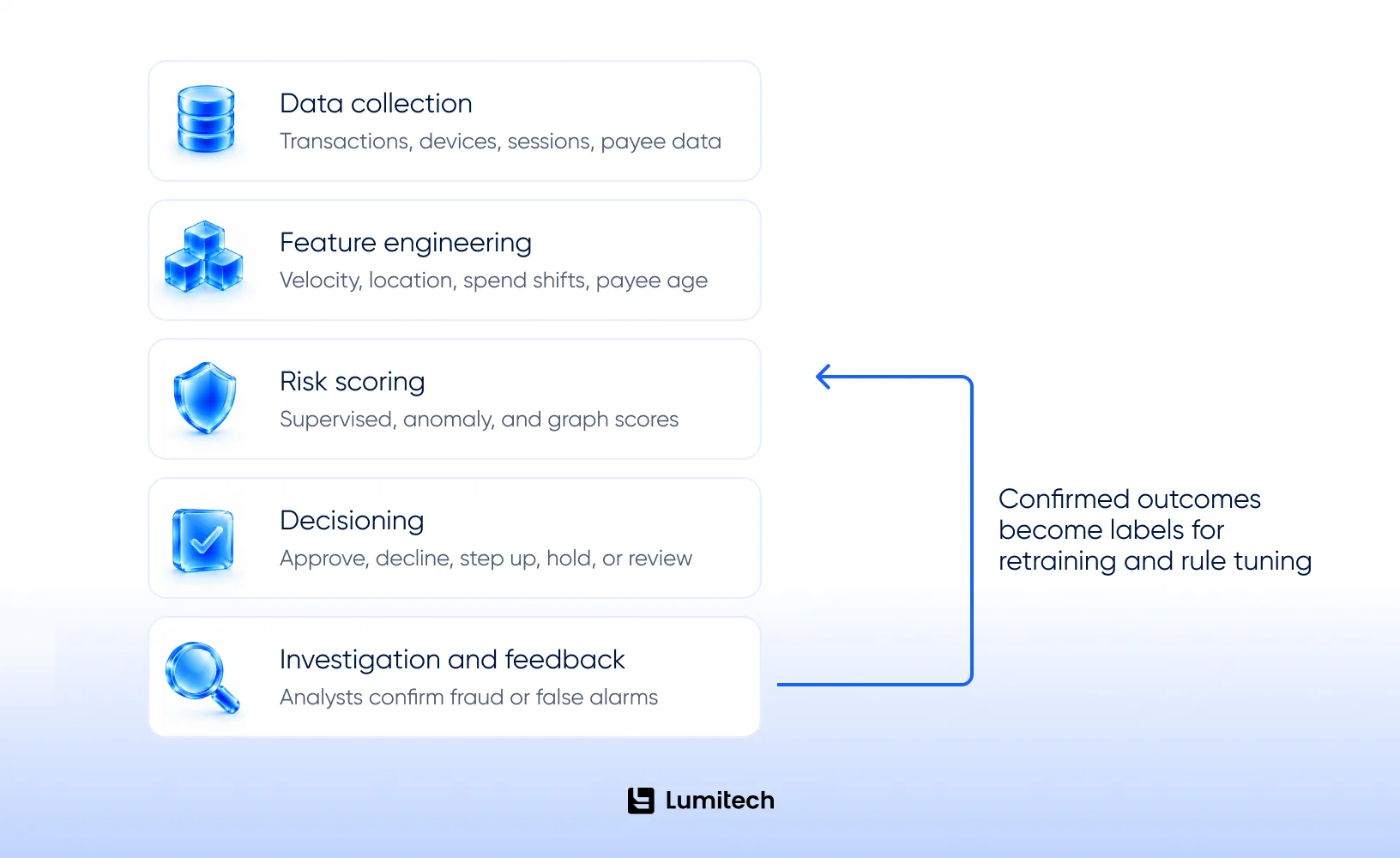
Every event runs through the same five stages, usually in under a second.
- 01
Data collection. Transactions, device and session signals, customer profiles, and payee data stream in from core banking, card processors, and digital channels.
- 02
Turning data into fraud signals. Raw transaction and behavioral data is converted into model features, such as transaction velocity, location changes, spending patterns, payee age, and shared-device links between accounts.
- 03
Risk scoring. Banks use a mix of supervised models, anomaly detection, and graph-based scoring to detect suspicious transactions.
- 04
Decisioning. A decision engine combines risk scores with business rules to decide whether to approve or decline a transaction, request additional authentication, place it on hold, or send it for review.
- 05
Investigation and feedback. Analysts review alerts, validate outcomes, and use their findings to update models and detection rules.
Banks set different response-time limits and risk thresholds for each channel. Card authorization allows just tens of milliseconds, while loan applications can take minutes. Ultimately, the key step is deciding what action to take. Fresh labels keep fraud detection automation sharp; as feedback slows, models struggle to keep up with evolving fraud patterns.
Core AI Technologies for Detecting Banking Fraud
Each technique answers a different question, and together they form the core of modern fraud analytics.
Using ML to Assess Transaction Risk
Supervised machine learning fraud detection learns from labeled history: past transactions marked fraudulent or legitimate. Gradient-boosted trees rule tabular payment data. A supervised fraud detection model shines on patterns the bank has already seen, such as card testing. Machine learning for fraud detection has one stubborn weakness: labels arrive late, through chargebacks and claims filed weeks after the event.
Anomaly Detection
Isolation forests and autoencoders learn what normal activity looks like for a customer or peer group and flag unusual behavior. While they can catch previously unseen fraud patterns, they also produce more false positives. Banks therefore often combine their anomaly scores with other inputs in the main model.
Graph Analytics
A fraud ring’s main defense is fragmentation. Spread the activity across dozens of accounts, and each one looks too small to worry about. The weak spot is what they share: the same phone, the same device, the same handful of payees. Graph analytics connects those dots across accounts, devices, phone numbers, and payees. The pattern then becomes clear: mule networks, clusters of new accounts on one device, and money fanning out within minutes.
The BIS Project Aurora proof of concept showed the potential of combining network analysis with machine learning. Tested on synthetic payment data, the approach detected potentially up to three times more money laundering networks and reduced false positives by up to 80% compared with siloed, rule-based monitoring.
Behavioral Analysis
For a genuine customer, behavioral analytics is invisible. They log in, pay their bills, and never notice a thing. In the background, the bank learns their usual rhythm: how fast they type, how they move through the app, and whether they enter payee details by hand. When that rhythm breaks, the system reacts. A pasted account number during an active screen-sharing session can trigger a check, a warning, or a hold, while everyday payments keep flowing without extra friction.
Generative AI in Fraud Detection and Investigation
Large language models are the investigator’s shortcut. They sift alerts, logs, and messages, surface what matters, and hand analysts a case timeline and a draft report to refine. Authorization keeps its own specialist: calibrated scoring models that decide in milliseconds and stand up to validation.
Approach | Detects best | Data it needs | Main limitation | Role |
|---|---|---|---|---|
Rules | Known patterns, policy limits, sanctions hits | Thresholds and lists | Brittle and easy to probe | Hard stops and policy |
Supervised ML | Known fraud patterns at scale | Labeled history | Label quality and delay | Primary risk score |
Anomaly detection | New or rare behavior | Baselines of normal activity | Higher false positives | Secondary score or feature |
Behavioral analytics | Account takeover, scam coaching, bots | Session and device telemetry | Channel SDKs and privacy review | Session risk signal |
Graph analytics | Mule networks, synthetic identity rings | Entity links across accounts | Entity resolution and compute cost | Network risk score |
Generative AI | Investigation workload | Alerts, case notes, documents | Hallucination and validation | Analyst support |
Have a fraud use case in mind?
Lumitech engineers review your data, labels, and integration points, then scope a proof of concept you can test against real cases.

What Gives Each Fraud Type Away
Fraud rarely looks suspicious in a single event. It gives itself away in patterns, and each pattern needs a different detection method.
Thousands of Identities, One Set of Addresses: Synthetic Identity Fraud
A New Jersey-based fraud ring created more than 7,000 fake identities and obtained tens of thousands of credit cards, resulting in over $200 million in losses, according to the U.S. Department of Justice.
The tell: applications that look legitimate alone but share addresses, phone numbers, or devices.
The method: graph analytics and document forensics detect hidden links, forged payslips, and fake IDs.
Thousands of Cards Waking Up at Once: Payment Fraud
Attackers generated valid Tesco Bank debit card numbers by algorithm and took £2.26 million in 48 hours. The FCA later fined the bank £16.4 million.
The tell: a sudden rise in first-time transactions across the portfolio, alongside payments that test transaction limits.
The method: real-time scoring across the whole card portfolio.
Money That Stays Only Minutes: Money Mules
Europol and 2,822 participating banks identified 10,759 money mules as part of EMMA 9 in 2023.
The tell: money coming in from many different senders, moving out almost immediately, and little prior account activity.
The method: fan-in and fan-out features with network risk scores.
Valid Credentials, Wrong Sequence: Account Takeover
Impersonating bank support cost victims more than $262 million in 2025, according to the FBI. Attackers may also carry out SIM swaps to take control of a phone number and obtain authentication codes.
The tell: a SIM change followed by a device switch, password reset, payee addition, and high-value transfer in rapid succession.
The method: sequence models assess a series of actions together. Lumitech builds event timelines for fintech platforms.
A Real Customer Following Someone Else’s Script: Scams
After a video call where every participant was a deepfake, an Arup employee made 15 transfers totaling HK$200 million.
The tell: urgent, high-value payments to new beneficiaries, often during an active phone call.
The method: behavioral analytics combined with risk scoring of the receiving accounts.
How Banks Detect Payment Fraud in Real Time
Real-time fraud detection in banking sector scores each transaction before or during authorization, while the money can still be stopped. Customer profiles are retrieved in milliseconds, risk scores are returned within the gateway’s latency budget, and the decision engine uses those scores to make policy-based decisions.
Straightforward cases are handled automatically, while uncertain ones trigger additional checks. These may include step-up authentication, a short payment hold, a scam warning, or a call from the fraud team. Every second counts: once the money moves out of the receiving bank, recovery becomes much harder. Small wonder that institutions in a Federal Reserve working group on FedNow fraud controls showed strong interest in advanced detection using machine learning (FedNow Fraud Working Group).
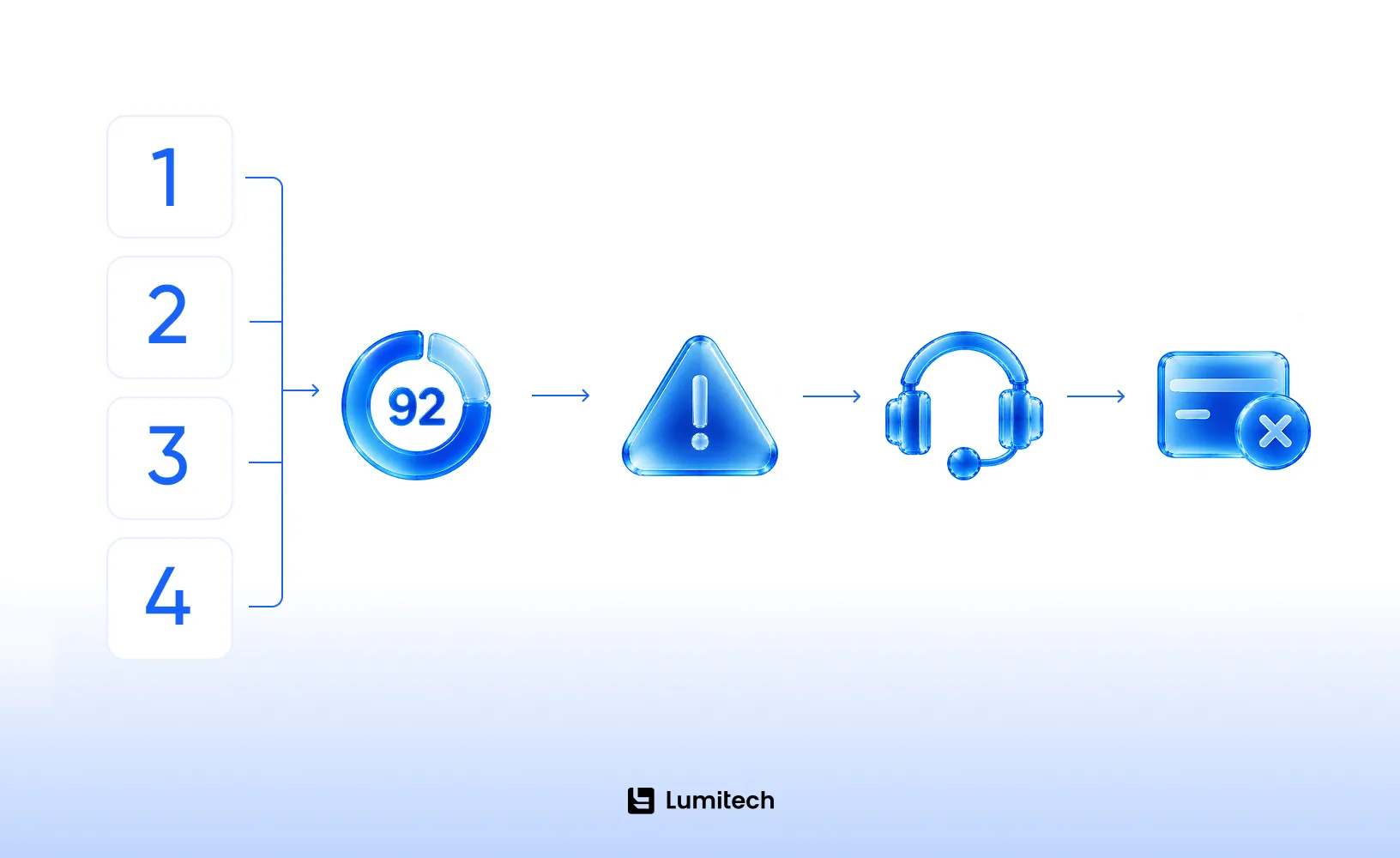
Here is the situation that can happen in real life. A 68-year-old customer is going to send 75% of her savings to a payee created four minutes ago. She uses her regular phone, enters the right credentials, and logs in from a familiar location. On the surface, everything looks normal.
But the bank spots three warning signs: the customer is on a call, the payee was only just registered, and the receiving account has already been engaged in 14 transactions that day. No single sign is enough to block the payment, but together they trigger a hold for review. A fraud analyst calls the customer and finds out that a “bank investigator” told her to make the transfer. The bank cancels the payment.
Key Advantages for Banks
AI fraud detection in banking delivers the greatest value when supported by labeled data, robust integration, calibrated thresholds, and sufficient analyst capacity. Combined, these measures provide banks with such benefits:
Faster decisions, earlier intervention. Scoring transactions at authorization helps stop fraud before settlement and handle peak transaction volumes.
Coverage of complex patterns. Models weigh interacting signals and adapt to tactics no rule describes yet.
Fewer disruptions for legitimate customers. Models use contextual signals to distinguish unusual but genuine activity from potential fraud.
Sharper investigations. Risk-ranked queues send analyst time to the alerts most likely to be fraud.
Network visibility. Graph features reveal the mule rings behind seemingly isolated incidents.
The U.S. Treasury reports that data-driven screening, including machine learning, helped prevent and recover over $4 billion in fraud and improper payments in fiscal 2024, up from $652.7 million a year earlier.
Banks adopting AI for fraud detection see these gains when AI fraud prevention has owners, budgets, and review cycles like any other operating capability. Artificial intelligence fraud detection without that discipline mostly produces alert volume.
Key Challenges of AI Fraud Detection
Most of the hard problems sit outside the model, in data, governance, and the wider enterprise fraud management program.
Challenge | What it means in practice |
|---|---|
False positives vs. false negatives | Make the threshold too strict, and you turn away real customers at checkout. Make it too lenient, and fraudsters get through. What works best depends on the product and channel. |
Data silos and reliability issues | A model is only as sharp as its inputs. When addresses are outdated, or device IDs are missing, even strong fraud indicators can lose their value. Data quality checks should catch these issues at ingestion. |
Model drift and new tactics | Block one scheme, and fraudsters start testing the next one within days. Models that skip monitoring and retraining fall behind quietly, long before anyone notices. |
Explainability | Analysts and auditors need a reason for every flag. Reason codes and feature attribution provide it, and the Federal Reserve’s SR 11-7 sets expectations for validation and documentation. |
Privacy and compliance | Typing rhythm and device data are powerful signals and sensitive ones. Financial fraud detection falls outside the high-risk category under the EU AI Act, but that does not make fairness any less important for ethical AI in finance. |
Legacy integration | Batch-oriented core systems can’t feed real-time decisions without streaming connectors and scoring services that work within strict latency limits. |
How to Measure AI Fraud Detection Performance
Low fraud rates make accuracy a poor measure of detection quality. If just 0.1% of transactions involve fraud, approving every payment produces 99.9% accuracy without detecting any fraud at all. Banks must look at a balanced range of metrics instead.
Metric | What it measures |
|---|---|
Precision | Share of flagged transactions that are actually fraudulent |
Recall / detection rate | Share of relevant fraud the system detects |
False-positive rate | How often legitimate activity is incorrectly flagged |
False-negative rate | How often fraudulent activity is missed |
Fraud loss rate | Financial losses attributable to fraud, usually per volume processed |
Detection latency | Time between the event and the risk decision |
Manual review rate | Share of cases that require analyst intervention |
Approval rate | Share of legitimate transactions approved without friction |
When evaluating fraud detection using AI, teams need to look at metrics collectively and break them down by fraud type, channel, and customer impact. Recall should also reflect transaction value, since one missed high-value transfer can outweigh dozens of blocked small card frauds.
Not sure your fraud metrics tell the full story?
Lumitech's data engineers audit detection pipelines and build dashboards that tie model performance to losses and customer friction.

How to Implement AI Fraud Detection in a Bank
AI-based fraud detection in banking pays off fastest as a phased program that tackles one use case at a time. Most banks introduce these capabilities in three stages.
Phase 1: Scope the Problem and the Data
Pick a specific use case with a clear business impact and a designated owner. Account takeover is one example. Before moving forward, determine whether the data is fit for purpose, including historical transactions, fraud-label coverage, available signals, data quality, and access. This check shows which methods are realistic, whether rules, supervised models, anomaly detection, graph analytics, or a hybrid. For known payment patterns, fraud detection using machine learning in banking usually starts with a supervised model.
Phase 2: Pilot in Shadow Mode
Testing starts with historical transactions and realistic fraud scenarios. The next step is shadow mode, where the model processes live traffic without influencing decisions. Teams compare its detection rates, false-positive rates, and latency with current performance while existing rules remain in control. After the model meets the required targets, banks can integrate its risk scores into payment and case management workflows. Custom fintech software development services help connect the model to existing banking infrastructure.
Phase 3: Roll Out and Keep Improving
Expand deployment gradually, channel by channel or segment by segment. Route ambiguous cases to human reviewers and ensure the team can quickly revert to the previous system if needed. After deployment, monitor changes in model performance, confirmed fraud results, operational workload, and customer experience to determine when retraining is necessary.
Timelines vary with the bank’s architecture, data maturity, fraud use case, and regulatory obligations.
The Next Phase of Fraud Prevention in Banking
Most AI fraud detection banking roadmaps build on what already works. Five directions stand out, each solving a gap fraud teams already feel in daily operations:
Direction | What changes | Why it matters for fraud teams |
|---|---|---|
Unified fraud decisioning | Rules, supervised models, and graph analytics feed one decision layer | One consistent verdict per event, with fewer conflicting alerts |
Defense against AI-powered impersonation | Liveness checks, injection-attack detection, and document forensics | Deepfakes and synthetic identities get caught at onboarding |
Expanded scam detection signals | Call status, device trust, and payee risk data at authorization | Scams surface while the payment can still be stopped |
Analyst copilots | Generative AI drafts case narratives, analysts approve outcomes | Less time on paperwork, more time on real investigations |
Fraud intelligence sharing and oversight | Privacy-enhancing tech for signal sharing, plus monitoring, explainability, and clear model ownership | Cross-bank risk signals flow safely, and models stay auditable |
Governance is quickly becoming standard practice across AI in financial services, and fraud is one of the areas where regulators look first. For fraud teams, the payoff of AI fraud prevention is practical. They see links across more data, catch suspicious activity earlier, and spend their time on the cases that need human judgment.
What Separates Fraud Teams That Keep Up
The fraud teams that keep pace share a few habits. They connect data across channels, score risk before money moves, measure precision and recall honestly, and retrain models before drift sets in. That discipline turns AI-based fraud detection in banking from a pilot into a lasting capability. The technology is ready, and the difference lies in how it’s run.
If your team is weighing where to begin, Lumitech can help assess your data and integration landscape and scope a proof of concept for fraud detection in banking.


