Open Banking and Open Finance in MENA: How the Region Is Moving Toward API-Driven Financial Ecosystems
MENA is quietly rebuilding its financial plumbing. Here’s what open banking and open finance mean for banks, fintechs, and digital businesses in the region — and how to get ready before the shift becomes mandatory.
- Open banking
- Open finance
- MENA
July 17, 2026
 AI Overview
Open banking and open finance in MENA give licensed providers secure, consent-based access to banking, insurance, lending, and investment data through APIs. The UAE, Saudi Arabia, and Bahrain lead this shift through centralized frameworks and mandatory rollout. Saudi Arabia already requires all 23 licensed banks to provide standardized API access. Without strong consent, security, and integration architecture, firms face compliance failures, service disruptions, and costly market-by-market rebuilds.

MENA Is Moving From Open Banking to Open Finance
A quiet infrastructure shift is underway across the Gulf, and it’s changing the ground rules for fintech software development in the region.
In April 2024, the UAE’s Central Bank published a regulation that most consumers will never read, and most businesses can’t afford to ignore: a mandate requiring every licensed bank and insurer in the country to expose customer data through standardized APIs, with a single centralized hub connecting them all.
The UAE Central Bank has noted that it is the first regulator globally to implement a consolidated trust framework and a centralized API as part of its Open Finance Framework, establishing a single secure, centralized connection to facilitate cross-sectoral data sharing and the initiation of transactions on behalf of users with their express consent.
That’s not open banking. It’s something broader, and the naming is deliberate. What started as open banking Middle East regulators launched roughly a decade behind Europe, is now evolving into open finance Middle East institutions are racing to build for — a model where insurance policies, investment accounts, loans, and pensions all sit behind the same kind of consent-based, API-driven access as a checking account.
This isn’t a side project regulators are running alongside a broader digital transformation services initiative — it’s foundational infrastructure. The UAE’s Open Finance Regulation applies to a broad range of financial products and services across banking, insurance and payments — including current and savings accounts, credit cards, personal and auto loans, mortgages, overdraft facilities, and insurance products such as motor, health, life, and property cover. That’s a fundamentally different scope than “can an app see your account balance.”
For banks, fintechs, and digital businesses across the region, the strategic question has already shifted. It’s no longer whether open banking and open finance in MENA will matter — the regulation is written, the infrastructure is live, and participation for licensed institutions is often mandatory rather than optional. The real question is how early a business gets its API architecture, compliance model, data strategy, and product roadmap in shape to benefit from it, rather than scrambling to comply after competitors have already shipped the products customers want.
What Are Open Banking and Open Finance in MENA?
The terms get used interchangeably in casual conversation, which causes real confusion when it comes to planning a product roadmap. They aren’t the same thing, and the difference determines what kind of business opportunity you’re actually looking at.
Understanding this distinction matters more in the Gulf than almost anywhere else, because open banking in MENA and open finance in MENA are developing on parallel, sometimes overlapping tracks rather than one clean sequential evolution.
Open banking is the practice of letting customers grant licensed third parties secure, consent-based access to their bank account data and payment initiation capabilities — usually through APIs regulated by a central bank. Think account aggregation apps, payment initiation services, and budgeting tools that read your transaction history.
Open finance extends the same principle — permissioned, consent-based data sharing through secure APIs — across a much wider range of financial products: insurance, investments, pensions, lending, and increasingly, embedded finance experiences inside non-financial platforms. It’s the difference between “an app can see your checking account” and “an app can see your checking account, your car insurance, your investment portfolio, and your pension, and can act across all of them with your permission.”
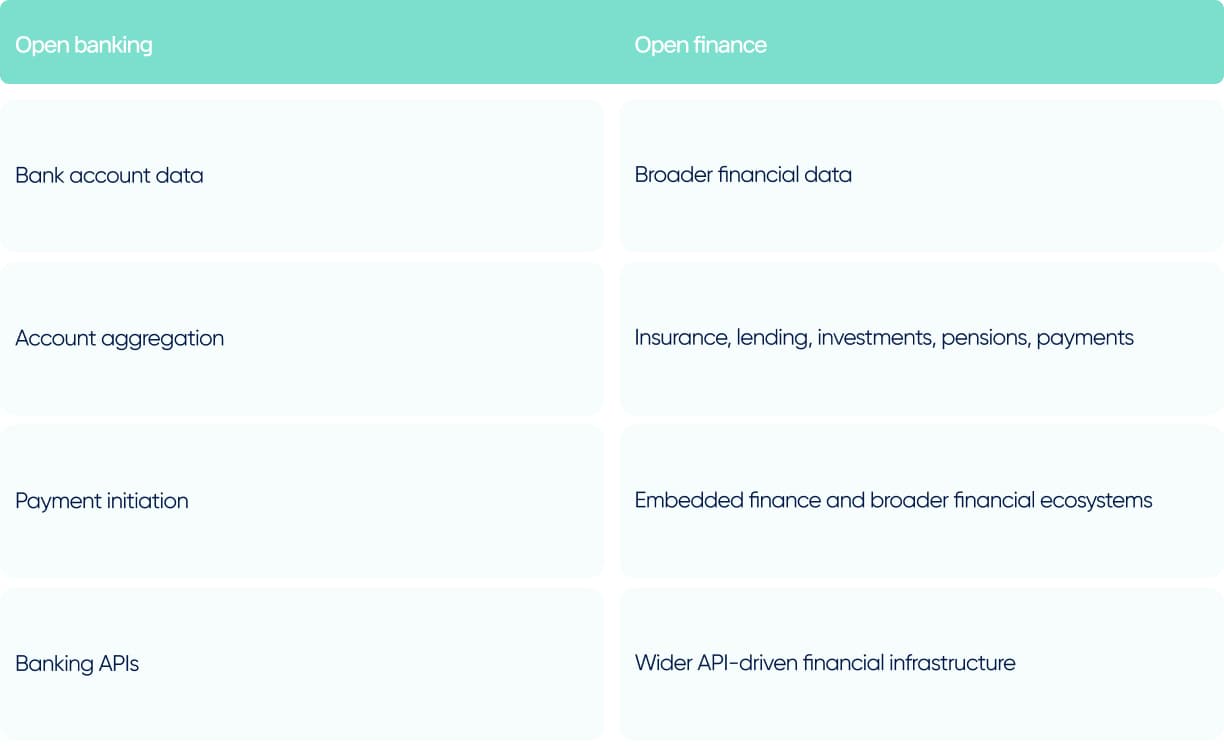
In short: MENA open banking gave customers a window into their bank accounts. MENA open finance turns that window into a door — one that connects banks, insurers, fintechs, and digital platforms across a much wider financial life, all through secure, permissioned APIs. This shift is happening faster and with more central coordination than in most Western markets, largely because regulators are building it top-down rather than waiting for market pressure to force it.
Why Open Banking in UAE and Open Finance Matter in MENA
It’s tempting to treat this as a compliance story. It isn’t — it’s a market-readiness story, and the numbers behind open banking adoption in MENA and open finance adoption in MENA back that up.
Several forces are converging at once across the region:
Digital and mobile-first populations. Saudi Arabia’s population skews young and highly connected, with 97% smartphone penetration and 71% of residents under the age of 35 — a profile that adopts new financial apps quickly once infrastructure exists.
Cashless momentum well ahead of plan. As part of Vision 2030, Saudi Arabia aimed for a 70% non-cash transaction rate by 2025 — and hit it two years early, in 2023. That’s a market that has already made the behavioral leap that open finance products depend on.
Government-led financial innovation. Unlike the UK or EU, where open banking emerged from years of market pressure, the UAE, Saudi Arabia, and Bahrain each built their frameworks as explicit government-led initiatives tied to national diversification strategies — a pattern also visible in broader software development for government sector initiatives across the Gulf.
Real fintech investment growth. Saudi fintech investment grew 34% year-over-year, alongside a jump in the number of CMA-licensed entities and SAMA sandbox participants.
SME financing gaps. SMEs have historically struggled to access credit through traditional underwriting; open finance-enabled cash flow data, combined with modern data analytics services, changes what’s assessable.
Demand for faster onboarding. Manual document collection is being replaced by instant, API-based verification — materially lowering customer acquisition costs.
Personalization expectations. Customers who expect personalized experiences from e-commerce and streaming increasingly expect the same from their bank.
Embedded finance MENA growth. Non-financial platforms are increasingly embedding lending, payments, or insurance directly into their products, turning financial services into a feature rather than a separate destination.
The core opportunity: open finance can help MENA’s financial institutions move from product-centric banking — where the bank designs a product and pushes it to everyone — to data-driven financial services, where offers, pricing, and risk assessment are built around what a permissioned data set actually shows about a specific customer or business. That’s a meaningfully different competitive game, and it rewards whoever builds the data and API capability first.
Need help assessing open finance requirements in your target MENA market?
A short discovery phase can clarify licensing scope, data obligations, and technical dependencies before development begins.

How Is MENA Regulating Open Banking in Saudi Arabia and Other Regions?
Regulation is the part of this story that’s easiest to treat as a footnote and hardest to actually skip. Tracking open banking regulations in MENA — and increasingly, open finance regulations in MENA — is now a prerequisite for any serious product roadmap, since every meaningful product in the region sits downstream of a licensing decision, a consent standard, or an API specification set by a central bank.
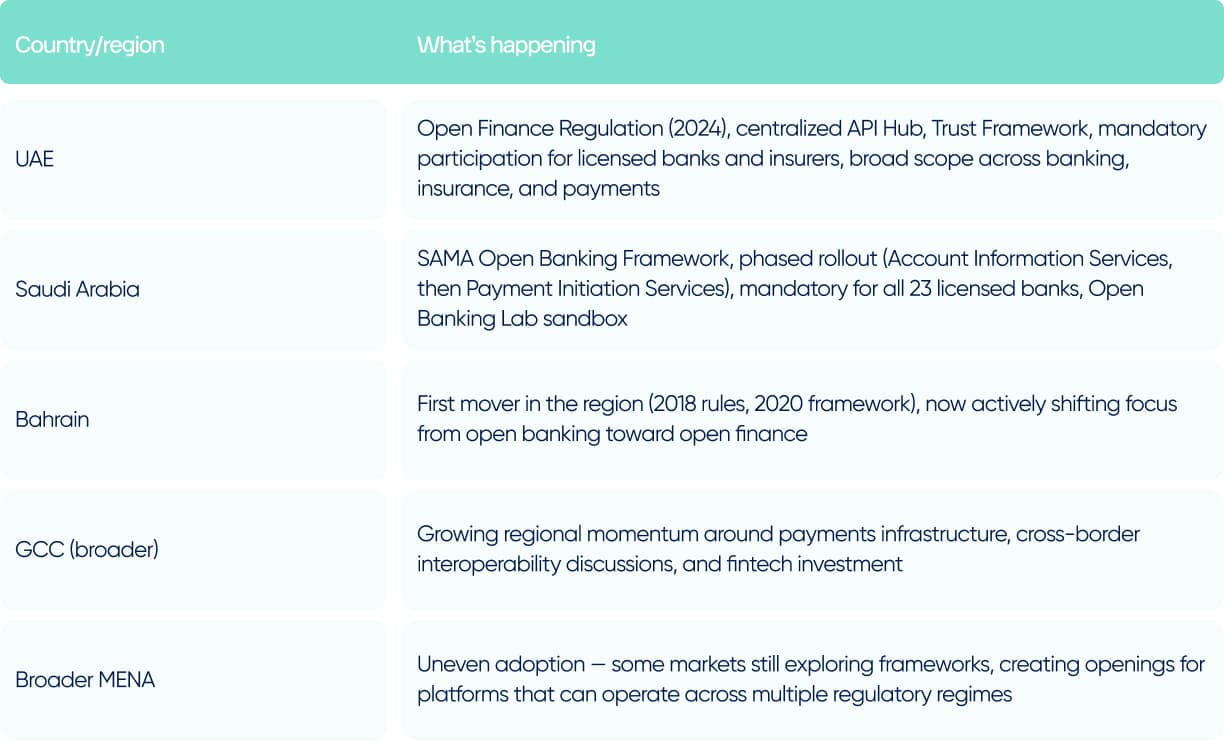
The UAE open finance regulation establishes requirements for the licensing, supervision, and operation of an Open Finance Framework, consisting of an API Hub, a Trust Framework, and Common Infrastructural Services that together enable cross-sectoral data sharing and transaction initiation on behalf of users. Participation is mandatory for all licensees with respect to the products and services within its scope, and data holders must give participants access to customer data and the ability to initiate transactions — always subject to the user’s express consent and appropriate authentication.
Saudi Arabia has taken a phased, use-case-driven approach with its Saudi open banking framework. SAMA launched the program in 2022, first enabling Account Information Services, followed by Payment Initiation Services in September 2024 — a staged rollout rather than a big-bang mandate. By 2025, all 23 Saudi-licensed banks were required to provide standardized API access, with 8 licensed third-party providers operating under the framework and over 180 million API calls processed that year.
Bahrain got there first, and its approach has shaped much of the regional playbook for open banking in Bahrain and beyond. Bahrain was the first country in the MENA region to implement formal open banking rules, mandating all retail banks to comply as early as December 2018, followed by the Open Banking Committee in 2019 and the Bahrain Open Banking Framework in October 2020. The CBB has already begun shifting its focus from open banking to open finance, exploring how third-party providers can operate across a wider range of financial products, not just retail accounts.
What businesses actually need to track isn’t the legal text — it’s five practical dimensions that recur across every version of open banking regulations in MENA:
Licensing (do you need one, or can you build on a licensed partner’s access)
Third-party access rules (who counts as an authorized data recipient)
Consent standards (duration, revocation, disclosure)
API and technical standards (whose specification you build against)
Customer authentication requirements under each regulator’s rules.
The important reframe: regulation here isn’t purely a constraint. The UAE’s regulation opens up vast opportunities for fintech companies to innovate, develop personalized products, and offer integrated financial services — but capturing that opportunity often means pairing new API layers with legacy systems modernization services, since older core banking systems weren’t built with this level of real-time data exchange in mind.
Country-by-Country Overview: UAE, Saudi Arabia, Bahrain, and the Wider GCC
No single playbook explains the open banking ecosystem in MENA — or the emerging open finance ecosystem in MENA — since each country is moving at its own pace and with its own regulatory philosophy.
UAE: building the most centralized model of open finance in MENA
The UAE has adopted a centralized Open Finance architecture that is fairly unique globally — a central API gateway operated through the Central Bank’s subsidiary Al Etihad Payments standardizes how banks, insurers, and fintech apps connect, so third-party providers can integrate once and gain secure, consented access across the whole banking and insurance market.
This makes open banking in UAE — and increasingly open finance in UAE — one of the most centralized models anywhere in the world, a materially different approach from the UK’s decentralized model, where each bank builds and maintains its own compliant API.
The CBUAE has also joined Project Aperta, a Bank for International Settlements-led initiative launched in October 2024 that’s exploring how to connect domestic open finance infrastructures across multiple jurisdictions — a signal the UAE is positioning for eventual cross-border interoperability, not just domestic rollout.
Saudi Arabia: scale, mandate, and measurable adoption
The approach to open banking in Saudi Arabia stands out for the scale of mandatory participation combined with hard service-level requirements. The framework carries a 99.5% uptime requirement and a 4-second response time SLA, exceeding most international open banking standards, and SAMA estimates open banking’s economic contribution at SAR 2.8 billion in 2025, growing toward SAR 12 billion by 2030.
Consumer awareness is still catching up, though: despite awareness campaigns reaching an estimated 5 million residents, consumer awareness of open banking sits at roughly 40%, well below the 95%+ smartphone banking adoption rate — a gap that’s itself an opportunity for whoever builds the product experience that finally makes it click.
Bahrain: the first mover, now shifting again
Bahrain’s head start has produced tangible success stories. Tarabut Gateway, which launched out of Bahrain’s regulatory sandbox, had become the MENA region’s largest open banking platform by mid-2024, having raised a $32 million Series A round in 2023 to fund expansion into Saudi Arabia.
BenefitPay, Bahrain’s near-real-time peer-to-peer payment app, saw transaction volumes grow at a compound annual growth rate of 73% over three years — a clear sign of how fast usage can scale once the right product meets the right infrastructure. Tarabut also partnered with Bahraini digital lender FLOOSS to streamline loan approvals, cutting wait times from weeks down to minutes using open banking-based data access.
The most expensive assumption we see is treating the UAE, Saudi Arabia, and Bahrain as interchangeable. They’re not — not in licensing, not in pace, not in scope. Plan for three regulatory environments from day one, and expansion becomes a configuration problem instead of a rebuild.


The wider GCC and MENA picture
Beyond these three markets, adoption across the region is uneven — some regulators are still in the framework-design stage, while others haven’t formally started. Momentum around open banking in GCC markets and open finance in GCC markets is nonetheless building, and platforms that can architect their systems to operate across multiple regulatory regimes at once — rather than building bespoke integrations market by market — will have a real structural advantage as more countries formalize their frameworks over the next few years.
Key Open Banking and Open Finance Use Cases in MENA
This is where the strategic conversation about open banking and open finance in MENA usually gets more interesting than the regulatory one. Compliance gets you into the framework; the actual business value comes from what you build on top of it.
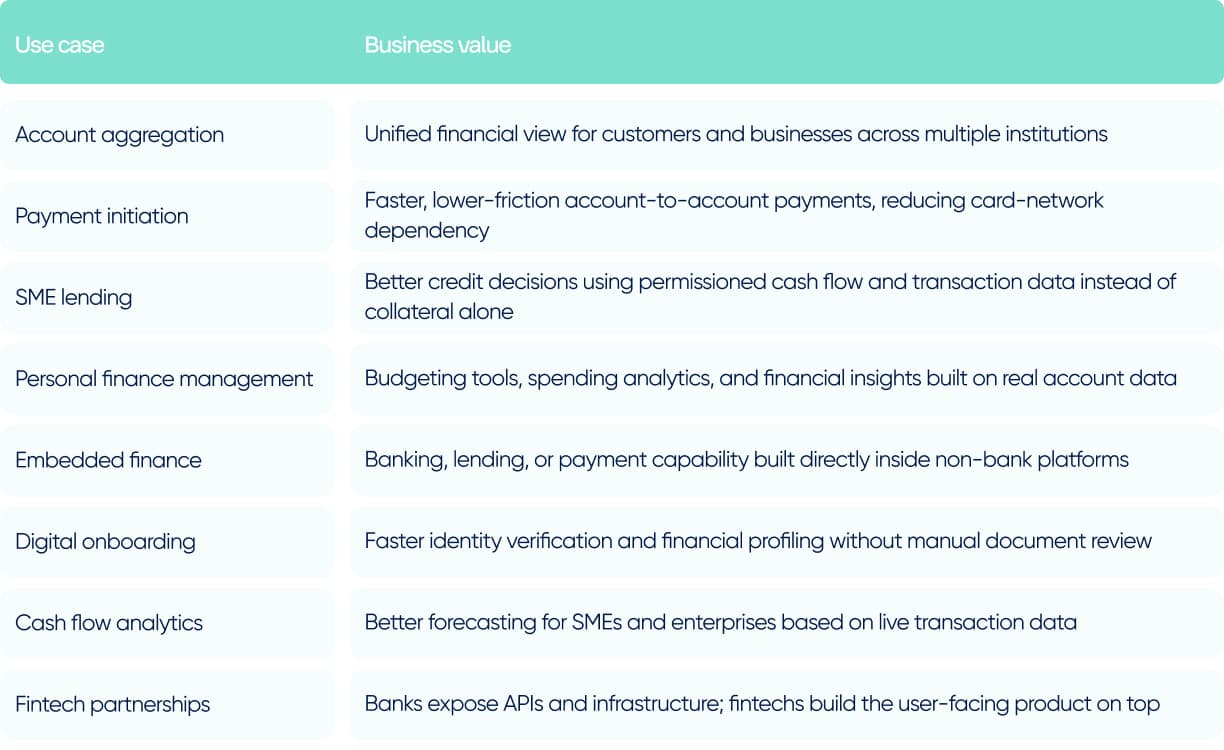
Payment initiation in particular is reshaping regional payment trends, as account-to-account transfers reduce dependency on card networks and open up faster settlement options for both consumers and businesses.
Three of these deserve a closer look because of where the region’s momentum is concentrated:
SME lending is arguably the single most consequential use case in MENA, given the long-standing structural credit gap for smaller businesses. Open banking-based data sharing allows SMEs easier access to financing by enabling fintech companies to provide personalized credit solutions based on more accurate data assessments — rather than the collateral-heavy underwriting that has historically shut smaller businesses out.
Digital onboarding delivers a cost benefit that’s easy to underestimate: instant bank verification through open banking APIs, paired with modern KYC automation, reduces customer acquisition costs for financial platforms by an estimated 40–60% compared to manual, document-based verification. That’s a direct line to unit economics, not just a UX improvement.
Embedded finance is where digital businesses outside traditional finance stand to benefit most — a community platform, marketplace, or B2B SaaS tool can plausibly offer lending, payments, or insurance without becoming a licensed bank, by building on a licensed partner’s open finance access.
Worth internalizing: the real opportunity in open finance isn’t regulatory compliance itself — it’s building new products on top of the infrastructure. Compliance is the entry ticket, not the destination.
Customer Stories
Explore What We've Built
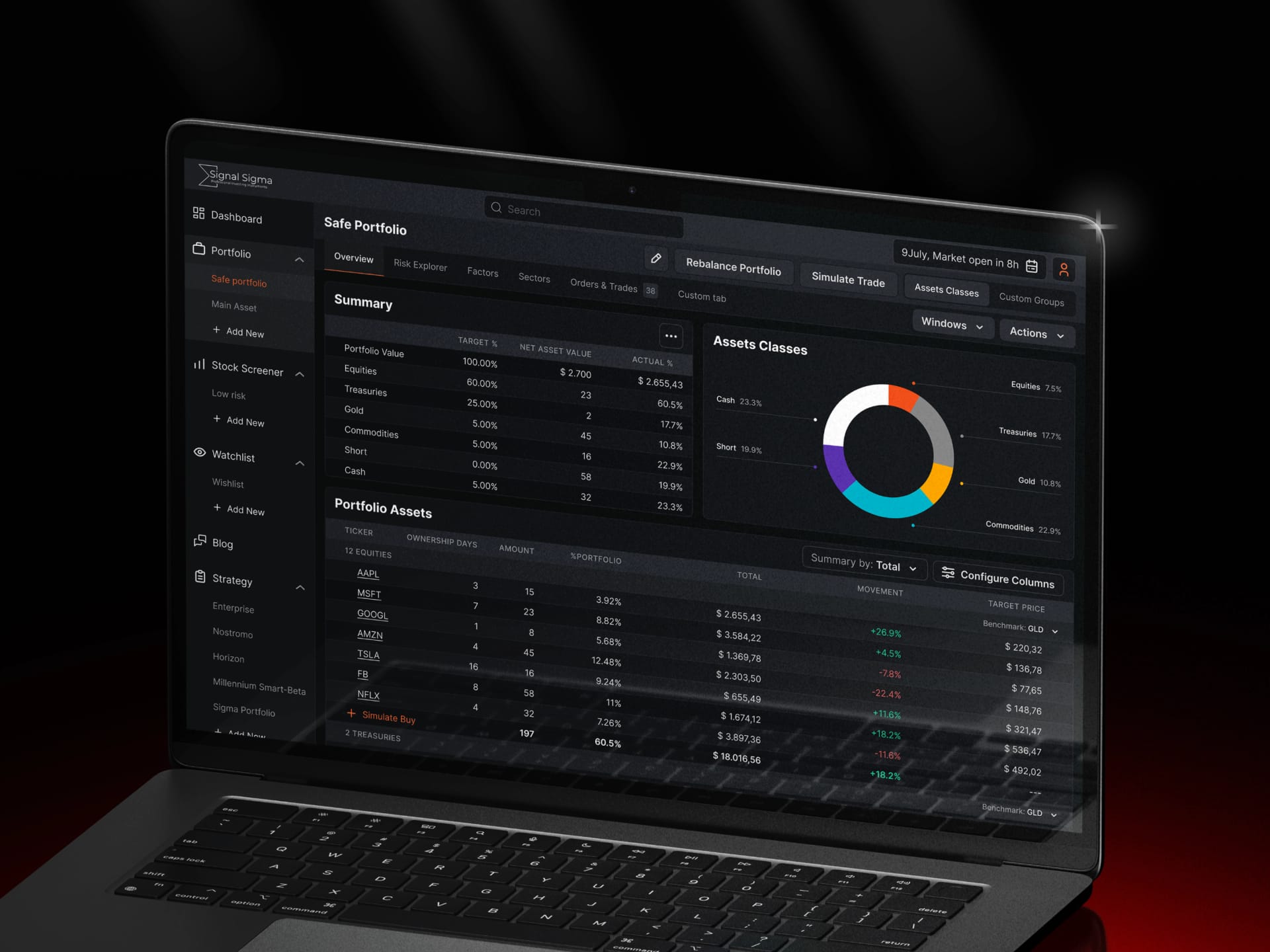
Analytics-Driven Investment Platform for Finance Professionals
Learn more on how to make smarter investment decisions with SignalSigma, use real-time analytics, optimized portfolio insights, and improved asset allocation.

Bucharest
Aug '24 — Now
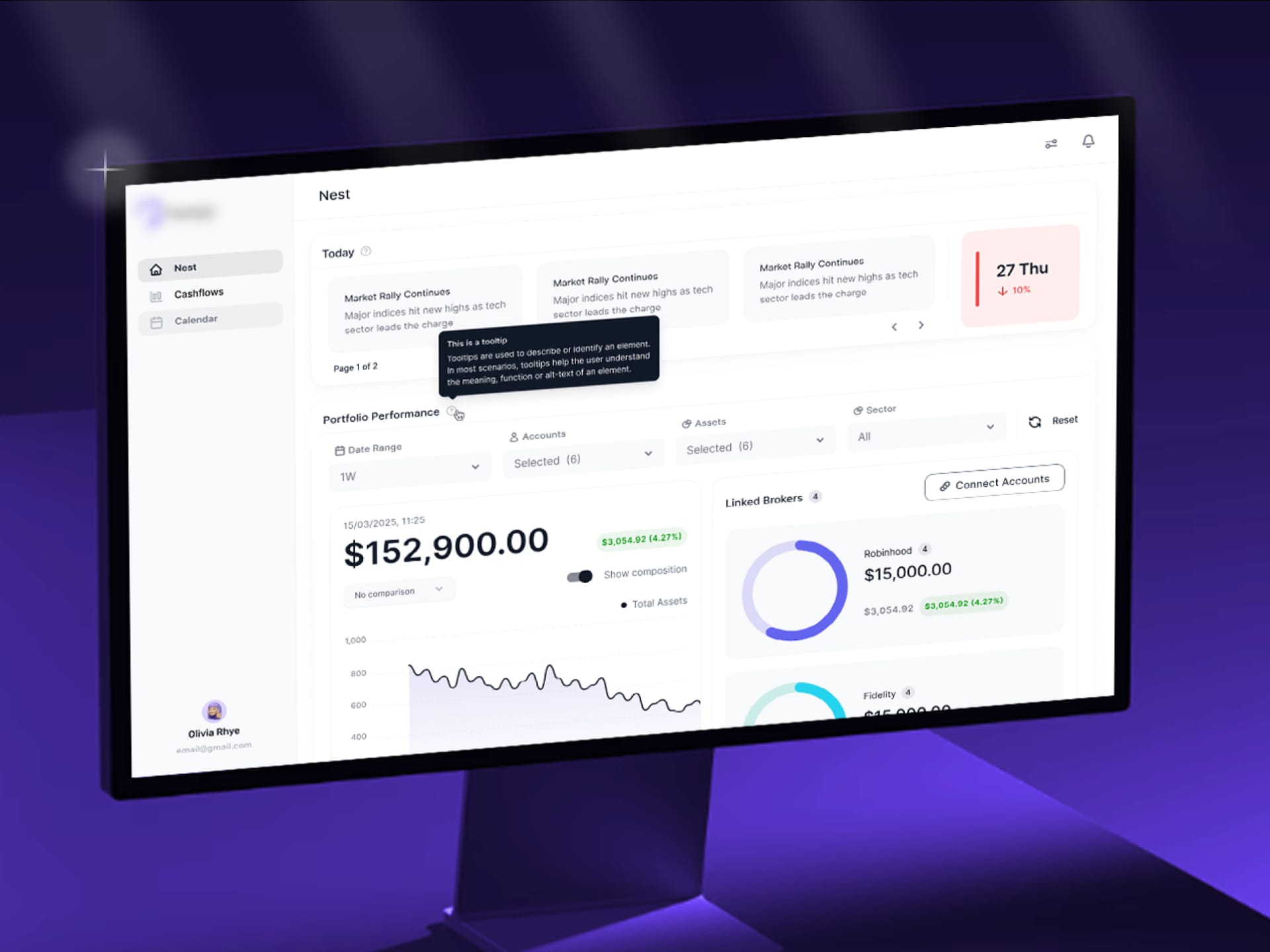
AI-Powered Investment Intelligence Platform
Building a RAG-based investment intelligence platform for a Panama fintech startup — from multi-broker data aggregation to AI-driven portfolio analytics that explain market events in real time.

Panama
Aug '25 – Feb '26
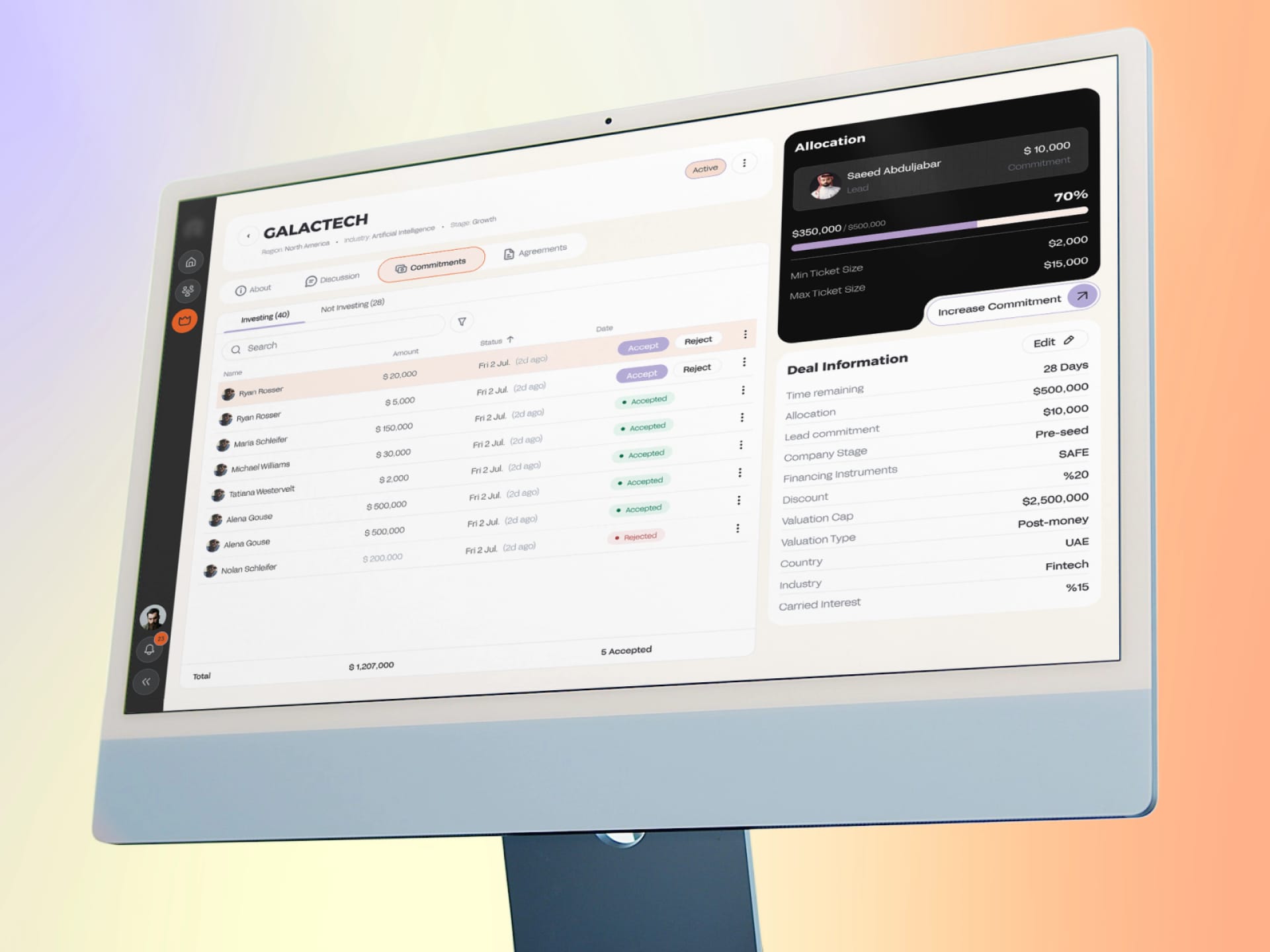
Angel Syndicate Investment Platform for a Saudi Family Office
Turning a fragmented angel investment workflow into a private, generative AI‑powered operating system for syndicates, family offices, and co‑investors.

Jeddah
May '25 - Nov '25

Crypto Indices Platform Powering Top Global Digital Asset Products
Lumitech has built a robust and scalable platform designed to power the next generation of digital asset products.

New York
Feb '23 — Apr '24
FinTech & Finance
Analytics-Driven Investment Platform for Finance Professionals
Learn more on how to make smarter investment decisions with SignalSigma, use real-time analytics, optimized portfolio insights, and improved asset allocation.
Client Location
Bucharest
Duration
Aug '24 — Now
Platform
Web
AI-Powered Investment Intelligence Platform
Building a RAG-based investment intelligence platform for a Panama fintech startup — from multi-broker data aggregation to AI-driven portfolio analytics that explain market events in real time.
Panama
Aug '25 – Feb '26
Angel Syndicate Investment Platform for a Saudi Family Office
Turning a fragmented angel investment workflow into a private, generative AI‑powered operating system for syndicates, family offices, and co‑investors.
Jeddah
May '25 - Nov '25
Crypto Indices Platform Powering Top Global Digital Asset Products
Lumitech has built a robust and scalable platform designed to power the next generation of digital asset products.
New York
Feb '23 — Apr '24
APIs as the Technical Layer of Open Finance
Everything described above — consent, aggregation, embedded finance, SME lending — depends entirely on one technical layer actually working: open banking APIs in MENA and, increasingly, open finance APIs in MENA that connect banks, fintechs, licensed third parties, and digital platforms. For a deeper technical breakdown, see this guide to understanding open banking APIs.
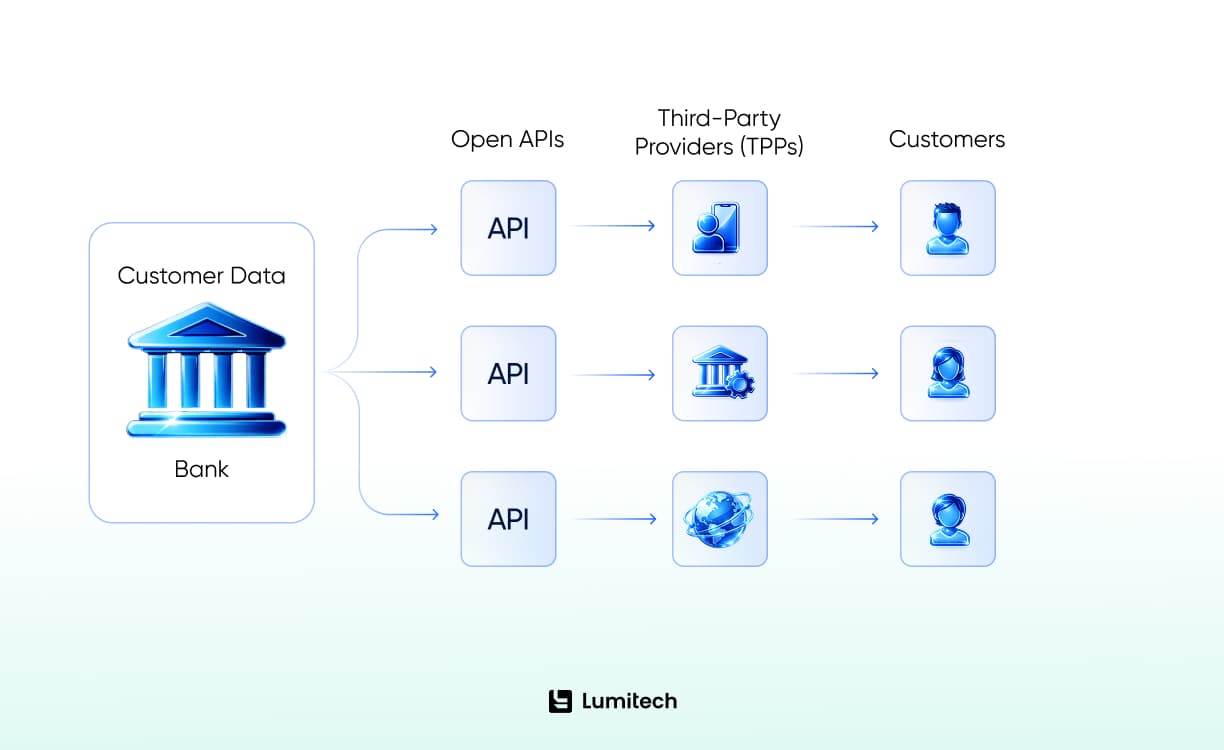
A centralized API gateway lets third-party providers integrate once and gain secure, consented access across an entire banking and insurance market — the backbone of financial data sharing MENA institutions are now expected to support, and the technical foundation for consent-based data sharing MENA regulators require by law. That single-integration model is a genuine advantage of the UAE and Saudi approaches over more fragmented markets — but it also means the API layer itself has to be treated as core infrastructure, not a side integration project.
Open banking APIs in MENA: things making this layer harder than a typical third-party API integration
Secure authentication and consent flows are non-negotiable. TPPs must use digital certificates and get listed in a central participant registry as part of the trust framework, which handles identity verification, authentication, and accreditation.
Reliability standards are strict and enforced. As mentioned above, Saudi Arabia’s framework carries a 99.5% uptime requirement and a 4-second response time SLA — real engineering pressure, not a “best effort” expectation.
Documentation and sandbox testing matter more than usual. SAMA’s Open Banking Lab gives banks and fintechs a secure environment to develop and test services using mock data, validate APIs through conformance testing, and simulate real-world environments before going live.
Fallback logic and monitoring aren’t optional. APIs need continuous testing, patching, and red-teaming, and both banks and fintechs must invest in serious security engineering as more applications plug into the system.
The practical implication: an open finance product isn’t a fintech idea with an API connection bolted on. It requires integration architecture, careful data mapping between your product and the regulator’s API spec, and fallback logic for when an upstream bank’s API is slow or unavailable — a software engineering discipline, not a checkbox.
Challenges: Compliance, Consent, Security, and Interoperability
None of this comes free, and pretending otherwise is the fastest way to build a product that fails in production or gets flagged in a compliance review — anyone building in this space needs to treat these risks as core requirements, not afterthoughts.
Regulatory fragmentation across MENA. Each country’s framework has its own licensing categories, technical standards, and consent rules — a product built for one market rarely transfers cleanly to another without real rework.
Customer consent management. Consent isn’t a one-time checkbox — it has to be specific, time-bound, revocable, and auditable. In Bahrain, regulated entities can access consumer bank data for up to 12 months under current rules, and getting duration, renewal, and revocation flows wrong is both a compliance risk and a trust risk.
Data privacy obligations. Saudi Arabia’s Personal Data Protection Law, in effect since 2023, requires consent that is voluntary, specific, and revocable at any time, with consumers able to view, modify, or delete their data — reinforcing the need for strong data governance in banking practices across the region.
API security and fraud risk. Centralizing access through a single hub concentrates risk as much as it does convenience — a compromised participant or a weak authentication flow has outsized consequences.
Legacy banking systems. Many banks are still running core systems not designed for real-time API access, making strict uptime and latency SLAs a genuine engineering lift.
Interoperability across borders. The absence of a shared regional standard means cross-border ambitions require careful architecture decisions today.
Trust between banks, fintechs, and users. Even when regulation and infrastructure are in place, adoption can lag due to high product development costs, limited consumer awareness, and financial literacy gaps — technical readiness and market readiness aren’t the same thing.
The core point: success in open finance depends less on simply launching an API connection, and more on whether the resulting data sharing is genuinely secure, properly permissioned, reliably available, and — most importantly — actually useful to the end customer. Any one of those four failing undermines the other three.
Reduce compliance, security, and integration risks before development starts by scoping these challenges against your specific target market and use case.

The Open Finance Readiness Framework
Before committing engineering time and budget to an open finance product, it’s worth honestly scoring your organization across six dimensions. This isn’t a decorative checklist — treat it as a real gate before you start building.
Regulatory readiness — Do you understand the licensing requirements, market rules, and compliance obligations in your target market (UAE, Saudi Arabia, Bahrain, or elsewhere)? Do you need your own license, or can you operate under a licensed partner?
API readiness — Can your systems support secure integration with the relevant API Hub or bank-by-bank connections? Is your documentation, uptime, and monitoring capability mature enough to meet SLA expectations?
Consent readiness — Do you have a clear model for how users grant, view, and revoke permissions? Is data transparency built into the product, not just the legal terms?
Data readiness — Is your data quality high enough to support the use case? Do you have a clear data mapping and governance process between your systems and the regulator’s standard?
Product readiness — Is there a clear, specific use case with real user value and a defined monetization model? Many open finance products are delivered through SaaS development services rather than one-off custom builds — or is this a vague “we should do open finance” initiative without a concrete product behind it?
Security readiness — Do you have strong authentication, encryption, fraud controls, and audit trails in place, and are they tested against realistic attack scenarios, not just theoretical ones?
Score each dimension honestly before greenlighting a project. A business that’s strong on product vision but weak on API and security readiness is not ready to launch — it’s ready to start a focused six-to-twelve-week technical and compliance sprint first.
Implementation Roadmap for Open Banking in MENA
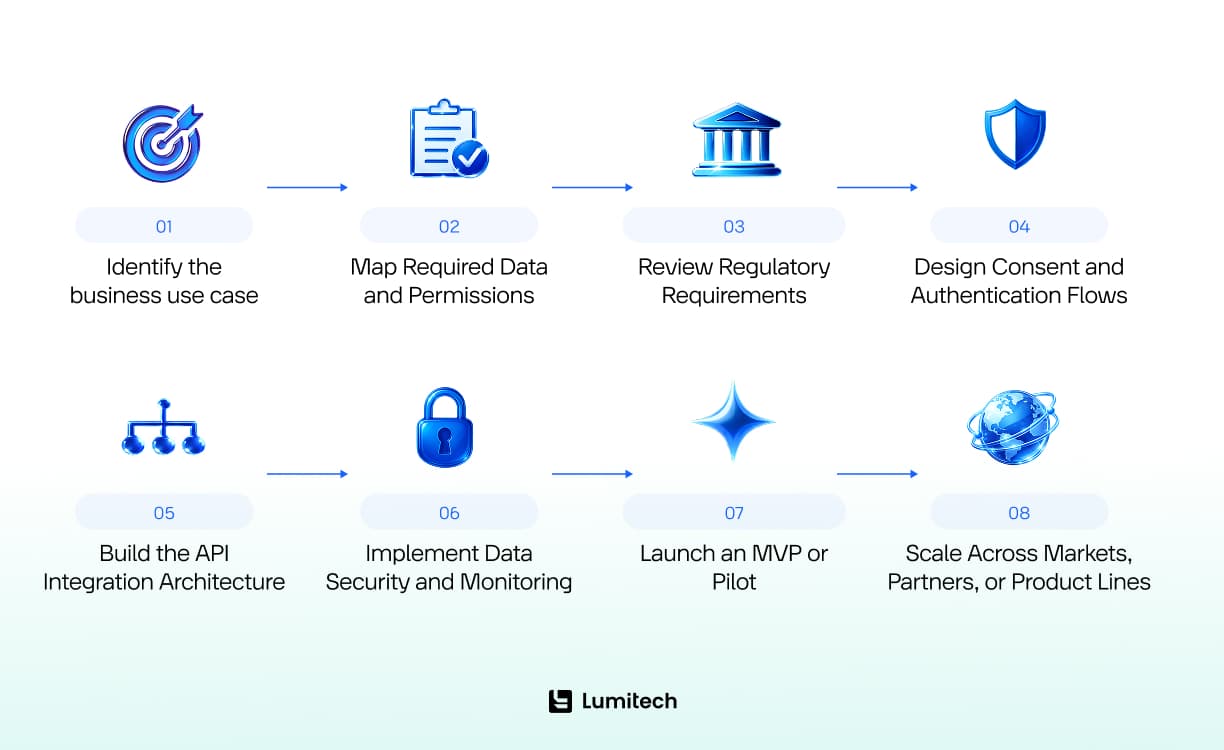
For a business — bank, fintech, or digital platform — actually planning to build in this space, here’s a practical open finance implementation roadmap:
Identify the business use case. Payments, lending, aggregation, onboarding, or embedded finance — pick one clear starting point rather than trying to address all of them at once.
Map required data and permissions. Define exactly what data is needed, why, and for how long, before writing a line of integration code.
Review regulatory requirements for your target market. UAE, Saudi Arabia, Bahrain, or another market — each has different licensing categories and technical standards.
Design consent and authentication flows. Build these as first-class product features, not compliance afterthoughts bolted on before launch.
Build the API integration architecture. Plan for data mapping, fallback logic, and monitoring from the outset, not as a post-launch fix.
Implement data security and monitoring. Encryption, fraud controls, and audit trails need to be production-grade before real customer data flows through the system.
Launch an MVP or pilot with one use case. Prove the model works commercially and technically before expanding scope.
Scale across markets, partners, or product lines. Only once the first use case of open banking and open finance in MENA is validated and stable.
What’s Next: Future of Open Banking in MENA
A few trends look durable enough to plan around when thinking about the future of open banking in MENA and the future of open finance in MENA, based on where the region’s three most advanced markets are heading:
The center of gravity keeps moving from open banking to open finance. Bahrain’s regulator is already signaling this shift, and the UAE built its 2024 framework around open finance terminology from the outset.
Payment initiation use cases will keep expanding. Saudi Arabia’s Payment Initiation Services only went live in September 2024 — this use case is still early in its adoption curve even in the region’s most mature markets.
Embedded finance will grow beyond fintech-branded apps. Expect retail, logistics, real estate, and community platforms to quietly add lending, payments, or insurance built on licensed partners’ access.
Fintech-bank partnerships will deepen. The centralized API hub model in the UAE and Saudi Arabia is specifically designed to make these partnerships easier to form and scale.
SME lending and credit scoring will mature fastest, given the structural credit gap for SMEs across the region.
Cross-border interoperability will slowly mature. The UAE’s participation in the BIS-led Project Aperta, connecting domestic open finance infrastructures across jurisdictions, signals where regional efforts are heading — though this remains a multi-year horizon.
Regulatory maturity will keep increasing, with ongoing amendments rather than a single “final” version of any framework.
The likely shape of the future: open banking trends in MENA and open finance trends in MENA both point toward the same outcome — countries that combine clear regulation, trusted consent frameworks, scalable API infrastructure, and commercially useful fintech products will define the next phase, not simply whichever country moved first or built the most technically sophisticated system on paper.