
AI in Real Estate: Use Cases, Data Requirements, and an Implementation Roadmap
AI in real estate works, but only where the data is complete, consistent, and legally usable. Explore four production use cases, what each one needs, and a five-stage roadmap from data audit to live system.
- AI Integration
November 12, 2026
 AI Overview
AI in real estate is the use of machine learning and language models for property valuation, leasing, lease document extraction, and building operations. Model accuracy depends on data completeness and consistency. Zillow’s valuation model, for example, shows roughly four times higher error on homes without live listing data, so data audits come before model selection.


AI in real estate is the use of machine learning and language models to value property, price, and fill space, read lease and transaction documents, and run buildings. The systems learn from listing feeds, transaction records, lease files, and sensor and meter readings. What limits them is rarely the model. It is whether the underlying property data is complete, consistent, and legally usable. That is why real estate software development services for AI projects usually begin with data integration and cleanup, well before any model is chosen.
In brief:
Four families of AI in real estate are in production: valuation and pricing, leasing and tenant operations, document extraction, and building operations.
Deployment evidence is easy to find; outcome evidence is rare, and most of the savings figures you see published are vendor maxima with no baseline.
Zillow’s published error rates show the same model performing roughly four times worse on homes without live listing data.
Regulation already constrains design, and two widely repeated claims about the EU AI Act are now wrong.
A viable sequence is diagnose, prove, govern, productionise, extend with the data audit before the model.
What Is AI in Real Estate?
The phrase covers three technology families that buyers often treat as one, and each can fail in a different way. Predictive models learn the numeric relationships from the historical records and drift as the market evolves. Language models read and generate text, from lease clauses to maintenance tickets, and fail plausibly, producing a clause summary that reads correctly and is wrong. Control systems act directly on a building and fail physically, with people inside.

Adoption of artificial intelligence in real estate is broad and shallow. In the RICS AI in Commercial Property and Construction Report 2026, drawn from 1,265 commercial property responses among 3,148 professionals worldwide, more than three-quarters reported some AI use but only 6% described widespread or full integration. Deloitte's 2027 Commercial Real Estate Outlook, based on 950 C-level executives and direct reports at owners and investment companies with at least US$250 million under management, surveyed in June and July 2026, found 92% still piloting or researching and 8% integrated.
Neither isolates adoption among 50- to 500-employee property companies, which is worth knowing before borrowing an enterprise statistic to justify a mid-market budget.
AI Use Cases in Real Estate, and What Each One Costs in Data
Most production deployments of artificial intelligence in real estate fall into four families. The table pairs each with the data it genuinely requires, because that determines whether a pilot can scale.
Use case family | What the system does | Data it requires |
|---|---|---|
Valuation and pricing | Estimates value, rent, or close probability | Transaction history with outcomes, property characteristics, live listing signals, consistent area definitions |
Leasing and tenant operations | Answers inquiries, schedules tours, chases renewals, triages maintenance | Lead and conversation history, unit availability, pricing rules, resident records |
Documents and lease data | Extracts terms from leases, amendments, and loan documents | Document corpus with the amendment chain intact, a target schema, labeled examples |
Building operations | Optimizes HVAC and lighting, detects faults, forecasts energy use | Semantically tagged BMS points, equipment register, meter data, setpoint history |
Valuation and Pricing
This is the most mature application of AI in real estate, and the one with the best public evidence. Zillow's Zestimate is a neural network AVM covering more than 120 million US homes, and Zillow publishes and maintains its nationwide median error rate: as of the table’s 30 September 2026 refresh, 1.77% for homes on the market and 7.20% for off-market homes.
That pair is the useful fact: same model, same homes, same market. The only difference is that the on-market properties have the live listing data (asking price, days on market, comparables, etc.). Feature availability rather than model architecture is what accounts for the ~4x difference in accuracy.
A comparative study of AI-based automated valuation models published in the Journal of Property Tax Assessment and Administration in August 2026 found ensemble machine learning outperformed linear regression on accuracy, precision, and equity across datasets from Adams County, Belfast, and Eindhoven. These are mass-appraisal contexts, so the direction transfers more safely than the magnitude.
Leasing and Tenant Operations
Conversational systems that handle inquiries are among the most widely deployed applications of AI in real estate. EliseAI reports more than 600 housing owners and operators on its platform, and Alex Immerman of a16z Growth, which led its 2025 round, said the company “already powers 10% of the U.S. apartment market”. That is an investor’s description of scale, not evidence of outcome.
The caution applies across the category. Yardi describes AI agents spanning leasing chat, video-based unit inspection, and invoice processing, with its customer KETTLER reporting an 86% reduction in invoice processing time, a vendor figure with no baseline or measurement period.
Documents and Lease Data
Lease abstraction is the property sector’s clearest case for intelligent document processing, and the work is a lot harder than the demos would suggest. A commercial lease with amendments and exhibits can be 100 pages or more, and the governing terms are scattered across the original lease and a series of subsequent instruments. So answering “what is the current rent” is a reconciliation rather than a field lookup.
There is a structural reason to organize this data anyway. IFRS 16, effective for annual periods beginning on or after 1 January 2019, and FASB ASC 842, effective for US public companies from fiscal years beginning after 15 December 2018 and for private companies three years later, require lessees to recognize a right-of-use asset and a lease liability. That requires an organization to store dates, term, options, payment schedules, and a discount rate in a system of record rather than in PDFs, and many companies already do that work for accounting and can reuse it.
Building Operations
This family has the most extravagant vendor claims and the thinnest independent validation. The only exception is a peer-reviewed field study from Oak Ridge National Laboratory (published in Energy and Buildings in December 2024), which looked at conventional control, ASHRAE Guideline 36 control, and reinforcement learning control at a commercial test facility in Tennessee. The results were measured as hourly averaged field data rather than annual totals. Guideline 36 reduced HVAC energy by 45% compared to the conventional control and by 66% compared to the reinforcement learning control.
The honest number for an owner is neither. It is the 21 percentage points of that baseline separating reinforcement learning from Guideline 36, because a well-commissioned building already runs closer to Guideline 36 than to the conventional case. The study also measures HVAC energy at one facility, not whole-building energy.
The Benefits of AI in Real Estate are Easier to Claim than to Measure
Across the AI in real estate industry, deployments are reported with a consistent asymmetry: scale is documented, and impact is not.
In 2023, CBRE disclosed that its AI for facilities management had reached 20,000 sites and a billion sq ft. The savings published alongside it, including reductions of “as much as 20%”, are a ceiling quoted in a promotional statement, with no baseline, sample, or named client. JLL’s chief executive told the Q3 2025 earnings call that more than 41% of its “addressable population” used its AI tools daily, a measure of internal adoption rather than client outcomes.
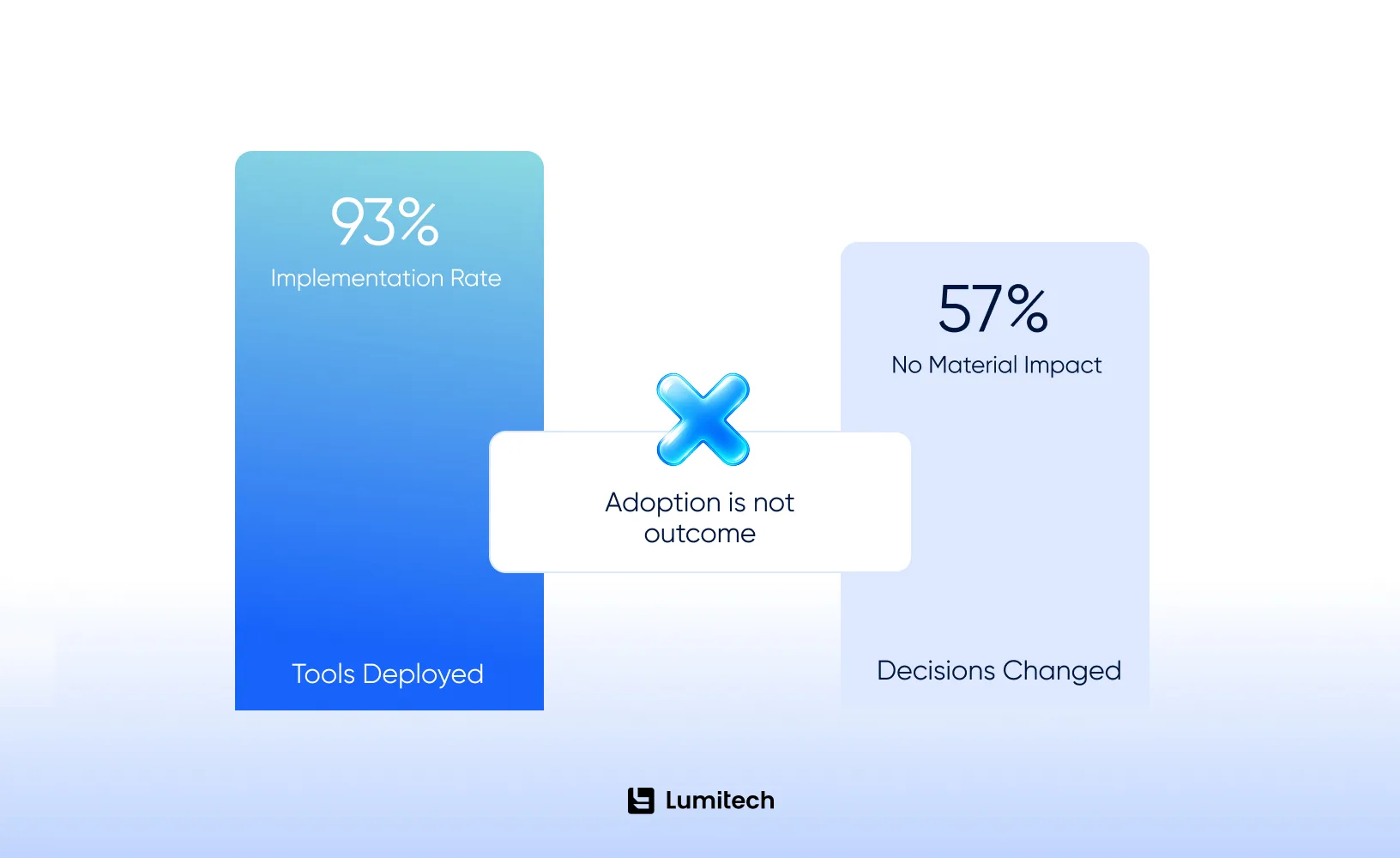
Self-reported experience is more sobering. In the 2025 REALTORS® Technology Report, based on 1,241 usable responses fielded in July 2025, 46% of respondents reported no noticeable impact from AI, against 33% moderately positive and 17% significantly positive. A CBRE survey of more than 200 office occupiers in India, published in August 2026, found that 93% were at some stage of implementation, while 57% said AI had no material impact on their leasing decisions. That survey covers India only, but adopting AI and changing a decision are not the same event.
None of this argues against investment. It argues for measuring your own baseline first, because published figures will not tell you what a system is worth in your portfolio. The realistic benefits of AI in real estate are time recovered on repetitive work, faster document handling, and better-informed pricing, each measurable once you know what the task cost before.
Not sure whether your property data can support an AI use case? Lumitech can run a data audit before any model is built.

Data Requirements for AI in Real Estate
When RICS asked commercial property professionals what was holding AI back in 2026, the first answer was data quality and availability, followed by integration with existing systems and the lack of skilled people. The limiting factor is more often the state of the records than the model, which is why an honest AI readiness assessment starts with the data rather than the use case.
When we start an AI project with a real estate company, we look at the data first, and the model usually comes much later. Listings, leases, and building records tend to sit in different systems with different definitions, so even a simple question like how large a unit is can have three legitimate answers. Sorting that out early saves a lot of rework once the pilot has to run on live systems.


Listing and Transaction Data
In US residential, the RESO Data Dictionary is the only broad field-level schema an ingestion pipeline can target, and it is contractually mandatory for MLSs owned and operated by associations of REALTORS® under NAR’s Handbook on Multiple Listing Policy, which also requires implementing new releases within a year of ratification.
Two details change how you build. RESO states that full adoption of the Data Dictionary is not expected of most organizations and is not required for certification, so a certificate does not imply field coverage, and certification still runs against Web API Core 2.0.0, although 2.1.0 was ratified in December 2023. T3 Sixty’s Real Estate Almanac counted 481 MLSs in the US at the end of 2025. If you then multiply that by optional field adoption, version drift, and per-source licensing, you have the actual integration surface.
Europe has no equivalent: no cross-border listing schema, and no analog to the NAR mandate. The UK has the industry-led Property Data Trust Framework, Germany has OpenImmo as a widely used XML exchange format, and most other markets rely on portal-specific feeds.
Area Definitions, and Why They Break Joins
Square footage behaves like a primitive and is not one. BOMA’s April 2026 standards price list shows four editions of the office measurement standard still in print, from 1996 to 2024, all still in use because a lease references whichever edition was in force when it was signed. The multifamily and hospitality standard has two area methods, and the net method has two levels, so one asset can legitimately have three different area figures. Add IPMS: All Buildings and cross-border portfolios face a three-way conflict. Any per-square-foot feature (be it rent, energy intensity, or a valuation adjustment) will be wrong if the measurement standard, edition, and method don't go with the number as metadata.
Building and Equipment Data
For operations work, building management system points are named by whoever commissioned the building. Brick Schema and Project Haystack are the two semantic schemas in active use, and both continue to version independently.
The standard meant to unify them is unfinished. As of October 2026, ASHRAE’s semantic data model had completed a second public review in June 2026 and was still listed as BSR/ASHRAE Standard 223P, with the P marking it as proposed rather than published, eight years after ASHRAE, Haystack, and Brick announced their collaboration.
The effort is documented. A Lawrence Berkeley National Laboratory and UC Berkeley team that built Brick models for more than ten existing commercial buildings called the work costly and labor-intensive, and named understanding the buildings’ data streams as the major bottleneck. Their argument for doing it is reuse. Handover data has a parallel gap, since COBie is still a draft at version 3 and its System table is required only by contract.
Where energy data matters, ENERGY STAR publishes an unusually explicit minimum: to generate a score, meters must cover all energy use for all fuel types in the whole building regardless of who pays the bills, with at least twelve consecutive calendar months of data. Tenant-metered fuel is usually why a portfolio cannot meet it.
How Much History Does a Model Need?
There is no defensible general answer, and the citable minima are procedure-specific. The IAAO’s Standard on Automated Valuation Models specifies at least five sales, and desirably fifteen, per independent variable, and requires testing against sale prices excluded from calibration. Its Standard on Data Quality scores data at 90% or above as good and below 80% as poor, and its worked example puts land square footage, sale quarter, building age, and basement finish at the top of the elements whose errors most degrade uniformity. Both of those are advisory US assessment standards. For demand forecasting or predictive maintenance, there is no public benchmark, so any figure you are given is just a planning heuristic.
One structural change is worth planning around. The redesigned Uniform Residential Appraisal Report replaces free-text addenda with discrete, repeatable fields, and UAD 3.6 becomes mandatory for new reports submitted to UCDP on or after 2 November 2026, with a temporary exception available on application to 19 May 2027 and UAD 2.6 retired on 28 June 2027. Records on either side of that cutover are not directly comparable.
What Regulation Already Constrains AI in the Real Estate Industry
AI compliance in real estate isn’t waiting for future legislation, and two widely repeated claims about the EU AI Act are no longer accurate — reason enough to assess your AI readiness against what applies today rather than what was announced.
The high-risk deadline moved. Regulation (EU) 2026/1744, the Digital Omnibus on AI, entered into force on 27 July 2026. The obligations for Annex III high-risk systems now apply from 2 December 2027, and Annex I product-embedded systems from 2 August 2028.
Annex III does not list private tenant screening. Within Annex III point 5, the binding entries closest to property are creditworthiness assessment and credit scoring, and public authority decisions as to eligibility for essential public assistance benefits (the recitals go on to list social and housing assistance as examples of such benefits). Mortgage or consumer credit scoring is the clearest route for a property business to acquire high-risk obligations. There is no mention of a private tenant screening tool that would check references, income documentation, or payment history, although one which produces or uses a credit score could be included.
What already applies to most property AI is Article 50 transparency, in force since 2 August 2026: any system interacting with a person must state that it is an AI, providers of generative systems must mark the synthetic output in machine-readable form, and deployers of deep fakes must disclose them. Generative systems placed on the market before that date have until 2 December 2026 to meet the Article 50(2) marking requirement, which matters for AI-written listing copy, enhanced photography, and virtual staging.
US rent pricing law turns on competitor data, not on AI. In its case against RealPage, the Department of Justice alleged that nonpublic, competitively sensitive data from landlords’ property management systems was used both to price competing landlords’ units and to train the models. The proposed final judgment would bar that data at runtime, require training data at least twelve months old and not drawn from active leases, keep the covered models from resolving geography more narrowly than a state, and require symmetrical guardrails. A final judgment has been entered against Greystar; as of late October 2026, the RealPage judgment is still proposed.
That has an effect on architecture. A model trained solely on the portfolio of one owner is in a very different position than one that draws on the data of a number of unaffiliated owners, and state and city law draws that line in different places.
Have an AI project in mind?
Tell us about the use case and the data behind it, and we will outline the integration work, the governance decisions, and a realistic first step.
How to Use AI in Real Estate: a Five-Stage Implementation Roadmap
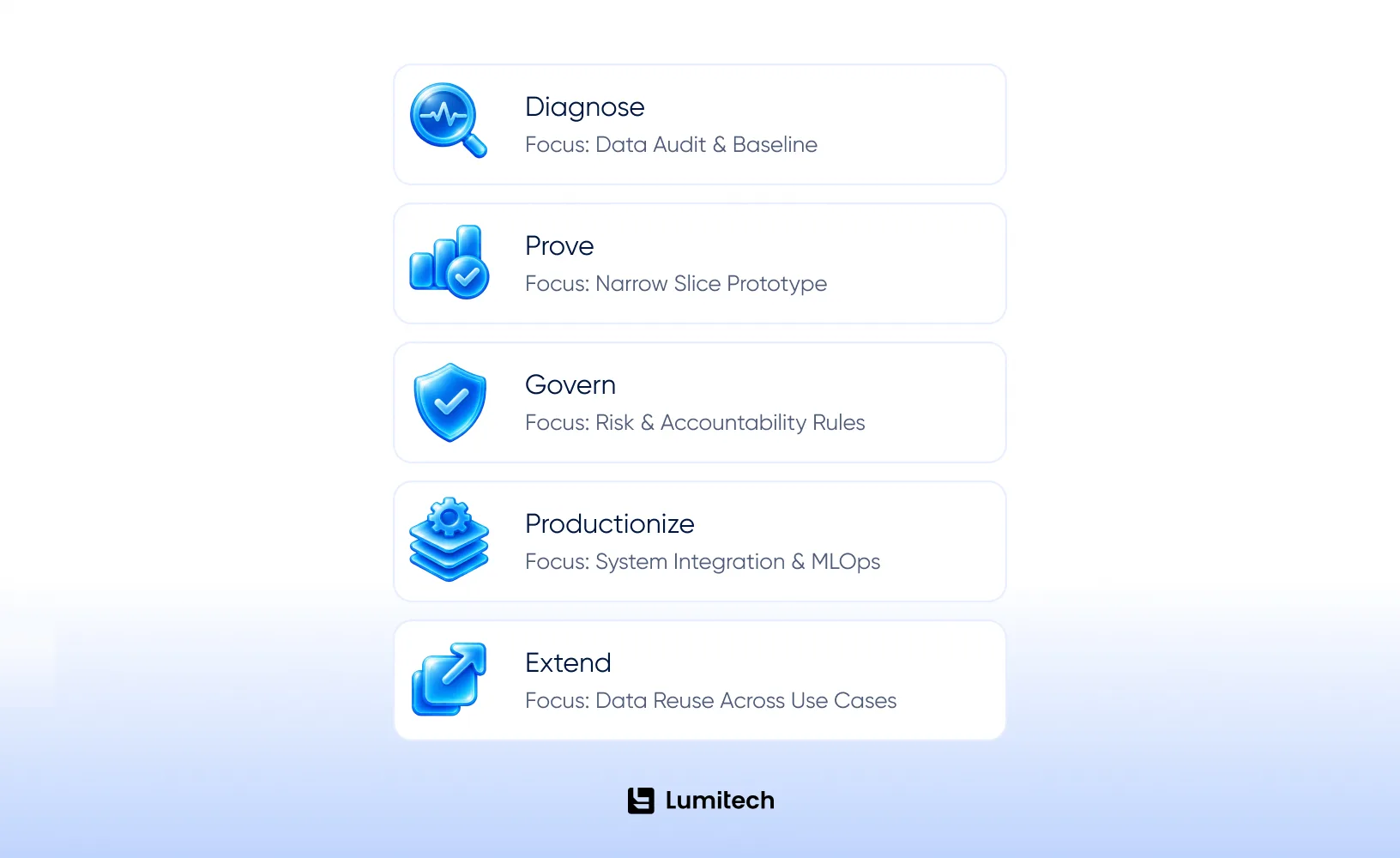
Deciding how to use AI in real estate is largely a sequencing problem, and the order below reflects where the constraints above bite. Treat the stage boundaries as decision gates rather than as a schedule. There is no published benchmark for how long any of the stages will take at mid-market scale, so any timescale you’re given is purely a planning heuristic until you’ve tested it against your own systems.
1. Diagnose before you model. Pick a decision that is made repeatedly, with a measurable current cost and a recorded outcome. Audit the data it’s based on: what fields are there, how fully do the sources populate them, do the identifiers reconcile, and have historical outcomes been captured? Record your baseline now, as you absolutely cannot demonstrate any improvement later on without it. If the audit shows the data simply can’t support the decision, then you’ve had a successful stage in that you’ve fixed the foundation via data engineering services rather than having to go back and fix the same problem after a model has already been built.
2. Prove value on a narrow slice. Build against one asset class, one region, one document type. Validating an AI proof of concept means defining success in the business’s terms before you start, holding out a test set the model has never seen, and scoping the prototype cheaply enough to abandon.
3. Decide governance while the system is still small. Teams often skip this stage, and the Deloitte survey suggests the field is weakest here: 72% of respondents completed preliminary data mapping and source verification, but fewer than half implemented stronger controls such as challenger models, exception handling, or detective controls. Decide which decisions the system may make alone, which require review, and who is accountable.
4. Productionize, which is mostly engineering — in property companies, mostly AI integration services, because the model has to reach systems never designed to feed it. The reason systems fail after a successful pilot was documented prior to the current wave of models: Sculley and colleagues’ Hidden Technical Debt in Machine Learning Systems identified entanglement, hidden feedback loops, undeclared consumers, and pipeline jungles. The companion ML Test Score rubric adds a useful rule: readiness equals the weakest of the data, model, infrastructure, and monitoring dimensions. For language-model and agent features, the OWASP Top 10 for LLM applications is the reference most engineering teams accept.
5. Extend deliberately. Reuse is where the data investment pays off: a semantic building model serves fault detection, control optimization, and comfort analysis, and a lease dataset built for accounting serves abstraction, renewal forecasting, and reporting. Extend along the data that you’ve already made trustworthy rather than along the use case that did the best demo.
The use of AI in real estate rarely stalls on model selection. It stalls where fragmented property data meets systems never designed to exchange it, an integration and data engineering problem before it becomes a machine learning one. Lumitech has built AI against that kind of data, including an AI-native CRM for real estate deal management whose scoring layer worked across active pipelines, client records, and historic transactions. Our real estate software development team can complete the data audit and select use cases before building any model.


