
Beyond the Hard Hat: How to Use AI for Workplace Safety Today
In the world of industrial safety, we’ve spent decades relying on the “Safety Third” irony, usually right after “Profit First” and “Meeting the Deadline Second.” But in 2026, the game has changed.
- Industrial
- AI Development
March 10, 2026
 AI Overview
Creating a safer workplace is no longer just about compliance. Organizations are increasingly using AI to reduce operational risks, improve incident prevention, and gain real-time visibility into safety conditions across construction sites, warehouses, and industrial facilities.

If you’ve ever walked a factory floor, you know the drill: the safety officer turns the corner, and suddenly, like a synchronized dance troupe, everyone’s goggles slide down from their foreheads to their eyes. It’s safety theater, and it’s dangerous.
Most safety teams already know these patterns. The hard part is seeing what’s going wrong consistently, across shifts, across facilities, and across the thousands of micro-moments that never make it into an incident report.
That’s where AI-powered workplace safety monitoring is becoming genuinely useful: computer vision systems that detect PPE compliance, zone breaches, and proximity risks in real time, and give clear insight into “when, where, and how often.”
This article breaks down how AI workplace safety systems work, what “good” deployment looks like (especially on edge cameras with privacy safeguards), the common traps, and the most exciting stuff — return on investment.
The Anatomy of AI for Workplace Safety: PPE Detection 2.0
In 2026, detecting a hard hat is the “Hello World” of safety AI. It’s the bare minimum. Modern systems have evolved into high-context engines that understand the nuance of a workspace. This isn't just a software layer; it is the sophisticated application of AI in mechanical engineering that allows systems to understand the physical constraints of machinery and how human 'pose estimation' skeletons interact with those moving parts.
Beyond presence: contextual compliance
Old-school detection systems would flag a worker for not wearing a mask, even if they were alone in an outdoor parking lot. That’s how you get employees to hate technology. Today’s artificial intelligence for workplace safety uses Contextual Logic Gates. The AI integrates with your facility’s digital twin. It knows that a worker in “Zone A” (Assembly) needs safety glasses and a vest, while “Zone B” (Loading Dock) requires a hard hat and steel-toes. If a worker crosses the invisible line without the right gear, the system flags it. If they’re in the breakroom? The AI minds its own business.
Modern neural networks, trained on millions of synthetic and real-world images, can detect whether a chin strap is unbuckled or whether a high-visibility vest has lost its luminance due to dirt and wear. According to Avigilon’s 2026 Safety Outlook, real-time identification of these “micro-violations” reduces the risk window from hours to milliseconds.
The technical “How”: YOLOv10 and beyond
We’ve moved past basic CNNs (Convolutional Neural Networks). We are now deploying architectures like YOLOv10 (You Only Look Once) and specialized Pose Estimation models. These allow the system to:
Identify the human “skeleton.”
Map PPE “anchors” (head, hands, torso).
Confirm the “state” of the PPE (on, off, or incorrectly worn).
Humor Note: Let’s be honest, AI is now better at spotting an unbuckled helmet than your site supervisor is at spotting a free donut in the breakroom. And the AI doesn’t get distracted by sports scores.
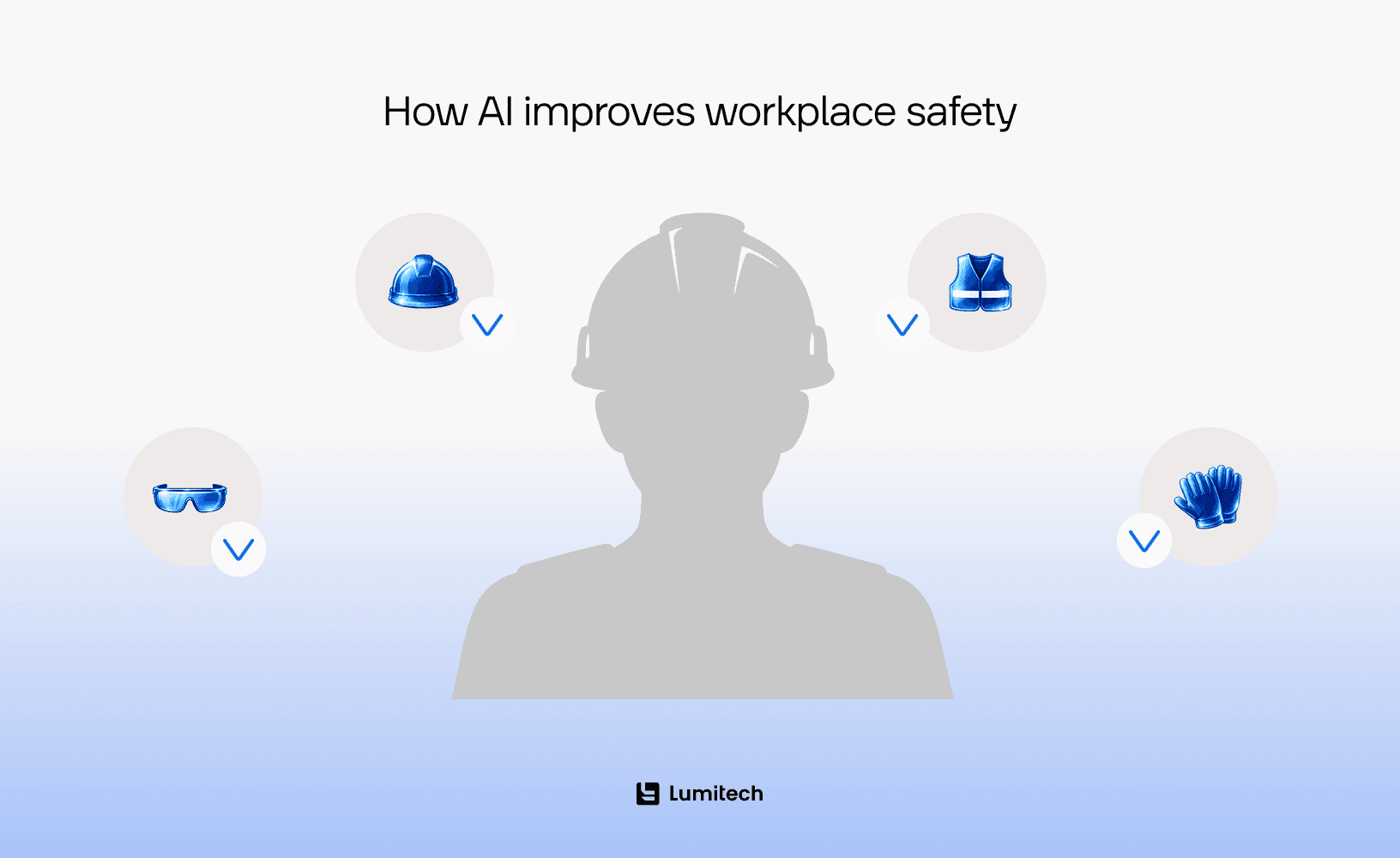
How AI Improves Workplace Safety: Detecting PPE, Zone Breaches, and Proximity Risks
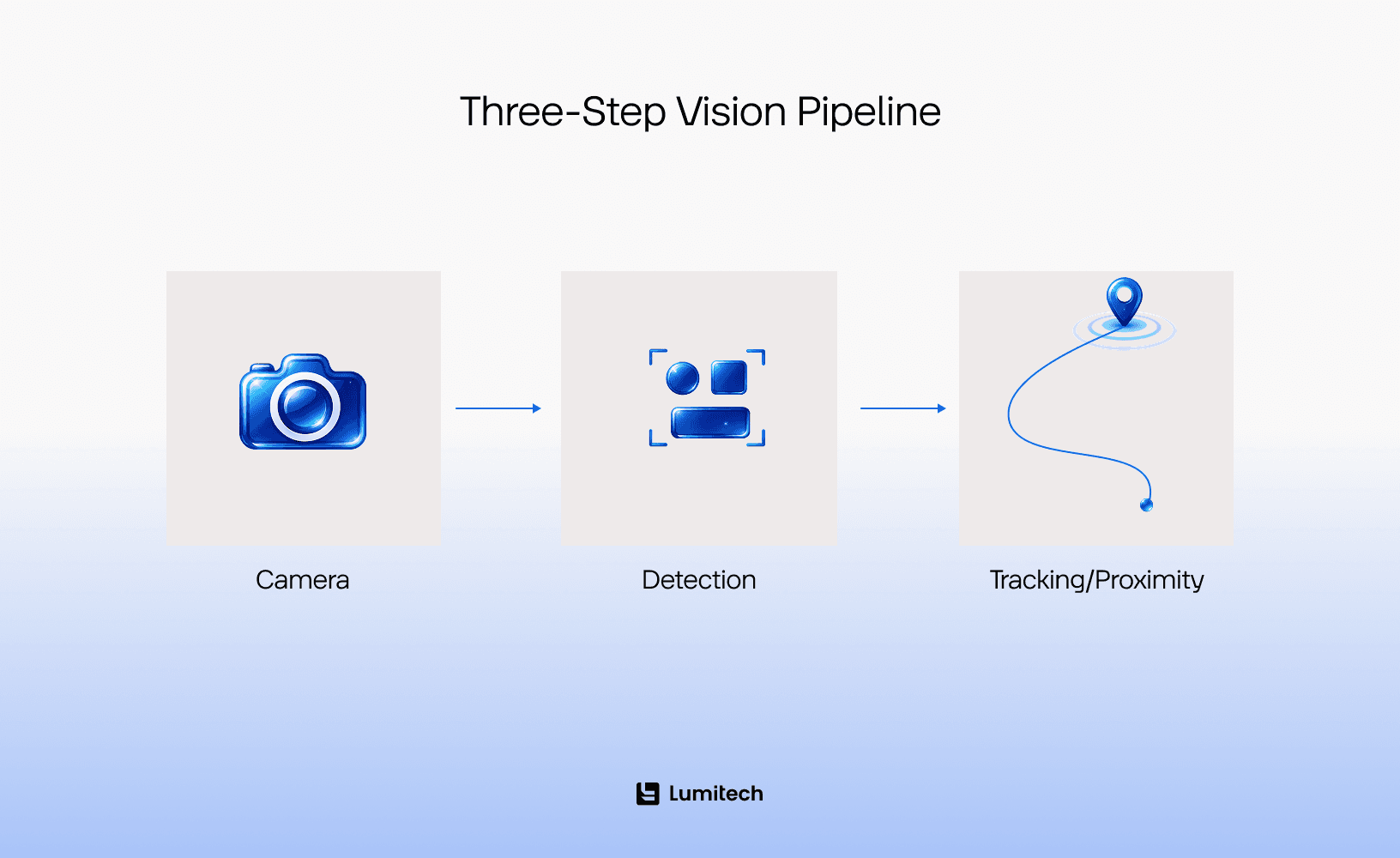
Under the hood, most systems combine a few core capabilities:
AI workplace safety examples: object detection
AI solutions for workplace safety detect items like person, hard hat, safety vest, forklift, safety glasses. PPE detection has become an active research area, with approaches commonly built on object detection architectures (e.g., YOLO-family models) tailored to industrial settings.
Tracking
Tracking maintains identity within the video stream (not necessarily identifying the worker as a person) so the system can recognize ongoing noncompliance:
A worker enters without a helmet and stays without a helmet for 45 seconds
A forklift approaches a crossing pedestrian, and the distance shrinks rapidly
This is critical because safety isn’t a single frame; it’s motion and context.
Geofencing/virtual safety lines
Zones are defined as polygons in the camera view:
Restricted machine areas
Forklift routes
“No-go” zones near loading docks
When an object’s tracked position crosses a boundary, the system triggers a zone breach.
Need a pilot plan that gets real-time PPE and proximity alerts working, without turning safety into surveillance?

Proximity Alerts: Mapping the “Invisible Fence”
If PPE is the last line of defense, proximity monitoring is the first line of prevention.
The Red Zone paradox
In heavy industries like mining and construction, the most dangerous place to be is near moving “yellow iron.” Traditional proximity systems relied on RFID tags or Bluetooth beacons. The problem? If a worker forgot their tag, they became invisible to the machine.
Computer Vision (CV) removes the tag dependency. Using 3D depth-sensing cameras and LiDAR fusion, AI creates a dynamic “Safety Bubble” around machinery.
Dynamic Geofencing: As a forklift moves, its “Red Zone” moves with it. The AI for workplace safety calculates the stopping distance based on the machine's current velocity and floor conditions (detected via moisture sensors).
Predictive Pathing: This is the “secret sauce.” The AI doesn't just alert when a human is in the way; it alerts when a human is on a trajectory to be in the way. It’s the difference between a “near miss” and a “non-event.”
Deployment of AI workplace safety solutions on the edge
To make this work, we can't wait for data to travel to a cloud server in another country. We use Edge AI. A typical edge architecture looks like a modern product stack — and it’s a great example of AI in SaaS development meeting on-site operations.
Technical Deep Dive: By processing video feeds directly on the camera or a local ruggedized gateway (using hardware like NVIDIA Jetson Orin), we achieve latencies under 50ms. In safety, that’s the difference between a triggered E-Stop and a tragedy.
Near-Miss Analytics: The “Crystal Ball” of Safety
One of the most valuable (and underutilized) features of AI in workplace safety is Near-Miss Analytics. For every one major accident, there are usually 300 near-misses that go unreported. Why? Because Dave doesn't want to fill out a 4-page PDF just because he almost tripped over a stray cable.
AI doesn't find paperwork tedious. It records every stumble, every sudden swerve, and every unauthorized entry into a zone.
Heatmapping Risk: Over a month, the system might show that 80% of near-miss incidents occur in the North-West corner of the warehouse between 3:00 PM and 4:00 PM.
Root Cause Identification: Is it poor lighting? Shift-change fatigue? A blind spot in the racking?
Auditable Alerts: These logs provide an indisputable record for OSHA 2026 compliance, which now places heavy emphasis on electronic recordkeeping (see OSHA’s 2026 Reporting Requirements).
AI Workplace Safety Examples: How Does AI Detect High-Risk Employees or Behaviors?
This question is important because it’s also where deployments can go wrong. The safest (and most effective) answer is: AI should identify high-risk situations and patterns, not label “high-risk employees” as a permanent category.
What “high-risk” looks like in practice
AI systems surface leading indicators such as:
Repeated PPE noncompliance in a specific area
Elevated near-miss frequency at a crossing point
Increased zone breach rates during night shifts
Forklifts exceeding safe speeds in a defined lane
Recurring unsafe approach distances near a machine
These insights are behavioral and environmental patterns, exactly the kind of thing human audits often miss due to limited sampling.
Risk scoring that doesn’t turn into a witch hunt
If you do assign risk scores, keep them:
Event-based (this event is high-risk)
Time-bounded (last 7/30/90 days)
Contextual (by zone, shift, workflow)
Actionable (what intervention reduces it?)
A better model is “This zone has a persistent PPE gap + near-miss clustering during shift change”, not “This person is a problem.” You want prevention, not paranoia.
Privacy Safeguards: Protecting Employee Data with AI Solutions for Workplace Safety
If your workplace safety AI technology becomes a privacy incident, you’ve simply traded one risk for another.
A responsible deployment starts with the premise that video is personal data when people are identifiable, and that monitoring must be proportional, transparent, and purpose-limited, especially in workplaces where power dynamics make “consent” tricky. Guidance on video data processing emphasizes avoiding unexpected uses (such as performance monitoring), limiting the purpose, and implementing safeguards.
Here are practical safeguards that show up in mature deployments:
1) Data minimization by default
Process on edge where possible
Store only event metadata unless a short clip is essential for investigation
Define strict retention windows (e.g., 7–30 days for events; less for raw video)
Disable audio unless there’s a clear legal basis and purpose
NIST’s privacy guidance and frameworks emphasize managing privacy risk through governance and engineering practices (including minimization and manageability).
2) Privacy-preserving visuals
Face blurring or full anonymization for standard reporting
Render silhouettes or stick figures for trend analytics (where feasible)
Store cropped regions showing PPE noncompliance without full scene context
3) Role-based access + audit logs
Only EHS and designated investigators can access clips
Every view/export is logged
Export requires a reason code
4) Clear policy boundaries: safety ≠ performance monitoring
A strong policy explicitly prohibits productivity scoring, performance grading, or repurposing safety videos for AI sentiment analysis for HR.
This matters because regulators have shown concern about disproportionate workplace monitoring, particularly when biometrics or identity-linked tracking is involved.
5) DPIA / impact assessment and worker communication
If you operate in jurisdictions with GDPR-style obligations, you’ll likely need:
A documented impact assessment
Transparent notice (what’s monitored, why, how long retained)
A way for workers to raise concerns
The UK ICO’s guidance on monitoring at work emphasizes practical steps for lawful, fair monitoring and impact assessment.
Being explicit here prevents safety tooling from drifting into an HR decision-making platform by accident — or by temptation.
If you’re planning a pilot and want it to be fast, privacy-safe, and measurable, we can help you design it.
ROI and Compliance of Artificial Intelligence for Workplace Safety
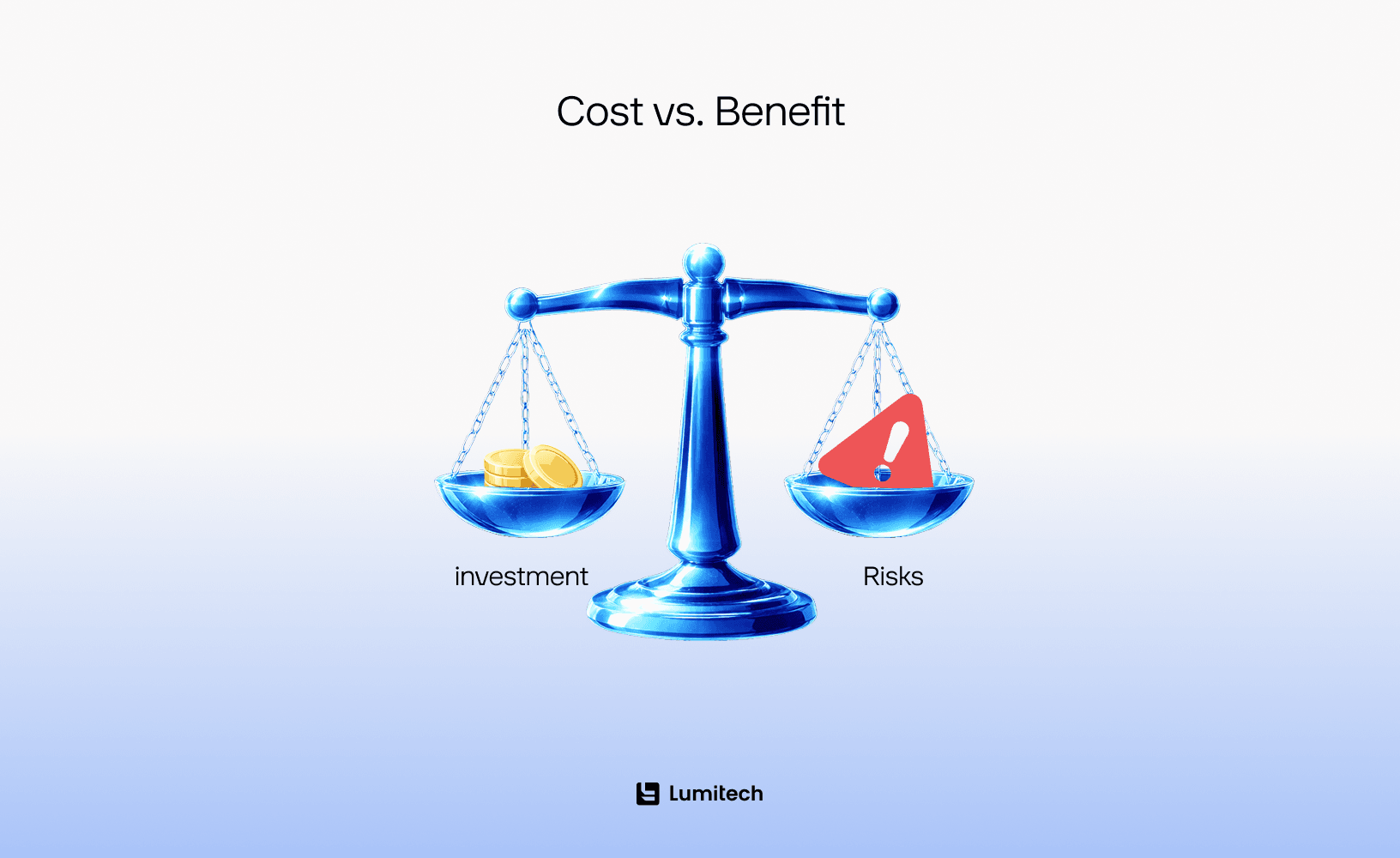
Safety is an investment, but the CFO wants to see the return. In 2026, the ROI of AI workplace safety solutions is no longer theoretical.
The Financial Logic
Direct Cost Savings: The average “recordable incident” in the US now costs upwards of $50,000 in direct costs (medical, legal, fines). Preventing just two incidents a year often pays for the entire AI deployment.
Insurance Premium Reductions: Major insurers are now offering “Tech-Enabled Discounts.” Companies that can prove 24/7 AI monitoring are seeing 15–25% reductions in workers' comp premiums.
Productivity Gains: Manual safety audits take up to 20 hours of a supervisor’s week. Automating this frees them up to actually train and lead, not just patrol.
According to a 2026 ISEE Vision study, the typical payback period for a mid-sized manufacturing facility is 7 to 12 weeks.
Quantifying Results: Incident Reduction and Compliance Improvements From Pilot to Scale
There is no universal “AI solutions for workplace safety reduce accidents by X%.” Your results depend on:
Baseline safety culture
Camera placement and coverage
How often alerts lead to real intervention
What risks are you monitoring (PPE vs traffic vs machine guarding)
Whether you fix root causes or just chase symptoms
That said, there are credible case studies reporting substantial reductions in unsafe acts/conditions, and in incident rates after deploying computer vision safety systems, often within weeks to months.
Examples reported publicly include:
A case study describing a 90% reduction in unsafe acts and conditions within six months for a manufacturer using an AI safety platform.
A Protex AI case study showing a 62% reduction in safety events for a UK packaging manufacturer.
A Protex AI case study describing reduced overall incidents by 80% in an early deployment period (10 weeks) at Marks & Spencer warehouse operations.
Treat these as directional signals, not guarantees.
Realistic pilot-to-scale measurement plan for implementing artificial intelligence for workplace safety
Phase 1: Pilot (4–8 weeks)
Goal: prove detection reliability + operational workflow
Choose 1–3 high-risk zones (forklift crossings, loading docks, machine areas)
Define 3–5 event types (e.g., helmet missing, vest missing, zone breach, proximity threshold)
Establish baseline rates
Set alert thresholds conservatively (reduce false alarms)
Confirm privacy controls + access rules
KPIs:
Precision/false alert rate
Time-to-acknowledge alerts
Time-to-correct behavior
PPE compliance % by zone/shift
Near miss frequency trend
Phase 2: Controlled expansion (2–3 months)
Goal: show outcome impact (leading indicators)
Add cameras in adjacent zones
Introduce “root-cause interventions” (barriers, signage, routing, training)
Compare trends between monitored and unmonitored zones (where feasible)
KPIs:
Reduction in repeated violations
Reduction in near misses in hotspots
Improvement in compliance during historically weak periods (night shift, shift change)
Over time, that reporting becomes a turnaround tracker for industrial sector teams — showing whether interventions are actually reducing risk week over week across sites.
Phase 3: Scale (3–12 months)
Goal: tie to lagging indicators (recordables, claims, downtime)
Standardize playbooks across sites
Integrate with EHS reporting tools
Build monthly executive reporting that links risk reduction to business outcomes
KPIs:
TRIR / recordable incident trend (site-by-site)
Severity reduction (lost-time incidents)
Audit nonconformities reduced
Training impact (post-training compliance uplift)
Scaling across sites is less about the model and more about disciplined industrial software development: standardization, integrations, and change management.
A key insight about how AI improves workplace safety from teams that succeed: The model doesn’t “reduce incidents.” Your response system does. AI just ensures you’re reacting to reality, not guesswork.
Common Pitfalls and How to Avoid Them
Pitfall 1: Alert storms
AI and safety in the workplace present an obvious fatigue risk. If your system generates too many low-value alerts, humans will “mute” it mentally.
Fix: tune thresholds, prioritize severity, and measure alert usefulness (did it lead to action?).
Pitfall 2: Treating AI for workplace safety as enforcement instead of prevention
If workers see the system as a surveillance tool to punish, they’ll route around it — literally.
Fix: communicate intent (“get everyone home safe”), involve safety committees, design privacy safeguards, focus on systemic fixes.
Pitfall 3: Ignoring the environment
Bad lighting, occlusions, dirty lenses, camera angles, and reflective PPE — all impact performance.
Fix: a site survey, test camera placement, and a model monitoring plan (drift happens).
Pitfall 4: Overreaching into biometrics
Identity tracking and facial recognition are not required for PPE detection, and can dramatically increase legal and ethical risk.
Fix: default to non-biometric designs unless there is a clearly justified safety necessity (rare).
The Future of AI in Occupational Health and Safety
The next wave of AI and safety in the workplace is less about “detect helmet” and more about predict and prevent.
Here are the trajectories that are becoming realistic:
1) From detection to predictive risk
AI workplace safety solutions will shift from counting violations to predicting hotspots:
“Near misses spike when inbound deliveries overlap with shift change.”
“Glove noncompliance rises after 2 hours in high-heat areas.”
The next step is essentially building a real-time forecasting system logic for safety: risk heatmaps that update continuously as conditions change.
2) Multi-sensor safety intelligence
Computer vision will combine with:
Access control logs
Vehicle telematics
Wearable proximity tags (where appropriate)
Environmental sensors (noise, air quality, temperature)
3) Near-miss analytics as a standard management metric
Near misses are already recognized as valuable signals for prevention; AI for workplace safety makes them measurable at scale.
4) Stronger governance and regulation
If you operate in Europe or sell into Europe, keep an eye on AI governance requirements. Certain AI uses in employment contexts are treated as high-risk categories under emerging frameworks, with obligations around risk management, transparency, human oversight, and documentation.
Translation: “We built it fast” won’t be enough. You’ll need “We built it responsibly.”
A Practical Deployment Checklist
Technical
camera placement survey (lighting, occlusion, angle)
edge inference plan (latency + bandwidth)
event definitions + thresholds per zone
alert routing + escalation policy
model performance monitoring (false positives/negatives)
Operational
who responds to alerts and how fast
corrective action workflow (log → intervene → verify → close)
weekly hotspot review meeting
training + signage updates linked to insights
Privacy + governance
Purpose limitation (safety only)
Data minimization + retention policy
Access controls + audit logs
Worker notice + consultation
Impact assessment (where required)
AI risk governance structure (e.g., NIST AI RMF approach)
If you do all of that, the AI workplace safety implementation gives a desirable result: an extra set of eyes, not Big Brother with a clipboard. This is where experienced AI development services matter: reliable detection, edge deployment, and governance, not just a demo.
Conclusion
Workplace safety has always been a game of attention, and attention doesn’t scale. People get tired, shifts change, and the riskiest moments are often the quickest ones: a missing helmet, a shortcut through a restricted zone, a forklift that comes a little too close.
Artificial intelligence for workplace safety helps because it turns safety from periodic observation into continuous visibility. PPE detection, zone breach alerts, and proximity warnings don’t replace safety culture; they reinforce it with facts, speed, and consistency. They surface patterns humans can’t reliably catch across hours and locations, and they give teams a chance to intervene before a near miss becomes an incident.
The real value, though, isn’t being able to say “we use AI.” It’s building the right system around it: alerts that are useful instead of noisy, edge deployment that keeps latency low and privacy protections strong, and auditable records that make compliance easier rather than harder. Done responsibly, this isn’t surveillance — it’s prevention.
Because the goal was never to catch people doing something wrong. It’s to help everyone go home safe, every single day.


