
How AI Anomaly Detection Finds What You Didn’t Know to Look For
When is a problem already costing money? Often, before anyone sees it as urgent. Fraud and system failures usually start with faint signals. AI anomaly detection helps teams spot unusual patterns before they become bigger business issues.
- AI Development
April 24, 2026
 AI Overview
Most costly business problems do not appear all at once. Fraud, system failures, security incidents, and operational inefficiencies often begin as small deviations hidden within large volumes of data. AI anomaly detection helps organizations identify these signals early, distinguish meaningful risks from routine noise, and respond before minor issues become major losses. The ability to detect unusual behavior in real time has become a valuable capability across finance, cybersecurity, manufacturing, logistics, and other data-intensive industries.

Detecting unusual behavior is no longer the difficult part; most platforms can already do that. The harder question is whether an alert reflects a real issue or adds to the background noise. That is where teams still lose time. The 2025 SANS Detection and Response Survey makes the point clearly: 73% of respondents identified false positives as their main detection problem, 60% pointed to data volume, and more than 60% said false positives are a frequent part of daily work.
That is the operating reality for many teams. Logs, metrics, traces, and behavioral signals now accumulate faster than they can be reviewed by hand. In that kind of environment, serious problems rarely arrive as fully visible failures. More often, they begin as small deviations - easy to dismiss in the moment, but expensive to ignore.
AI anomaly detection has clear business value in that context. As one of the more practical applications of AI and ML development services, it helps teams separate meaningful signals from routine variation and act while there is still time to limit operational or financial impact.
What is AI Anomaly Detection?
AI anomaly detection is built to identify patterns that fall outside the normal behavior of a system, process, or market. In many cases, those patterns are the first sign that something is beginning to shift in the wrong direction, even before the issue becomes visible in a conventional alert.
That is where it differs from rule-based monitoring. Rather than relying on fixed if-then thresholds, AI interprets signals in context. It uses historical behavior, related variables, and changing conditions to distinguish routine variation from events that may require attention.
What Counts as an Anomaly
An anomaly is not simply a value that looks unusual. It is a break from expected behavior that matters in a specific business context. The same signal can be harmless in one situation and critical in another, which is why anomaly detection is less about spotting outliers and more about understanding how reality differs from the system’s normal operating pattern.
Contextual anomalies appear suspicious only when context is considered. A payment amount may be ordinary, while the time it was made, the user’s location, or the device used may raise concern.
Collective anomalies are a series of events that may look harmless one by one, while the overall pattern points to a problem. For example, a user journey in an app may reveal a technical failure or an attack.
Hidden trends, or drift, develop more gradually. A service metric may shift gradually, with no obvious incident at first, until the change becomes large enough to indicate the system is moving out of its healthy range.
Failure precursors are early physical signs of wear. Small changes in vibration or temperature may not seem serious on their own, but they can indicate equipment degradation long before a breakdown occurs.
Runtime errors are another common case. A release may pass every automated test, yet unusual log behavior in production can still show that something is not working correctly. What connects these cases is the baseline. A signal becomes anomalous when it no longer fits the profile of normal behavior built from real operational data. This moves monitoring beyond the reactive question “What has already broken?” toward a more useful one: “What is beginning to move in the wrong direction?” In practice, that difference is critical. It gives teams time to respond before a technical issue becomes a financial loss, a security incident, or reputational damage.
Anomaly vs Noise
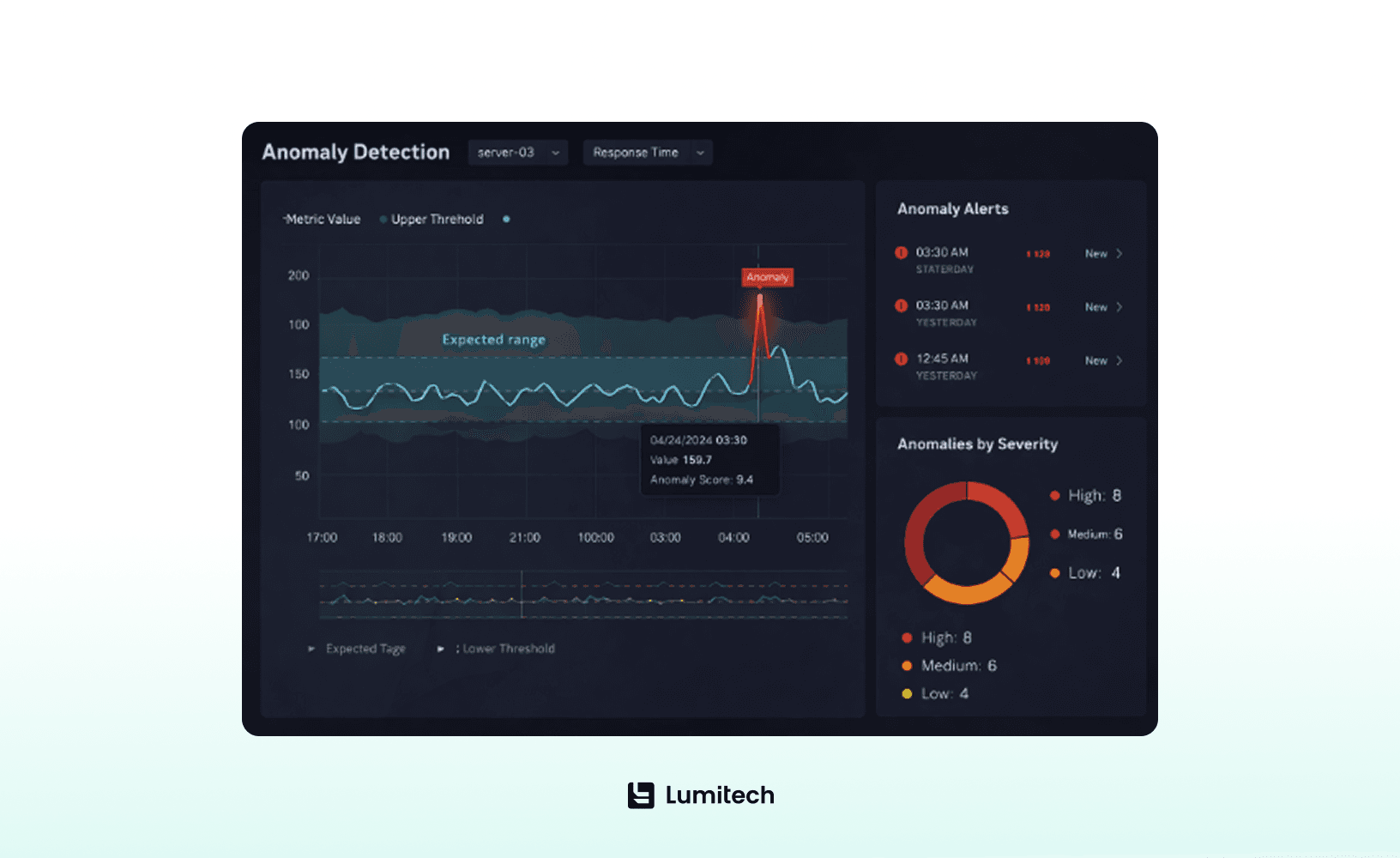
Noise is the natural movement of a living system. Traffic shifts, latency changes, and queues grow and shrink. Most of these fluctuations are harmless. The problem starts when the pattern no longer matches the context. A spike during a product launch can be a healthy sign of demand. The same spike at 3 a.m., with no release, campaign, or known increase in load, may signal a real issue. Static thresholds miss this nuance. They only see that a number crossed a line, not whether that movement makes sense.
Why AI Anomaly Detection is Different from Rule-based Monitoring
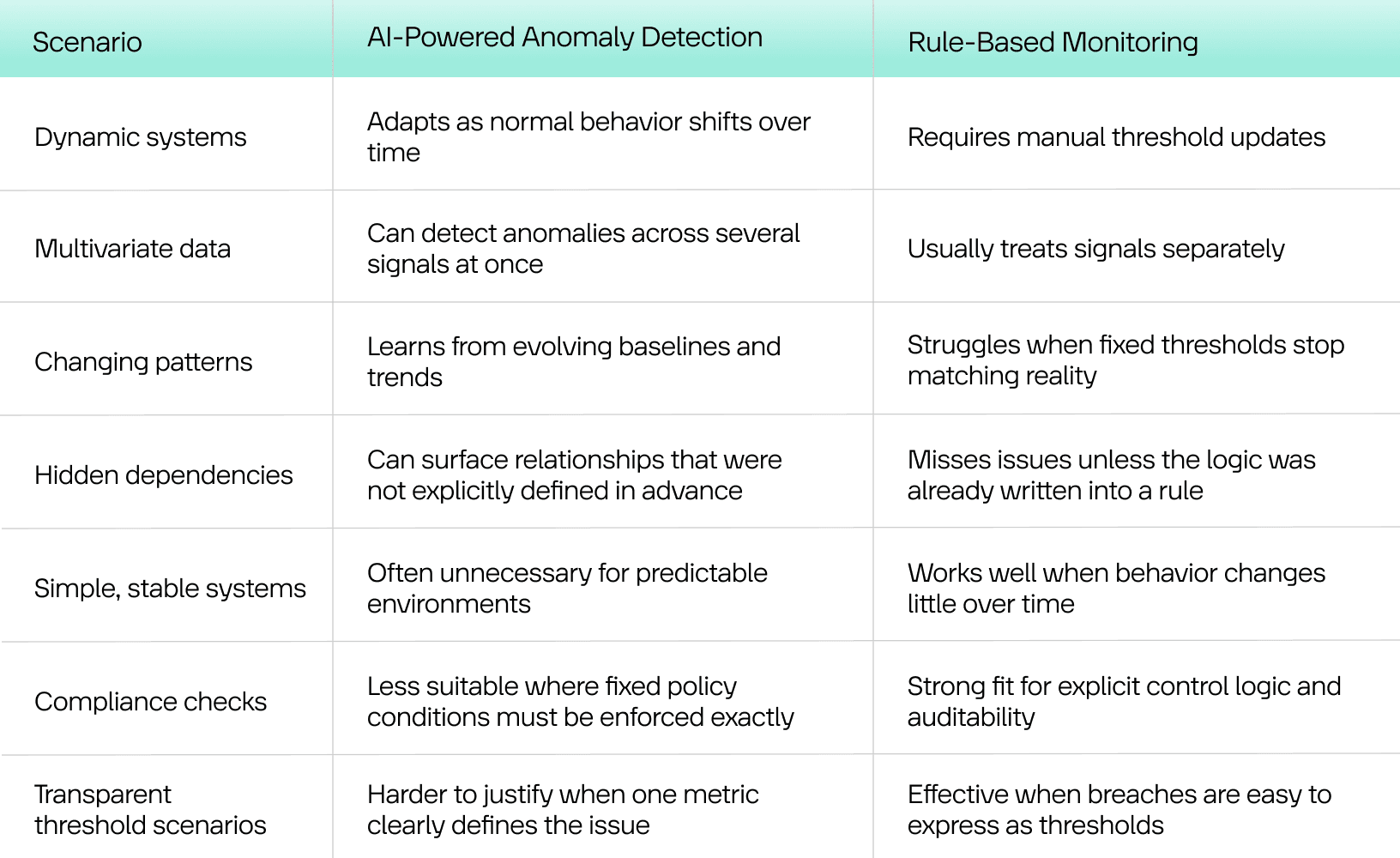
Rule-based monitoring is uncomplicated: a rule either matches or it does not. AI-based anomaly detection works differently. In anomaly detection, AI helps teams judge whether a deviation is meaningful enough to investigate, not just whether it happened. That matters because most real-world anomaly detection is not black-and-white. Teams are usually dealing with too many signals, so the real question is what to investigate first and what to ignore.
The difference becomes clearer in comparison.
AI anomaly detection works better in practice when it is linked to real actions, not left as a standalone machine learning task.


Baselines, Thresholds, and Anomaly Scores
Most AI anomaly-detection examples are built around three components: a baseline, an anomaly score, and a threshold. The baseline is the model’s reference for normal behavior. When a new signal comes in, the system compares it with that baseline and estimates how unusual the change is. The threshold decides when “unusual” becomes important. Anything below it is treated as expected variation. Anything above it may need a closer look. This line has to be chosen carefully. If it sits too low, teams waste time reacting to noise. If it sits too high, they may miss the early signs of a real problem.
How AI Anomaly Detection Works
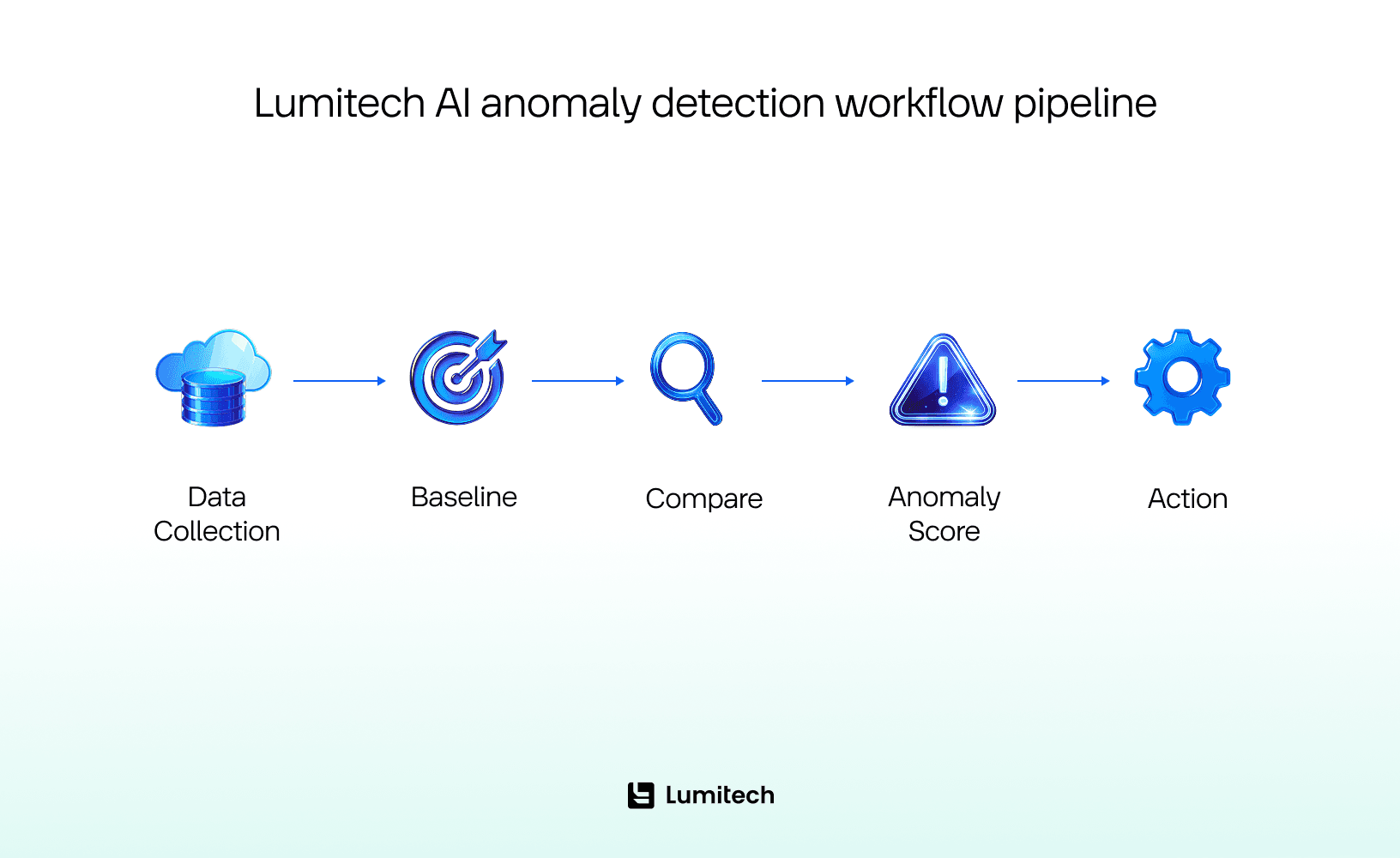
The AI anomaly detection process is simple in principle: understand normal behavior, then identify what no longer fits. In production, however, the challenge is not just detection. The system needs reliable data, a realistic baseline, and enough context to produce alerts that teams can actually use.
1. Collect the Right Data
The AI anomaly detection process starts with the right data, not just more data. Depending on the use case, this may include transactions, customer history, device behavior, logs, metrics, traces, or sensor data from industrial energy monitoring, such as vibration and temperature readings. If the system does not see the signal that matters, the model will miss the problem, too.
2. Build a Baseline
Before the system can flag anything as unusual, it needs to understand what normal behavior looks like. This baseline is rarely fixed. Normal activity changes with seasonality, growth, product releases, infrastructure updates, and user behavior, so the baseline has to adapt as conditions change.
3. Compare New Behavior Against the Baseline
Once the reference point is in place, the system can evaluate new events. Strong AI anomaly detection typically does not rely on a single metric in isolation. It examines patterns and relationships among signals. A transaction may look normal on its own, while its timing, device, location, or sequence tells a different story. In many cases, the anomaly appears not in a single value but in the interaction among several signals.
4. Assign an Anomaly Score
Each new event or reading is compared with the baseline and assigned an anomaly score. The greater the deviation from expected behavior, the higher the score. In AI in mechanical engineering, anomaly scoring can help detect early signs of stress, wear, abnormal vibration, overheating, or developing equipment failure before the issue becomes more serious.
5. Turn the Signal into Action
This is where anomaly detection techniques either help the business or become background noise. A signal should point to a real next step, not just say that something looks unusual. It may trigger a fraud review, stop a risky release, or push a security issue to the right team. When that response path is missing, detection improves visibility, but it does not improve outcomes.

Supervised vs Unsupervised vs Semi-supervised Anomaly Detection in AI
The choice usually starts with a simple business question: Do you have real examples of past anomalies?
If the answer is yes, supervised models may be a sensible option. But they also tend to be the most expensive to prepare, since someone has to label what counts as normal and what counts as abnormal - and that takes time, expertise, and sustained effort.
If you do not have that kind of history, unsupervised and semi-supervised approaches are often a better fit. They are less dependent on perfectly labeled data and easier to use when the business has plenty of raw information but only a few confirmed anomaly cases. In practice, that often means a faster launch and a lower adoption cost.
So the trade-off is fairly simple. Supervised models give you more control, but they are harder and more expensive to prepare. Unsupervised and semi-supervised models are usually easier to launch and scale when data is messy, and anomalies are difficult to define.
In real production environments, the best choice is often not the most precise model on paper. It is the one the team can realistically deploy and use.
Core AI Anomaly Detection Models and Algorithms
When discussing the technical side of AI for anomaly detection, it’s helpful to think of these models as different lenses for examining "normal" behavior. Depending on how your data is structured - whether it’s a simple spreadsheet or a high-speed stream of complex sensor readings - different algorithms become the frontrunners.
Google Cloud already describes anomaly detection through workflows such as PCA, K-means, autoencoders, and time-series analysis. AWS, by contrast, frames it more around monitoring, where statistical and machine learning methods are used to interpret metrics and logs.
So, what are the best AI models for anomaly detection? Some are better with structured data, some with time-series patterns, and some with high-dimensional inputs. Response speed matters too.
The table below compares the main options and where they tend to perform best.
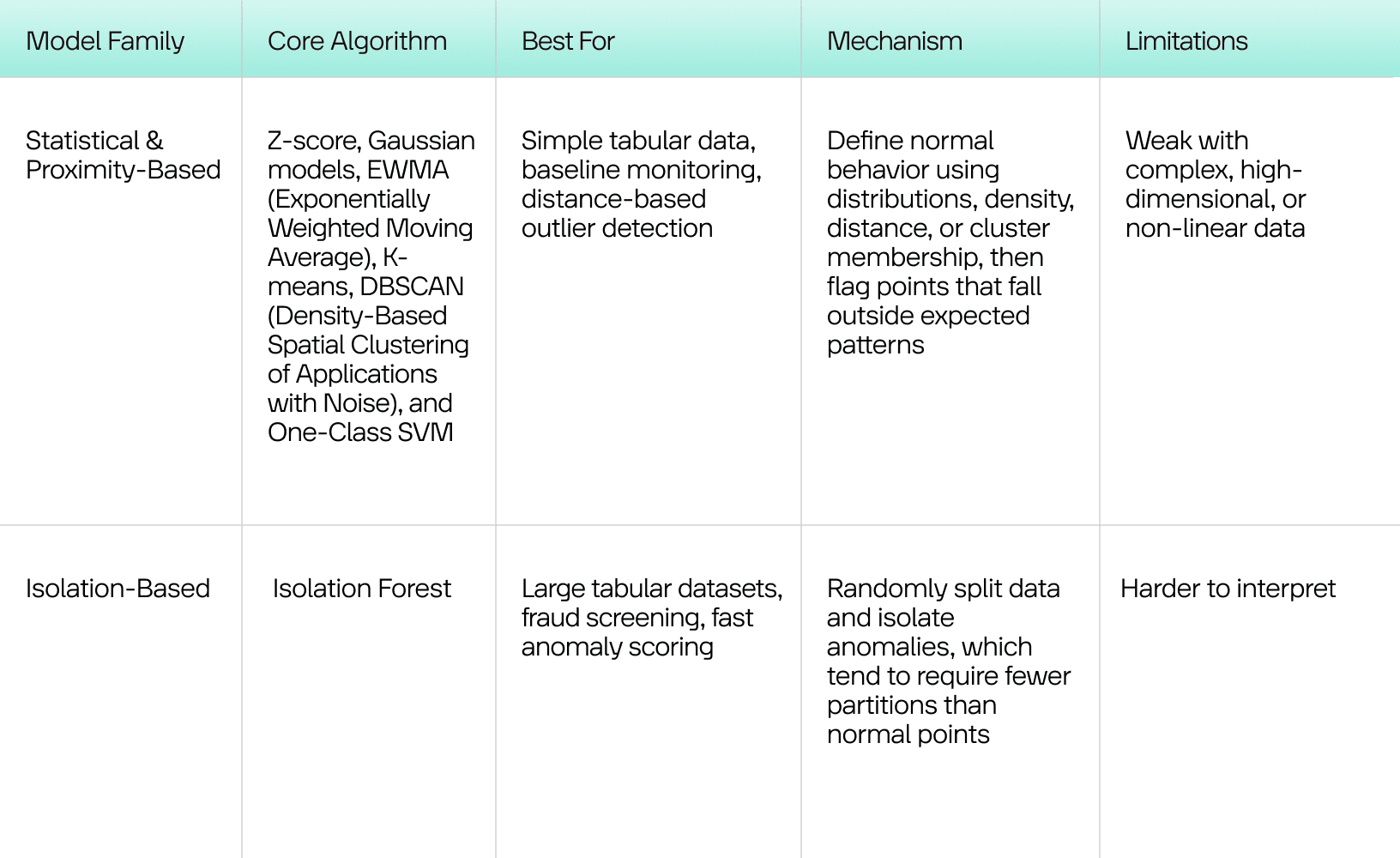
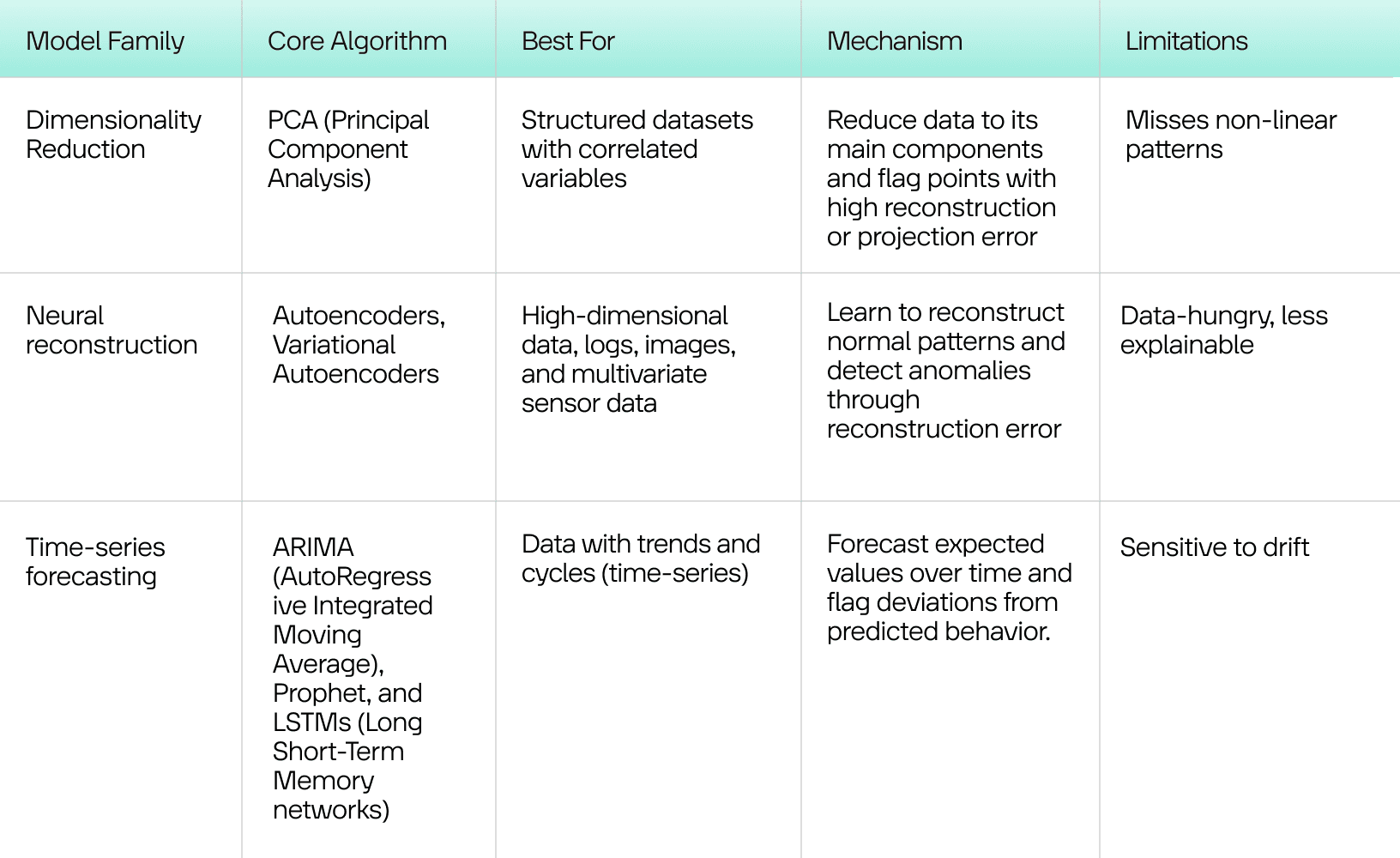
In practice, most teams do not rely on a single method for long. They combine approaches, especially when the data changes over time. Many important anomalies only become visible when the system examines how behavior shifts, not just at a single isolated value.
Problems often emerge in multivariate anomaly detection, where several weak indicators become meaningful only when combined. In those cases, the system's success depends as much on the surrounding data engineering solutions as on the model itself.
Time-series Anomaly Detection
Many AI-driven anomaly detection systems are built around time-series data, such as CPU (Central Processing Unit) usage, latency, transaction flow, sensor readings, and error rates. That is especially true in industrial anomaly detection AI, where machine behavior is continuously tracked over time.
The challenge is that normal behavior shifts. It changes with usage patterns, seasonality, releases, and demand. So the issue is usually not the value itself. It is the same value appearing at the wrong time, under the wrong conditions, or in the wrong sequence. Fixed thresholds often struggle with that. Forecasting and moving baselines tend to be more useful.
Once those signals are required to support real-time decisions, the challenge becomes both operational and technical.
Real-time Anomaly Detection in AI
Some anomalies can wait. Others cannot. In fraud, security, cloud incidents, and industrial environments, a late signal often has little value because the damage is already done.
Even when a model detects a real change, teams still need enough context to understand whether it affects reliability, security, revenue, or user experience. That is why real-time anomaly detection depends on more than model choice. It also depends on data quality, a strong baseline, and outputs that support a real decision. In practice, that often means resolving data migration challenges before detection becomes reliable.
In more advanced setups, real-time detection may also connect with generative AI development, especially in investigation and response workflows. In document-heavy environments, it can work alongside intelligent document processing to surface anomalies hidden in records and approvals.
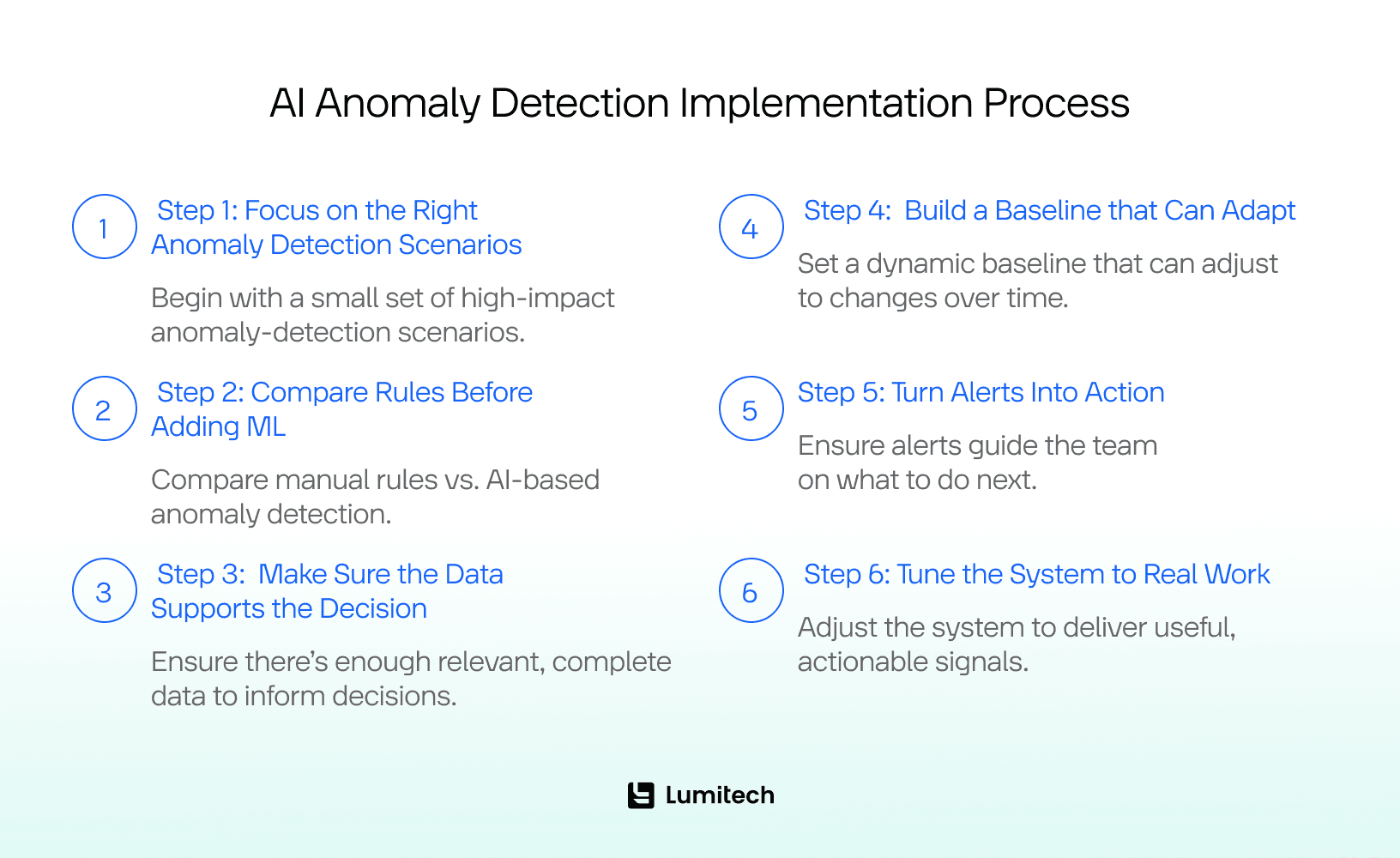
AI Anomaly Detection Implementation Process
For us, using AI for anomaly detection does not start with the model. It starts with impact. Before building anything, we look at where a deviation would affect revenue, reliability, security, or user experience, and whether the scalability of anomaly detection systems will hold up in real operating conditions.
Step 1. Focus on the Right Anomaly Detection Scenarios
We begin with a small set of anomaly-detection scenarios, such as suspicious logins, failed transactions, or unusual latency shifts. That makes it easier to show how AI anomaly detection can benefit the business.
Step 2. Compare Rules Before Adding ML
Before moving further, we compare manual anomaly detection, rules-based logic, and AI-based anomaly detection. This helps define where anomaly detection using machine learning is actually justified and whether an anomaly detection algorithm will improve decisions or just automate noise.
Step 3. Make Sure the Data Supports the Decision
At this stage, the problem is usually not the model - it is the data. Teams need a picture that is complete enough to support an actual decision: logs, transactions, device behavior, customer history, or whatever else genuinely affects the choice to react or wait.
Step 4. Build a Baseline that Can Adapt
Anomalies only make sense against a baseline of normal behavior. Since traffic, products, and infrastructure change, that baseline has to adapt as well.
Step 5. Turn Alerts Into Action
A signal is only useful if the team knows what to do next. Good alerts should help people assess the issue quickly and move to action, sometimes through internal tools or flows shaped by AI chatbot development.
Step 6. Tune the System to Real Work
In AI in workplace settings, the system has to do more than detect unusual patterns. It has to deliver the right level of coverage, with signals the team can realistically use.
Let’s build an AI anomaly detection pipeline around your product, your data, and the decisions your team needs to make.

Benefits of AI Anomaly Detection and Use Cases
AI for anomaly detection is used wherever unusual behavior needs to be spotted early and understood quickly. From fraud and cybersecurity to infrastructure, manufacturing, and healthcare, the benefits of AI anomaly detection lie in catching patterns that do not fit before they become larger operational, financial, or security problems.
Fraud detection - flags unusual transactions, login patterns, or payment behavior that may point to fraud.
Cybersecurity monitoring - identifies suspicious activity, such as unusual access requests, anomalous traffic, or behavior that does not match normal system use.
Predictive maintenance - helps detect early equipment issues through sensor, vibration, temperature, or pressure data. In practice, vibration analysis predictive maintenance uses smart data collection to identify wear before failure.
Supply chain monitoring - reveals unexpected delays, demand spikes, inventory gaps, or logistics disruptions before they become larger problems.
Quality control - identifies defects or process deviations in manufacturing when products or production data fall outside normal patterns.
Infrastructure monitoring - detects issues in servers, networks, or cloud systems by identifying odd changes in latency, CPU usage, memory load, or error rates.
Healthcare monitoring - catches unusual patterns in patient data, medical devices, or clinical systems that may require closer review.
Financial operations - uncovers unusual spending, accounting irregularities, or reporting issues that may require investigation.
These are only a few of the most common use cases. In practice, AI anomaly detection is used far more broadly across industries and operational environments.
What are the biggest challenges in AI Anomaly Detection Systems?
The first problem most teams feel is false positives. When too much normal behavior gets flagged, alert fatigue sets in fast, and trust starts to wear down.
False negatives are less visible, but often more serious. A missed anomaly can lead to fraud, service degradation, or a security issue that goes unnoticed until the damage is already done.
Then there is concept drift. A system does not stand still. User behavior changes, traffic shifts, products evolve, and infrastructure gets rebuilt. Something that looked unusual six months ago may now be part of normal activity. If the model does not keep up, its alerts become less reliable over time.
Data quality causes its own problems. Missing context, weak inputs, or inconsistent history can limit the system long before model choice becomes the main issue.
And explainability still matters. An outlier in the data is not automatically something worth acting on. Someone still needs enough domain knowledge to judge whether the signal is meaningful or just odd.
What is trending in anomaly detection using AI?
The market is moving away from isolated ML experiments and toward AI anomaly detection models that fit into real operating environments. That means systems that are reliable, visible, and easier to maintain inside existing stacks.
The strongest demand is for large-scale time-series monitoring, built-in cloud anomaly detection, and log anomaly detection that runs directly within telemetry pipelines. AWS CloudWatch, for example, learns expected metric behavior from historical data, accounts for hourly, daily, and weekly patterns, and keeps adapting as behavior changes.
Observability-led anomaly detection is also becoming the practical standard. Teams do not want alerts with no context. They want signals they can connect to telemetry, correlate quickly, and investigate without losing time.
That shift is giving more weight to AI-native workflows. Anomaly detection in AI is no longer being treated as a separate model sitting off to the side. It is becoming part of day-to-day production operations. Grafana’s 2026 Observability Survey points in the same direction: anomaly detection ranked as the top AI use case in observability, and 92% of respondents said AI helps surface issues before they turn into downtime.
Final Thoughts
The real test of AI anomaly detection is not whether it can surface unusual behavior. It is whether that signal arrives with enough clarity to change what happens next.
The most effective AI anomaly detection systems do more than highlight deviations. They help teams make faster calls, cut through noise, and respond before a small anomaly becomes a larger operational, financial, or security problem. That is where the value is now.
Getting there usually takes more than a model on top of a dashboard. It requires the right data, the right response logic, and the right foundation for the system - often extending into integration work or data engineering.
If your team is still spending too much time interpreting alerts instead of acting on them, contact us!


