Top IT Companies in Bahrain: 10 Providers Compared for 2026
Bahrain has a clear digital economy strategy, cloud-first public policy, a strong fintech ecosystem, and a business environment that supports international investment and 100% foreign ownership in most non-oil sectors.
- For New Clients
- Software Development
October 08, 2026
 AI Overview
IT companies in Bahrain fall into six types: custom software and product development firms, managed IT services providers, systems integrators, cybersecurity specialists, telecom-backed enterprise connectivity providers, and ERP or business-application vendors. Compare them on delivery model, Bahrain presence, sector fit, support coverage, and published proof of comparable work — not on the length of a service list. The costliest shortlisting error is matching the wrong type to the job: an infrastructure integrator hired for a product build, or an MSP for a regulated data migration, typically surfaces the mismatch weeks into scoping.

Top Bahrain IT Companies at a Glance
This guide compares ten IT companies in Bahrain across the six provider types that make up the local market, from custom software development to managed IT, security, and ERP. Each provider is described using the same fields, drawn from its own published information, so you can shortlist on fit rather than on marketing language. It is written for startups, SMEs, enterprises, and regulated-sector buyers who need to narrow a list to two or three providers worth contacting. If you are specifically evaluating software development services in Bahrain, the provider-type section below is the fastest way to determine whether that is what your project needs.
Bahrain’s IT market is made up of several distinct provider types: software and product development firms, managed IT service providers, systems integrators, cybersecurity specialists, telecom-backed enterprise connectivity providers, and ERP and business application vendors. The right choice depends on your delivery model, whether you need on-site support, your sector’s compliance obligations, and the evidence a provider can show of comparable work. This guide compares ten IT companies in Bahrain against the same buyer-facing criteria.
The Six Types of IT Companies in Bahrain, and Which One You Need
Most shortlists fail at the first step because “IT company” covers businesses with very different operating models. Naming the categories first makes the rest of the comparison usable.
Software and product development firms build custom applications, platforms, and SaaS products — including SaaS development services and MVP development — engaged by project, by outcome, or through dedicated development teams, and judged on engineering depth and delivery record. This is the group most people mean when they search for software companies in Bahrain, and it is the right group only if something needs to be built rather than run.
Managed IT service providers (MSPs) look after your environment on a day-to-day basis, handling areas such as helpdesk, endpoints, servers, backups, and patching, typically under an annual maintenance agreement involving a fixed monthly charge. Instead of evaluating them by their engineering portfolios, you assess them by response times, escalation procedures, and the scope of their support.
Systems integrators connect infrastructure, platforms, and applications at enterprise scale — data centers, cloud migrations, digital transformation services across business units. They fit when the challenge is making many systems work together, and rarely when speed on a single product is the priority.
Cybersecurity specialists range from managed security operations to external threat intelligence and digital risk protection. Security is increasingly bought separately from infrastructure, because the skills and tooling differ.
Telecom-backed enterprise providers sell connectivity and managed networks — SD-WAN, multi-site links, network security — layered on carrier infrastructure. They matter most to businesses operating from several locations.
ERP and business application vendors implement and support finance, operations, and reporting platforms, plus the business intelligence and data analytics services that sit on top of them.
These categories overlap at the edges but rarely at the center: a strong MSP is not automatically a credible platform builder, and an integrator built for national-scale infrastructure is not the natural choice for a first product release. Buyers looking for software development companies in Bahrain should filter on delivery model first — it eliminates more of the market, faster, than any other criterion.
Quick Comparison: 10 IT Companies in Bahrain
The table below lists the providers alphabetically. The order is not a ranking, and the numbering in the profiles that follow does not reflect any quality assessment. This is a comparison of IT services companies in Bahrain, assembled editorially — it is not an audited ranking or a certification.
Company | Provider type | Best fit | Bahrain presence | Typical engagement |
|---|---|---|---|---|
Almoayyed Computers Middle East (ACME) | Systems integration, managed services, cloud | Enterprises and government bodies running large mixed estates | Ma’ameer, Manama | Multi-year infrastructure and managed services contracts |
Beyon Solutions | IT and digital transformation consultancy, systems integration | Organizations wanting a Bahrain-group-backed integration partner | Part of Bahrain-headquartered Beyon Group | Consultancy and integration programs, managed cloud |
CTM360 | Cybersecurity — external threat intelligence and digital risk | Banks, fintechs and brands managing external attack surface | Bahrain Financial Harbour, Manama | Platform subscription across named modules |
Fakhroo Information Technology Services | Managed IT, network and security, data center | Established SMEs and corporates needing dependable local IT operations | Gufool district | Managed services and infrastructure projects |
Gulf Business Machines (GBM) | Systems integration, managed and cloud services, security | Buyers needing delivery across several countries, not Bahrain alone | Bahrain office within a seven-office regional network | Enterprise infrastructure, managed and support services |
InfoPie Global IT Solutions | ERP and business applications, managed IT, software services | Mid-market firms standardizing operations on ERP and BI | Sanabis district | Implementation projects, managed services, resource outsourcing |
Kalaam Telecom | Telecom-backed enterprise connectivity and managed networks | Multi-site businesses with branch connectivity requirements | Seef District | Managed network contracts and connectivity services |
Lumitech | Custom software, AI and product development | Teams building or modernizing a software product | Regional and remote delivery serving Bahrain; nearest listed office Dubai | Outcome-based milestones, dedicated team, or embedded engineers |
Nexcel Bahrain | SME IT support, AMC and office infrastructure | Smaller offices wanting predictable day-to-day IT support | Service coverage stated across Bahrain | Fixed monthly fee annual maintenance contracts |
Sprint IT Solutions | Managed infrastructure and managed security, GRC, ELV | Businesses outsourcing security operations and compliance workload | Manama | MSP and MSSP retainers, compliance and ELV projects |
Read the table as a filter rather than a scoreboard. The “provider type” and “typical engagement” columns will disqualify most of the list for any given project within a minute, which is the point — the remaining two or three are where evaluation effort belongs.

How We Selected These Companies
Every provider on this list was assessed against the same criteria, using publicly available information from its own website and, where relevant, named third-party sources:
Bahrain relevance — a Bahrain office, Bahrain-focused delivery, or demonstrable service to Bahraini buyers.
Service clarity — a published, specific set of core services rather than a claim to do everything.
Public proof — service pages, named products, certifications, partner status or independent recognition that can be checked.
Identifiable buyer fit — a clear answer to who the provider is for: startup, SME, enterprise, regulated sector or multi-site business.
Delivery and support model — project delivery, managed services, staff augmentation, or a subscription platform.
Specialization — the part of the market where the provider is strongest.
Inclusion boundary: The list covers Bahrain IT companies serving local buyers across software, managed IT, systems integration, cybersecurity, connectivity, and business applications. It is deliberately cross-category rather than a ranking of a single segment, and it is not exhaustive: there are far more IT companies in Bahrain than ten, and a provider’s absence is not a judgment about it. Entrants whose current service model could not be confirmed from a first-party source at this review were replaced rather than carried forward.
Disclosure: Lumitech publishes this guide and is included in the comparison. To limit bias, every provider is described using the same fields and the same public-evidence standard; the order is alphabetical rather than ranked; no provider is compared favorably against another by name, and no call to action appears inside a company profile. Inclusion here is editorial. It is not a certification and not an independently audited ranking.
The 10 IT Companies in Bahrain in Detail
Listed alphabetically. The numbering is for navigation only.

1. ACME
ACME is a division of the Almoayyed International Group, operating in Bahrain since 1979 and positioned around enterprise infrastructure and managed technology for large organizations. Its published vendor partner roster spans AWS, Microsoft, Google Cloud, Oracle, Cisco, VMware, Red Hat, Fortinet, and OutSystems.
Core services: cloud migration across hybrid and cloud infrastructure, managed services with 24/7/365 monitoring, digital transformation, and an AI capability stack.
Best fit: enterprises and government bodies running large, mixed technology estates.
Bahrain presence: Bahrain office in Ma’ameer, Manama.
Public proof: an unusually broad published partner list, plus AWS Government Competency status, a designation AWS grants for demonstrated delivery of government workloads, and an OutSystems partnership dating to 2018.
Consider if: its published positioning is enterprise infrastructure and systems integration, not lean product delivery. A team wanting a first release in weeks is engaging a different kind of provider.

2. Beyon Solutions
Beyon Solutions is the IT and digital transformation arm of Beyon, the Bahrain-headquartered group that also owns Batelco. The group describes it as “an agile IT and digital transformation consultancy offering cutting edge system integration solutions to businesses of all sizes” — between a pure integrator and a consultancy.
Core services: ICT infrastructure and services, cloud managed services, cybersecurity solutions, business applications development and delivery, and digital transformation services.
Best fit: organizations that want an integration partner backed by a large domestic group, particularly where connectivity, cloud and applications are being bought together.
Bahrain presence: part of the Bahrain-headquartered Beyon Group. The group’s related security business, Beyon Cyber, publishes a Hamala, Bahrain address and states it is “the first Bahraini company to achieve CREST SOC accreditation”.
Public proof: group ownership is publicly documented, and the security affiliate’s CREST SOC accreditation is a named, checkable credential.
Consider if: the published service description is broad. Ask for the named delivery team and references for your own workload rather than relying on group scale.

3. CTM360
CTM360 is a Bahrain-headquartered cybersecurity company focused on external threat intelligence and digital risk protection — the part of security concerned with what is exposed and impersonated outside the perimeter rather than inside it. It sells a defined product set rather than general consulting.
Core services: six named modules — HackerView (external attack surface management), CyberBlindspot (digital risk protection and threat intelligence), ThreatCover (cyber threat intelligence), DMARC360 (email intelligence and DMARC oversight), RiskHub (centralized risk management) and CyNA (cyber news, alerts and advisories).
Best fit: banks, fintechs and consumer-facing brands managing brand abuse, phishing and external exposure.
Bahrain presence: Office in Bahrain Financial Harbour, Manama, with a second office in Kuala Lumpur.
Public proof: CTM360 is one of 17 vendors evaluated in Gartner’s Magic Quadrant for Cyberthreat Intelligence Technologies, published on 4 May 2026. It is the only provider on this list evaluated in that report.
Consider if: this is a specialist platform vendor — no general application development, infrastructure build or IT support.

4. Fakhroo IT Services
Fakhroo Information Technology Services W.L.L has operated as a Bahrain IT provider since 1987, with a conventional and clearly bounded infrastructure and managed services portfolio.
Core services: network and security solutions, data center management, cloud services, business applications, enterprise hardware, and managed IT services.
Best fit: established SMEs and corporate offices that need dependable local IT operations and infrastructure rather than software development.
Bahrain presence: Bahrain office in Gufool, Manama.
Public proof: a published six-line service taxonomy and a Manama address, with an operating history stated since 1987.
Consider if: proprietary software products and web-scale application work sit outside the published offer.

5. GBM
GBM is a regional end-to-end digital transformation provider operating from seven offices, including Bahrain, with more than 1,500 employees and a stated history of over 36 years. It is included because multi-country delivery is a real decision factor for Bahraini businesses expanding into Saudi Arabia, the UAE, Kuwait, or Oman.
Core services: technology and infrastructure solutions, security (its GBM Shield framework), managed services, hybrid IT and cloud, technical support, and its CloudX cloud management platform.
Best fit: buyers whose requirements span more than one country, or who need a single support structure across borders.
Bahrain presence: a Bahrain office within a network covering Abu Dhabi, Dubai, Bahrain, Kuwait, Oman, and Pakistan.
Public proof: a published multi-country office footprint, stated headcount, and named proprietary platforms.
Consider if: engagements are built around enterprise infrastructure and managed services. A Bahrain-only requirement may be better served by a local provider with a shorter escalation path.

6. InfoPie Global
InfoPie Global IT Solutions is a Bahrain-registered provider with a wide published portfolio spanning business applications, managed services and software delivery, concentrated most heavily in ERP, business intelligence and system integration.
Core services: ERP implementation and support, business intelligence and data analytics, system integration, cloud and cybersecurity solutions, custom development and software services, managed IT services, QA and vulnerability testing, IT infrastructure, resource outsourcing and corporate training.
Best fit: mid-market firms standardizing finance and operations on ERP and building reporting on top of it.
Bahrain presence: Bahrain office in Sanabis, Manama.
Public proof: a published Bahrain commercial registration number and a detailed, itemized service list.
Consider if: the portfolio is very broad. Ask which lines are delivered by its own staff, and request references specific to the one you are buying.

7. Kalaam Telecom
Kalaam Telecom combines enterprise connectivity with managed network services, which makes it a different proposition from both an MSP and an integrator: the network is the product, and IT services are layered onto it.
Core services: fully managed end-to-end network solutions, managed SD-WAN with centralized cloud-based control and zero-touch provisioning, enterprise connectivity across multi-branch and geographically dispersed sites, and managed network security.
Best fit: businesses operating from several locations, where branch connectivity and network performance are the binding constraint.
Bahrain presence: Bahrain office in Seef District, Manama.
Public proof: published managed network and SD-WAN service pages describing scope from single-site to multi-branch deployments; the SD-WAN service is stated as available in Bahrain and Saudi Arabia.
Consider if: engagements are network-centric infrastructure contracts. Application development is not part of the published offer, and any claim about underlying network ownership should be confirmed in writing during procurement.

8. Lumitech
Lumitech is a custom software and AI product development company serving Bahrain through regional and remote delivery, with a published prototype-first model in which working software is demonstrated early rather than specified in advance.
Core services: custom software engineering, AI development services, SaaS, web and mobile development, enterprise software development, UX/UI design, and MVP and proof-of-concept work. Related coverage: AI in SaaS.
Best fit: teams building a new software product, or modernizing one, where engineering depth matters more than on-site presence.
Bahrain presence: regional and remote delivery serving Bahrain. Lumitech does not operate a Bahrain office; the nearest listed address is Dubai Silicon Oasis, UAE.
Public proof: ranked #59 on the Clutch 100 Fastest-Growing Companies list for 2026, a ranking Clutch states is based on verified financial data and absolute revenue growth from 2024 to 2025. Lumitech's own account: Lumitech joins Clutch’s list of the 100 Fastest-Growing Companies Driving Growth in 2026.
Consider if: the published focus is custom software and AI product delivery. Organizations that need on-site infrastructure work, hardware supply, day-to-day desk support, or a local helpdesk should shortlist a Bahrain-based managed services provider instead.
Many companies can write functional code, but very few can build digital products that users actually love to interact with. Lumitech is built on the intersection of elite software engineering and human-centric design. We build tools that don’t just solve today’s technical fires, but position your business to lead the market over the next decade.



9. Nexcel Bahrain
Nexcel Bahrain is an SME-focused IT support provider whose published model is a subscription annual maintenance contract rather than project work, with scope extending past IT into low-voltage office systems.
Core services: IT support and annual maintenance contracts covering servers, computers, networks and phone systems; Windows Server and Mac support; structured cabling; access control devices; and cloud setups.
Best fit: smaller offices, retail sites and schools that want predictable, bounded day-to-day IT support.
Bahrain presence: service coverage stated across Bahrain; no street address is published on its services page.
Public proof: a published engagement model — “a fixed, predictable monthly fee for your complete IT support – No hidden costs!” — and a stated response time of less than four hours under its AMC.
Consider if: it publishes a pricing model, not rates, so comparison requires a quote. The design is day-to-day support, not architecture or software delivery.

10. Sprint IT Solutions
Sprint IT Solutions is a Manama-based provider with a security-led published positioning: managed infrastructure and security operations, governance and compliance work, and low-voltage systems delivery.
Core services: cyber security (continuous penetration testing, zero-trust browser security, honeypot as a service), governance, risk and compliance including ISO compliance and Aramco CCC, managed infrastructure (MSP), managed cyber security (MSSP), AI development, IT support and consulting, and ELV services covering structured cabling, data centers, audio-visual, LAN and surveillance.
Best fit: businesses outsourcing security monitoring and compliance workload alongside infrastructure management.
Bahrain presence: Bahrain office in Manama.
Public proof: a published, itemized security and compliance service set, including named compliance regimes.
Consider if: the offer spans security, infrastructure, and physical systems. Ask which services its own security operations staff deliver and which are partner-delivered.
Building or modernizing a software product for the Bahrain market?
See how Lumitech's delivery model works.

How to Choose an IT Company in Bahrain
Start with the business problem, not the vendor shortlist. The sequence below eliminates unsuitable providers faster than any amount of proposal review, and it is the practical answer to how to choose an IT company in Bahrain without spending a quarter on it.
First, define the job to be done. Stabilizing support, migrating to cloud, building software, hardening security, modernizing infrastructure, and outsourcing IT ownership are six different jobs, and each points to a different provider type from the taxonomy above. A product build will also carry sub-jobs of its own — web app design, integration, data — but they belong inside one engagement, not across several vendors. Getting the top-level job wrong is the most expensive error in the process, because it is usually discovered mid-contract.
Second, check fit by delivery model. A company that is strong at systems integration is not automatically strong at delivering software products, and a capable MSP is not the natural choice for a complex platform build. Judge providers on whether their core operating model matches the work, not on the breadth of their capability list.
Third, pressure-test the support model. Ask about response times, escalation routes, named teams, and business hours versus 24/7 coverage. In a market this size, support availability and communication quality matter as much as technical skill, because the same people will handle your issues for years.
Fourth, validate local understanding. Bahrain’s business environment is not identical to Saudi Arabia’s, the UAE’s, or a generic offshore model. Ask how a provider handles local expectations, regulatory realities, on-site attendance, and stakeholder communication in the Kingdom — and ask for a specific example rather than a reassurance.
What to Compare Before You Sign
The selection framework above narrows the field. These are the terms that decide whether the engagement works once it starts, and they belong in the contract rather than in the proposal.
SLA and escalation. Binding response and resolution windows by severity, a named escalation path, and what happens when a window is missed.
Data residency and PDPL responsibilities. Bahrain’s Personal Data Protection Law, Law No. (30) of 2018, was issued on 19 July 2018 and, according to Bahrain’s Personal Data Protection Authority, came into effect on 1 August 2019. No vendor can guarantee your compliance on your behalf: establish where data will be stored and processed, who the processor is, and which obligations sit with each party.
IP and source-code ownership. For custom builds, the contract should state explicitly who owns the intellectual property and source code on completion, and what happens to it if the engagement ends early.
Support hours and on-site coverage. Whether support is business-hours or 24/7, and whether on-site attendance is included, chargeable, or unavailable.
Language. Bilingual Arabic and English delivery is a selection factor where local stakeholders are heavily involved, not a universal requirement.
GCC and multi-country coverage. If expansion into Saudi Arabia or the UAE is planned, verify multi-country delivery, support and integration experience before signing rather than after.
Regulated-sector checks. Financial services, healthcare and government buyers should ask for the provider’s security certifications, audit history, sub-processor list and incident-notification commitments — and verify certifications with the issuing body rather than treating them as a compliance guarantee.
Common Mistakes When Choosing an IT Company in Bahrain
Even a strong shortlist can lead to a bad choice if the evaluation process is weak. These are the most common mistakes businesses make when comparing IT partners in Bahrain.
Choosing based on breadth instead of fit. Many vendors claim to do everything, from infrastructure and cybersecurity to software delivery and cloud migration. In practice, the better choice is usually the company that is strongest in the one or two areas your business actually needs.
Paying too little attention to support. A polished proposal means very little if the support is slow, unclear, or routed through the wrong team. Before signing, check response times, escalation routes, and who will actually handle the issues after launch.
Overlooking communication quality. Technical skills matter, but so does the ability to explain decisions, quickly flag risks, and keep projects moving. If communication is vague during the sales process, it usually doesn’t improve later.
Focusing only on price. The cheapest option often becomes the most expensive one when outages drag on, change requests pile up, or the vendor has to be replaced mid-project. Cost matters, but so do reliability, accountability, and long-term fit.
Assuming all top vendors are interchangeable. Not every highly rated company is right for every business. A fintech startup, a retail chain, and an international enterprise should not end up with the same shortlist or the same evaluation criteria.
Skipping local context. Bahrain is a convenient base for local and regional delivery, but buyers still need to assess how well a vendor understands the local business environment, support expectations, and regulatory realities.
Local, Regional or International Provider?
There is no universally better answer here, and any list that gives you one is selling something.
A Bahrain-based provider offers proximity, easier on-site attendance, same-time-zone working, and familiarity with local procurement and stakeholder expectations. That matters most when the work is physical, when downtime requires someone in the building, or when the buying process involves many local parties.
A regional or international provider offers multi-country coverage, deeper specialist benches and scale. That matters most when the requirement spans borders, when a niche skill is scarce locally, or when the work is genuinely remote-deliverable — software development being the clearest example, which is why several capable software companies in Bahrain’s market serve it without a local office.
Directories of Bahrain IT companies rarely make this distinction, which is why they are a poor shortlisting tool on their own. The useful question is not which is better but which constraint binds your project: physical presence, or specialist depth. Some buyers need both, and resolve it by splitting the work — a local MSP for operations, a specialist partner for build.
Red Flags to Watch For
Unclear ownership or subcontracting. If a provider will not say which work is done by its own staff and which is passed to partners, assume the latter and price the risk.
No named delivery team. A proposal that names only account managers tells you nothing about who will do the work.
Undefined escalation. “We’re very responsive” is not an escalation path.
No proof of comparable work. Ask for a reference in your sector, at your scale, in the last two years. Vagueness here is the most reliable negative signal in the process.
Unclear IP or source-code terms. If ownership is left to be settled later, it will be settled unfavorably.
Questions to Ask Before You Sign
What kinds of clients do you serve best, and which do you turn away?
What work is done through true in-house development versus external partners or contractors?
Who will actually work on our account, and what is their availability?
What is your support model after go-live, and how do you handle security incidents?
What is your experience in Bahrain and in our industry, specifically?
How do you price change requests and additional support?
When our scope grows, how quickly can your team scale with us?
If the answers are vague, over-polished, or suspiciously friction-free, keep looking.
Why Bahrain’s IT Market Matters for Buyers
Bahrain has deliberately positioned itself as a digital business base, and three facts about that policy environment have practical consequences for anyone buying IT services here.
Bahrain's National Digital Economy Strategy states that it “consists of 49 strategic initiatives to achieve the ambition with the support of more than 20 government and semi-government agencies”. That program is being executed, not merely announced: in October 2025, the Information & eGovernment Authority reported completing six of the nine first-phase initiatives. For buyers, sustained public-sector digitization means a deeper local supplier base and more providers with recent, relevant delivery experience.
Separately, Bahrain’s Cloud First Policy (version 1.0, 24 April 2017) commits the government to reducing ICT costs “by eliminating duplication of solutions” and “increasing security by using accredited platforms”. The effect on the private market is that cloud-native delivery is the default assumption in most local proposals rather than an upgrade you have to request.
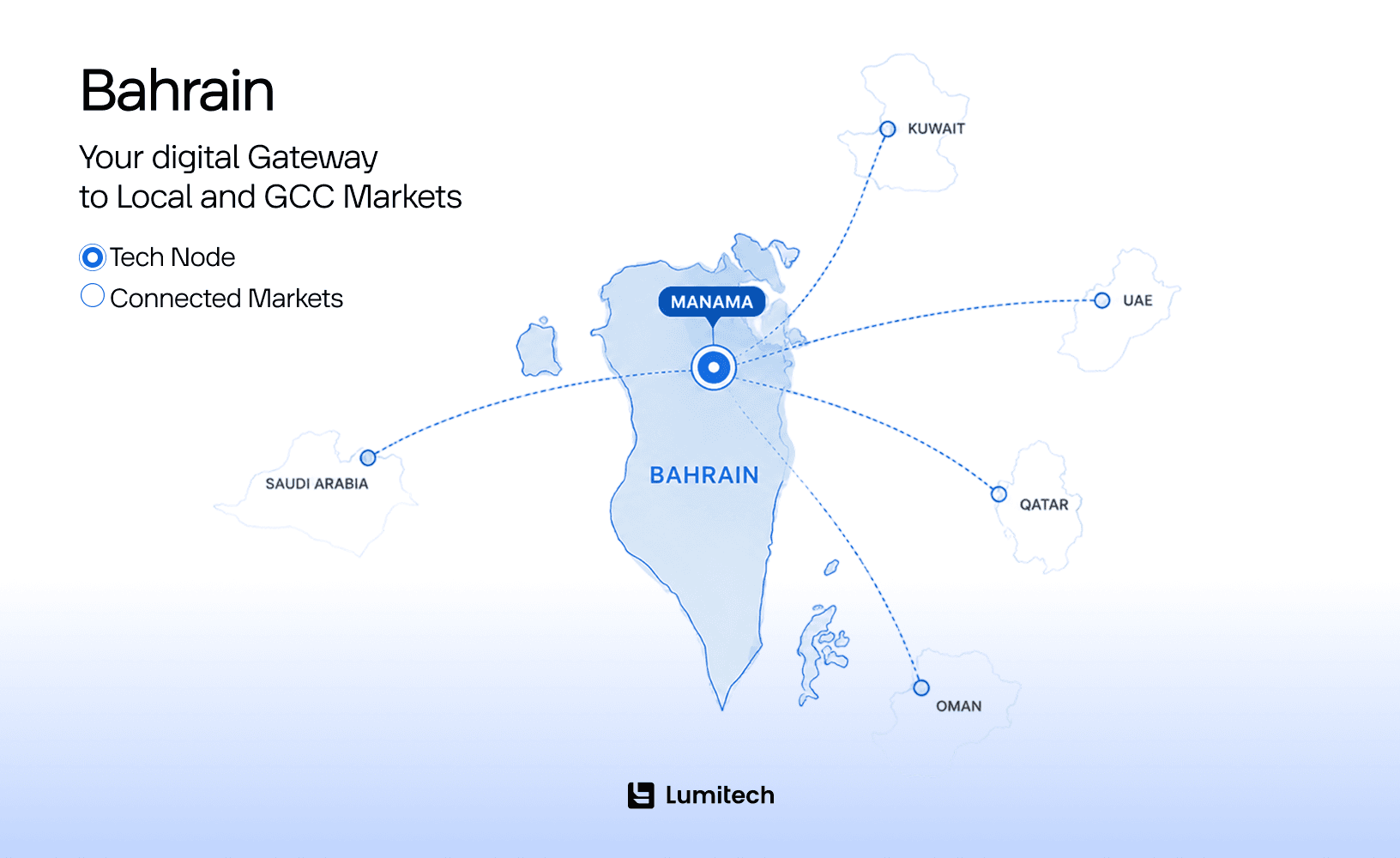
On market structure, TechBehemoths’ Bahrain company directory — last updated in September 2026 — lists 59 companies covering 103 services and industries. That figure is the number of listings on one directory, not the size of Bahrain’s IT market, but it indicates that a buyer has real choice, and that Bahrain ICT companies are concentrated in and around Manama.
Finally, on establishing operations: Bahrain’s Economic Development Board states that “with the exception of trading, contracting and construction-related activities, and power generation, all sectors are open to 100% foreign ownership”. For international firms setting up a Bahraini entity alongside a delivery partner, that scope matters — and it is narrower and more specific than the “non-oil sectors” shorthand often repeated. Broader regional context on where delivery models are heading is covered in our analysis of AI-driven software market trends from Web Summit Qatar 2026.
Key Takeaways
Provider type is the first filter, not price or reputation. Match the operating model to the job — build, run, integrate, secure, connect, or implement — before comparing anything else.
Evidence beats adjectives. Every claim in this guide links to the provider’s own published material or a named third party. Apply the same standard to proposals: if a capability is not published, documented or referenceable, treat it as unverified.
Local presence is a requirement for some work and irrelevant for others. Decide which constraint binds your project before you weight it.
Contract terms decide the outcome more often than vendor choice does. SLA, escalation, data residency responsibilities, and IP ownership are where engagements succeed or fail.
Lists go stale. Any roundup of top IT companies in Bahrain is a starting point, not a substitute for checking the provider’s own site before you contact it.