
AI Risk Assessment: A Practical Template for Enterprise AI Projects
What to assess, in what order, and who signs it off. A six-step AI risk assessment template covering classification, scoring, controls, residual risk, generative and agentic failure modes, and what the EU AI Act now requires by December 2027.
- AI Development
- AI Integration
November 20, 2026
 AI Overview
An AI risk assessment identifies how an AI system could cause harm, classifies the system by consequence, assigns controls, and records residual risk. Unassessed systems reach production without named owners or defined override paths, so failures surface through customer complaints rather than monitoring. EU AI Act providers of high-risk systems must hold this evidence from 2 December 2027.

An AI risk assessment is a structured evaluation of how an AI system could harm people, the business, or the organization’s compliance position before it reaches production and while it runs. It identifies credible failure modes, classifies the system by consequence, scores what it can, assigns controls, and records the remaining risk. Its output decides how much oversight that system carries.
That decision has become harder to put off. The Stanford HAI AI Index 2026 reports that the AI Incident Database logged 362 AI incidents in 2025, up from 233 in 2024, after annual counts stayed below 100 until 2022. In the AI Index’s survey of business leaders across regions and industries, excluding China, 72% of respondents considered cybersecurity a relevant AI risk, and 61% said they actively mitigate it. The proportion of respondents reporting an AI incident stayed flat at 8% over the two years, though within that small group the proportion reporting 3-5 incidents rose from 30% to 50%.
In brief
An artificial intelligence risk assessment is a repeatable process, not a document: it reruns whenever the system, its data, or its context changes.
EU high-risk obligations were pushed back to 2 December 2027 (Annex III) and 2 August 2028 (Annex I).
Generative and agentic systems need a wider net: OWASP’s 2026 LLM Top 10 moved Excessive Agency to third.
Why AI Systems Resist Classical Risk Management
Many organizations already run some form of AI risk management under a broader enterprise risk function. In regulated sectors, an AI model risk assessment process inherited from finance may already exist. The problem is that the assumptions underneath conventional IT risk work hold less well here.
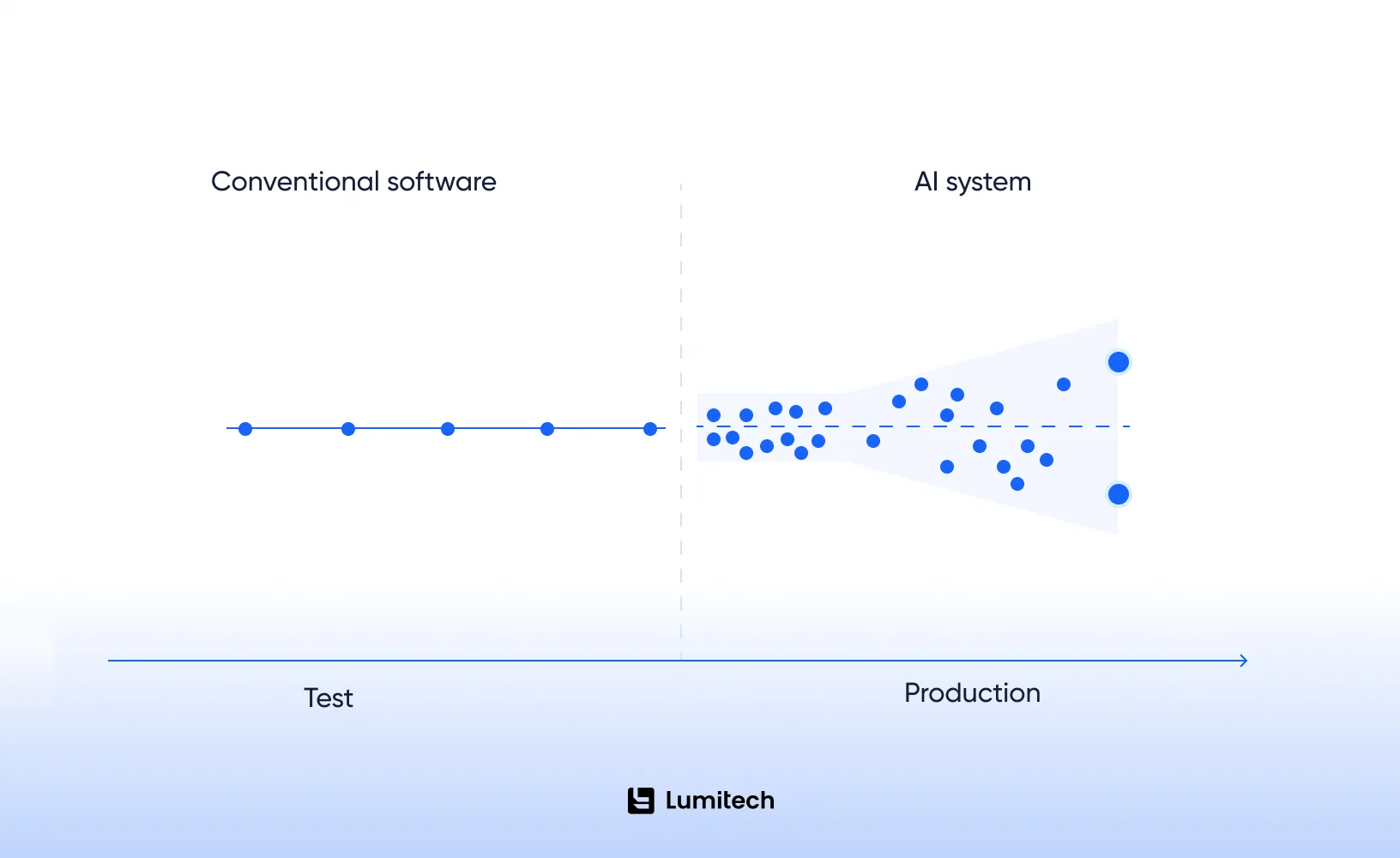
A conventional application behaves the same way twice. A model does not necessarily, and its behavior in testing may not hold up under live traffic. The NIST AI Risk Management Framework notes that laboratory measurements “may differ from risks that emerge in operational, real-world settings” and that “inscrutable AI systems can complicate risk measurement.”
The second difference is ownership. Enterprise AI will typically be running on a mix of components that the organization itself didn’t build, and NIST notes that “risk metrics or methodologies used by the organization developing the AI system may not be the same as the risk metrics or methodologies used by the organization deploying or operating the system”. That divergence becomes very real when a vendor’s safety assessment replaces your own.
The part people underestimate is the vendor’s own evaluation. A supplier tests against their risk appetite, not yours, and that testing usually stops at the model boundary, which is where your integration problems start. Accepting it as your assessment is a decision, and it should be recorded as one.


One idea from banking supervision transfers cleanly. Since 2011, SR 11-7 has described “effective challenge” as “critical analysis by objective, informed parties that can identify model limitations and produce appropriate changes.” That guidance covers US banking and never mentions AI, but the principle holds: someone independent must be able to say no.
Choosing a Framework to Anchor On
No single document covers the whole problem, and choosing a spine before layering others saves rework. The fundamental difference is between voluntary guidance, certifiable management systems, and binding law.
Reference | What it is | What it contributes |
|---|---|---|
NIST AI RMF 1.0 (NIST AI 100-1, January 2023) | Voluntary framework built on four functions: GOVERN, MAP, MEASURE, MANAGE | Lifecycle structure plus seven trustworthiness characteristics |
ISO/IEC 42001:2023 | Certifiable AI management system standard | Policy, roles, controls, continual improvement |
ISO/IEC 23894:2023 | Guidance on risk management for AI | Process guidance for developers, deployers and users |
ISO/IEC 42005:2025 | AI system impact assessment | Harms and benefits taxonomy, plus an impact assessment template |
EU AI Act, Article 9 | Legal duty for providers of high-risk systems, from 2 December 2027 | A mandated risk management system across the lifecycle |
Adoption is uneven: in the AI Index 2026 survey data, 43% of respondents said the EU AI Act influenced organizations’ approach, 36% cited ISO/IEC 42001, and 33% cited the NIST AI RMF.
If you want one AI risk assessment framework to start from, the NIST functions map most easily onto an existing delivery process: GOVERN is cross-cutting, while MAP, MEASURE and MANAGE attach to lifecycle stages. NIST states that AI RMF 1.0 is being revised, so anchor on the functions rather than on specific wording. ISO/IEC 42005 is the one most teams overlook; in BSI’s description, it carries an impact assessment template in Annex E.
How to Conduct an AI Risk Assessment: a Six-Step Template
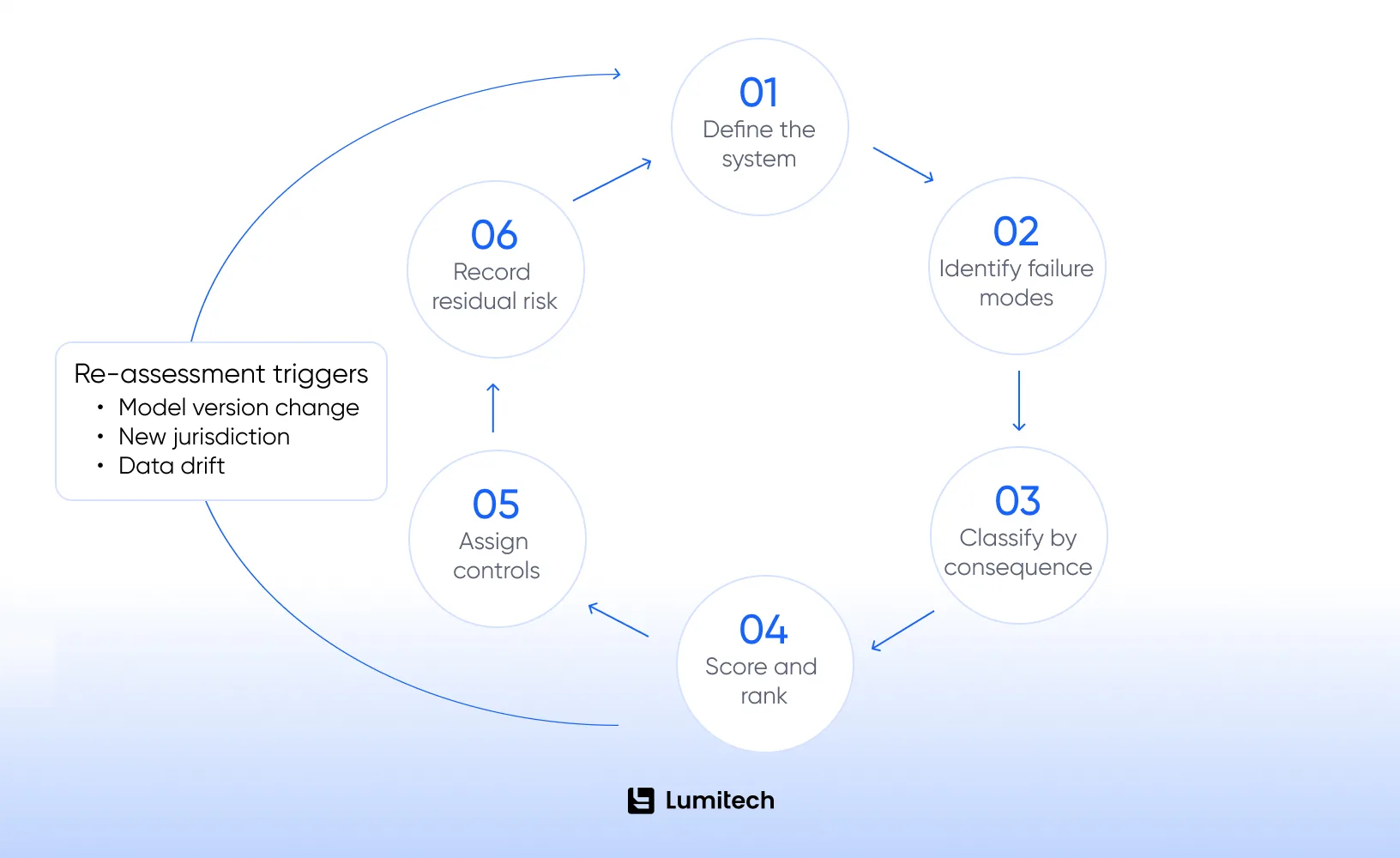
The AI risk assessment process below is framework-neutral: it maps onto the NIST functions, produces the documentation ISO/IEC 42005 describes, and generates most of what Article 9 requires from providers. Run it per system, not per department.
Step 1 — Define the System and Your Role
Every AI risk assessment starts with a scoping decision that is easy to get wrong. You need to make three decisions upfront as to what counts as one system, what it’s being used for, and whether you’re the provider, the deployer, or both. The boundary matters: a retrieval-augmented assistant is a pipeline rather than a single component, and risks concentrate at the joins. An honest AI readiness assessment surfaces the gaps that make the rest meaningful: undocumented data lineage, no owner for a third-party model, no defined human override path.
Step 2 — Identify What Can Go Wrong
Risk identification is far more effective as a structured sweep than a brainstorm, and there are two public sources that provide a useful grid. The NIST AI RMF names seven characteristics of trustworthy AI systems: valid and reliable; safe; secure and resilient; accountable and transparent; explainable and interpretable; privacy-enhanced; and fair, with harmful bias managed. The MIT AI Risk Repository, maintained by MIT FutureTech with researchers at the University of Queensland, sorts cataloged risks into seven domains, including discrimination and toxicity, privacy and security, misinformation, and AI system safety, failures, and limitations.
Running AI risk identification across both grids picks up what one grid alone would miss: NIST is very good at identifying risks in terms of system properties, and MIT is very good at identifying risks in terms of who is harmed. Record each risk as the failure it describes rather than the control you have in mind.
Step 3 — Classify the System
Risk classification decides how much scrutiny a system earns. If your system will be placed on the EU market or used in the EU, Annex III of the AI Act identifies eight high-risk areas (biometrics, critical infrastructure, employment and worker management, and access to essential services and administration of justice being the most prominent).
Outside the EU scope, that list still works as a consequence taxonomy. For internal AI risk classification, three or four tiers are usually enough, defined by what happens when the system is wrong: whether a human decision is replaced or merely informed, whether the affected party can contest it, and whether the error is reversible. A drafting tool and a job-applicant screening tool may share an architecture and belong in different tiers; the test is how consequential the system’s decision is. The constraints shaping ethical AI in finance push many use cases up a tier that would sit lower elsewhere.
Step 4 — Score, and Be Honest About the Limits
Risk scoring turns a long register into a ranked one. A viable scheme multiplies likelihood by impact, then adjusts for two factors missing from generic matrices.
Dimension | Question | Scale |
|---|---|---|
Likelihood | How often would this failure occur under realistic load? | 1–5 |
Impact | What is the worst credible consequence for an affected person or the business? | 1–5 |
Detectability | Would we notice within minutes, days, or only after a complaint? | 1–3 multiplier |
Reversibility | Can the outcome be corrected after the fact? | 1–3 multiplier |
Detectability and reversibility are what separate an AI register from a generic one: an error that surfaces instantly and can be undone differs from one a customer finds months later.
NIST is explicit that an inability to measure a risk “does not imply that an AI system necessarily poses either a high or low risk,” so a risk that resists scoring belongs in the register as unscored, not low. The framework also “does not prescribe risk tolerance,” so the blocking threshold is an organizational decision, best settled before the first assessment rather than during an argument about a system.
Step 5 — Assign Controls and Treat the Risk
Every risk that’s scored above tolerance requires a named control, an owner, and a verification method. Push controls as far into design as possible, since removing a risk through architecture requires no monitoring: access scoping, retrieval filtering, output constraints, and mandatory human review are design decisions, not later additions. This is where an assessment either changes the build or becomes paperwork, and where AI integration services absorb the findings, since most controls land between the model and the systems around it.
Step 6 — Record Residual Risk and Set Re-assessment Triggers
Close with what remains: the risk taken, who took it and on what basis. Then define what would trigger a re-run: model version change, prompt/retrieval change, new user populations, new jurisdictions, material data drift. Article 9 describes the required system as “a continuous iterative process planned and run throughout the entire lifecycle of a high-risk AI system.” Monitoring decays without ownership, which is why MLOps services and the AI risk assessment process converge: drift detection, evaluation pipelines and incident routing are the register’s operational half.
Not sure which systems to assess first?
A short discovery pass usually separates the two or three systems carrying real consequence from the dozen that do not.

Assessing Generative and Agentic Systems
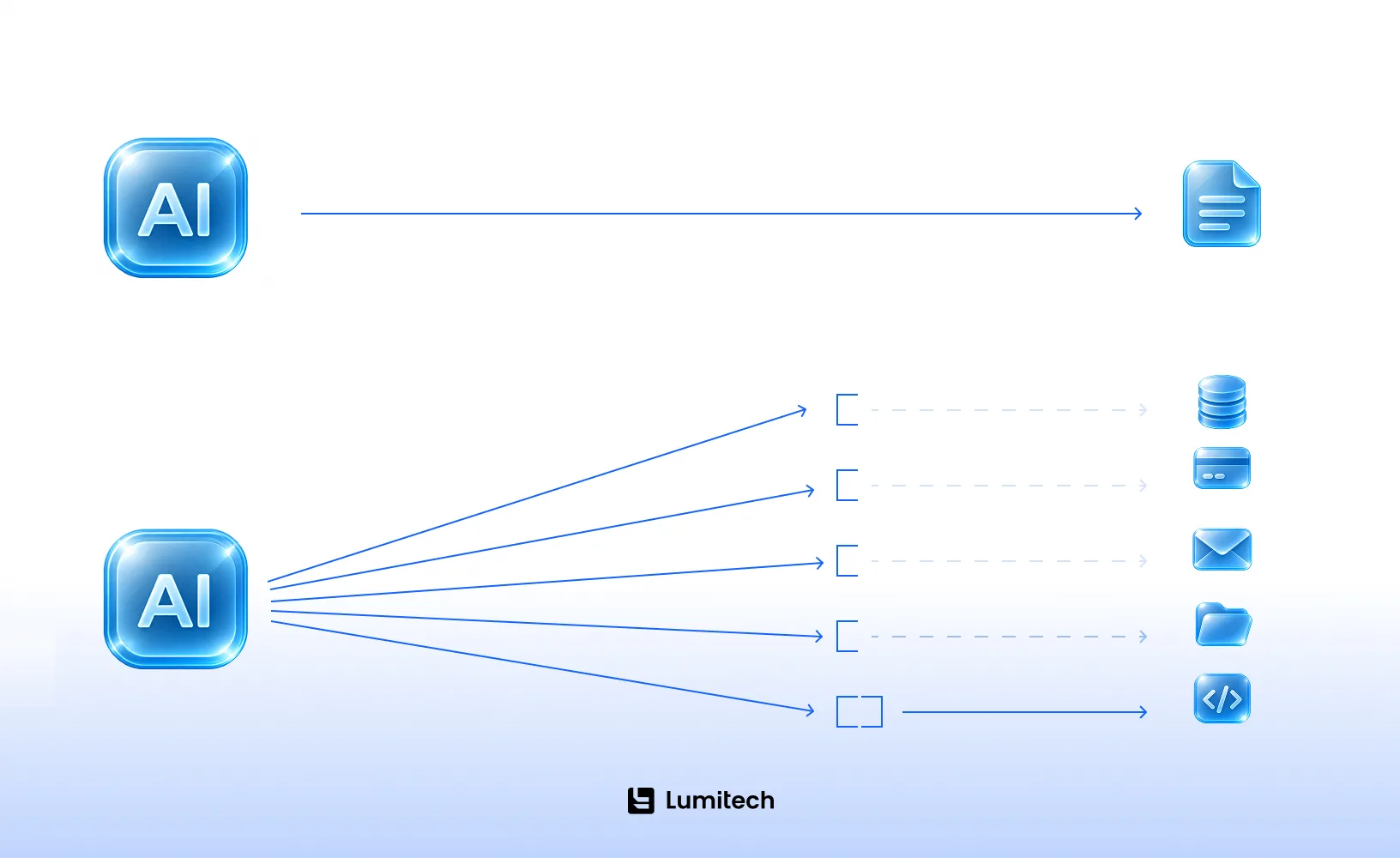
A generative AI risk assessment needs a wider net than a predictive-model one, and an agentic system wider still.
NIST’s Generative AI Profile (NIST AI 600-1, July 2024) enumerates twelve risks it describes as unique to, or exacerbated by, generative AI, including confabulation, data privacy, harmful bias or homogenization, information integrity, intellectual property, and value chain and component integration. Confabulation deserves singling out because the profile frames it as structural: confabulations “are a natural result of the way generative models are designed.” Treating hallucination as a defect to patch rather than a property to bound is a common framing error.
For application-layer security, OWASP’s Top 10 for LLM Applications is the working reference, and the 2026 edition announced on 1 September 2026 is the one to assess against. The reordering is the informative part: Excessive Agency rose from sixth to third, Unbounded Consumption from tenth to sixth, Improper Output Handling fell furthest, from fifth to tenth, and System Prompt Leakage was reframed as Hidden Context Exposure.
Systems that call tools or write to records fail differently from those that just return text. That means the questions get a lot more focused: what can this agent do, under what credentials, with what write and spending limits, and what actually stops a chain from going any further. In the AI Index 2026 survey data, 62% of respondents cited security and risk concerns as the main barrier to scaling agentic AI.
An Enterprise AI Risk Assessment Example From Delivery
In a Lumitech project for a regional fintech institution in the MENA region, the brief was an internal legal and compliance knowledge assistant. The recorded constraints read as assessment outputs rather than preferences: no legal or internal data could be processed by public AI services; every answer had to be traceable and anchored in approved documents; and access had to strictly follow roles and clearance levels. The design that emerged was retrieval-augmented generation with role-based access control, with out-of-date files filtered out of the answer pipeline, back-linking to the source documents, and very clear boundaries as to what the assistant could and could not say.
One qualification matters: the published story is a delivery under NDA; it’s a qualitative story with no metrics at all. It’s a story of how the findings became architecture rather than a story of how much risk was actually reduced. That caveat applies to any AI risk assessment example from a vendor. A case proving a system was built is not a case proving it worked.
The transferable point is sequencing: each constraint, had it arrived after the architecture was fixed, would have forced a rebuild rather than a design choice. That is the argument for running an enterprise AI risk assessment early, whether you scope enterprise AI solutions in-house or with a partner.
What Regulation Requires, and By When
As of November 2026, the EU compliance picture is less immediate than much published guidance suggests.
The AI Act (Regulation (EU) 2024/1689) came into force on 1 August 2024 and became generally applicable on 2 August 2026, with prohibited practices and AI literacy obligations applying from 2 February 2025 and general-purpose AI model obligations from 2 August 2025. The high-risk requirements did not arrive on that date. The AI Omnibus, Regulation (EU) 2026/1744, entered into force on 27 July 2026 and extended them: the European Commission states that the rules for high-risk use cases in certain sensitive areas (Annex III) “have been extended to 2 December 2027,” and that systems embedded into regulated products (Annex I) have “an extended transition period until 2 August 2028.”
The correct reading is not that there’s more time. Article 9 still requires providers of high-risk systems to have a documented, continuously updated risk management system in place that covers the identification and analysis of known and reasonably foreseeable risks, their assessment and evaluation, and appropriate mitigation. The only thing that has changed is the date by which that evidence must exist. If you’re treating the extension as a reason to delay, then you’re effectively saying that you’ll be in December 2027 with no lifecycle records at all to show.
Scope deserves care where summaries overreach. The fundamental rights impact assessment under Article 27 does not apply to all deployers: it covers bodies governed by public law, private entities providing public services, and deployers of the Annex III systems used for creditworthiness assessment and for pricing life and health insurance. The standards layer is only now forming. EN 18286:2026, from CEN and CENELEC, became the first harmonized standard supporting the AI Act when its reference was published on 19 October 2026, covering the quality management system requirements in Article 17.
Enforcement has already started on the timing issue. In July 2026, Italy’s data protection authority fined Character Technologies Inc. 158,000 euros, finding, among other things, that the required data protection impact assessment had been prepared late. The procedural lesson for any AI risk assessment methodology is that an assessment produced after deployment may not count at all.
Where an AI Risk Assessment Goes Wrong
The AI risk assessment best practices that we could list are essentially just the correction of all the common errors. Assessments are run once at launch and never again, failing the lifecycle requirement every framework states. Risk tolerance isn’t defined until you have a system that’s been contested, and then you work backward from the answer you want. Vendor evaluations are accepted as the organization’s own, registers name no owners, and scoring is treated as objective, producing precise numbers for poorly understood risks.
The structural fix is to treat AI risk assessment and mitigation as one loop with a single owner rather than two handoffs between functions. Ownership is consolidating slowly: in the AI Index 2026 survey data, organizations reporting no designated owner for responsible AI fell from 9% to 5%. Where no owner exists yet, AI governance consulting work usually starts by naming one and tiering the portfolio behind it.
Teams that handle this well settle on how to conduct an AI risk assessment and who signs it off, before they have a system to argue about. Standardizing that across the portfolio turns a one-off review into a repeatable control, and marks where an enterprise AI risk assessment stops being a project and becomes governance.


