
Enterprise AI in Manufacturing: From Predictive Maintenance to Autonomous Operations
A seized bearing costs nine hours of downtime — not because data was missing, but because no one closed the loop. See how enterprise AI in manufacturing turns predictions into action: from maintenance alerts to autonomous control.
- Industrial Sector
- AI Integrations
- Software Development
August 21, 2026
 AI Overview
Enterprise AI in manufacturing integrates equipment data, predictive maintenance, quality inspection, and process optimization into one decision loop that turns predictions into automated actions. Predictive maintenance cuts unplanned downtime by 30–50%. Standalone AI models without that integration stall at the pilot stage rather than reaching autonomous operations.

It is 3:40 on a Saturday morning when one of the bearings in the packaging line seizes. The line is down nine hours, the weekend crew puts in overtime on a repair that would have taken forty minutes on a Tuesday, and two orders slip a week. Somewhere in the plant historian, the vibration signature that predicted this had been drifting upward for eleven days. There was really no one to blame for not looking into the readings, since it wasn’t anyone’s job.
Thus, what is the real issue on most plant floors is not a modeling problem. The data existed, and the model — had anyone built one — would have been unremarkable. What was missing was a loop: readings that reach a model, a decision that lands in a work queue or a controller setpoint, and a record of whether it worked.
Enterprise AI in manufacturing starts paying off when that loop closes — when equipment data, production systems, and business processes are combined into a single, continuous decision-making system rather than four separate projects. This article walks that path: what industrial AI is, where it can be beneficial, why companies fail to see results in their pilots, and what “autonomous” really means.
What Is AI in Manufacturing?
AI in manufacturing is machine learning applied to plant data — sensor streams, machine logs, inspection images, quality records, ERP transactions — used to predict what a production system will do next and act on that prediction. What separates it from ordinary enterprise software development is not the algorithm, but the constraint: outputs must be accurate, fast, and safe enough to operate equipment capable of scrapping a batch or injuring someone.
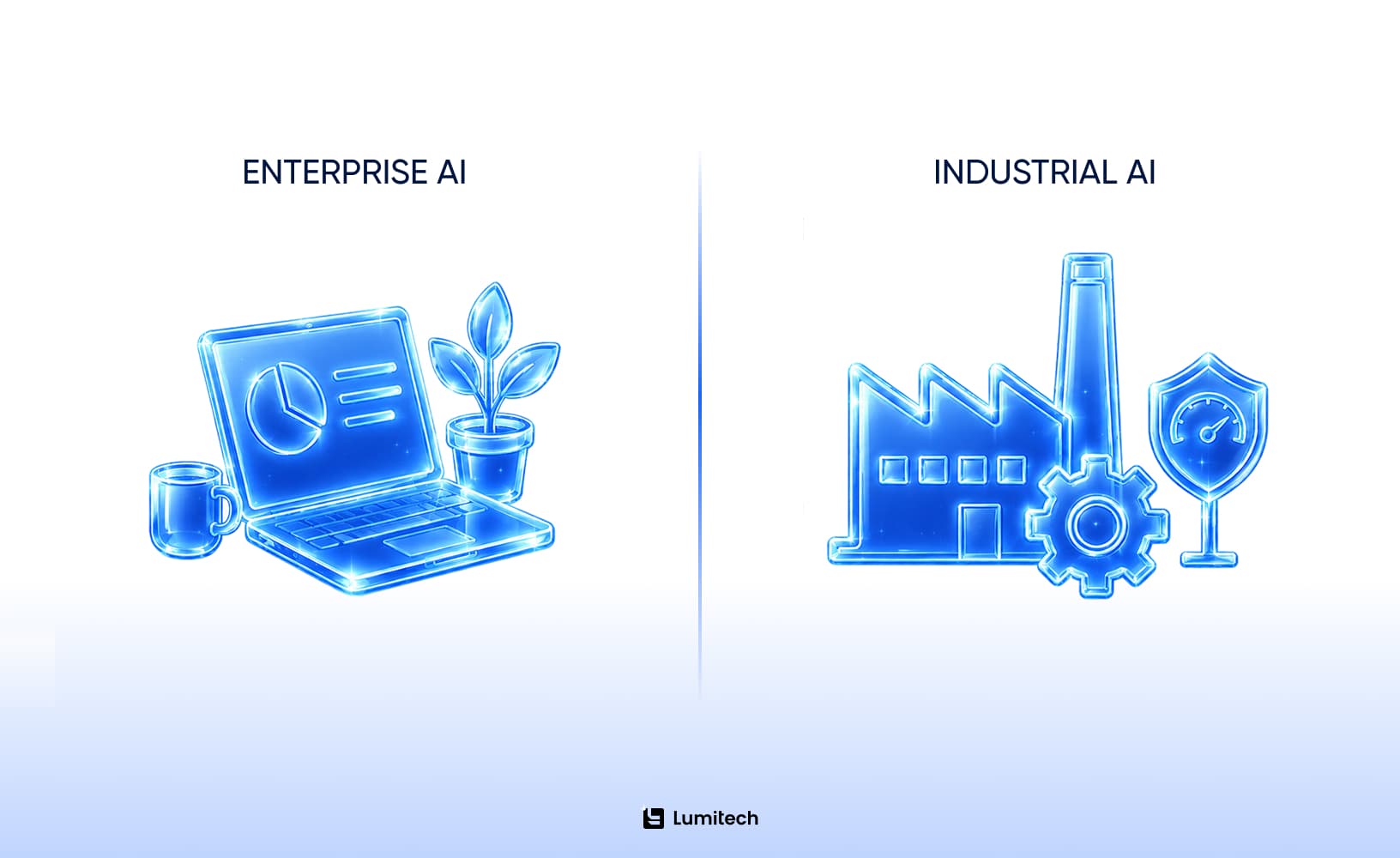
A marketing model that misfires costs a bad email; a control loop that misfires costs a spindle. The AI used in manufacturing answers to physics and safety cases before accuracy metrics.
Three differences matter in practice:
Latency budgets are harsh. Inspection at line speed results in a few milliseconds of inference, performed by hardware located right by the conveyor in an OT network with its own change-control standards.
The data is context-poor. A tag named TT_4471_PV means nothing until someone maps it to an asset, product, shift, and recipe. That mapping is 60–70% of most projects.
Drift is physical. Retool a press, change a steel supplier, swap a lubricant, and the model degrades silently. Nobody retrains a churn model because the weather changed; here you do.
This is why artificial intelligence in manufacturing is less of a chatbot and more of an instrument in a control room because of its narrow, calibrated, and auditable nature. Buyers evaluating vendors for AI in the manufacturing sector should ask them about historian integration and MES write-back long before knowing the model architecture.
How Is AI Used in Manufacturing?
AI in manufacturing is used as a chain, not a standalone product: industrial data is collected and contextualized; a model turns it into a prediction; a person or rule converts that into an operational decision; a system executes it; and the result feeds back as a training signal. Breaking any single link turns everything after it into decoration, which is exactly where most industrial AI programs quietly die.
Walk the chain with one asset:
Industrial data. In classic AI in mechanical engineering, a gearbox creates vibration, motor current, oil temperature, and load. Additionally, there are work orders from CMMS, lead times on spare parts, and the time schedule for the process. Each piece of information on its own is not useful, but their combination creates a training set.
Model. An anomaly detector plus a remaining-useful-life estimate, trained on the twelve failures you have records for and the thousands of healthy hours you also have. The use of artificial intelligence in manufacturing stands or falls here — not on the algorithm, but on whether the labels reflect what maintenance actually found when they opened the housing.
Prediction. “Bearing degradation, 78% confidence, functional failure in 9–14 days.” Useful. Not yet a decision.
Operational decision. Strategic calculations compare a four-hour planned intervention during Thursday’s window with an unplanned nine-hour downtime occurring at an unknown point in time, an analysis that requires the cost of downtime per hour and the availability of parts and personnel for the task.
Execution. A work order appears in the CMMS with the part reserved. Not an email, not a dashboard tile someone might notice.
Feedback. The technician records what they found; that becomes label thirteen.
AI in manufacturing processes rarely fails at the math. Vendors often hand you a list of technologies — computer vision, LLMs, digital twins — which is the wrong shape of answer. The AI applications in manufacturing that survive a second budget review are wired into an execution system, because that is where a prediction turns into money.
The AI Maturity Path: From Prediction to Autonomy
Maturity does not imply model complexity. It is about how much decision authority the system holds, and how tightly that authority is bounded. Production assets pass through different stages that describe what happened, explain why it occurred, predict future events, and sometimes even recommend an action to be taken, while remaining within boundaries. Most manufacturing companies are situated at levels 2-3, while only a few have level 5 processes in their advanced systems.
Maturity level | What AI does | Manufacturing example | Human role |
|---|---|---|---|
1. Monitored | Reports what happened | OEE and SPC views fed from machine data | Reads, interprets, decides everything |
2. Diagnostic | Explains why it happened | Clusters scrap events to isolate a humidity-sensitive resin | Validates the explanation, fixes the cause |
3. Predictive | Says what will happen, and when | Vibration and thermal models flag a gearbox 9–14 days out | Judges the alert, schedules the intervention |
4. Prescriptive | Recommends an action and its trade-offs | Proposes a kiln setpoint change, ranks yield vs. energy | Approves or overrides; owns the outcome |
5. Bounded autonomy | Acts within defined limits, logs every action | Closed-loop control trims oven temperature within ±2 °C | Sets the limits, monitors exceptions, can stop it |
The jump that breaks companies is 3 to 4. Prediction is a technical exercise; recommendation forces someone to decide, in writing, what an hour of downtime on line 4 is worth. That conversation is organizational, which is why level-3 pilots sit unused for years.
Key AI Use Cases in Manufacturing
The applications with the greatest potential can be found where three specific conditions intersect: the existence of machine-ready data, the existence of repetitive decisions, and the availability of a workforce capable of acting on the resulting information. The AI in manufacturing examples below all pass that test. Each follows the same shape — problem, data, what the model does, KPIs — because a use case without a KPI is a science project with nicer slides.
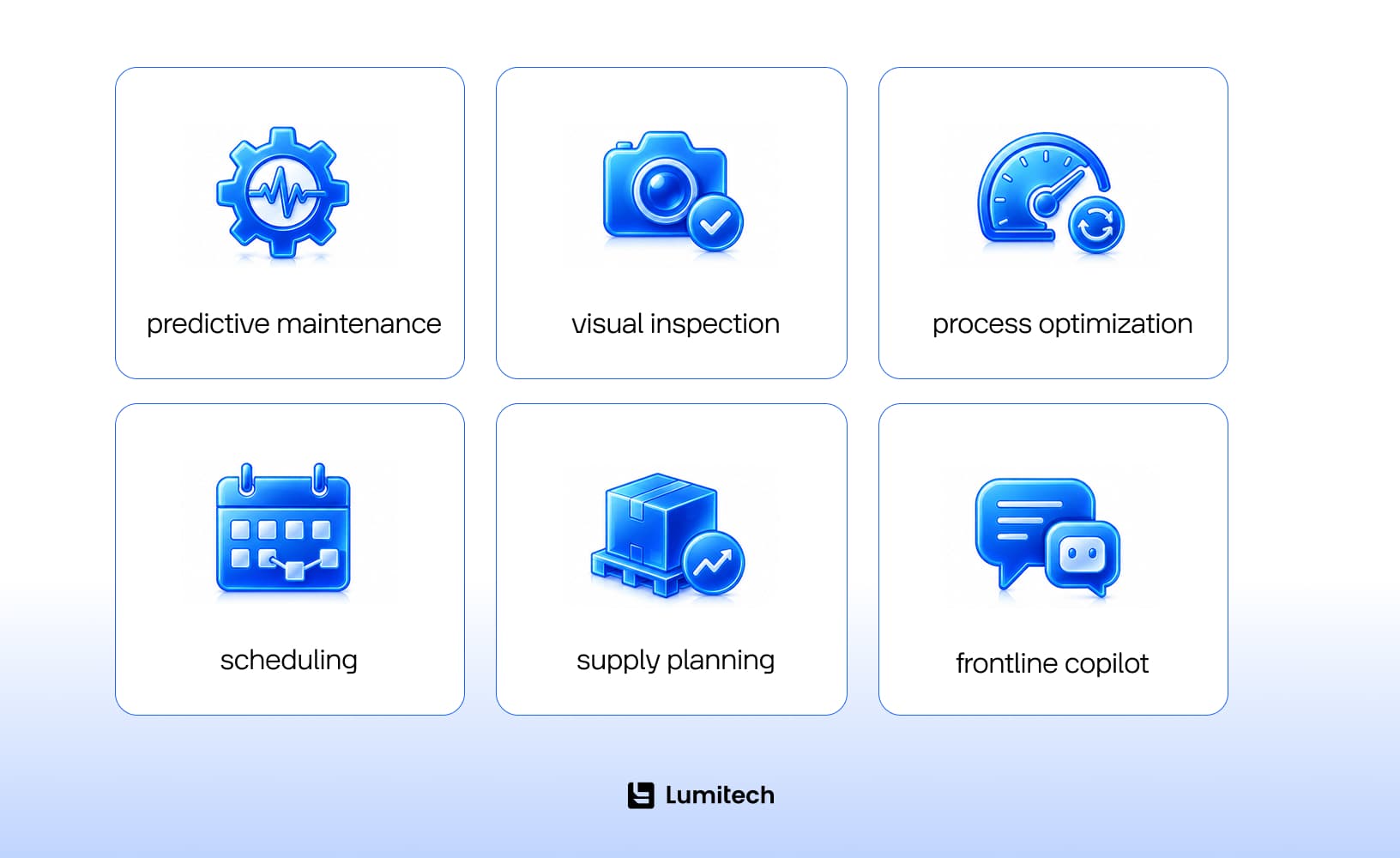
1. Predictive Maintenance
Problem: unplanned stops on constrained equipment, plus a maintenance calendar invented in 2009 that still replaces healthy parts on schedule.
Data: vibration, current, temperature, CMMS failure history, part lead times.
What AI does: detects deviation from a healthy baseline, estimates remaining useful life, and ranks assets by risk-weighted cost. McKinsey’s operations research puts the typical effect at 30–50% less machine downtime and 20–40% longer machine life.
KPIs: unplanned downtime, MTBF, maintenance cost per unit, emergency freight.
2. Automated Visual Inspection
Problem: human inspectors stay consistent for about two hours, and end-of-line checks catch defects long after the material is unrecoverable.
Data: labeled images of good, marginal, and defective parts, joined to the parameters running at the time.
What AI does: classifies every part at line speed, then traces defect classes back to upstream settings. A 2026 review in Sensors found industrial vision accuracy frequently above 95%. Vendor decks call this AI quality control manufacturing; on the floor it is “the camera that catches what the second shift misses.”
KPIs: escape rate, scrap, rework hours, cost of poor quality.
3. Process and Setpoint Optimization
Problem: operators run recipes conservatively, because the penalty for a bad batch beats the reward for a good one — so yield and energy leak every shift.
Data: historian series, lab results, ambient conditions, material certificates.
What AI does: learns the response surface between settings and outcomes, then recommends setpoints per batch rather than per recipe. The category label is AI process optimization manufacturing, the most underrated line in most business cases.
KPIs: first-pass yield, cycle time, fill-weight giveaway, and energy per unit tracked through an industrial energy monitoring system.
4. Scheduling and Changeover Planning
Problem: the schedule is a spreadsheet maintained by one person who is, alarmingly, near retirement.
Data: open orders, routings, machine states, tooling, labor calendars, changeover matrices.
What AI does: searches feasible sequences against competing objectives — due dates, changeover minutes, constraint utilization — and re-plans when a machine drops out.
KPIs: on-time-in-full delivery, changeover hours, WIP.
5. Demand-Linked Supply Planning
Problem: forecast error lands as expedite freight or dead inventory, both absorbed as a cost of doing business.
Data: sales history, promotions, customer forecasts, supplier lead-time variability.
What AI does: produces probabilistic forecasts, turns them into reorder and safety-stock recommendations, and flags which supplier is quietly slipping.
KPIs: forecast accuracy, inventory turns, expedite spend, stockouts.
6. Frontline Knowledge Copilots
Problem: thirty years of knowledge lives in three people’s heads, and 4,000 PDFs, and a new technician needs six months to become useful.
Data: SOPs, maintenance logs, drawings, alarm histories.
What AI does: retrieves grounded answers with citations to the source document, so a technician at 2 a.m. finds the 2019 fix in ninety seconds.
KPIs: mean time to repair, onboarding time, alarm response.
Use case | Core data | AI output | KPIs it moves |
|---|---|---|---|
Predictive maintenance | Vibration, current, temperature, CMMS history | Failure probability, remaining useful life | Unplanned downtime, MTBF, maintenance cost |
Visual inspection | Line images, defect labels, process parameters | Defect class and confidence | Escape rate, scrap, rework, COPQ |
Process optimization | Historian series, lab results, recipes | Setpoints per batch | First-pass yield, energy per unit, cycle time |
Scheduling | Orders, routings, machine states, tooling | Feasible sequence with fewest changeovers | OTIF, changeover hours, WIP |
Supply planning | Sales history, lead times, supplier performance | Demand distribution, reorder points | Inventory turns, expedite spend, stockouts |
Frontline copilots | SOPs, logs, drawings, alarms | Cited answers from plant documents | MTTR, onboarding, alarm response |
Notice how few are exotic. The AI use cases in manufacturing industry surveys that rank highest are those with clean feedback: the outcome gets recorded, so the model improves, so the outcome improves again.
Benefits and Business Impact of AI in Manufacturing
Improvements are reported in four areas: asset availability, quality cost, throughput on a given asset base, and the speed at which a plant copes with a disruption. Results published from the World Economic Forum’s recent Lighthouse cohort include average labor productivity gains of 53% and conversion cost reductions of 26%. That is an upper limit set by respectable players in the industry, rather than a baseline expectation.
The more durable benefits of AI in manufacturing are the ones nobody writes a press release about. Tribal knowledge becomes queryable rather than retired. Root-cause analysis takes an afternoon rather than a quarter.
There is also a compounding effect spreadsheets handle badly. Every closed loop generates labeled data, the scarcest resource in artificial intelligence in manufacturing industry settings. A plant two years into a working feedback cycle is ahead by a dataset nobody can buy.
Impact of AI in Manufacturing Industry: Where the Numbers Land
Strip away the vocabulary, and the impact of AI in the manufacturing industry comes down to four numbers a CFO already tracks: cost per unit, OEE, first-pass yield, and working capital tied up in inventory and spares. A project that cannot name which of those it moves is curiosity with a budget code. Most AI in the manufacturing industry reporting quotes wide ranges for a reason: outcomes depend more on asset age, instrumentation coverage, and whether anyone acts on alerts than on the model itself.
Not sure which manufacturing AI use case can deliver the fastest return?
Get an AI opportunity assesement.

How Does AI Reduce Manufacturing Costs?
AI cuts manufacturing costs through four mechanics, ranked here by reliability: fewer unplanned stops, earlier defect detection, tighter process control, and labor redeployed from data collection to exception handling. Predictive maintenance alone typically cuts unplanned downtime by up to 50% and lowers maintenance spend by 10–40%, according to McKinsey’s operations research.
Fewer unplanned stops on constraint equipment. Predictive maintenance catches failures before they become emergencies — which also cuts the premium freight bill, since a large share of that spend exists only because someone learned too late that a machine or a supplier was going to miss a delivery.
Less scrap and rework, because defects are caught earlier. Inline inspection flags a bad part before it consumes another 10 steps of processing, rather than at the end of the line, where material and time have already been spent.
Tighter setpoints that cut energy and material giveaway. A process running at 103% of target instead of 99.6% still passes every quality check while quietly wasting money each cycle. This is the most overlooked of the four mechanics, precisely because it never shows up as a defect.
Labor redeployed from data collection to exception handling. The same crew handles greater complexity rather than being cut, and a retiring technician’s judgment is captured rather than lost.
Why the Use of AI in Manufacturing Stalls After the Pilot
Manufacturing AI pilots stall because proving a model works is a technical task, while scaling it requires proving an organization works, and most companies never complete that second step. The World Economic Forum reports that more than 70% of companies investing in advanced analytics, AI, or digital solutions never move past the pilot phase, and a 2026 Sensors review found the same pattern in industrial vision specifically: 77% of implementations stayed at prototype or pilot scale.
The use of AI in manufacturing rarely fails for technical reasons. Post-mortems surface the same five patterns:
The pilot line was the good line. Best instrumentation, best crew, newest equipment. The model generalizes to nothing, and every next site becomes a new project.
No owner on the operations side. IT owns the platform — often treated like any other IT service for enterprise companies’ engagements — a vendor owns the model; nobody owns the KPI. When results are ambiguous, ambiguity wins.
The output goes on a dashboard. But if any actions based on the prediction require opening up another app, the prediction will be forgotten in three weeks.
No retraining plan. Accurate at go-live, drifted after a tooling change, two false alarms, crew trust gone. Trust is harder to rebuild than accuracy.
Data engineering was scoped as a phase, not a capability. Tag mapping, asset hierarchies, and unit normalization are permanent work; treat them as setup and the second site costs as much as the first.
The thread: pilots are designed to prove feasibility; scaling demands repeatability. Different designs.
The pattern we see across every industry we work in is the same: AI stops being a science project the moment it’s wired into a decision that already happens, not a new decision invented for it. Manufacturing just makes that principle harder to ignore, because the cost of a broken loop shows up on the shop floor instead of hiding in a dashboard nobody opens.



How to Implement AI in Manufacturing
Start with a decision that repeats and is currently made badly, not with a technology you want to try. Work backward to the data that decision needs, partner with dedicated AI/ML development services to build the smallest model that beats the status quo, wire its output into the system where work is already scheduled, and instrument the feedback. Prove it on an average line, not your best. Only then discuss site two.
A sequence that holds up in practice:
Rank decisions by the cost of the error. Score ten to fifteen candidates on frequency, error cost, and data availability. Pick two.
Audit the data honestly. Which tags exist, at what frequency, and how far back? Three weeks here prevents a nine-month surprise.
Fix context before models. Asset hierarchy, product genealogy, shift calendar, unit consistency — unglamorous, and the reason AI in manufacturing processes succeeds or fails.
Baseline the KPI with finance before the model exists. Retroactive baselines lose arguments.
Ship narrow. One asset class, one line, one defect family. Deciding how to use AI in manufacturing at scale is a question you earn the right to answer.
Integrate into execution. Work orders in CMMS, holds in MES, setpoints, and activations in the planners must have clear relations.
Define the retraining trigger and the override before go-live: who reviews drift, how often, and what happens when an operator disagrees.
Bring the frontline in during design. Operators know which alarms are already ignored, and why. Artificial intelligence in the manufacturing industry that contradicts floor experience loses, correctly.
AI in the manufacturing industry rewards patience with data plumbing more than ambition with algorithms. Teams that scale usually started small enough to look disappointing.
Build, Buy, or Customize an AI Manufacturing Solution?
Buy where the problem is generic and the data standard — inspection of common defect types and condition monitoring of rotating equipment. Build where the model encodes something proprietary about your process, product, or constraints — the territory of specialized industrial software development services rather than off-the-shelf platforms. Customize, where most manufacturers actually land, when a platform gets you 70% of the way, and the remaining 30% is your integration layer, asset hierarchy, and decision logic.
Most AI solutions in manufacturing arrive in one of three shapes, and each fails differently:
Point products solve one use case well and multiply integration debt: six vendors, six pipelines, zero shared context.
Platforms promise a unified layer and deliver a long implementation. Worth it if you truly intend six use cases; expensive overhead for two.
Custom builds fit the process exactly and need an owner in year three — the year nobody budgets for.
Two main questions arise: Will vendors be able to write back into the MES and CMMS systems, or will they only be able to extract data from the historian? And who trains the model in about 18 months from now?
The practical middle path keeps the decision logic and data layer under your control and treats models as replaceable components. It is also why AI applications in manufacturing increasingly ship as engineered software rather than licensed products: the durable asset is the integration, not the algorithm. Lumitech works at that layer as a software development vendor, often through legacy modernization services that connect decades-old MES and historian systems to new models, building the pipelines and interfaces that let them reach the people making decisions. Seen that way, artificial intelligence applications in manufacturing become an architecture question rather than a procurement one.

What Autonomous Manufacturing Actually Means
There are no factories that are completely automated without human intervention. Instead, there are specific, bounded control loops where a system takes a defined action inside defined limits, logs everything it does, and escalates anything outside its envelope. Autonomy is granted per loop, per asset, per limit — never plant-wide. The interesting engineering is not the model; it is the guardrail, the fallback state, and the audit trail.
A realistic example: an oven controller that trims temperature within ±2 °C to hold a target moisture reading, reverts to the last known-good recipe if the sensor goes stale, and pages a supervisor after three corrections in the same direction. That is autonomy — and deliberately dull.
Autonomous operations in manufacturing mirror how permissions expand in any safety-critical system: one loop proves itself over months, its limits widen, an adjacent loop joins, and the human role shifts from making each call to setting the envelope. Three things gate that progression — the same three that underpin any credible AI for workplace safety deployment — sensor redundancy good enough to trust the input, a defined safe state for every failure mode, and an audit log a regulator would accept.
Accountability does not change. When a loop scraps a batch, the answer is never “the model decided” — someone approved that envelope. Mature programs treat autonomy as delegated authority with a named owner.
Conclusion
The bearing that seized on Saturday morning was not a data problem or a modeling problem — it was a broken loop. That is the pattern behind almost every disappointing industrial AI program: a competent model with no path from prediction to action to feedback, and no record of whether the action worked.
Value in AI in manufacturing accrues to companies that treat it as a decision system rather than a technology purchase — equipment data joined to production systems, joined to business context, feeding decisions that are executed and measured. Start with one recurring decision that already costs you money, instrument it end-to-end, and prove it on an ordinary line. Autonomy comes last, not first: bounded autonomous control is what a working feedback loop earns.


