What Is Industrial AI? A Plant-Floor Guide to Risk, ROI, and Readiness
Industrial AI turns sensor data into decisions that change what happens on the line — not a dashboard. How it actually works, where it pays off, and why most pilots never reach production.
- Industrial Sector
- AI Development
August 25, 2026
 AI Overview
Industrial AI applies machine learning to physical processes — production lines, rotating equipment, process plants — where output changes a machine, batch, or worker outcome, not a dashboard reading. Sensor data pipelines, edge inference, and drift monitoring are core components; without retraining after process changes, model accuracy degrades, and predictions become unreliable. Only 5% of generative AI pilots reach measurable production value.

Industrial AI applies machine learning to physical operations, where a model’s output changes what happens to a machine, a batch, or a person — not just what appears on a dashboard. That covers production lines, rotating equipment, process plants, energy systems and logistics networks. That difference sets every hard constraint in the field: millisecond latency budgets, safety duties backed by law, sensor data rather than form data, and models that must keep working after the process changes. It is also why industrial software development in this sector sits closer to control engineering than to enterprise IT.
The question behind what is industrial AI is usually practical: can this change something on my line, and what has to be true first?
In brief
Data comes from physical processes; the output feeds a decision someone owns.
Data engineering accounts for the largest expense; costs associated with model development are comparatively small.
Predictive maintenance, visual inspection, and process optimization are proven. Autonomous agents are not.
Latency, bandwidth, and network isolation push most inference to the plant edge, and functional safety standards restrict where models may run.
The Industrial AI Definition That Survives Contact With a Plant
A workable industrial artificial intelligence definition has three parts. The data originates in physical processes: sensors, controllers, vision systems, historians. The output feeds a specific operational decision with a named owner. And industrial AI systems have to stay accurate under shifting conditions: new product mix, replaced bearings, recalibrated sensors, a different raw-material supplier.
The definition of industrial artificial intelligence that sticks around the longest emerges from academic work rather than vendor marketing. Jay Lee, who directs the Industrial AI Center at the University of Maryland, describes it as a systematic discipline for developing, validating, and deploying machine learning algorithms for industrial applications with sustainable performance, based on four technologies: data, analytics, platform, and operations. That emphasis on sustained performance is the whole point. A model that dazzles in a demo and drifts in month four has failed, whatever its benchmark scores.
So what does industrial AI mean in practice? Plenty of pages define it; far fewer explain how it works once the model is in production and the underlying process shifts.
What Industrial AI Is Not
Much of the confusion about the meaning of industrial AI stems from two adjacent ideas. It is not a synonym for Industry 4.0, which describes the connected, instrumented substrate: IIoT, cloud, robotics, data capture. Industrial AI is the layer on top that turns captured data into prediction and decision support. Without the substrate, there is nothing to learn from.
Nor is it a replacement for the control stack. PLCs and DCS execute deterministic real-time control; SCADA supervises and acquires data; MES manages production execution; historians store time-series data; and ERP handles resource management. AI in industrial automation isn’t designed to displace these; it consumes their output and returns an inference.
The practical answer to how industrial AI differs from traditional AI has little to do with algorithms, since the same gradient-boosted trees and convolutional networks appear in both. What differs is the operating envelope. A recommender that is wrong 20% of the time is still commercially useful, whereas a false negative on a weld inspection ships a defect and a false positive stops a line. Consumer systems optimize the average case; industrial ones survive the tail.
For anyone who wants industrial AI explained without the vendor gloss, the honest test is whether existing control theory already solves the problem. If a PID loop, a deterministic rule, or advanced process control handles it, machine learning adds cost without capability. Industrial AI earns its place where the pattern is high-dimensional, non-linear, or perceptual: a bearing-failure signature spread across dozens of correlated variables, or a surface defect that no rule can describe.
How Is AI Used in Industry Beyond the Factory Floor?
Asked how AI is used in industry, most people reach for discrete manufacturing first. The deployment base is wider. A fuller answer to that takes in rail, utilities, water treatment, mining, chemicals, and oil and gas — sectors that share the same profile of expensive assets, dense sensor coverage, and costly unplanned stoppages.
Deutsche Bahn is a useful European example of industrial artificial intelligence outside the factory floor. Its DIANA diagnosis and analysis platform, built by DB Engineering & Consulting with infraView, consolidates condition data from point machines, point heating, and rolling stock, so deviations can be diagnosed remotely before they cause failures.
How Does Industrial AI Work?
When an operations director asks, “How does industrial AI work?”, the useful answer starts with the data path, not the model. The model is typically the smallest and cheapest component.
The Data Path From Sensor to Decision
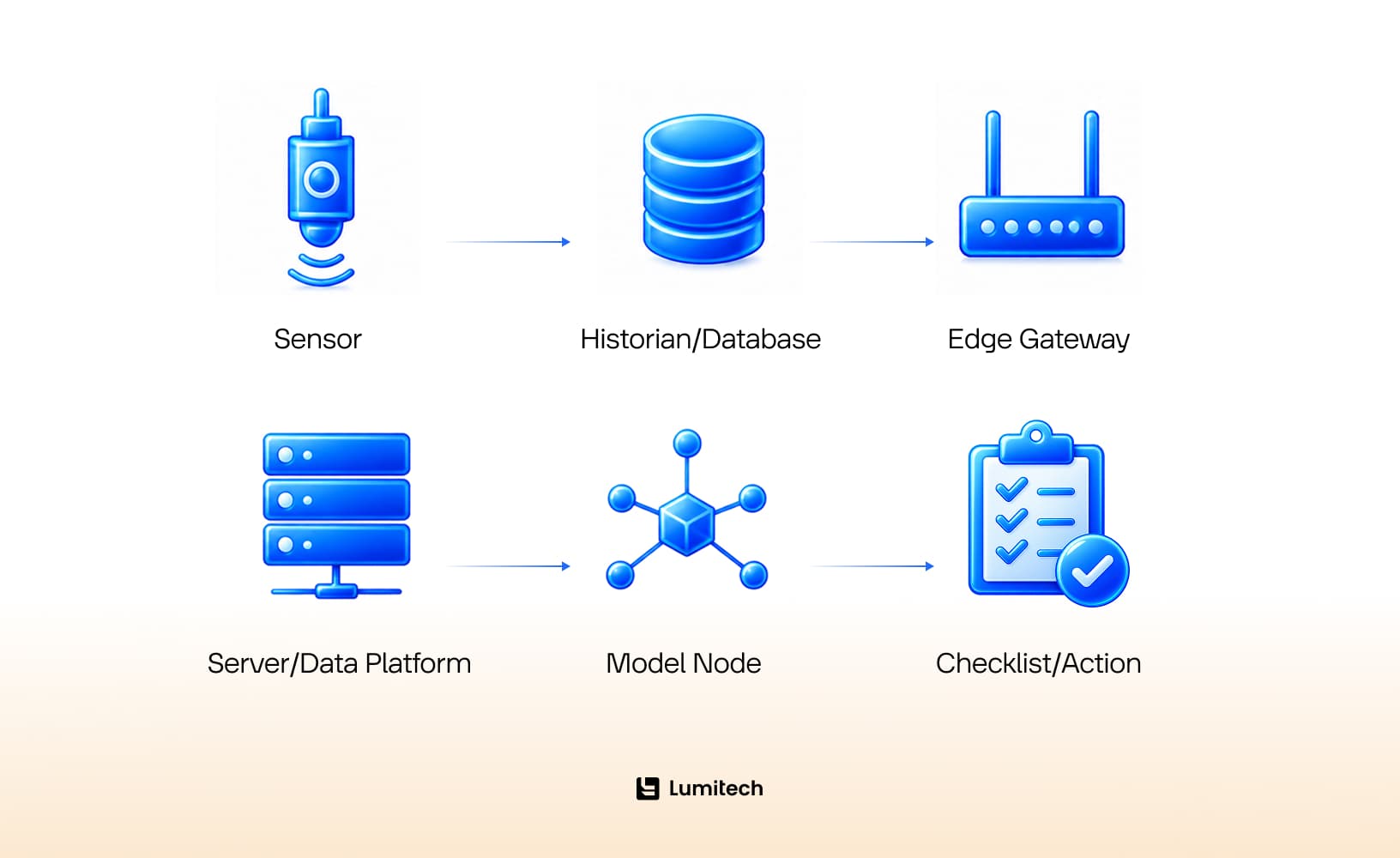
A conventional pipeline runs: sensors, PLCs, and historians → edge gateway → data platform → feature engineering → model training → deployment to cloud or edge → monitoring and retraining → an action in the workflow.
Three standards carry most of the weight. OPC UA provides object-oriented information modeling at the machine level. MQTT with Sparkplug B supplies lightweight publish/subscribe transport with standardized topic namespaces. ISA-95 and the Purdue model define the hierarchy from enterprise down to individual tag.
The architectural pattern that has taken hold is called Unified Namespace: a single event-driven broker that every system publishes to and subscribes from. It preserves the ISA-95 hierarchy while flattening Purdue’s rigid layer-by-layer data flow, replacing the brittle point-to-point integrations that accumulate in multi-plant estates. It is a design pattern, not a product, and it augments SCADA rather than replacing it. It is also what makes an industrial AI platform viable, because models need addressable, consistent data rather than a bespoke extract per use case.
Then there is the data, where most projects meet reality. A 2025 meta-review in Computers in Industry by Li, Cheng, Møller and Lee identified 72 distinct data issues across the industrial data lifecycle. The recurring ones are first-order obstacles: failures are rare, so classes are severely imbalanced; failure events are often unlabeled; sensors drift; tag naming is inconsistent between plants; history is short; metadata is missing. Any credible industrial AI analytics effort spends most of its budget here.
Why Industrial Edge AI Moves Inference to the Plant
Industrial edge AI refers to the use of local hardware (like gateways, industrial PC’s or smart cameras) to perform inference instead of using their data center. Four constraints drive the choice.
Latency. Control-adjacent tasks commonly require responses in the single-digit to low-tens-of-milliseconds range, and vision-based inspection must complete within the machine cycle. A cloud round trip of 100–200 milliseconds is unremarkable by IT standards, but a robot arm moving at 2 m/s travels 200–400 mm in that window.
Determinism and bandwidth. Continuously backhauling raw vibration and video from dozens of assets is expensive and often impractical, and control-adjacent functions need bounded timing that best-effort connectivity cannot guarantee. Architecting around that constraint is core to what AI/ML development services actually build.
Sovereignty and isolation. Many OT networks are deliberately air-gapped or tightly segmented, and some jurisdictions constrain where operational data may be processed. This is why most AI in industrial automation runs on-premises, whatever the vendor’s cloud preference.
The drawback is lifecycle cost: edge fleets need patching, model versioning, hardware refresh, and remote observability. Industrial AI systems scoped as one-off deployments quietly degrade once nobody owns the estate.
Industrial AI Applications: Where the Money Actually Is
The commercial case for industrial AI applications rests more on avoided losses than on new revenue, and most business cases start with a downtime number. Siemens’ True Cost of Downtime 2024 report estimates that unplanned downtime costs the world's 500 largest companies around $1.4 trillion a year, roughly 11% of revenues, with an idle automotive line costing up to $2.3 million per hour. Read the methodology first: it rests on 181 interviews with large industrial organizations conducted from April 2019 to March 2023, with the Fortune Global 500 total extrapolated from that sample. Treat it as an order-of-magnitude signal, not a benchmark for a mid-market site.
Industrial AI Use Cases With Documented Deployments
Named deployments beat anonymous case studies, so the industrial AI use cases below are publicly documented. The caveat is that operators tend to publish the mechanism and withhold the outcome.
Quality inspection — BMW Group, Plant Regensburg. BMW’s GenAI4Q pilot, developed in-house with Munich startup Datagon AI, uses generative AI to produce tailored inspection recommendations for the roughly 1,400 vehicles built each day on a line where a car is completed every 57 seconds. Because virtually no two vehicles share the same specifications, it generates a vehicle-specific catalog rather than a single checklist for an average car. BMW has published no defect-rate figure, so read it as evidence that the approach survives a demanding environment, not as a quantified return.
Energy and process optimization — Google DeepMind. DeepMind’s control system for data-center cooling cut cooling energy by a consistent 40%, equivalent to a 15% reduction in PUE overhead — a clean illustration of how industrial AI works when the feedback loop is tight, and the sensor data is clean. It remains the cleanest published figure of its kind, but it dates from 2016 and describes a data center, not a factory.
Predictive maintenance — Deutsche Bahn, as described above.
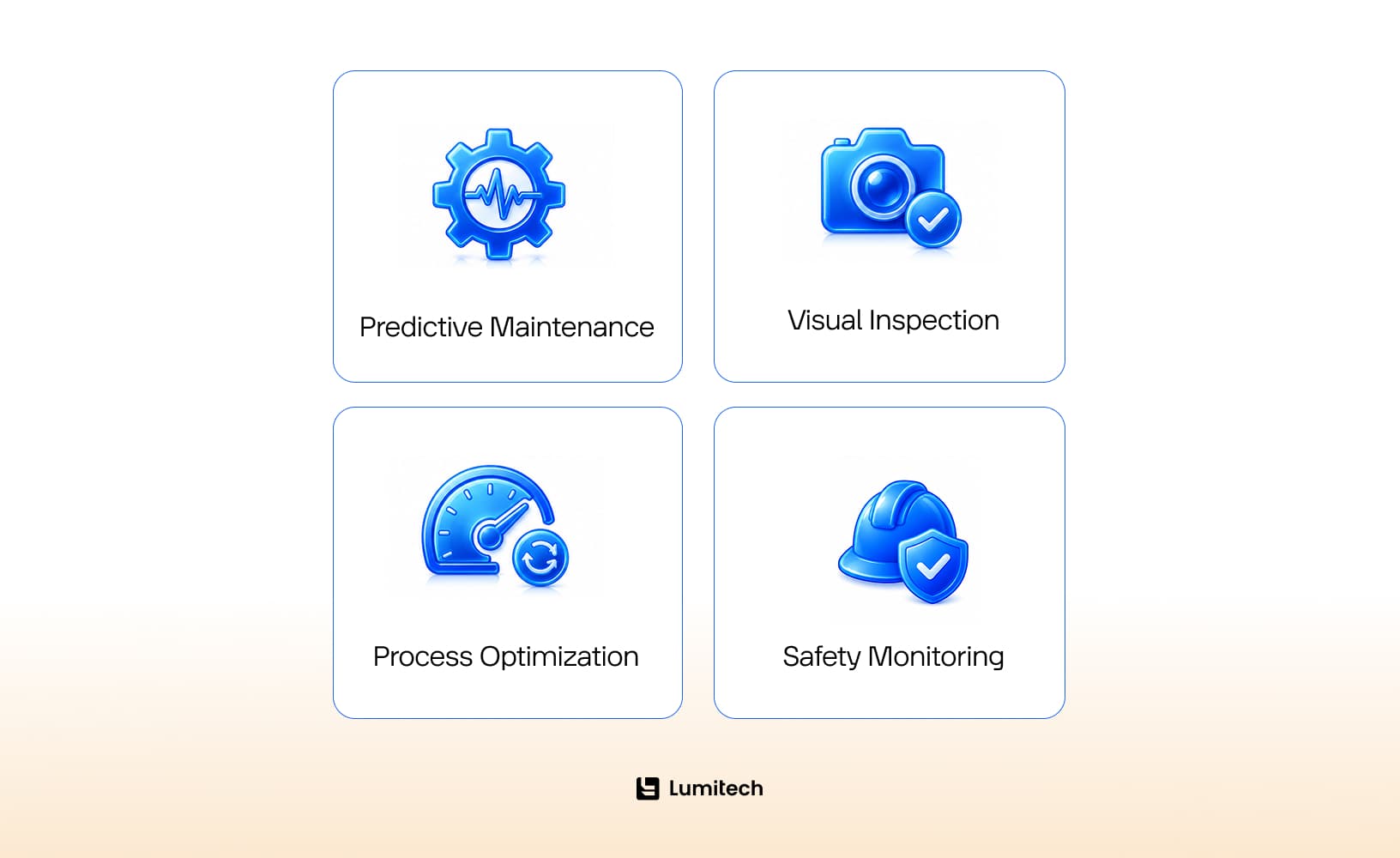
Use case | What the model does | Data it needs | Typical maturity |
|---|---|---|---|
Predictive maintenance | Estimates failure risk or remaining useful life | Vibration, temperature, load history, labeled failures, CMMS records | Proven; hardest data requirement |
Visual quality inspection | Classifies defects from images | Labeled defect images, consistent lighting and fixturing | Proven; fastest to value |
Process optimization | Recommends setpoints for yield or energy | Historian time-series, quality results, process constraints | Proven in continuous process |
Safety monitoring | Detects PPE gaps, zone breaches, proximity risk | Camera feeds, zone definitions, privacy controls | Proven; governance-sensitive |
Engineering copilots | Retrieves and drafts from technical documents | Manuals, drawings, work orders, standards | Emerging; assistant-stage |
Across all of these, AI for industrial operations is judged on one question: does the output change a decision somebody was already making? Predictions nobody is accountable for acting on generate cost and no return.
Considering your first industrial AI project?
At Lumitech, we cover the full scope, from data readiness to deployment and monitoring.

What You Need in Place Before Any Model Ships
Readiness is unglamorous and decisive. Before committing budget to industrial AI, confirm six things: an operational decision with a named owner; historian coverage for the assets in scope; standardized tag naming across sites; reliable connectivity from the equipment; MLOps and AI infrastructure to monitor and retrain; and an OT security posture aligned to IEC 62443 and NIST SP 800-82 Rev. 3.
Cost is harder to state honestly because independent benchmarks are scarce, and most circulating figures originate with vendors. What is defensible is the shape of the spend: data engineering and analytics dominate, and model development is a minority line item. Timelines follow the same logic. As a planning heuristic, expect a single-plant pilot on ten to twenty machines to take a few months, production at one site the better part of a year, and a multi-site rollout to take longer, with data readiness setting the pace. Anyone quoting a fixed price for industrial AI solutions before seeing your tag list and historian coverage is guessing, and the same applies to any industrial AI platform sold on a per-asset license.
Why Most Programs Never Leave the Pilot

Reliable pilot-to-production data specific to industrial AI is scarce. The closest available evidence comes from generative AI — industrial AI’s fastest-moving adjacent category — and it isn’t encouraging: MIT Project NANDA’s report, The GenAI Divide: State of AI in Business 2025, found that just 5% of generative AI pilots were delivering significant value, with the large majority showing no measurable P&L impact. The report drew on more than 300 publicly disclosed initiatives, 52 structured interviews, and 153 survey responses from senior leaders, though it’s a preliminary July 2025 study, not peer-reviewed work. McKinsey’s research on agentic AI found a comparable pattern: fewer than 10% of deployed use cases ever move past the pilot stage.
Where AI in Industrial Operations Breaks Down
AI in industrial operations fails in patterns specific enough to design against:
Lack of failure examples. Supervised models need labeled failures, and well-maintained assets produce few. Physics-informed hybrid models, combining first-principles equations with learned components, are the usual response.
Drift after change. Retooling, a new variant, or a replaced sensor shifts the input distribution, and accuracy degrades unnoticed.
Alarm fatigue. Though the false positive rate indicated in the reports may seem normal, it is extremely high for operations. In such a case, people stop accepting results, thus ignoring the system.
Integration friction. Getting an inference into MES, ERP, or the CMMS work-order queue is often harder than producing it, and the model has no institutional home once the internal champion moves on.
OT/IT ownership conflicts. The two functions use different risk models and definitions of uptime, and industrial AI applications sit at that boundary.
Most of these are organizational failures wearing technical clothing. AI in mechanical engineering hits the same wall: the engineering is tractable, and operational integration is where projects stall.
Safety, Regulation and the Limits of Autonomy
Some applications are out of scope, and standards rather than preference draw the boundary. IEC 61508 is the generic functional safety standard behind SIL 1–4, and the technique tables in Annex A of IEC 61508-3:2010 classify artificial intelligence as not recommended above SIL 1. IEC 61511 covers safety-instrumented systems in the process industries; ISO 13849 and IEC 62061 cover machinery safety.
Newer work exists because those standards assume predictable, exhaustively testable failure modes that statistical models do not offer. ISO/IEC TR 5469, published in January 2024, describes the properties, risk factors, and methods relevant to AI in safety-related functions. Its successor specification, ISO/IEC TS 22440, is being developed in three parts within ISO/IEC JTC 1/SC 42 and was still at the committee-draft stage in mid-2026, making it a direction of travel rather than something to design against today.
No industrial AI technique available today removes the need for a deterministic safety layer. The defensible architecture keeps that layer hard-separated and hard-real-time, confining models to an advisory envelope with human oversight and runtime monitoring. Perception is the same: computer vision monitoring, such as AI for workplace safety, should surface risk patterns and prompt human intervention, not act as an interlock.
What the Rules Require in the EU, US and UK
Jurisdiction influences how artificial intelligence is used in industry, and the requirements are not converging. The summary below reflects the position as of August 2026 and is general information, not legal advice.
European Union. The AI Act, Regulation (EU) 2024/1689, applies in phases: prohibitions and AI-literacy duties from 2 February 2025, general-purpose AI obligations from 2 August 2025. The Digital Omnibus on AI, adopted by the Council on 29 June 2026, deferred the heaviest high-risk obligations: stand-alone Annex III systems to 2 December 2027 and AI embedded in products already covered by EU product safety law to 2 August 2028. It also moved the Machinery Regulation (EU) 2023/1230 from Annex I Section A to Section B, so full Chapter III obligations no longer apply directly to AI safety components of machinery; instead, the Commission must adopt delegated acts adding AI-specific health and safety requirements under the Machinery Regulation itself by 2 August 2028. The definition of “safety component” was also narrowed: AI used solely for optimization, efficiency, automation, or convenience is not high-risk unless a malfunction could endanger health or safety. Article 50 transparency duties were not deferred and apply from 2 August 2026.
United States. There is no federal law dedicated to AI. Practice rests on voluntary frameworks: the NIST AI Risk Management Framework, NIST CSF 2.0, and NIST SP 800-82 Rev. 3 for OT and ICS security.
United Kingdom. The UK adheres to a principles-based and sector-led approach coordinated by the DSIT. The AI Growth Lab, a cross-economy sandbox that can relax specific rules for licensed pilots, began operating in 2026, with advanced manufacturing among the sectors named for later cohorts.
Cutting across all three, ISO/IEC 42001 offers a certifiable AI management system, and IEC 62443 governs industrial cybersecurity.
Which AI Agents and Generative AI Tools Are Actually Shipping
This is where marketing and reality diverge most sharply. Industrial generative AI has a genuine but bounded role: retrieval across maintenance manuals and standards, work-order summarization, engineering copilots, and code generation for PLC and HMI programming. It does not belong in a control loop.
Assistant-grade products are genuinely available. Siemens ships an engineering copilot for TIA Portal that generates SCL code and initial WinCC Unified visualizations against a live project, and AVEVA and Schneider Electric offer comparable assistants. Cognite reports its Atlas AI agent workbench in production with customers including Aker BP and Idemitsu Kosan, though no independent outcome data has been published.
Industrial AI agents that execute processes autonomously deserve more skepticism, because most are still demonstrations or partnerships. Rockwell Automation and Microsoft showed AI-orchestrated factory engineering at Hannover Messe in April 2026 as a demonstration, not a product, and Rockwell’s July 2026 partnership with Augury, linking machine-health insight to the Fiix CMMS, was announced with an initial offering expected that September.
Gartner’s June 2025 assessment is the useful counterweight. It predicts that over 40% of agentic AI projects will be canceled by the end of 2027 because of escalating costs, unclear business value, or inadequate risk controls, and warns of “agent washing” — rebranding assistants, RPA and chatbots as agentic — estimating that only around 130 of thousands of self-described agentic vendors are the real thing. When evaluating industrial artificial intelligence products, ask for a named production reference and a documented failure mode, not a demo.
Is AI the Next Industrial Revolution?
Asking if AI is the next industrial revolution invites a yes-or-no answer the evidence does not support, and the economists disagree. MIT’s Daron Acemoglu estimates the macroeconomic effect as nontrivial but modest, no more than a 0.66% increase in total factor productivity over ten years, because only a small share of tasks will be profitably automated in that window. Goldman Sachs, whose 2023 forecast Acemoglu was arguing against, projected a closer-to-7 % lift in global GDP over a decade. Erik Brynjolfsson’s “productivity J-curve” reconciles the two: measured gains lag because firms must first restructure work and build intangible capital.
The defensible position for a plant-level decision-maker is narrower than either camp. The industrial artificial intelligence technologies now in production demonstrably change outcomes on specific lines and assets. Whether that translates into an economy-wide shift remains unresolved, and your capital plan does not need to address it.
AI Readiness Sequence for Mid-Sized Manufacturers

Six steps separate a program that ships from one that stalls at the pilot — and the order they happen in decides which.
Industrial AI technologies reward sequencing. Fix data and ownership first; deployment compounds. Start with a model, and you get an impressive pilot and a stalled program.


Here's that sequence, in order:
Name the decision, not the technology. “Should we pull this pump this week?” is a project. “Let’s do AI” is not.
Audit data before funding a model. Historian coverage, tag consistency, labeled failure history.
Fix the plumbing. OPC UA at the machine, MQTT/Sparkplug B for transport, a Unified Namespace so data survives SCADA changes.
Pilot narrowly, instrument heavily. One line, one asset class, drift monitoring from day one.
Own the model for its whole life, retraining after maintenance and retooling.
Keep AI out of safety functions. Map your EU exposure early and evaluate industrial AI solutions against that boundary before signing.