
MVP Development Cost: What It Really Takes to Build in 2026
You have the idea, the deck, and a Notion doc with 47 features. What you don’t have is a straight answer to what your co-founder, investor, and bank account all want to know: how much does an MVP cost?
- Software Development
August 17, 2026
 AI Overview
MVP development cost depends on scope, design depth, team region, and integrations, and typically ranges from $15,000 to $75,000 in 2026. Adding features without cutting others increases cost and delays launch, since each feature adds design, testing, and maintenance work. Founders who define scope early control MVP development cost and avoid budget overruns.

Ask three agencies what an AI app costs, and you’ll get three wildly different answers: $15,000, $100,000, or “let’s schedule a discovery call.”
That gap isn’t a scam — it’s the same reason quotes vary wildly across general IT services for small businesses, not just app studios. An “AI app” can mean a quick wrapper built on top of an existing LLM in a few weeks, or a HIPAA-compliant triage tool that requires six months of dev work, strict security audits, and constant legal oversight.
Here’s what things actually cost in 2026: realistic price ranges by feature, the surprise maintenance bills that usually hit around month four, and where you can safely trim the budget without launching a half-baked product.
How Much Does an MVP Cost? The Direct Answer
A functional AI-powered MVP costs $15,000–$75,000 in 2026, with most MVP development for startups ranging from $35,000 to $60,000. Most startups with venture-backed teams land between $35,000 and $60,000. A lean single-feature app ships for under $20,000. The costs of MVPs with payment processing or sensitive data go from at least $60,000 and can rise quickly. The average MVP development cost sits near $45,000 — but averages lie, so use the matrix instead.
2026 MVP Development Cost Matrix
Tier | What you get | Timeline | Cost range |
|---|---|---|---|
Clickable prototype | Figma flows, no working backend. Investor demo only. | 1–3 weeks | $3,000–$10,000 |
Lean MVP | One core AI workflow, auth, basic UI, one platform. | 5–8 weeks | $15,000–$30,000 |
Standard MVP | 3–5 features, payments, admin panel, real design. | 3–4 months | $35,000–$65,000 |
Complex / regulated MVP | Real-time, custom models, compliance, integrations. | 5–7 months | $75,000–$180,000+ |
That bottom row is where a complex MVP development cost lives — fintech, healthtech, two-sided marketplaces, an AI MVP for logistics tracking freight in real time — anything where a bug means a lawsuit rather than a bad review. Budgeting for a regulated product like a lean one is how founders end up with 70% of an app and 0% runway.
Get a ballpark estimate for your MVP
Share your product type, core features, and target platform to receive an initial budget range.

Here’s the good news: a simple MVP cost in 2026 is genuinely lower than in 2022. The MVP development cost 2026 baseline dropped because foundation model APIs removed any need to train your own model, and modern tooling collapsed weeks of boilerplate into hours.
What the Cost to Build an MVP Actually Covers
Founders sometimes assume the quote is just “engineers typing.” This is not the case. A realistic cost to build an MVP covers discovery phase services (5–10%), UI/UX design (15–20%), frontend and backend build (45–55%), AI integration and prompt engineering (10–15%), QA (10%), and project management (10–15%). Roughly half your MVP development cost is engineering; the other half is what makes the engineering usable.
So when an agency quotes $22,000 and a freelancer quotes $9,000 for the same scope, the delta is mostly due to those non-coding lines. Whether that’s overhead or insurance depends entirely on how much you enjoy managing software projects yourself.
The 5 Main MVP Development Cost Drivers
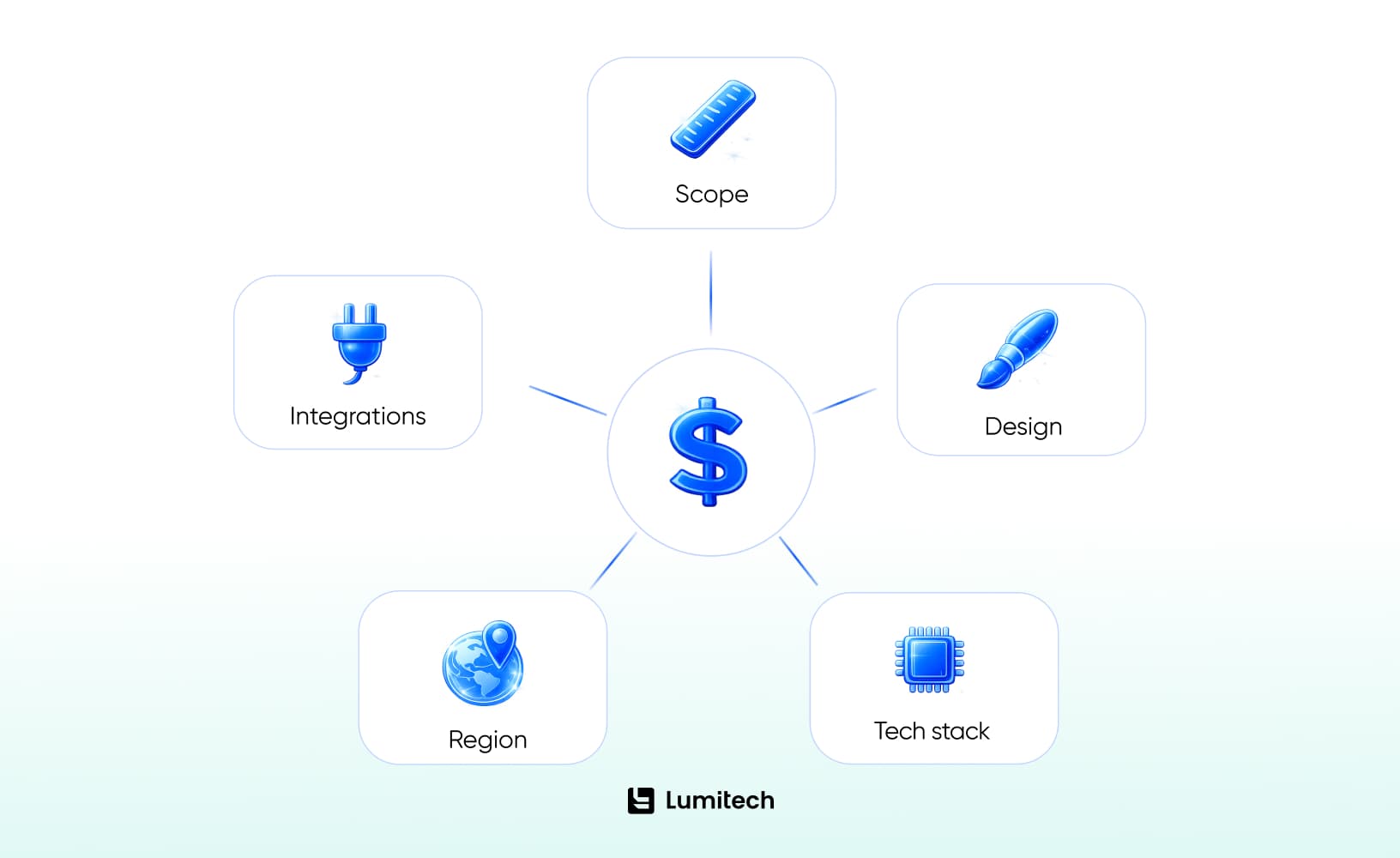
Five factors account for 90% of price variance: scope, design depth, tech stack and platform, team location, and third-party integrations. Move any one and your quote shifts by thousands. Understanding the factors affecting MVP development cost is what lets you negotiate intelligently instead of just asking for a discount and hoping.
1. Scope (the biggest lever, by a mile)
It is important to note that each feature carries a hidden tax: design, backend logic, tests, error states, an admin view, documentation. A feature that takes two days to build takes five to ship properly. Ten “small” features is not a small MVP — and scope is why the cost to build MVP quotes in your inbox vary by 5x off the same one-paragraph brief.
CB Insights' post-mortem research finds that running out of cash and building something nobody wanted are the top startup killers — frequently the same mistake wearing two hats.
There’s a version of this business where developers just say yes to every feature a client asks for, because it’s an easier sales conversation and a bigger invoice. At Lumitech, we don’t do that, because it doesn’t actually help anyone — it just delays the moment clients find out whether their product works. So most of our early calls are less about what we can build and more about what actually needs to exist on day one.



2. Design depth
Design is the second-largest line item on most MVP development cost sheets and the easiest to overbuy. Template UI with a component library: $2,000–$6,000. Custom design system with distinctive identity, motion, and illustration: $12,000–$30,000. Only one is necessary before product-market fit. If you’re consumer social, design is the product — pay for it. If you’re B2B SaaS, your buyer just wants the export button to work.
3. Tech stack and platform
Web-only is the least expensive option. Cross-platform (React Native, Flutter) adds 20–30%. Native iOS and Android require roughly twice as many engineering resources. For AI features, an API-first approach using OpenAI or Anthropic models is far cheaper than fine-tuning, which is itself far cheaper than training. Do not train a model for an MVP. Please.
4. Team region
The highest multiplier for the hourly salary. Details are in the table below.
5. Integrations and AI plumbing
Stripe, Auth0, Twilio, a vector database, a RAG pipeline, an eval harness, a moderation layer. Each is 8–40 hours long and becomes a dependency you’ll debug at 2 a.m. Budget $1,500–$5,000 per non-trivial integration.
Build Approaches Compared: MVP Development Pricing by Model
There are five realistic paths to MVP development services, ranging from $0 to $400,000 in first-year spend. No-code is the fastest and cheapest but comes with some restrictions. Freelancers are cheap and high-variance. Offshore agencies offer the best cost-to-capability ratio. Onshore agencies cost 2–3x for tighter collaboration. In-house hiring is the most expensive route to a first version and the cheapest route to the fiftieth.
Approach | Typical cost | Timeline | Best for |
|---|---|---|---|
No-code/low-code | $0–$8,000 | 1–4 weeks | Validation, internal tools, simple workflows |
Freelancers | $8,000–$30,000 | 6–14 weeks | Tight scope, technical founder |
Offshore agency | $20,000–$60,000 | 8–16 weeks | Most funded startups |
Onshore agency | $70,000–$200,000 | 10–20 weeks | Regulated industries, enterprise buyers |
In-house team | $180,000–$400,000/yr | 4–8 months | Post-funding, AI-as-core-IP |
The no-code vs. low-code line is blurrier than vendors admit — tools like Bubble, FlutterFlow, and Lovable, plus a Zapier-and-hope layer, genuinely work now for AI wrappers and CRUD apps. However, there are drawbacks, including performance issues, lock-in, and user-based pricing policies that can be unacceptable once the user count reaches 10,000. Fine for testing demand, but painful as a foundation.
Freelancers offer the lowest MVP price for real custom code. The catch: you are now the project manager, the QA department, and the person who discovers in week nine that “backend is done” meant something creative.
Offshore agencies in Eastern Europe, Latin America, and South Asia are where most sensible founders land: a full team — PM, designer, two engineers, QA — at a blended rate that works, and where the median MVP development cost sits. Vet for timezone overlap, not just rate.
Onshore agencies cost two to three times as much. Sometimes worth it — enterprise procurement that asks where your developers sit, heavily regulated products. Often not.
In-house development services are the wrong answer for a first build and the right answer eventually. Two senior engineers in a major US metro run $360,000+ a year before equity (Levels.fyi if you think that’s pessimistic). But your fifth iteration is far cheaper with a team that already knows the codebase.
MVP Development Cost by Region (2026 blended rates)
Region | Hourly rate | Standard MVP |
|---|---|---|
USA/Canada | $110–$220 | $90,000–$200,000 |
Western Europe | $85–$170 | $70,000–$150,000 |
Eastern Europe | $40–$75 | $32,000–$65,000 |
Latin America | $40–$70 | $30,000–$60,000 |
South/Southeast Asia | $22–$50 | $18,000–$45,000 |
Rate does not reflect quality. The cost to create MVP functionality is roughly the same number of hours everywhere; only the price per hour moves. A $50/hour engineer in Kraków and a $180/hour engineer in San Francisco often produce indistinguishable code. What differs is communication overhead, and that’s manageable with discipline.
Feature-by-Feature MVP Development Cost Breakdown
Here’s the MVP cost breakdown most agencies won’t hand you upfront. Figures assume a blended $50/hour offshore rate — multiply by 2.5–3x for onshore. Add up only the rows you actually need, and you have a defensible cost to build an MVP figure to negotiate against, plus instant visibility into which features are quietly eating your budget.
Feature | Hours | Estimated cost |
|---|---|---|
Email/social authentication | 20–40 | $1,000–$2,000 |
User profiles & settings | 25–45 | $1,250–$2,250 |
Onboarding flow | 20–35 | $1,000–$1,750 |
Core AI chat/generation interface | 60–120 | $3,000–$6,000 |
RAG pipeline (embeddings + vector DB) | 70–140 | $3,500–$7,000 |
Prompt engineering & eval harness | 40–80 | $2,000–$4,000 |
Content moderation/guardrails | 25–50 | $1,250–$2,500 |
Payments & subscriptions (Stripe) | 40–70 | $2,000–$3,500 |
Push/email notifications | 25–45 | $1,250–$2,250 |
Admin dashboard | 60–110 | $3,000–$5,500 |
Analytics & event tracking | 20–35 | $1,000–$1,750 |
Search & filtering | 30–60 | $1,500–$3,000 |
File upload & storage | 20–40 | $1,000–$2,000 |
Real-time chat/collaboration | 80–160 | $4,000–$8,000 |
Third-party API integration (each) | 15–40 | $750–$2,000 |
Multi-language support | 40–80 | $2,000–$4,000 |
QA & bug fixing | 15% of total | 15% of total |
Six rows from the middle is a $25,000 cost to develop MVP before you’ve written a line of marketing copy. Note that real-time collaboration costs as much as auth, profiles, onboarding, and notifications combined — the kind of fact that should change your roadmap today.
Wondering how much does it cost to build an MVP with one killer feature done exceptionally well? Roughly $12,000–$20,000 — often the exact brief handed to POC development services before a founder commits to the full build. A completely legitimate strategy, and arguably the best one.
Not sure which features belong in version one?
We can turn your product idea into a prioritized MVP scope and identify the features that can be postponed without affecting validation.

Hidden MVP Development Costs Founders Forget
Development is 70–80% of your true first-year spend. The rest is infrastructure, inference, store fees, and maintenance — typically $8,000–$25,000 in year one, which means your real MVP app cost is 20–30% above the build quote. Anyone answering how much does an MVP cost with a single build number is omitting a fifth of the bill.
Cloud hosting. $50–$400/month early, scaling with usage. Vector databases, managed Postgres, storage, and CDN all bill separately. Model it with the AWS Pricing Calculator before launch, not after your first traffic spike.
AI API usage. The one that surprises people: inference is a per-token cost that scales linearly with success. A chat app with 1,000 active users and 10 conversations per month costs $200–$2,000/month, depending on the model and context length. Bloated system prompts are an expensive habit. Cache aggressively, route simple queries to cheaper models, set hard spend limits on day one.
App Store fees. Apple's Developer Program is $99/year; Google Play is a one-time $25. Trivial. The commission on in-app purchases — up to 30%, reduced under small-business programs — is not trivial and belongs in your unit economics.
Payment processing. Stripe takes a cut of every transaction. Noise at low volume; a real line item in your projections.
Maintenance. Plan an annual MVP maintenance cost of 15–25% of the build. Dependencies break, OS versions ship, model APIs get deprecated on three months’ notice, and security patches don’t apply themselves. A $40,000 MVP needs $6,000–$10,000 a year just to keep breathing.
Everything else. Domain and SSL, error monitoring, transactional email, Twilio for SMS, App Store assets, and legal review of your privacy policy — especially if user data flows through third-party models. Call it $2,000–$5,000.
How to Cut MVP Cost Without Sacrificing Quality
Cut scope, never craft. Real savings come from building fewer things, not the same things worse. Founders who trim features intelligently ship 30–50% more cheaply with no visible drop in quality. Founders who hire the cheapest bidder to build the whole roadmap ship late, buggy, and pay twice. Here’s where to actually cut your MVP development cost.
Rank features ruthlessly. For each one: if this were missing at launch, would a paying user walk away? If it isn’t an immediate yes, it’s phase two. This alone typically removes 40% of an MVP development budget — deleting two features moves the cost of MVP development further than any rate negotiation will.
Ship web first. One responsive web app instead of iOS plus Android plus web. You can validate demand in a browser. Saves $15,000–$25,000.
Buy, don’t build. Auth, payments, email, analytics, admin panels, storage — solved problems with mature vendors. Every hour spent building custom authentication is an hour not spent on what makes your product interesting. Nobody has ever churned over a third-party login.
Use off-the-shelf models. Prompt engineering plus retrieval gets you 90% of the way for 5% of the cost of fine-tuning. Revisit custom models when you have proprietary data and paying customers, in that order.
Design with a system. Tailwind, shadcn/ui, Material — pick one and let your designer customize rather than originate. Saves $6,000–$12,000 and often looks better than bespoke work on a rushed timeline.
Test with five users, not fifty. Nielsen Norman Group found that five users surface most usability problems. Research isn’t where to spend big; it’s where to spend early.
Fix scope before you sign. The most expensive words in software are “while you’re in there, could you also…” Get a written feature list, a fixed price against it, and treat additions as change orders. A tight MVP cost estimate requires a tight spec — vague briefs get padded quotes, which is how two vendors produce wildly different MVP price figures off the same email.
Keep one decision-maker. Committee decisions cost money in ways that never appear on an invoice but always appear on the timeline.
Get a detailed MVP estimate
Receive a cost breakdown covering product discovery, UX/UI, development, QA, infrastructure, and launch.

The Bottom Line
Founders ask how much does it cost to build an MVP software and expect one number. There isn’t one — but there is a defensible range. The honest answer: less than you fear, more than the cheapest quote in your inbox, and almost entirely within your control. Your MVP cost in 2026 is set before anyone writes code — how many features, which platforms, which region, how much design. Scope is the lever; everything else is a multiplier.
Two things to keep. The MVP cost is not your total cost: add 20–30% for year one of hosting, inference, and maintenance. And whatever you budget, keep enough left to iterate — an MVP that ships and can’t be improved is just an expensive opinion.
Now go delete some features from that Notion doc.


