
US & UAE Connections: Why Smart Companies Build Across Both Markets
The more serious AI, fintech, and Web3 become, the less realistic it is to think in single-country terms. You can still launch in one market — but scaling, staying compliant, and securing infrastructure increasingly push you into a multi-region reality.
- For New Clients
April 08, 2026
 AI Overview
Dual-market tech architecture keeps the US as the innovation core for AI, fintech, and Web3 while using the UAE as a scaling layer with predictable digital-asset regulation, sovereign capital, and compute infrastructure. This design responds to US regulatory uncertainty and energy bottlenecks that raise governance and infrastructure costs. US data center demand already exceeds regional grid capacity by nearly 50% in areas like Northern Virginia.


For most companies we speak with, the pattern looks similar:
The US is still the innovation center — deep talent, capital, and customer access.
But structural constraints appear once you move beyond “product stage” into “infrastructure stage”.
At the same time, the UAE is quietly positioning itself as a disciplined extension layer: predictable virtual asset regulation, national AI policy, sovereign capital, and large-scale compute projects.
This article is not about shifting from the US to the UAE. It is about why smart companies start to think in architectures: US as the core, UAE as an external scaling layer — and how you design this in a way that holds under pressure.
The Structural Limits of Scaling in the US
The US is still where many category-defining products are born. But the same environment that supports innovation also creates friction when you try to scale AI-heavy, crypto-adjacent, or data-intensive systems. Let’s discover why.
Regulatory Uncertainty in AI and Web3
On the regulatory side, the US continues to rely heavily on “regulation through enforcement” for digital assets and, increasingly, for AI-related claims.
The SEC still uses the 1946 Howey Test as a core lens to decide whether a token is a security, instead of a bespoke digital asset framework. That approach has practical consequences. One study submitted to the SEC’s Crypto Task Force notes that when a token is classified as a security, its value falls on average by 17.2%, and trading activity can drop by roughly 50%. For founders, that is not an abstract legal risk — it shapes funding, listings, and product design.
At the same time, the SEC has explicitly placed AI and crypto together on its 2025 enforcement radar. Secretariat International summarizes it bluntly: in 2024, the SEC filed 583 enforcement actions and obtained US$8.2 billion in financial remedies, with US$4.98 billion in penalties linked to digital-asset participants alone. Looking ahead, the agency’s own 2025 examination priorities list “cyber security and artificial intelligence” and “emerging financial technology” as key focus areas.
For a US-based AI or Web3 company, this means:
the rules are still shifting;
enforcement is active and high-profile;
and the cost of being “first to try something” on the regulatory edge is high.
You can still build here — but you must assume higher governance overhead and more frequent external scrutiny.
Infrastructure Bottlenecks: Energy and Compute
The second structural constraint is physical: energy and compute capacity. Data centers in the US already consume around 183 TWh of electricity a year, which is approximately 4–5% of national demand. Projections compiled by researchers and industry groups suggest this could rise to 325–580 TWh by 2028, representing about 6.7–12% of all US electricity consumption. Several analyses, including work from the Belfer Center and World Resources Institute, point out that in key regions like Northern Virginia, requested data center load already exceeds grid capacity by nearly 50%.
At the same time:
AI workloads are significantly more energy-hungry than classic web requests — some estimates suggest an AI query can use roughly 10× the energy of a standard search.
A single large data center can draw as much power as 100,000 homes.
Bain and other analysts estimate that meeting global AI compute demand could require up to US$500 billion per year in capital for data centers, chips, and grid upgrades.
In practice, this translates into:
24–72 month delays to secure power in certain US regions;
stricter local permitting and environmental reviews;
and a growing mismatch between AI roadmaps and what the grid can realistically supply.
If your strategy depends on scaling training and inference aggressively inside the US, you will eventually run into these physical limits.
Capital Efficiency Pressure
On the capital side, money has not disappeared — but it is more selective, especially for infrastructure-heavy initiatives.
Several venture reports show that while total US VC deployment remains high, funds are concentrating on fewer, larger bets and demanding clearer paths to revenue from AI companies. Ropes & Gray’s 2025 AI report describes an “arms race for compute” where many players are constrained not only by capital but also by access to chips and energy.
That combination creates a tension:
You need more capital to build or secure compute.
You face longer timelines and higher risk due to regulatory and energy constraints.
Traditional venture structures are not always designed for 10–15 year asset plays.
By contrast, large sovereign wealth funds — especially in the Gulf — collectively manage about US$15 trillion, and allocated around US$66 billion specifically into AI and digitalization in 2025. Abu Dhabi’s Mubadala alone invested US$12.9 billion in AI and digital projects that year and was the most active sovereign wealth fund globally, with US$32.7 billion deployed across 40 transactions. That is a different capital profile from a typical early-stage fund.
Talent Constraints and Cost of Hiring
Talent remains a US strength — and a constraint. The US is still the highest-paying major market for software engineers, but that also means scaling teams domestically is expensive.
In 2025:
average US software engineer salaries sit around US$110,000–133,000 per year, with senior roles at US$150,000+ and much higher total compensation at large tech firms.
Western European averages are closer to US$50,000–85,000, depending on the country, with some markets like Germany and the UK in the US$55,000–70,000 range.
Many Asian markets are lower again, with typical ranges in the US$20,000–70,000 band depending on city and company type.
A realistic rule of thumb: a US-based engineer often costs 1.5–3× a similar role in Europe or many parts of Asia once you include benefits and taxes.
This does not mean US teams should be replaced. It does mean:
purely US-based scaling becomes expensive once you move beyond a small core;
long-term product support and 24/7 operations are hard to staff domestically;
and the market is tight, especially for senior AI and infrastructure roles.
Data Compliance and Cross-Border Complexity
Finally, compliance and cross-border data rules are becoming more fragmented. The US itself is introducing sector-specific AI and data guidance, while other regions — EU, UK, GCC — add their own frameworks.
For global products, this results in:
overlapping obligations on privacy, model governance, and transparency;
conflicting expectations around where data and models are hosted;
and higher operational complexity when everything is anchored only in one legal system.
None of this makes the US a “bad market”. It remains the primary innovation core. But if you are building serious AI, fintech, or Web3 infrastructure, you are likely feeling these constraints more directly each year.
The UAE as a Strategic Extension Layer for US Companies
Given this backdrop, it is tempting to frame the UAE as an “alternative”. We do not think that way. For most mature companies, the UAE works best not as a replacement, but as a second operational layer — an external accelerator attached to a US core.
Several trends from the sources point in the same direction:
The UAE has been building a unified, specialized regulatory framework for virtual assets through coordination between Dubai’s Virtual Assets Regulatory Authority (VARA) and the federal Securities and Commodities Authority (SCA).
The government has formalized a national AI strategy with clear objectives around infrastructure, governance, and talent, overseen by the Emirates Council for Artificial Intelligence and Digital Transactions.
Abu Dhabi and Dubai are positioning themselves as “AI infrastructure hubs” through projects like the Stargate AI cluster and large sovereign-backed AI investment vehicles.
In other words, the UAE is explicitly designing itself to host:
regulated virtual asset activity;
large-scale AI compute;
and cross-border tech operations.
For a US company, that looks like an extension slot — a place where parts of the system that are hard to scale domestically can live, while the core product, governance, and strategy stay in the US.
Where UAE Directly Solves US Scaling Constraints
The reasons US companies look at the UAE are rarely ideological. They are practical: regulation, infrastructure, capital, talent, and expansion.
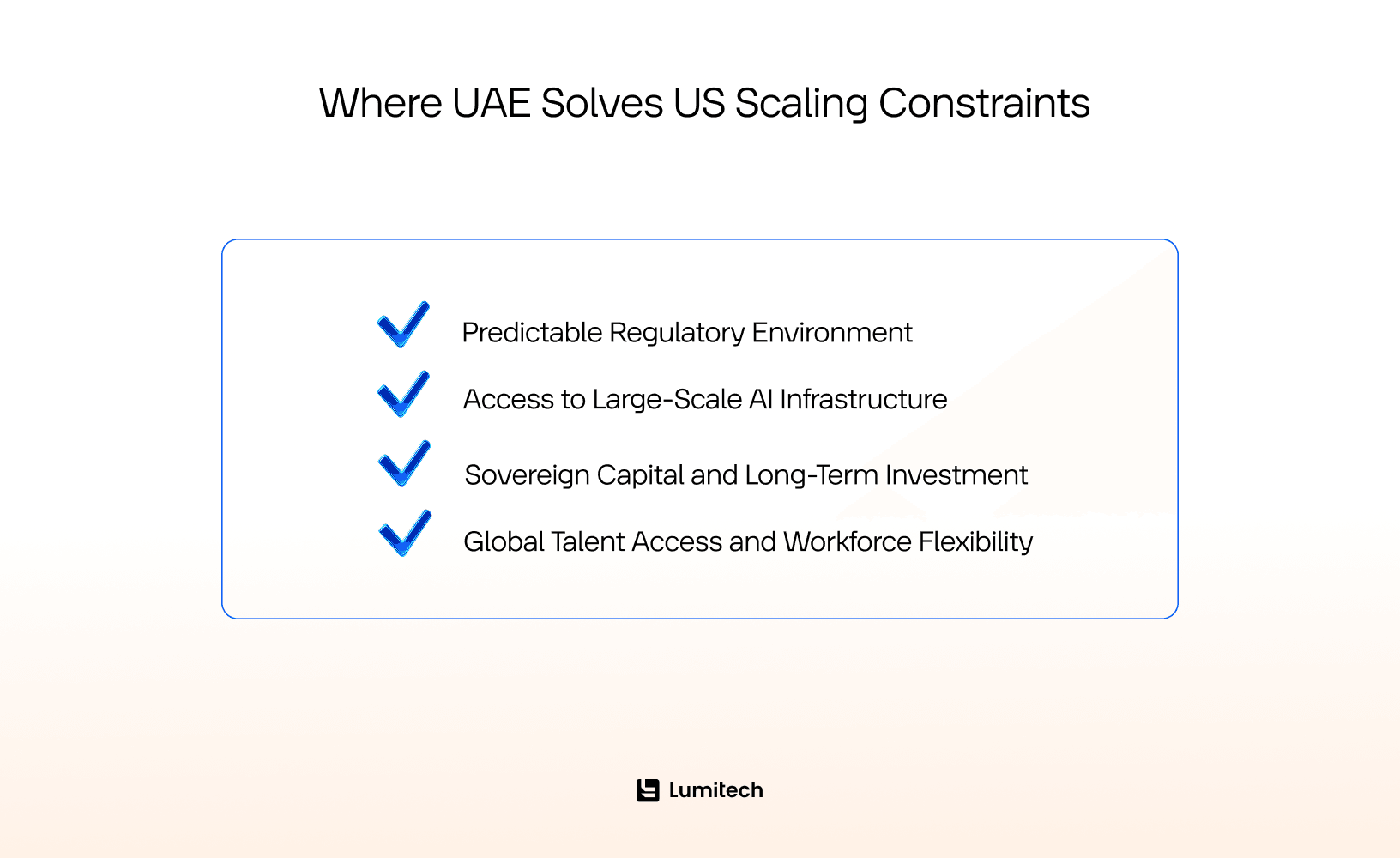
Predictable Regulatory Environment
On the crypto and Web3 side, the UAE has taken a more codified approach than the US. Dubai’s VARA and the federal SCA signed a regulatory cooperation framework that:
unifies registration mechanisms for virtual asset service providers;
defines joint supervision, oversight, and information exchange;
and aims to eliminate regulatory duplication across jurisdictions within the UAE.
VARA’s CEO described this as “laying the groundwork for a globally credible, secure, and innovation-first ecosystem” with aligned supervisory frameworks. FiscalNote’s roadmap on UAE virtual asset leadership highlights that this unified approach is designed to provide clarity to firms operating across emirates, in contrast to fragmented, case-by-case enforcement elsewhere.
On the AI side, the UAE Cabinet approved a national AI strategy with eight explicit objectives, including:
reaffirming the UAE’s position as a global hub for AI;
providing a data-driven infrastructure to support AI experiments;
and optimizing AI governance and regulations.
For a US company operating at the intersection of AI and finance or Web3, this does not magically remove complexity. But it does offer:
a defined licensing and oversight path for virtual assets;
a national stance on AI that can be referenced in design and compliance;
and regulators who have already signaled that AI and virtual assets are strategic sectors, not purely risk centers.
Access to Large-Scale AI Infrastructure
On infrastructure, the UAE is actively building what many US regions struggle to deliver: ready-to-scale AI compute coupled with energy planning.
Numerous reports describe G42’s Stargate project as a multi-gigawatt AI infrastructure cluster in the UAE, with ambitions around 1 GW in initial capacity and up to 5 GW for a broader AI ecosystem. This sits in the same global conversation as OpenAI’s wider “Stargate” capacity plans, which target around 10 GW of AI-focused infrastructure worldwide with specialized chips and next-generation NVIDIA architectures.
Crucially:
Microsoft announced a US$1.5 billion investment into G42, coupled with a strategic partnership and a US$1 billion joint developer fund.
NVIDIA, OpenAI, Oracle, and other US players are part of this ecosystem, using the UAE as a key node in global AI capacity.
When you compare this to US grid constraints — multi-year delays, local resistance, and questions about water and energy footprints — it becomes clear why some companies prefer to keep core R&D at home but attach a scaling arm to regions like the UAE, where dedicated AI infrastructure planning is a national priority.
Sovereign Capital and Long-Term Investment
Capital in the UAE works differently from classic venture cycles. Global SWF data shows sovereign wealth funds worldwide reached about US$15 trillion in assets, with US$66 billion directed to AI and digitalization investments in 2025 alone. Middle Eastern funds led this push: Abu Dhabi’s Mubadala invested US$12.9 billion into AI and digitalization and a record US$32.7 billion over 40 transactions across asset classes that year.
Abu Dhabi also launched MGX — an AI investment firm targeting US$100 billion in assets under management — with a focus on semiconductors, digital infrastructure, and AI ecosystems. This is patient capital aimed at infrastructure-scale plays.
For US companies facing capital efficiency pressure at home, this offers:
a complementary pool of capital that understands AI and infrastructure;
longer time horizons and tolerance for asset-heavy investments;
and, in some cases, a way to co-locate compute, capital, and market access in one region.
It does not replace US venture funding, but it does change how you think about where to anchor long-lived assets.
Global Talent Access and Workforce Flexibility
The UAE also functions as a talent hub with relatively flexible immigration frameworks.
While US engineer salaries sit in the US$110,000–133,000 range on average, the combination of European, Asian, and regional talent accessible from the UAE allows companies to build blended teams with cost profiles 1.5–3× lower for some roles. Free zones and visa programs are explicitly aimed at attracting global tech workers and founders, with streamlined processes compared to many Western systems.
This matters when:
you want a 24/7 operations or support capability;
you need to scale engineering capacity beyond a small senior core;
or you want to combine US product leadership with a more distributed delivery organization.
Operational Gateway to Emerging Markets
Finally, geography plays a quiet but important role. Operating from the UAE gives you practical access to markets across the Middle East, Africa, and South Asia — a catchment area of over 3 billion people within reasonable time zones and flight distances.
Many virtual asset and AI policies in the UAE are explicitly framed around being a “gateway” for responsible innovation into these regions. For a US company, that means:
you can test products in a regulated environment;
then scale across adjacent markets without maintaining entirely separate legal and operational footprints in each country;
while still keeping your primary corporate structure and governance anchor in the US.
Building a Dual-Market Business Architecture (US + UAE)
Once you stop thinking “US vs UAE” and start thinking in systems, a practical architecture begins to emerge.
US as the Innovation Core
For most companies, the US remains:
the primary hub for product strategy and experimentation;
the place where you build your senior leadership and core engineering;
and the main entry point to enterprise customers in North America and global capital markets.
The US is where you:
define your product and data models;
align with US regulatory expectations (SEC, banking regulators, sectoral AI guidance);
and validate that you are building something with real market pull.
UAE as the Scaling Engine
The UAE then becomes the scaling engine attached to that core. Depending on your sector, that can mean:
running a portion of your AI training and inference workloads on UAE-based clusters like Stargate;
obtaining virtual asset licensing through VARA or SCA for specific product lines;
setting up a regional operational center to serve customers in GCC, Africa, and South Asia.
In this model, you deliberately separate:
innovation risk (held mostly in the US);
infrastructure and regional execution (anchored in the UAE);
while keeping strong links between engineering, compliance, and operations on both sides.
When you build across the US and UAE, you are not opening ‘a second office’ — you are deciding which parts of your business live closest to customers, which sit next to capital, and which need to be near regulated data and high‑density compute. If you treat this as a location question instead of a system design question, you almost always leave resilience and value on the table.



Financial Structuring and Cash Flow Optimization
Financially, dual-market architectures allow you to align:
higher-margin software and platform revenue with your US entity;
infrastructure-heavy, capex-intensive components (like data centers, local partnerships, or regulated entities) with UAE-based structures where appropriate.
The UAE’s corporate tax regime offers a 0% rate for qualifying income earned by eligible free zone entities, while other taxable income is generally subject to the standard 9% rate, so businesses can structure operations carefully to align profits and costs with the applicable rules. At the same time, you must account for the lack of a full US-UAE tax treaty and ensure transfer pricing and profit allocation are defensible.
It is not about “tax arbitrage”; it is about building a structure where cash flow and risk are aligned with where work is actually done.
Distributed Teams and Operational Efficiency
Operationally, a distributed US + UAE setup also supports:
follow-the-sun support and monitoring;
separation between strategic and operational workloads;
more resilient hiring, since you are not dependent on a single talent market.
The challenge — and the opportunity — is to treat this as one system, not two separate companies. That means:
shared metrics and KPIs;
clear ownership boundaries;
and strong cross-border communication routines.
This is exactly the kind of architecture we design when we help clients create systems that hold under pressure rather than ad hoc teams attached to different jurisdictions.
Why This Model Is Gaining Momentum Now
This dual-market model is not theoretical; it is emerging from a convergence of trends described across the sources.
AI demand and infrastructure race. Global AI compute needs are growing faster than US grid and data center capacity, with forecasts of up to 580 TWh of US data center consumption by 2028 and US$500 billion per year in required capital.
Regulatory pressure in the US. The SEC’s 2025 priorities put AI and crypto in the same risk bucket, and crypto enforcement has been intense, with 73% of actions in 2024 alleging fraud. Companies operating in these domains face real exposure if they get the sequencing wrong.
Capital shifts toward sovereign and strategic funds. Sovereign wealth funds, especially in the Gulf, are deploying tens of billions into AI and digital infrastructure and are comfortable with long time horizons.
Regionalization of tech ecosystems. Reports on AI and sovereign capital point to increasing fragmentation and nationalization of tech hubs — with the US, EU, China, and the Gulf all building their own regulatory and infrastructure stacks.
Put simply: the forces that make single-country strategies harder are also making multi-region architectures not just attractive, but often necessary.
Conclusion: Not a Shift — But a Strategic Expansion
For serious AI, fintech, and Web3 companies, the question is no longer “US or UAE?”. The more accurate question is: “What should live in the US, and what should we move to an external layer like the UAE so the whole system can scale and stay compliant?”.
The US remains the innovation core — the place where many products are conceived, funded, and pressure-tested. The UAE is increasingly the scaling engine — a region designed with virtual asset regulation, AI infrastructure, and long-term capital in mind.
When you treat these as two parts of one architecture, rather than competing options, you unlock a more resilient way of building:
regulatory risk is diversified and managed explicitly;
compute and energy constraints are addressed at the infrastructure layer;
capital and talent strategies are aligned with the kind of work each region does best.
At Lumitech, this is exactly how we think about systems: multiple layers, each with its own constraints, working together to support real business outcomes. If you are considering a US + UAE setup — or already feel the limits of a US-only model — we can help you map what belongs where, design compliant data and AI architectures, and build the software and operational systems that connect it all.


